


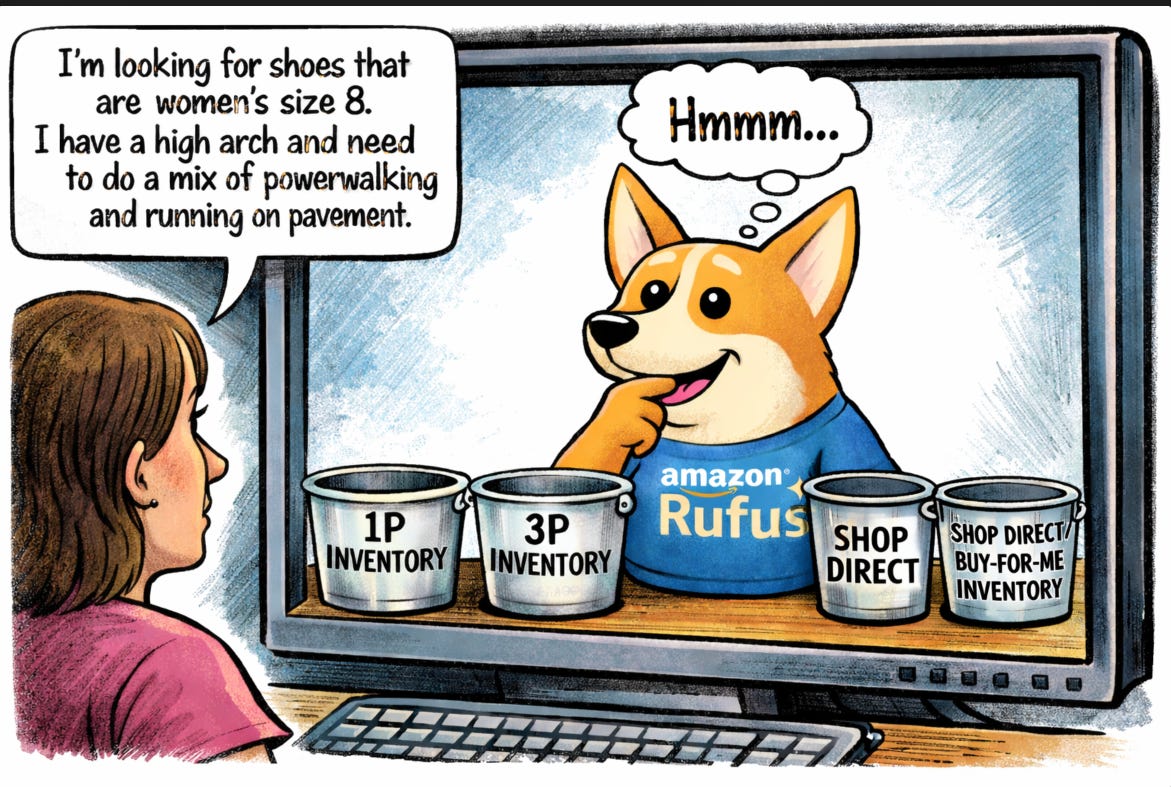
If you’re a deep ecommerce person with years of Amazon knowledge, you can click here to jump right to the news. Most of our Retailgentic readers are newer to this Amazon World, and I’ve prepared this super-fast backgrounder to orient you a bit before we get into today’s big news.
Brief Backgrounder
I’ve been working with Amazon (as a partner) since before they had a marketplace and for those of us that lived through all of this - where we are today makes sense. But I’ve noticed one of the TOP FAQs when I meet Retailgentic readers/merchants at tradeshows is a lot of questions about the differences between 1P, 3p, Shop Direct and Buy-for-Me. Here’s my attempt to try and add clarity there for everyone.
Amazon’s Four Buckets of Inventory
This table lays out the four types of inventory - 1P, 3P, Shop Direct, and Shop Direct/Buy for Me→

A couple of caveats here for those of you that want to get really Amazon-nerdy on me:
Shop Direct fulfillment - Yes, technically the merchant could use FBA’s MCF program, I’m gonna guess that the venn diagram of those circles is the null set.
CS for 3P - The Merchant handles most of these, but if Amazon fulfilled via FBA, they take over shipping questions.
Permission model / 3P - I’m aware that many categories are gated (frequently counterfeited I think is the lingo).
The ‘no ads yet’ for Shop Direct models is me speculating that’s how they will look to monetize this eventually, should the program continue out of beta.
The point is Amazon is assembling a very unique set of four different pools of inventory that give them access to merchants of all sizes and relationship types. But the ultimate goal seems to defend against ChatGPT, Gemini and other ‘Agentic Commerce Answer Engines’ ‘Out-selectioning’ Amazon. To understand this strategy, we need to go a bit deeper in the history of how we got here.
Brief History of the Four Buckets
1P/First-Party/”The OG”/VendorCentral
Amazon was founded in July of 1994, by Jeff Bezos and was born with a traditional retail model. What we call the wholesale model, or first-party, commonly abbreviated 1P. In this model:
The retailer buys products from the manufacturer(brand/merchant) at a wholesale price.
They then re-sell that product at a (hopefully) markup
That difference minus the carrying costs, fulfillment and all other costs is the retailer’s profit.
VendorCentral has (near always) been the portal that wholesalers primarily use to work with Amazon.
3P/Third Party/MarketPlace/SellerCentral
In the very early 2000’s Amazon added used-books through a marketplace-like system. Then after a big blow up with Toys-R-Us, around 2004-2006, Amazon started to scale the marketplace outside the media (Books/movie/videogames) categories.
Then FBA was released in Sept 2006 and also that year they changed the buy-box algorithm so third-parties could famously “own the buy box” and we were really off to the races at that point.
Today - for the full year 2025, Wall St analysts estimate Amazon’s third-party marketplace at $575B in GMV 🤯
Note: GMV: Gross Merchandise Value - the measure of the transactional volume through the system, of which Amazon collects a % (called a take-rate), which is their revenue component of those sales.
Shop Direct
About a year ago, in Feb and then April 2025, Amazon rolled out:
Shop Direct - The name of a program that allowed for any merchant’s inventory to be shown to Amazon’s 100s of mullions of buyers outside of 1P and 3P for the first time ever and the qualified traffic delivered directly to the PDP. Details here.
Buy for Me - A subset of Shop Direct inventory that can be purchased on behalf of the shopper by Amazon’s agent. Initially this was restricted to merchants that opted in and took Amazon Pay. My understanding is this program has been expanded to include some Shopify stores as well, but I haven’t found those in the wild yet. Details here.
Understanding Amazon’s Agentic Commerce Strategy
Last thought before we get to the news. Amazon, being Amazon and given their ‘king of the hill’ position in ecommerce, has a unique strategy for Agentic Commerce that is also one of my TOP FAQs when I meet people, because it can be perplexing if you don’t see their point. I’ve found it’s helpful to compare to Walmart visually to help understand:
Walmart’s Agentic Commerce Strategy
First, here’s Walmart’s strategy, which I’ll call: Agentic Commerce: Open for business
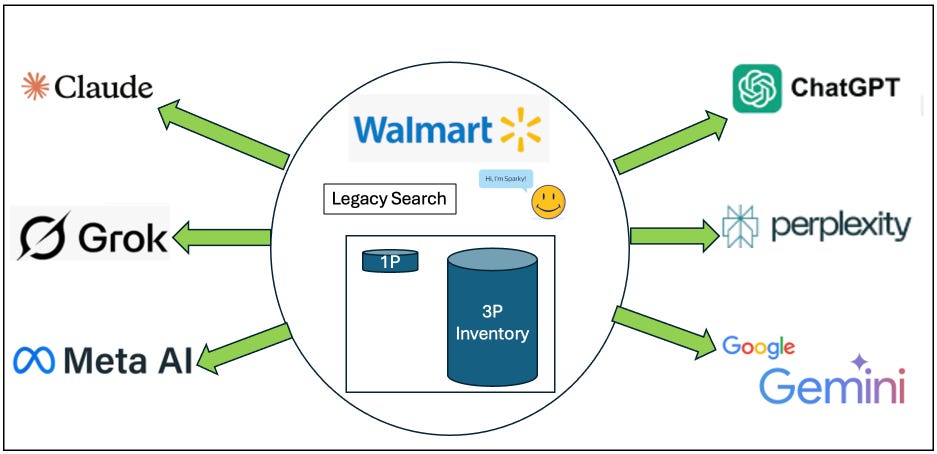
Walmart has thrown open the virtual doors for crawlers, ACP and UCP to come and get their inventory and bring in new customers. Walmart is betting that customers shopping via the Agentic Commerce ‘Answer’ Engines are incrementally new customers, and, maybe even Amazon’s customers. What’s even better, is Walmart’s 3P merchants come along for the ride, giving them even more exposure and opportunities to sell with zero effort.
Amazon’s Agentic Commerce Strategy
On the other hand, Amazon has taken the ‘The Agentic Doors to Amazon are Closed’ approach:
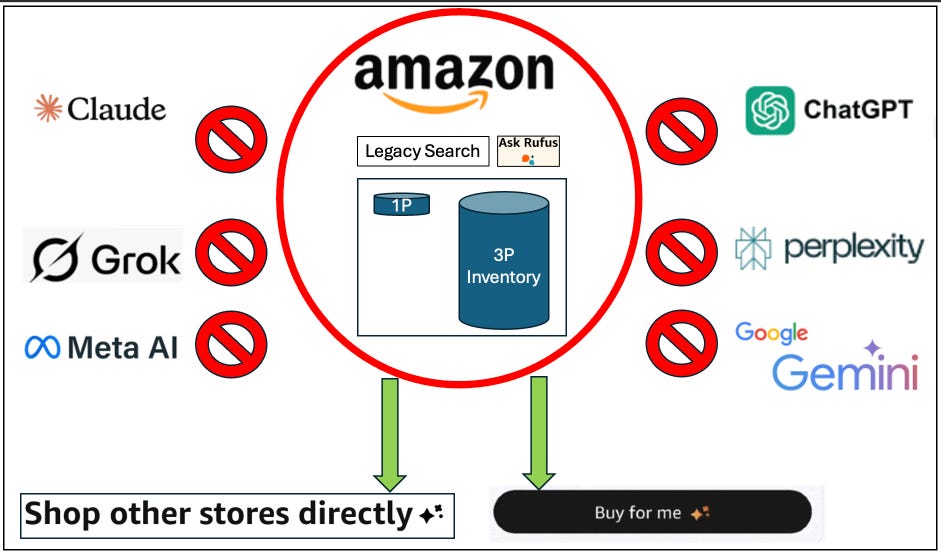
Amazon’s view is their inventory and associated data are the keys to the kingdom that must be protected. But by doing this, by definition, it puts Amazon at a disadvantage to ChatGPT and other engines because they will pull in inventory from any brand or retailer, therefore over time, their inventory selection will EXCEED Amazon’s. How can Amazon expand their selection to be at parity and even ahead of ChatGPT? Enter: Shop Direct.
If Amazon can have all of the Amazon inventory PLUS all the same merchants ChatGPT has (minus Walmart probably), then they can’t be out-selectioned.
Today’s Amazon Shop Direct News
That brings us to Amazon’s news today. They are announcing an expansion of the Shop Direct program to accept feeds. Today they announced are accepting feeds from some of the third-party pre-Agentic legacy feed providers and soon, they will be opening up a self-service merchant portal so merchants can upload their own product data feeds.
Prior to today, Amazon was crawling the ‘target’ Shop Direct merchant’s site to pull in unique inventory. For price, more product details and inventory levels, datafeeds are always more reliable than crawlers.
Amanda Doerr, Amazon’s VP of Core Shopping at Amazon said:
"Product feeds give merchants a streamlined way to reach Amazon customers who are searching for their products," said Amanda Doerr, vice president of Core Shopping at Amazon. "With feeds, merchants can easily sync their catalog, pricing, and inventory in real time and maintain their customer relationships, while the program drives meaningful traffic and sales and gives customers access to even more selection."
Highlights From My Conversation with Amanda Doerr.
The previous quote is from the Amazon News post. Yesterday, I was able to catchup briefly up with Amanda about the news and picked up a couple more tidbits of interest for Retailgentic readers:
First, I asked what their plans are to monetize this offering and she said:
“We’re really focused on ensuring that we first have knowledge of all of the World’s selection.” - Amanda Doerr, VP Core Shopping, Amazon
Ultra-Hybrid Mode?
At ChannelAdvisor, we started to see merchants use BOTH the 1P and 3P - we called this Hybrid mode. Each merchant had their own reasons for what SKUs went in which bucket (see the table at the start), but at the end of the day - it meant maximum selection for Amazon’s buyers.
That led me to ask Amanda: “Do you see a world where customers may have some inventory in three or four of these different buckets?”
Here I’m paraphrasing:
Yes. In fact, I think that this is also a great way to extend the amount of selection that merchants have on Amazon.
We look at this both as net new incremental coverage for brands that we might not have at all today, as well as making sure that we’re rounding out all of that selection.
I do see a world where we will have 1p and 3p selection as well as maybe some particular items they want available to amazon shoppers via shop direct.
I’m going to go ahead and call this Ultra-Hybrid mode which is a really big development for those merchants that want to really embrace the Amazon ecoystem.
Here’s a fictional, but not too far away from reality example:
Under Armour has a set of inventory that Amazon wants to move a lot of - say their OG dry-fit shirt. Some of the other inventory, maybe shoes, or golf, Under Armour chooses to place in 3P. Finally, maybe they have some items that can be customized using a unique ‘only on Underamour.com customization feature, or inventory exclusive, but who doesn’t want free access to hundreds of millions of qualified buyers? They go ahead and send that inventory in a datafeed and now they are Ultra-Hybrid:
1P: Super fast bestsellers that Amazon wants to price and move
3P: Under Armour wants to sell their whole line of team and individual sports
Seller Direct: Under Armour wants buyers to see their customizable line
Seller Direct/Buy for Me: Perhaps there are ‘dot com exclusives’ or “licensed brand items not able-to-be-sold-on-Amazon” that, unlike complex customization, are able to be purchased by Amazon’s agents.
The end result: 100% of Under Armour’s inventory is now exposed to Amazon’s buyers which wasn’t an option before.
What’s Does This Mean for Overall Agentic Commerce?
While ChatGPT, Gemini, etc.. are figuring out V1 of their Agentic shopping experiences, Amazon is shoring up their selection fortress by filling in brand holes that could be a weakness should ChatGPT, Gemini or any of the other players get traction.
Sometimes the best offense is a strong defense and that’s Amazon’s current strategy. Will it slow down the attackers at the gate? Only time will tell!
Holiday 2026 and 2027 are going to be very interesting to see how this all plays out, stay tuned!