


Editorial note from Scot
We had a slight delay on Part III of the current series, so it’s going to come out next week on July 22nd. In the interim, we have a special guest post for you today! One of the best ways to understand where retail is headed is to listen to the shoppers who are already living in the future.
My daughter, Rory, is a college sophomore and a member of the first generation to grow up with a connected device in one hand and an endless digital shelf in the other. When she sent me this guest post, one idea jumped off the page:
Social creates the spark. AI handles the questions. Commerce gets compressed.
That is agentic commerce from the shopper’s point of view - not a protocol or a fancy diagram, but a conversation that feels completely natural. Rory sees the shift because she and her friends are living it today.

Back to school: I don’t know just ask chat
Retailgentic guest post, By Rory Wingo
I’m Rory, and I’m a sophomore at the University of South Carolina (Go Gamecocks!). One of the perks my university offers is a free ChatGPT subscription for every student. What started as a tool to help us study has quietly become something much bigger.
My friends and I don’t even say the formal name “ChatGPT” anymore. We just call it Chat. We customize Chat with different voices, personalities, and favorite emojis. Then we spam it with every question known to man.
Need help updating your skincare routine after dorm life with hard water? IDK, ask Chat.
Trying to find makeup that survives the scorching South Carolina heat on game day? Ask Chat.
Decorating a tiny apartment on a college budget? Ask Chat.
Trying to figure out what to wear for sorority recruitment based on a Lookbook? Ask Chat.
Need a second opinion before buying something? Rely on Chat.
After a whole year of relying on Chat to help me curate my life, I looked around and realized my peers were using AI the same way. My age group is special: we’re the first to grow up with iPads in our hands and the internet open while making our Christmas lists instead of circling catalogs.
Shopping is changing, and it’s starting with savvy Gen Zers.
Shopping Has Always Been (and will always be) a Conversation
Growing up, shopping was never something I did alone. At the mall, I’d ask my mom which shirt looked better. Shopping with friends meant trying on clothes and eagerly waiting outside the fitting room for everyone’s opinion. Even online, I’d send screenshots to group chats asking, “Pick one” or “Is it worth $30?”
Shopping has always been a social activity. What’s changed isn’t that college students suddenly trust AI more than people, it’s that AI has become another more reliable person to ask.
When I ask Chat if a dress fits my style, which makeup will last through a football game, or what furniture will actually fit inside my apartment, I’m doing the same thing I’ve always done. I’m asking for a second opinion.
The difference is Chat remembers every conversation we’ve had. It already knows I like neutral colors. It knows my jewelry is normally gold. It knows I’ll spend a little more if something is going to last. It remembers projects I’m working on and purchases I’ve already made.
Unlike my friends, I don’t have to explain all of that every time I ask a question, Chat knows the context and history.
That’s why Chat became my first stop before Google.
Google can give me information < Chat gives me advice.
My AI Knows How I Shop Better Than I Do
While writing this article, I asked Chat to describe my shopping habits. I expected generic advice. Instead, it described patterns I had never noticed.
It pointed out that I almost always begin shopping by defining the constraints before looking at products:
“$500 budget.”
“Small apartment.”
“Needs to fit a full-size bed.”
“I need this to last.”
“This has to help me with work.”
Then it explained something else I hadn’t realized: I don’t buy impulsively. I compare and ask questions. Before clicking Buy, I usually ask:
Is this actually worth the price?
What are the other options?
What are the cons?
Chat also noticed that I don’t automatically buy the cheapest option. If spending a little more means I’ll use something for years, I’ll usually do it. Most of my purchases support something already happening in my life like my apartment, gardening, or even needlepoint.
Finally, it pointed out that I evaluate purchases almost like investments:
Will this save me time?
Will it improve my room?
Will it help my career?
Will I still use it three years from now?
If you had asked me ten minutes before this exercise how I shopped, I never would have described myself this way. But Chat recognized the patterns because it had seen hundreds of conversations over time. Whenever I ask for product recommendations, it automatically organizes the answer around this existing decision pattern.
That was the moment I realized AI wasn’t just recommending products. It understood how I make decisions.
The Social Platforms Are Changing Too
This isn’t happening only because students are prioritizing AI. The platforms themselves are encouraging it.
Recently, while scrolling Instagram, I was served an ad from ChatGPT promoting its image capabilities through a personal color analysis. It wasn’t advertising a specific clothing brand or a makeup company. It was advertising the concept of asking AI which colors look best on you before you even start shopping. This really stands out to me.
Instagram ad: “Create your personal color analysis with ChatGPT Images.”

For years, social media companies competed to show us products with ad placements. Now they’re also signaling that we should consult AI before making a purchase.
Instead of simply showing me another outfit, Instagram was suggesting I let AI help decide which outfits would actually work for me.
The recommendation itself is becoming part of the product.
A Viral TikTok Lip Combo Made Me Realize What’s Changing
The biggest example happened while doomscrolling.
I saw a TikTok featuring a lip combo that everyone seemed to be recreating.
The TikTok that started the shopping journey.
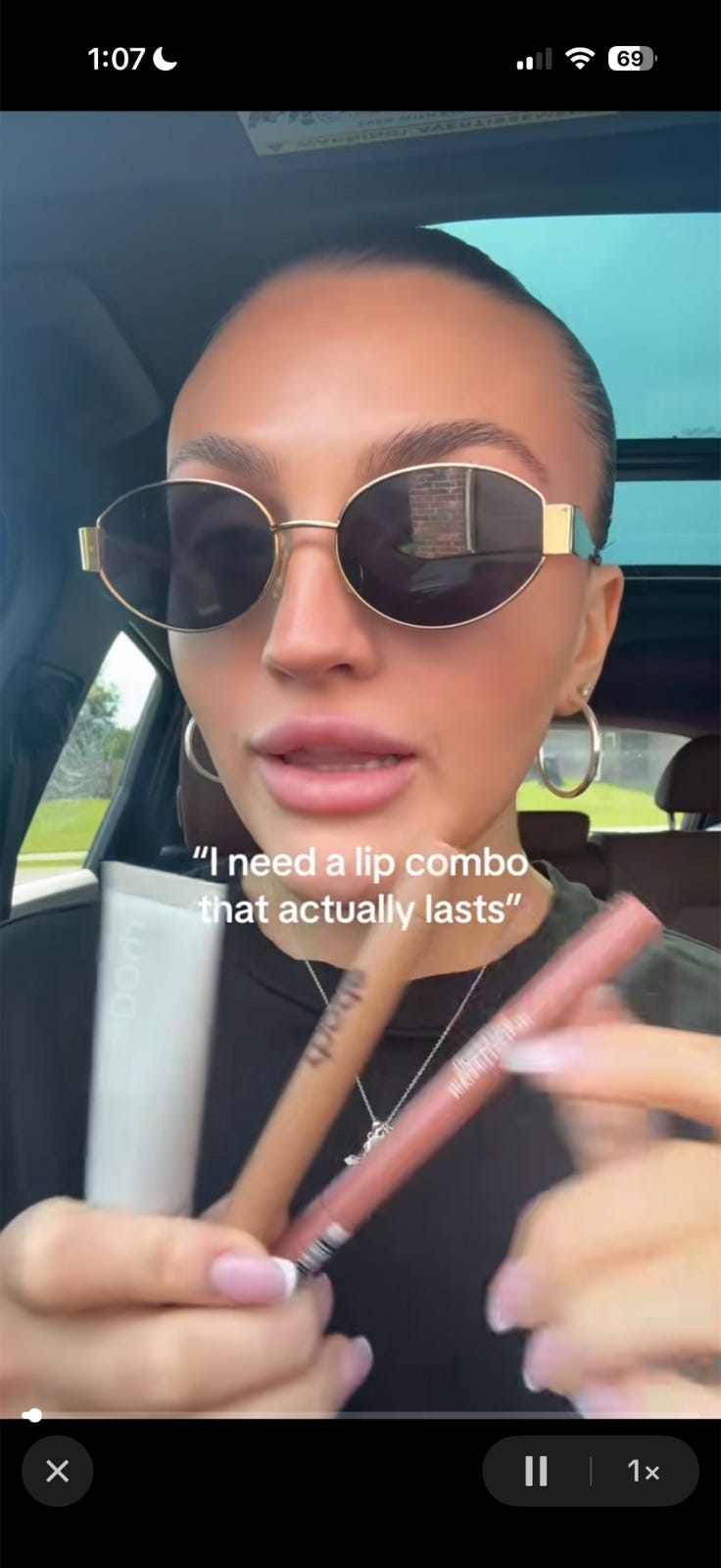
Before Chat, I probably would have: paused the TikTok→ searched through hundreds of comments→ opened Google → checked Sephora → searched TikTok Shop → compared prices, watched more reviews, and eventually decided where to buy everything.
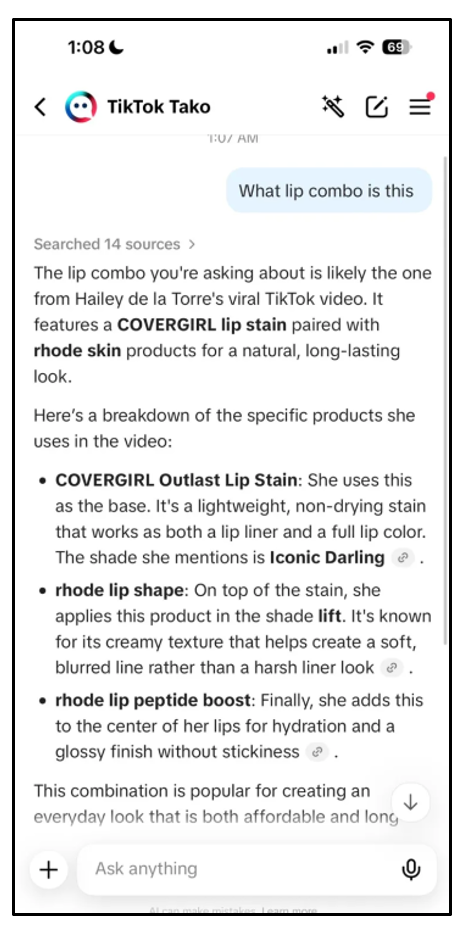
Instead, I clicked the little circle that opens TikTok’s AI assistant and asked:
“What lip combo is this?”
Within seconds, it identified every product in the video, with the right shades.
TikTok’s AI assistant identifies the products and shades in the video.
Then I typed:
“Where can I buy them?”
Instead of making me search multiple websites, it showed me retailers, pricing, and availability.
The assistant moves from identification to retailers, pricing, and availability.
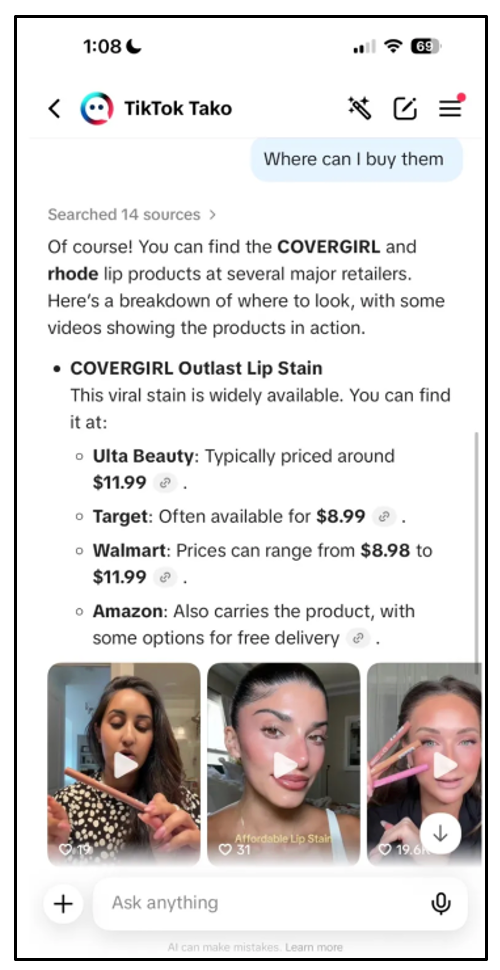
here’s the second page→
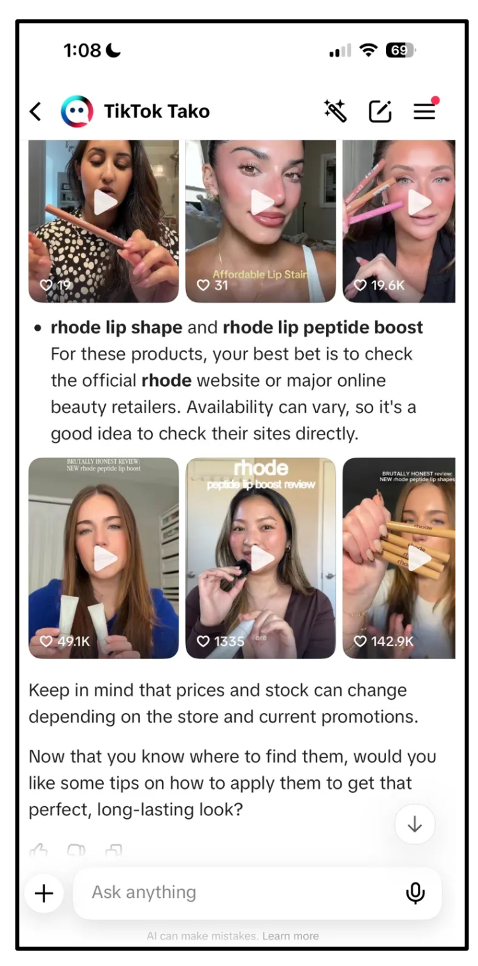
Next I asked:
“Is there a TikTok Shop option?”
Rather than simply answering yes or no, it surfaced TikTok Shop listings, recommended exclusive bundles, displayed customer ratings, suggested tutorial videos, and even prompted me with additional questions I might want to ask next.
From the original video to shoppable products and bundles - in one conversation.
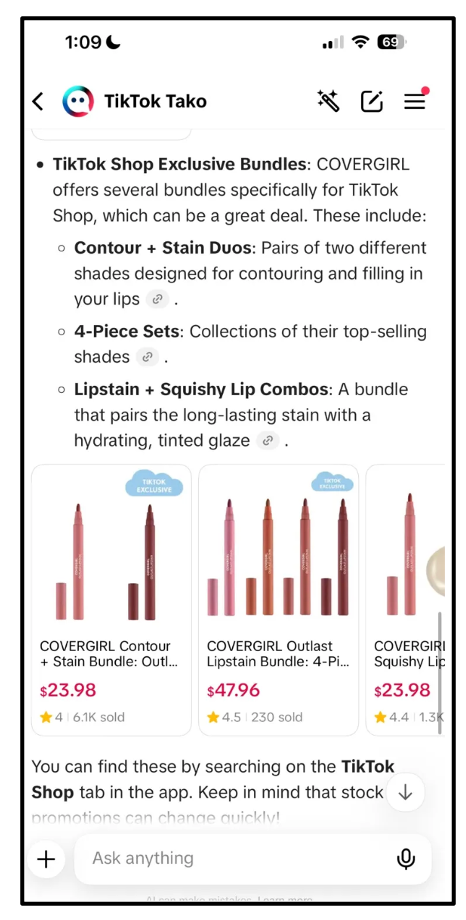
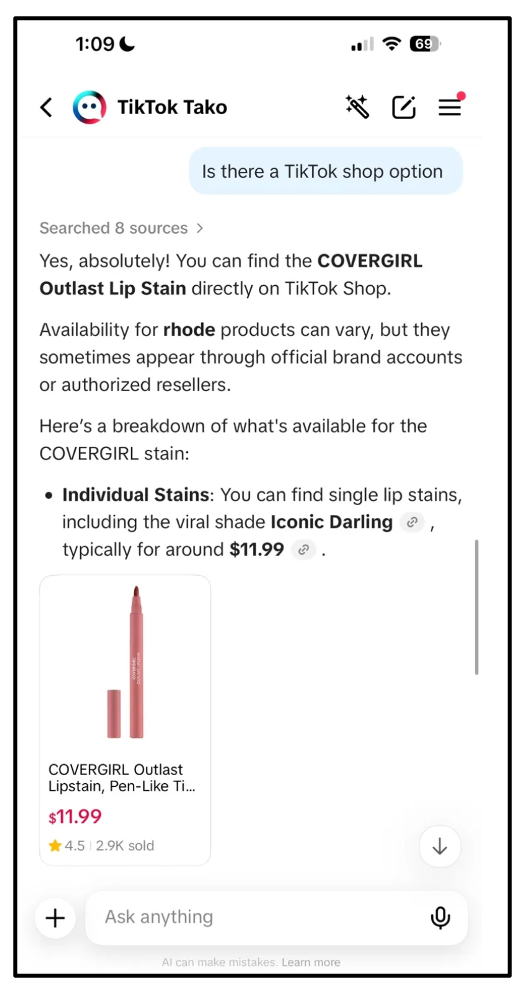
What struck me wasn’t simply that AI answered my questions. It got to the product discovery in seconds.
It was that it naturally handled the same conversation I would have had with a friend while we were getting ready. Offering me where to get and how they personally use the product.
AI Isn’t Replacing Social Media
I don’t think AI is replacing TikTok or Instagram. That’s still where I discover trends. That’s where creators introduce me to products I’d never search for on my own.
AI is replacing something else:
It’s replacing the conversation that happens after discovery.
The part where you ask:
“Should I actually buy this?”
“Which shade would look best on me?”
“Where’s the cheapest place to get it?”
“Is there a bundle?”
“What do you think?”
Instead of bouncing among Google, retailer websites, Reddit, TikTok comments, and group chats, I’m having one continuous conversation with an assistant that already understands my preferences.
The shopping journey that used to look like this:
TikTok → Google → Reddit → Sephora → Amazon → Buy
is starting to look more like this:
TikTok → AI conversation → Purchase
That might sound like a small change. I think it’s one of the biggest shifts happening in commerce.
What This Means for Brands
For years, brands have competed for clicks.
Very soon, they may also compete for recommendations from AI assistants.
If consumers increasingly rely on AI to answer “Should I get this?”, then winning their attention won’t be enough.
Brands will need to provide the information, context, and trust that help AI confidently recommend their products.
The customer will still make the final decision. Brands just need a seat at an increasingly competitive table.
Back-to-School Looks Different Now
Back-to-school shopping has always been one of the biggest shopping seasons for college students.
What’s changing isn’t what we’re buying. It’s who we’re going to for advice.
Gen Z still discovers products from creators, influencers, and friends. But instead of opening ten tabs and piecing together information ourselves, more and more of us are turning to AI to answer the questions that come next:
Does this fit my vibe?
Is it worth the price?
Where should I buy it?
What goes with it?
For years, those conversations happened with our moms, roommates, best friends, or the employee at Sephora. Now, more and more often, they happen with Chat.
Today, AI is helping us decide.
Tomorrow, it may compare retailers, build the cart, apply the coupons, and complete the purchase on our behalf. If that’s where shopping is headed, agentic commerce won’t feel like a sudden revolution.
For my generation, it’ll simply feel like the natural next step in a conversation we’ve already started.