


Editorial note: To keep this article’s vibe flowing, we’ve detailed the eight referenced resources at the end of the article if you want to dig into this topic more. Also, we’ve done this enough times with GA4 that we are happy to help anyone that would like to do an analysis with their own data. Join our Retailgentic Slack community here and let us know in the #dark-agentic-commerce-traffic channel.
Retailer’s Unexplainable 2026 Traffic Trends
We had a scenario recently where we were working with a large fashion retailer and they were using ReFiBuy’s Commerce Intelligence Engine to implement our 9-step Agentic Commerce Optimization framework. Their product-card visibility and offer-card positions were all showing very strong improvements at the product-level. But they weren’t seeing an increase in AI referrals 🤔.
Simultaneously, organic/paid Google traffic across all merchants continues to decrease as we accelerate towards a zero-click future. It’s outside the scope of this article, but some good current reads on this are here and here (we believe publishers/b2b are a canary in the coal mine for merchants).
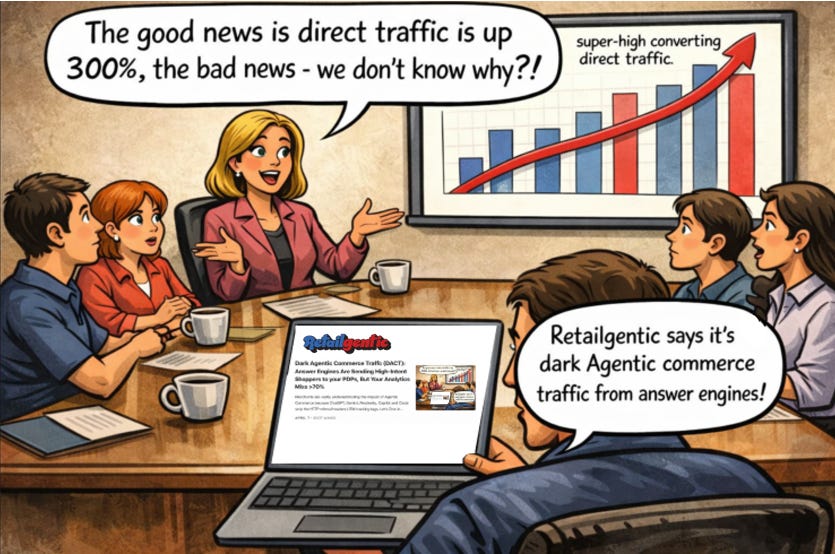
At the same time, traffic identified as ‘direct’ traffic is inexplicably growing faster than ever before. Engagement on ‘direct traffic’ is unusually high resulting in super-sized conversions
This is not a tagging error. That’s what we call dark agentic commerce traffic. Let’s dive deep into this one, given that we are are already 233 days away from Thanskgiving, we strongly recommend getting a handle on quantifying and tracking your DACT to create a baseline now enabling you to create a before/after for Holiday 2026.
What is Dark Agentic Commerce Traffic (DACT)?
When a user opens the ChatGPT mobile app, asks “what’s the best trail running shoe under $150 for wide feet,” gets a recommendation with a product link, and clicks through — that visit arrives at your PDP with no referrer. The referrer metadata and any UTM tags are stripped before the request is sent.
GA4 (Google Analytics 4) sees a new user landing on the /products/[shoe-name] PDP page with no referrer. It then puts them in Direct and you never know ChatGPT sent them.
🤯 The kicker
In controlled testing, when the Gemini iOS app sends traffic to a website, only 5 out of 56 visits (under 9%) are correctly identified as AI referrals in GA4. The other 91% land in Direct. (Source: Topify)
Which Traffic Sources Are The Culprit?
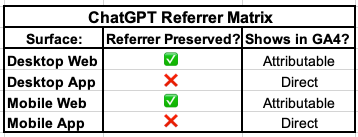
We’ve reviewed the research and done some of our own tests and the above matrix is what we believe to be the current state. Basically summarized - if someone is using an AI ‘app’ (both mobile and desktop versions) - that traffic is nearly 100% ‘dark’. For browser based traffic, that traffic is mostly trackable. The Answer engines want you to use their app experiences so they tend to put exclusive features in there. There’s no great reference that looks at which ‘surface’ shoppers are using for Gemini or ChatGPT, but I can guarantee your GA4 analytics is telling you that your AI referrals are 95%+ desktop. But we know that across e-commerce in most categories we’ve passed 50% mobile traffic and corresponding sales.
Is This Bot Traffic?
Note that this article is 100% relating to humans and not bots. 99% of bot traffic is easily identified and pre-filtered out by analytics programs, it’s identified by the ‘user-agent’ - bots/crawlers have to identify themselves as a specific user agent (we went into this back in this article if you want to learn more). These are most likely humans, unless someone is using an agent to manipulate a browser on their local machine which, outside of the Openclaw community, is pretty rare for your average shopper and would be in the browser side anyway, not on the app side. Because of this we’re certain these are real living breathing shoppers we’re talking about in this analysis.
What’s the Scale of Traffic We Are Missing?
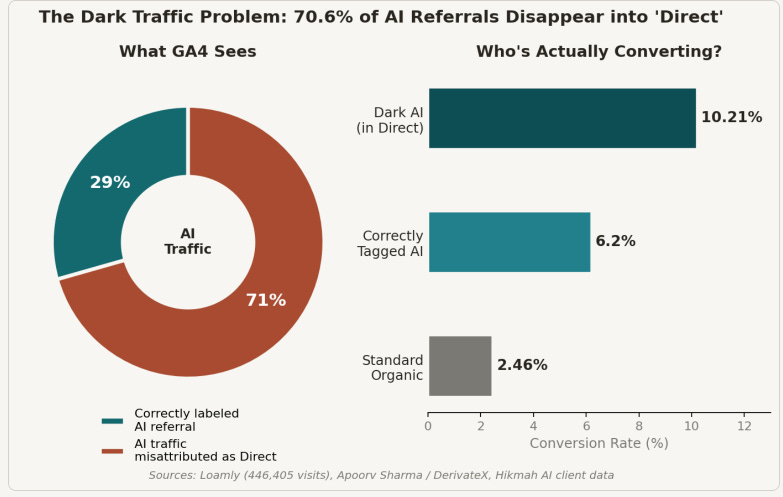
Loamly ran the most rigorous controlled analysis to date — 446,405 tracked visits — and found that only 29.4% of AI-influenced traffic carries any referrer at all. The other 70.6% lands as Direct. Apoorv Sharma at DerivateX validated this independently. Topify confirmed it with the Gemini iOS testing already mentioned.
Three independent datasets, same number. That’s not noise. That’s signal.
Now here’s the part that should make your head explode. That dark AI traffic — the stuff GA4 can’t see — converts at 10.21%. Average ecommerce traffic converts at 2.46%.
Therefore, What is essentially your best-performing traffic source is completely invisible and not attributed to anything. Note to our friends on Agentic Commerce teams - you should work on establishing credit for this ASAP.
“Your best-performing traffic source is invisible, untracked, and credited to nobody.” — Apoorv Sharma, DerivateX
What’s the Growth Trend of DACT?
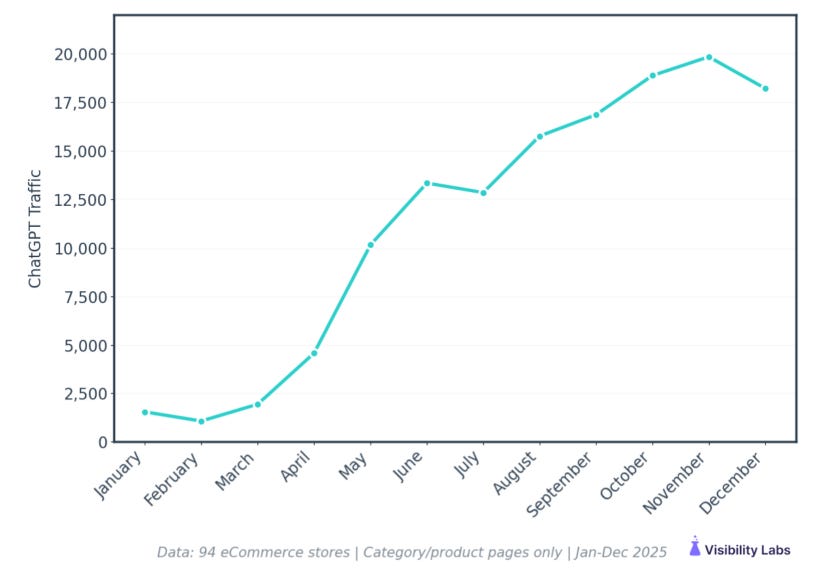
Visibility Labs (via search engine land report) spent all of 2025 analyzing 94 ecommerce brands — 9.46 million non-branded organic sessions vs. 135,000 ChatGPT referral sessions. What they found:
January 2025: 1,544 ChatGPT-attributed sessions/month across the dataset
April 2025: ChatGPT launches shopping carousel → hockey stick begins
December 2025: 18,202 ChatGPT-attributed sessions/month — +1,079% YoY
CVR advantage: ChatGPT referral converts 31% higher than non-branded organic (1.81% vs. 1.39%)
Revenue per session: $3.65 from ChatGPT vs. $3.30 from organic — despite lower AOV
Which Agentic Commerce Engine Causes the Most DACT?
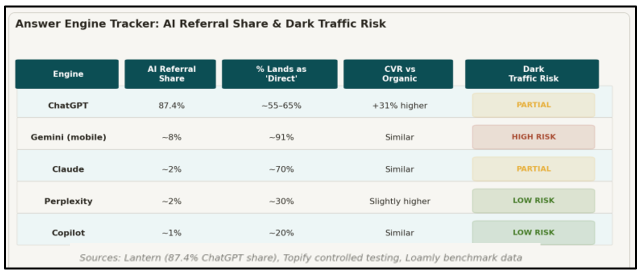
Not all answer engines are created equal here. ChatGPT dominates referral share but is a mixed bag on stripping referrers.
ChatGPT is the dominant channel — Lantern’s data shows 87.4% of all AI referral traffic comes from ChatGPT.
Gemini on mobile is basically invisible in analytics. With 91% of its traffic landing as Direct, every Gemini AI Mode product recommendation that converts is almost certainly being credited to “Direct” or “Branded Organic” — robbing your agentic commerce optimization efforts of any signal.
Perplexity is actually the best citizen here. With only ~30% landing as DACT, Perplexity sends cleaner referrer data than its peers. This is one reason Perplexity’s referrer data shows up more clearly in GA4 reports, even though its absolute share is smaller with shoppers.
How to Track Your DACT In GA4
There’s no silver bullet here, we can’t make the various answer engines stop ‘not’ sending referrer data (perhaps when they have more ad revenue/focus this will change, but we can’t control that).
What we’ve helped customers do is:
Understand and track the distinct ‘fingerprint’ for DACT
Create a GA4 pre-Agentic Commerce Baseline and then measure from that baseline.
The DACT Fingerprint
The traffic that you can safely assume is DACT has these X characteristics:
It is categorized as Direct or Brand (where traffic is categorized when referrers there are no referrers).
It lands directly on a PDP page (not home/about/category pages - deep into the site).
It has a low bounce rate and converts relatively high.
The Results
Based on this finger print, we created a baseline back to January of 2023 - days after the birth of ChatGPT, it didn’t have web search yet, Let’s call this X - and you will find it’s a very low number expressed either as a % of your traffic or as sessions.
Then we track this DACT traffic through March 2026. The results across many customers reveal that “Known AI sessions” (flagged by GA4 because they have referral tracking) are off by 100x of our estimates from the DACT traffic. For example, on a sessions % share basis if Known AI sessions are tiny at .12%, when you consider DACT fingerprinted traffic increased from baseline using GA4, that number grows to 12%.
I can also share that this traffic has an mind bogglingly high conversion rate and a very low (sub 20s) duration. Shoppers are hitting that PDP, adding to cart and moving on to checkout or to shop more of the assortment. As theorized, DACT is most likely your highest quality traffic and you’re not tracking it outside of Direct/Branded correctly.
As theorized, DACT is most likely your highest quality traffic and you’re not tracking it outside of Direct/Branded correctly.
As discussed from third party research, we can also confirm that the overwhelming majority (90%+) of traffic in the known AI referral bucket is attributed by GA4 to ChatGPT.
As mentioned at the top - we’ve done this enough times with GA4 that we are happy to help anyone that would like us (or help) to do an analysis with their own data. Join our Retailgentic Slack community here and let us know in the #dark-agentic-commerce-traffic channel.
One More Bucket of DACT: Influence Attribution 🤦♂️
Here’s where it gets even more mind boggling. There’s a second layer of dark influence that’s impossible to measure even with this fingerprint/baseline trick.
For example, what if a shopper asks ChatGPT for trail running shoe recommendations. ChatGPT names your brand. The user does all their research on ChatGPT, then opens Google. She searches “[your brand] + [product name]” — a branded query. They click your organic result and buy.
GA4 attributes that sale to Branded Organic Search. ChatGPT gets zero credit. Forever.
Interestingly, the Visibility Labs study found this pattern to be extremely common. They call it “intent compression” — Agentic Commerce Engines pre-qualify the shopper so thoroughly that by the time they hit the product page (via whatever path), they’re at the very bottom of the funnel. Your traditional channels are getting credit for closes that Agentic Commerce drove 90%+ of the influence on.
I do believe eventually, for this very reason, Agentic Commerce Engines will ‘pull up’ the transaction into the engine. In other words, I don’t think we’ve seen the last of ChatGPT Instant Checkout, especially if Google’s UCP checkout implementation has a strong Q4 in 2026.
Conclusions
DACT isn’t an analytics nuisance. It’s a signal that the ecommerce funnel has moved — and it’s moved to Agentic Commerce.
Shoppers are asking ChatGPT what to buy. They’re asking Gemini to compare products. They’re asking Perplexity to research specs. And then they’re landing on your PDPs — pre-qualified, high-intent, and ready to convert at 10x the rate of your average visitor.
The merchants winning this transition are making sure their products are showing up and giving the answer engines as much product-level content and context they can so that their products are recommended as that shopper works down the funnel.
Shopify’s Harley Finkelstein recently put a 7x traffic number on DACT.
Agentic Commerce isn’t coming. It’s here, hiding in plain site.
Dark Agentic Commerce Traffic Resource Resources
This article references these nine recent and well researched sources:
ReFiBuy Internal Proprietary Anonymized Client-level Research, performed by Link Walls (inspiration and referenced here.
Armando Roggio — The Truth about ‘Direct’ Traffic , Practical Ecommerce — Feb 15, 2026
Apoorv Sharma (DerivateX) — AI Search Traffic: The Invisible 70.6%, LinkedIn — March 3, 2026
Loamly — State of AI Traffic 2026: Industry Benchmark Report, Loamly.ai — Dec 13, 2025
Dan Taylor — Why Direct Traffic in GA4 Isn’t What It Looks Like, MarTech — March 9, 2026
Yotpo — Track AI Referral Traffic: 9 Expert Tips (2026), Yotpo.com — March 25, 2026
Danny Goodwin — ChatGPT Ecommerce Traffic Converts 31% Higher Than Non-Branded Organic Search, Search Engine Land — Feb 26, 2026
Topify.ai — The Traffic Analytics Tools Every Marketer Relies On in 2026, Topify.ai — April 4, 2026
Laurence Nixon - Agentic Commerce is Here, fabric.com blog, Dec 2025.
The DACT framing is the cleanest articulation I've seen of why GA4 will under-report agentic intent for the next two years. The follow-on question I keep coming back to: once that high-intent shopper lands on the PDP, what catches them? A static page is still a 2.7% world. We're building the on-site conversational layer for exactly that handoff — reads personality and intent in real time, adapts the offer. The off-site optimisation work you're doing only pays out if the on-site experience can match the agent's level of personalisation. Two halves of the same shift.