


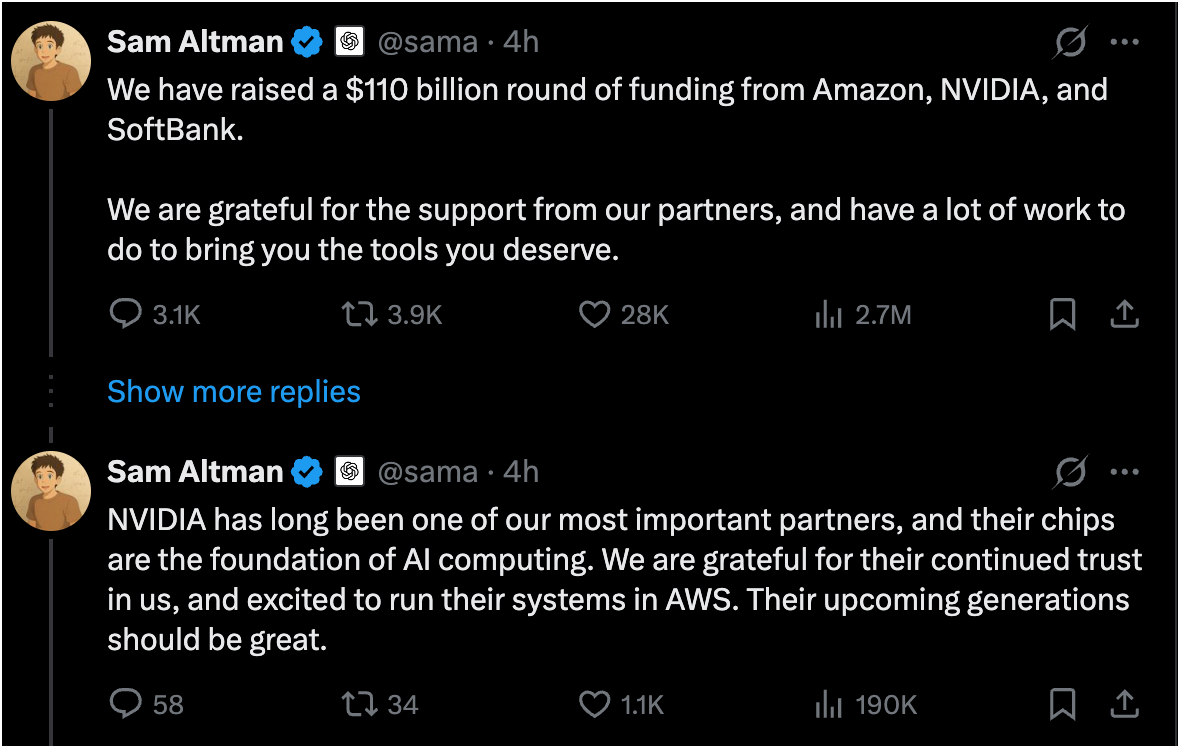
In typical AI-era fashion, an X post was heard around the world earlier today from non-other than SamA→
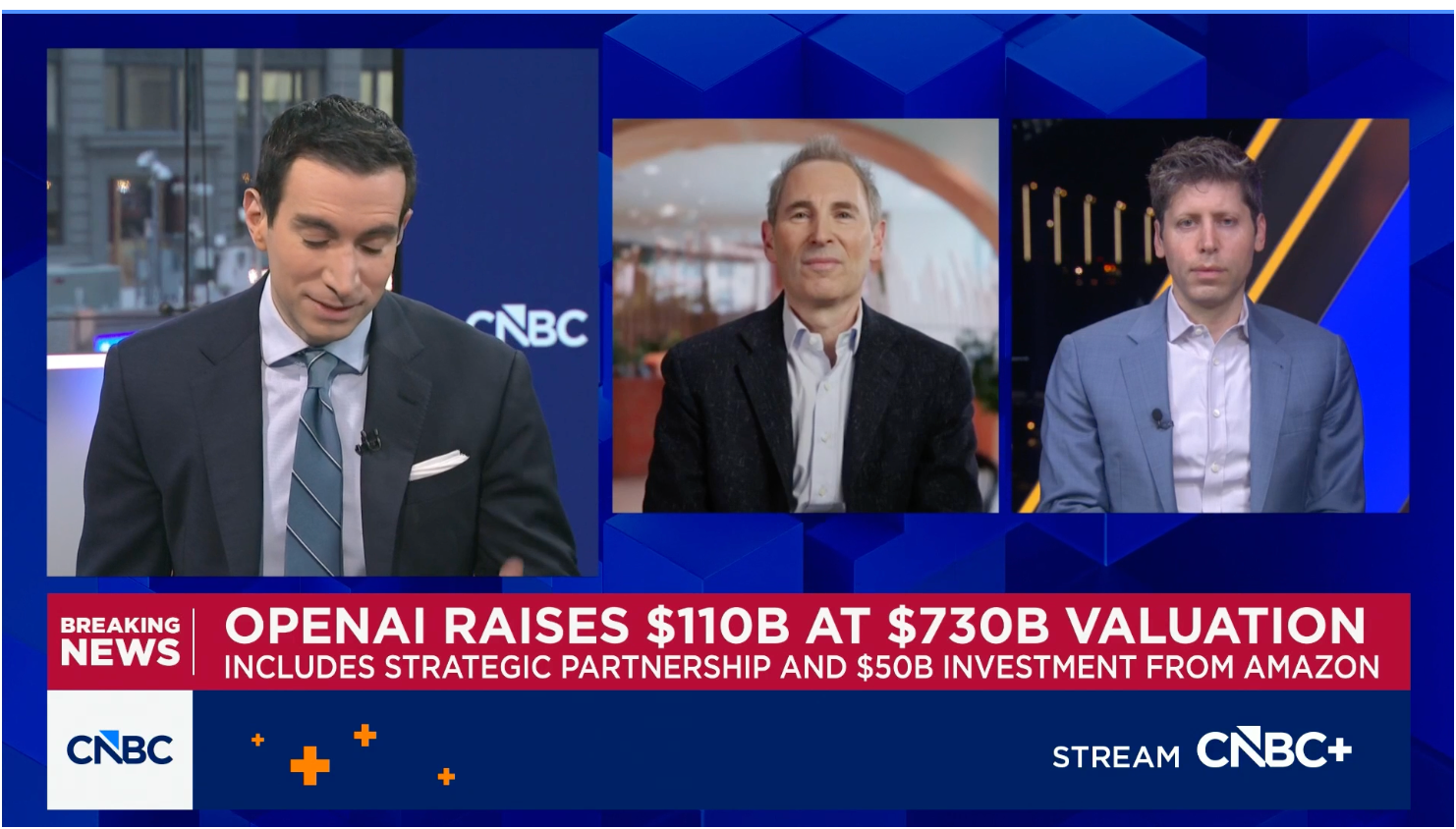
They then hopped over to CNBC to talk to ARS→
Big Picture Terms of the Deal
Here’s the bones of this investment deal by AMZN 0.00%↑ →
$50B - We have to start there, this is a big chunk of change, even for the $2.2T behemoth. As of their Q4 25 report in Feb, Amazon has $123B in cash, cash equivalents and marketable securities, therefore, this is effectively half their cash! Perhaps some of this was trade dollars and not cash, but its still a big bite.
They did mention there are tranches -the first is $15B so it’s not all up front. Future tranches are based on ‘future conditions being met’ 🤔
Valuation - This round was done at a $730B valuation which gives us a post money valuation of $840B! 🤯
AWS - OpenAI will run more of it’s workloads on AWS hardware, including a commit to 2 gigwatts worth of capacity on Amazon’s AI chip, Trainium.
OpenAI will parter to bring OpenAI to bedrock
AWS will be the “exclusive third-party cloud distribution provider” for OpenAI Frontier, an enterprise platform for building and managing teams of AI agents with shared context, governance, and security. Microsoft says Frontier will continue to be hosted on Azure.
Editor’s note - My read here is Amazon can ‘sell’ OpenAI Frontier into enterprises, but they aren’t hosting it, Microsoft keeps that juicy part of the biz because they were such a big founding investor. Frontier is OpenAI’s agentic framework.
Stateful runtime environment - powered by OpenAI's GPT models, available in Amazon Bedrock — enabling AI apps to retain memory, identity, tool-calling, and compute across sessions rather than starting from scratch.
Editor’s note: context windows on LLMs are. HUGE deal, this is a stateful context window so you don’t have to restart the RLAIF engine.
Joint Model building - They will collab to build “customized models” to power Amazon’s own customer-facing apps. (Alexa?, Rufus?)
What Andy and Sam Said:
“OpenAI and Amazon share a belief that AI should show up in ways that are practical and genuinely useful for people,” said Sam Altman, co-founder and CEO of OpenAI. ”Combining OpenAI’s models with Amazon’s infrastructure and global reach helps us put powerful AI into the hands of businesses and users at real scale.”
“We have lots of developers and companies eager to run services powered by OpenAI models on AWS, and our unique collaboration with OpenAI to provide stateful runtime environments will change what’s possible for customers building AI apps and agents,” said Andy Jassy, President and CEO of Amazon. “We continue to be impressed with what OpenAI is building, and we're excited not only about their choosing to go big on our custom AI silicon (Trainium), but also our opportunity to invest in the company and partnership over the long-term.”
What Does This Mean for Agentic Commerce?!
The TL;DR is that while nothing was announced here on the consumer side, it’s a big step towards a warming between the companies. Amazon is now fiscally tied to OpenAI in several dimensions which should open the door. How big a coupe would it be if ChatGPT had some exclusivity on Amazon inventory? (answer: 🐳)
Stay tuned, I suspect by the end of the Q, or maybe in April timeframe we’ll hear more…
Tasty Tidbits from the CNBC Interview
Sam on interest in an IPO and investor access:
“We are open to going public at the right time. There are advantages to being private. There are clear advantages to being public. In addition to all of the reasons that we get more access to capital, I also think that if these AI companies are as important as we think they may end up being, we want all investors to have access to them. So yes, there is definitely some excitement from various investors of ours to go public, and it is something that we are open to doing, but we need to figure out the right time to do it.”
Sam on demand growth and revenue from the Amazon partnership:
“Yeah, we continue to see just rapidly growing demand. The Codex in particular, I think it grew like 30 something percent in the last week. And that is an indication of what’s happening with enterprise and what people are ready to do now. As we started to look at the growth that is coming, we realized we did not have enough compute to support that. We’re excited, thrilled to get this additional Trainium capacity, and I think it’ll go to great use with customers. We also think, as Andy was saying, that Amazon can deliver so much more to us in terms of new demand and new opportunities in the market, that there will be huge incremental revenue here into the whole ecosystem. And we’re thrilled to get to do that.”
Sam when asked how much runway this little investment gets them→
“I don’t know the exact date, but it’s a very long runway. I expect we will need more capital. I don’t know what the form will be. It may not – you know, there’s, like, a lot of ways we could continue to finance growth, but this is like, a long runway from now.”
Sam on AGI:
“I don’t have – I can’t tell you the exact date that AGI arrives. And also, you know, it’s gotten to the point where people define it in different ways. The field is clearly making rapid progress. So I don’t want to, like, give a timeline, but if you look at what the current models are capable of, you know, you hear people say, man, it feels like something I didn’t expect to see this fast or I didn’t expect to see this in my lifetime. The – I expect continued, steep progress from here. I think we are all going to be surprised about the amount of AI progress the field sees this year. Probably every year after that. So I don’t have a timeline to give you, but it does feel like we are making maybe faster progress than even I expected.”
Andy on AWS AI Capex:
“On AWS capex dynamics and long-term returns: “I’ll start. You know, the way the AWS business works in such a way where the faster we grow, the more capital we put out there. And because the model works, you know, we’re investing in capital in data centers, power, land, chips, hardware, networking gear. So, all this infrastructure 18 to 24 months in advance of when we can monetize it. And then we spend the money in the first year, but a lot of these assets that we’re investing in are 30 to 40 year useful life assets like data center. And so what happens is, you spend the money in year one, but then you actually monetize over a long period of time, and you really like the return on investment in capital over time. You saw that in the early days of AWS, you know, as we are growing like crazy, just on the CPU side, where we were investing a lot of capital and the free cash flow looks different than it does once the growth rates start to level off. And so, as the growth rates are really high, we’ll spend more capital, but we like the operating income and the return on invested income over a long period of time, because those assets we can monetize over a long period of time.”
Andy on AI layoffs/jobs→ (tied it to the block/square giant RIF)→
“Well, I haven’t really digested that news very much, and I think every company is going to make their own decisions on these things. And you know, my view of it is what we’ve talked about in the past, Andrew, which is just, you know, I think that this is the most transformational technology shift that we’ve seen in our lifetime. I think it’s going to impact the way we all do our work. And I do believe that a lot of the jobs that we’ve thrown human beings at the last 20 or 30 years, you won’t need as many human beings doing those same jobs. But I also think there will be other jobs created. And that has always happened in every technology shift. And you know, I mean, 15 years ago, there was no such thing as a cloud solutions architect, and today there are tens of thousands, maybe 100,000 plus, of these types”
For More Information
You can read more about the news: