Welcome to the Retailgentic MAG4 Mega Earnings Agentic Commerce Report! (…said in my best monster truck announcer voice)
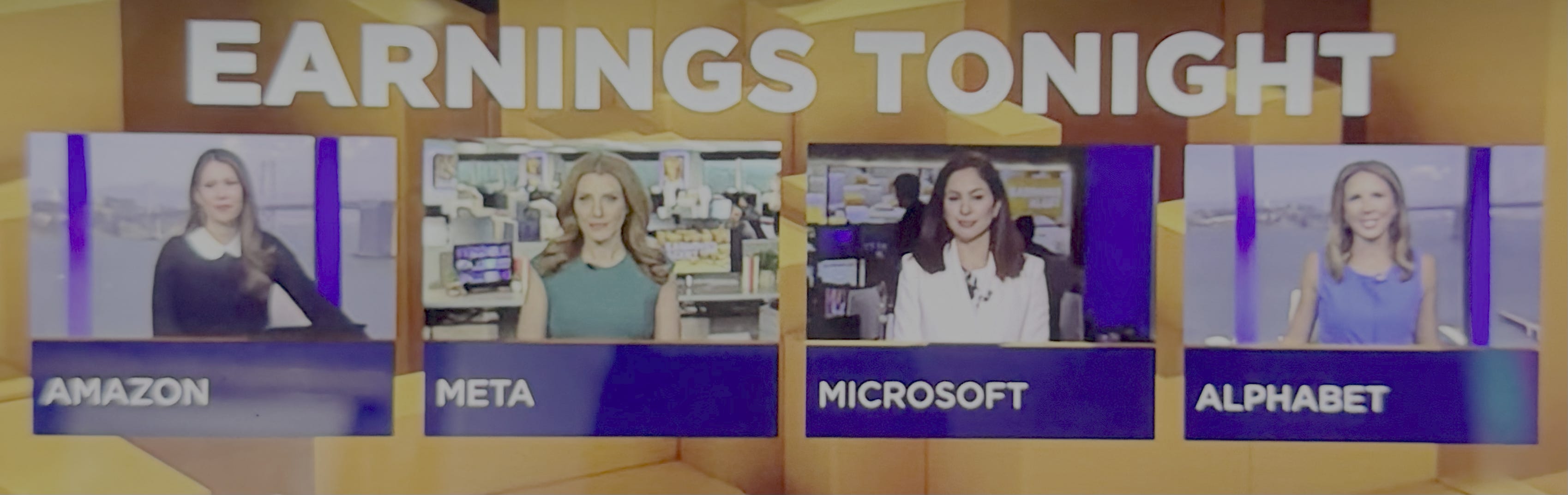
In a first ever in the history of internet stocks (confirmed with my Wall St buddies!), we had the four public companies we watch the closest here at Retailgentic report earnings and host their calls in the 120min window from 4-6pm today. It was insane! Look CNBC had to go to the rare 4 box!
Even good friend of Retailgentic, Wall St. analyst Gene Munster, who is usually the calm in the earnings storm, had his mind blown live on CNBC!
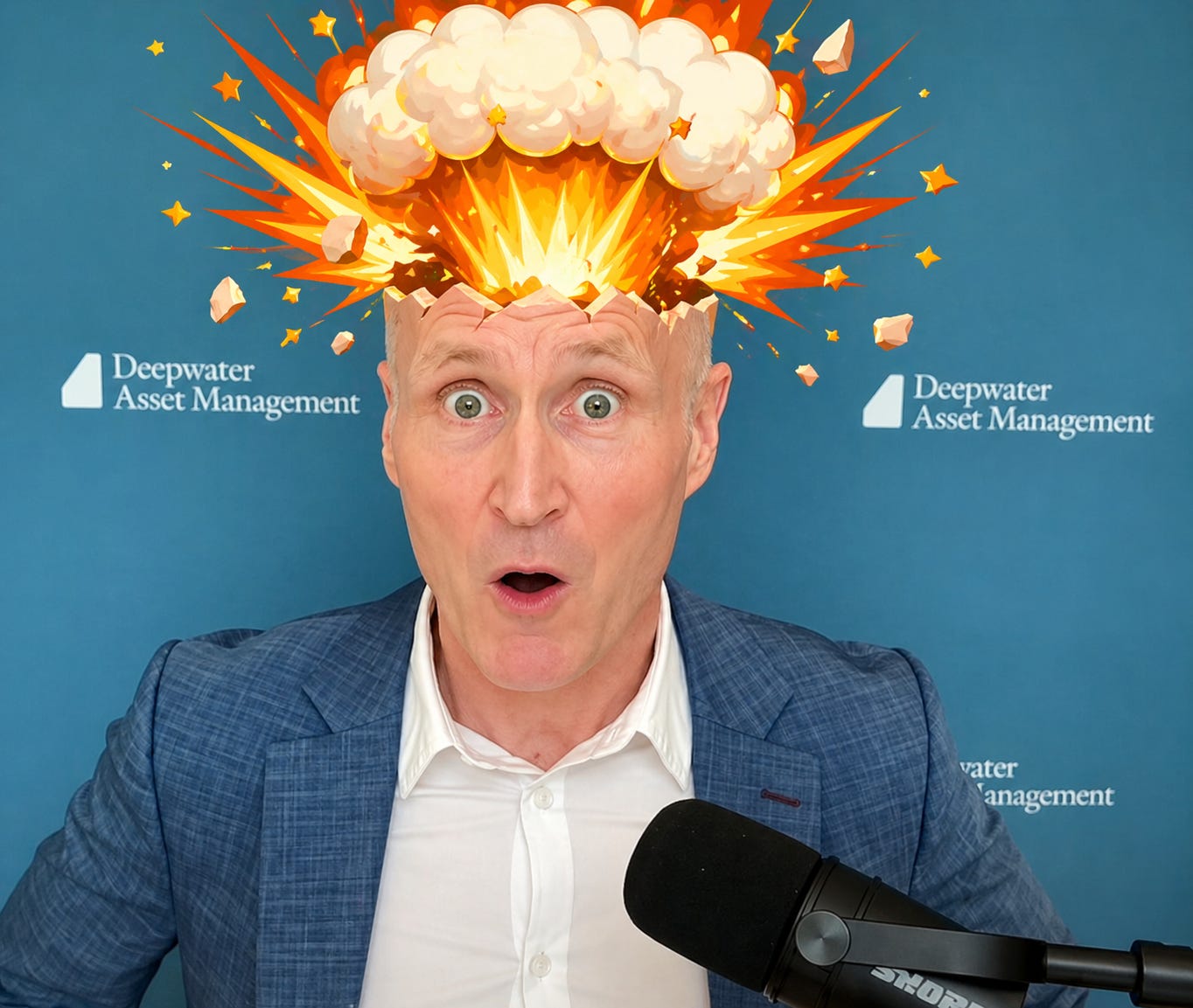
(Seriously though, watch this segment, it’s A+ and talks about, well you’ll see).
Who Was the Winner with Wall Street?
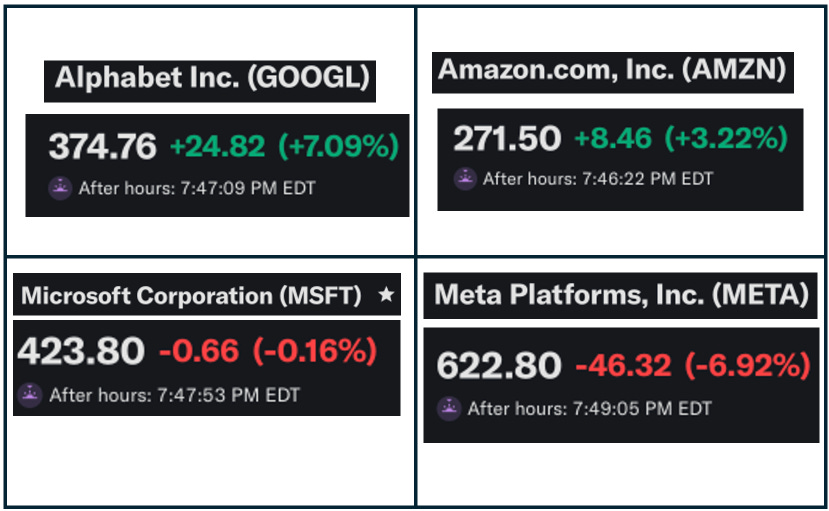
The table above shows the after hours moves in the stock at around 8pm ET which tells you how Wall St. reacted. Google was the only one of the three that had what is called a clean beat and raise and Wall St. loved it sending shares up 7%. Remember this is a $4T market cap stock so UP 7% is about 5 Targets (by market cap math) worth of market cap added.
Meta was the loser on this short-term sentiment measure dropping a similar amount to the downside (7%). More on that later, let’s look at…
Who Was the Agentic Commerce Winner?!
CNBC and Gene are going with:

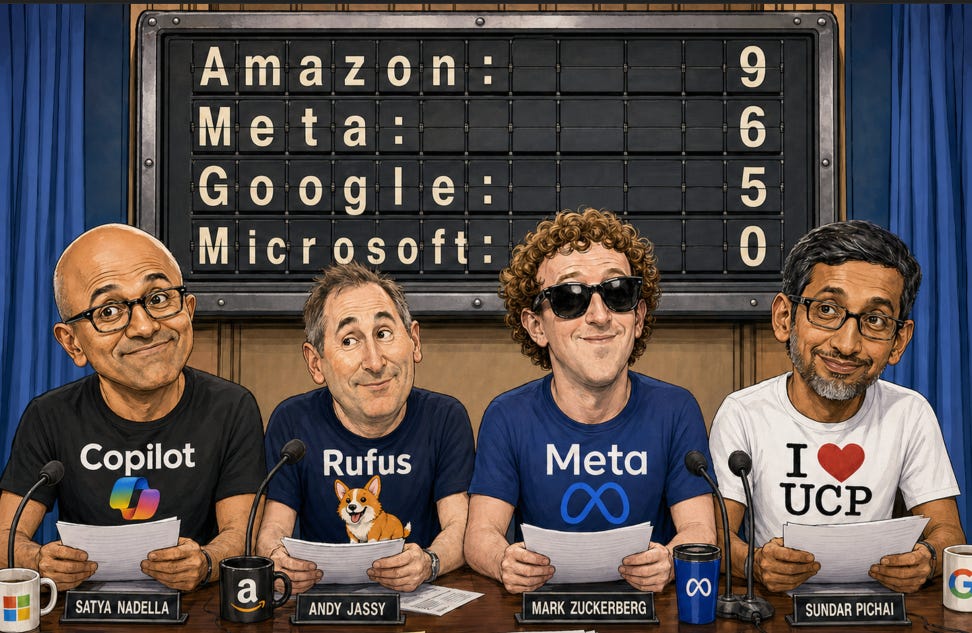
This Retailgentic ‘Agentic Commerce mentions’ scoreboard tells the same story. We went to work when the last call was done on tallying the mentions of ‘agentic commerce’ and surprisingly Amazon came out on top. Perhaps it was because they joined the UCP alliance and released 8 big Rufus features right before earnings? In any case they won on that super-un-scientific dimension:

Let’s go from least mentions to most and dig into what was said. If you add it up that’s 20, yes 20 Agentic Commerce mentions so this is going to be long, but for such a historic moment in time, we think it’s important to really capture this moment in all it’s grandeur.
For each section, we’ll highlight three different areas that are all part of the earnings mosaic: Press release mentions, prepared remarks mentions and Q+A questions that mentioned Agentic Commerce. One editorial note, we are favoring speed over perfect, these are preliminary transcripts - the gist is right, but every word may not be perfect.
At the end we’ll roll it all together into some conclusion.
Google’s Q1 Earnings Agentic Commerce Mentions
Google’s press release is very financially oriented, but in prepared remarks they added this from Philipp Schindler, senior vice president and chief business officer
“AI Mode already surfaces organic product recommendations based on a user's query, and we're now testing a new ad format that displays retailers who sell those recommended products. In addition, the retail industry is rapidly coalescing around the open source Universal Commerce Protocol, or UCP, we launched in January in partnership with the ecosystem. Last week, we welcomed Amazon, Meta, Microsoft, Salesforce, and Stripe as new members to the UCP Tech Council. They join founding members Shopify, Etsy, Target, Wayfair, and Google to further accelerate the transition towards an agentic future. Partners like Sephora and Macy's have joined companies like Ulta Beauty, who are already rolling out UCP and can now redefine consumer journeys from discovery to checkout. Ulta Beauty just last week launched agentic commerce within AI Mode and Search and the Gemini app.”
Question (Eric Sheridan, Goldman Sachs):
“Philipp, to bring you into the conversation, you referenced UCP and there’s been a lot of industry inertia around UCP very quickly. Talk to us a little bit about what UCP means. For the services business as agent to commerce scales in the years ahead. Thanks so much.”
Answer: (bolding is my own)
“Look, I mean, we’re in the early stages of the agentic era. Agentic is more than just completing transactions. We all know this. We see agentic experiences as additive. And it will really transform how we shop from discovery to decisions while helping, obviously, brands differentiate themselves. Our goal is really to remove the grunt work of shopping. So consumers can focus on the enjoyable parts. For decades, you could either shop fast or smart.
And I think with agentic commerce, you no longer have to actually choose between speed and certainty here. The universal commerce protocol, a new open standard for agent e-commerce that works actually across the entire shopping journey from the discovery to the buying and the post purchase support that we just talked about.
It was really co developed with the industry leaders, including I mentioned Shopify, Etsy, Walmart and so on. And we’ve received tremendous feedback so far from hundreds of top tech companies, payments partners, retailers really interested in integrating. It will help power a new checkout experience in AI mode and search and the Gemini app and allowing shoppers to actually check out from select merchants right as they’re researching on Google.”
Question: (Ross Sandler, Barclays):
“Just following up on the last question on agentic shopping. So it seems like we’re at the point in time where this is actually going to start happening finally. So, Philipp, just to elaborate a little bit, as you try, as you look at carrying the AdWords business from kind of the old way of doing things to this new agentic friction with shopping way, how do you see the price and volume kind of growth trends for core AdWords evolving as, as you start implementing more agentic workflows in search?”
Answer: (Philipp again)
“Look, our number one focus is obviously on the user experience here. I think, the most important part in this is, what I mentioned before. We are carefully designing the space in the agentic workflows for the users to actually see the valuable components, within that shopping journey. The second you have the space, you obviously have the ability, for interesting app advertising models. I think it’s also worthwhile noting that, beyond just the traditional agents, there is a lot of additional ways we can actually use AI to improve the shopping experience. You can think about it like our apparel try-on tools, that is now available in the U.S. You can think about Google Lens.”
Meta’s Q1 Earnings Agentic Commerce Mentions
In her prepared remarks, META’s CFO, Susan Li, said the following:
Last, I want to touch on our commerce efforts. People discover products on our platforms through ads and organic posts, with brands increasingly turning to creators to promote their products. This is contributing to rapid growth in our partnerships ads product, with its revenue run rate more than doubling year-over-year in Q1 to $10 billion. To support the product discovery and purchasing happening through creators, we're expanding our solutions beyond ads. Last month, we rolled out our affiliate partnerships offering on Facebook to more test partners, so creators can tag products from participating retailers on their posts and earn a commission when someone makes a purchase. We have also started testing similar experiences on Instagram. We see a real opportunity to help people more easily discover and buy products within our services, particularly as we incorporate AI deeply across our platforms.
Then in Q+A, the first question, and this is going to sound like deja vu…
Q: Eric Sheridan, Goldman
Thanks so much for taking the question. Maybe if I can build out on one of the topics that was discussed in the prepared remarks, but just the opportunity set that sits in front of the company with respect to putting agentic compute in front of both consumers and enterprises. You’ve long been associated with sort of the consumer landscape, and I am curious about how you’re thinking about extensions of the media engagement parts of your business model and the commerce parts of the business model to become more agentic over time. What do you see also as the opportunity set that sits in front of you across SMBs and enterprises where historically you maybe haven’t had as much product velocity? Thanks so much.
Zuck answers:
Of course, as we are able to build out more agentic capabilities, you know, enabling agents to help people be more productive, but also agents for businesses and enabling, frankly, those agents to interact with each other, and, you know, build what we hope will be a thriving commerce ecosystem on our platform. You know, I would say some of these are a little bit further out, you know, especially in that latter category of things. Again, the focus is on building personal super intelligence. You know, building a consumer agent that can work for you and help you get things done. That right now is a consumer experience that we're focused on, but we think there will be clear monetization opportunities over time. You can imagine commission structures or a premium offering.
Question: Ken Gawrelski with Wells Fargo
First, you talked on the Muse Spark launch, you talked about 2 categories or 2 verticals. You talked about health and wellness and shopping. Could I dive a little bit and ask you to dive a little deeper into the latter on the shopping and commerce side? Were there any learnings, you know, in the 2021-2022 phase where you pushed deeper into commerce on Instagram and on Facebook? Any learnings from that period that you might apply? Is there an opportunity for a next-gen marketplace-type business in commerce?
Ok, this one was music to my years - he tied together their plans for the future, but also some of the mis-steps in the past as well as pulling in marketplaces 👨🍳😘 question Ken!
This one is a really great answer, and I think you’ll get more out of listening to it here:
If you really want to read it: (it’s a 4min answer!)
I might give you a somewhat loftier answer to the question. You're asking about shopping. I think it's sort of an interesting example of the way in which the work that we're doing is different than what I think others are doing out there. You know, these products, AI agents get better when you fully optimize the stack. That's why we believe that we need to be a company that builds frontier models in addition to building the agents. You of course, need to build your infrastructure in order to be able to do that well. We're undertaking this large investment to be able to do that top to bottom.
I think a lot of the way to think about the investment that we’re making is a bet that the individual things that people care about and that people are going to be more important in the future. That’s sort of like I think it should be a pretty obvious thing to say, but I think so much of the rhetoric around AI in the industry is around, like, a company trying to build some kind of centralized thing that, like, does all the productive work in society in some way or something like that. That just is very different from how we see the world. Like, our vision for the future is one where society makes progress by individuals pursuing their own aspirations.
Some people care about big, grand things like curing diseases, and a lot of people care about personal things like finding the right shirt for my daughter. I just think that we’re gonna build things that help deliver this vision for personal agents for people. I think that part of the lane and what is interesting and differentiated about what we’re doing is that that’s just so different from how I hear everyone else talking about the work that we’re doing. Even though I think some of these ideas, they seem like they should be so obvious, I actually think that our approach of trying to empower individuals and building consumer things is just in the details extremely different from what others are doing.
Shopping might be one kind of specific example that I think is gonna have interesting commercial implications, and I think people, consumers are going to like it. You know, I don’t hear any other labs out there talking about how they’re building an AI that’s really good at shopping. I think that the reason for that is not because shopping is the most important thing by itself, but because empowering people to do the things that matter in their lives, whether that’s local or understanding social context or shopping or personal health things or understanding what’s going on around them visually, which is gonna be really important on the glasses. These are all elements of the personal super intelligence vision.
I think, like, a lot of this and when you're thinking about kind of the investment in Meta over time, I think you should think about it as coming down to these set of values. Around what do we want AI to do in society? If what you want it to do is empower individuals and build a world where the AI is in service to individuals' goals, then that is what we are going to build, and I think it's going to be incredibly valuable.
What’s funny about this one is it was a two-parter with part being a tactical question for Susan and she’s clearly a bit gobsmacked by Mark’s off-the-cuff monolog and to answer her question starts off with this lead in: “Gosh, I almost wish we could end on that answer.”
Amazon’s Q1 Earnings Agentic Commerce Mentions
Amazon had a hat trick: press release mention, prepared remark and TON of mentions in Q+A.
Let’s start with Q+A:

From Jassy’s prepared remarks:
Rufus, our agentic AI shopping assistant, continues to resonate with customers. Rufus can research products, track prices, and auto-buy products in our store when they reach a set price. Monthly active users are up over 115%. Engagement is up nearly 400% year-over-year.
He also echo’d the press release statement, we won’t duplicate that for brevity.
In Q+A the first question came from Brian Nowak (Where was Eric!?)from Morgan Stanley:
I have two questions. <cut for brevity> the second one, as you sort of think about milestones for Rufus and agentic commerce for you in 2026, what are you most focused on making sure you accomplish on the agentic side this year, just to make sure you stay at the nice edge of the agentic commerce offerings? Thanks.
Jassy answers: ( a long one!)
On the agentic commerce milestone question, you know, we are very bullish on what agentic commerce will look like. I think it's gonna be very good for customers in the long term. I think it'll be good for us too. You can see some of that focus from us in what we're building with Rufus. If you haven't checked out Rufus in a while, it really substantially improved over the last year, and we have a lot of customers using it.
As I mentioned earlier, you know, you see the monthly active users up over 115% in Rufus and the engagement up over 400% year-over-year. You know, I think, while I think there will be, we'll do a lot of work with third-party horizontal agents to try and make that customer experience better. By the way, I do think today it reminds me in some ways the stage we're in of what we saw in the early days of search engines, and they're trying to refer business to e-commerce. You know, it's never been a giant part of the referrals to our e-commerce business. Over the years, the experience got better.
What you see with agentic commerce is it's a small fraction of what we see with the search engine referrals, but the experience just hasn't gotten great with these third-party horizontal agents yet. They're not often able to get the pricing right or the product information right. They don't have any personalization data or any shopping history. We do wanna see that get better with third-party horizontal agents. We're having conversations with all those folks to try and make that better and find something that works for customers and all the companies. It'll be interesting over time which agents customers choose to use.
I happen to think that if you're going to a particular retailer that you like to do business with and you like to shop from, if they have a great agentic shopping assistant, you're gonna often start there because it's where you're doing your shopping. They have better product information. They have better information about what other customers like you are buying. You can make all sorts of changes to how your account and your shipping information is working there. You know, that's what we're aiming to make Rufus be, is we're aiming to have it be the best shopping assistant anywhere, and I think we're on that path.
Question: Shweta Khajuria with Wolfe Research
I have no doubt that Rufus could be the best shopping assistant available over time. For advertising opportunity, how do you view that if agents would be the ones taking action to shop? Thanks a lot.
Jassy Answers:
I think on the agentic commerce and how that impacts advertising, you know, I actually believe that we’re gonna like this for advertising. I think it’s gonna be good for customers, and it’s gonna be good for our business. I think first of all, the first thing to remember is the way that our Ads team has built tools and agents themselves is making it so much easier to do advertising.
You know, if you look at small, medium-sized businesses that had to take, you know, weeks and months to do creative and to pick the right audience, all that is just, it’s so much faster and so much easier because of our advertising agentic tools. You no longer have to take as much time or spend as much money building the creative. I think they’re gonna be a lot more advertisers with the rise of what’s happening in AI. If you look at the agentic commerce experiences, or you look at any of these agentic experiences, they tend to be multi-turn conversations, where you’re not interacting with one search and getting an answer. You tend to find that you’re asking questions, you’re narrowing questions, it’s asking you questions on what you want.
You know, in that process of having multi-turns, there are multiple opportunities to surface relevant products to customers, you know, many of which will be organic and some of which will be sponsored. You know, it also gives rise to opportunities like sponsored prompts. One of the interesting things that has been very successful for customers in our store has been when they ask certain questions, we give them a number of suggestions that are, that are, all created through AI. You know, we’ve gotten pretty good at also having sponsored prompts and that mix of questions and prompts that make it easy for people to keep digging deeper into what they’re interested in. I actually believe that, advertising will do well in a world of agentic commerce.
Headlines from Q1 Earnings
To summarize:
Microsoft had other priorities this Q 🤷♂️
Google is very bullish on the UCP momentum and took a minute to ‘spike the ball’ celebrating their big wins (at the expense of OpenAI’s ACP) and celebrating the big win with Ulta launching both on Gemini, but also using Google as their on-site agent partner.
Zuck at META threw the gauntlet down that he thinks they are thinking about shopping in a different way than any other company and it’s going to be “really good at shopping”
Amazon gave us three new Rufus datapoints this Q!→
20% - The % of shoppers who interact with a Brand Prompt continue to conversion with that brand.
115% - The growth in active users (probably a y/y measure).
400% - Year-over-year growth in engagement
Jassy frames Answer Engine Agentic Commerce as ‘horizontal agents’ (which is what we call it - 🤔. But he frustratingly still acts as if the experience is terrible (he cites wrong pricing and bad information) . I’m sure he’s pretty busy, but I think someone at Amazon needs to write him a 6-pager on why this is just 100% wrong.
Jassy is beyond bullish on Rufus, he’s downright giddy by my read. To me that says, they are blown away by the conversion data coming out of Rufus (more on this later with some fresh hot data that dropped earlier today, so much Agentic Commerce news, not enough time!).
On top of that, he’s just as jazzed about Ads in Agentic Commerce (Rufus)
Conclusion: Amazon, Google and META continue to be all-in on Agentic Commerce, continue to invest at a crazy pace in AI infrastructure, products, teams, etc. We are in a very strong setup for the rest-of-the-year heading into not only Holiday 2026, but an IPO season that could see SpaceX, OpenAI and Anthropic pushing to get public before EOY. 🚀🚀🚀🚀🚀🚀
For More Information…
If you want more analysis on the Q1 results from Amazon, Meta, Microsoft and Google such as broader AI topics, backlogs, their insane AI Capex and all the broader topics, Jason and I are recording an episode this week, and we’ll drop that on the Jason and Scot Show soon.

Bonus charts for staying this long:
Meta capex: 🤯🤯 (spoiler alert - this is why the stock went down)
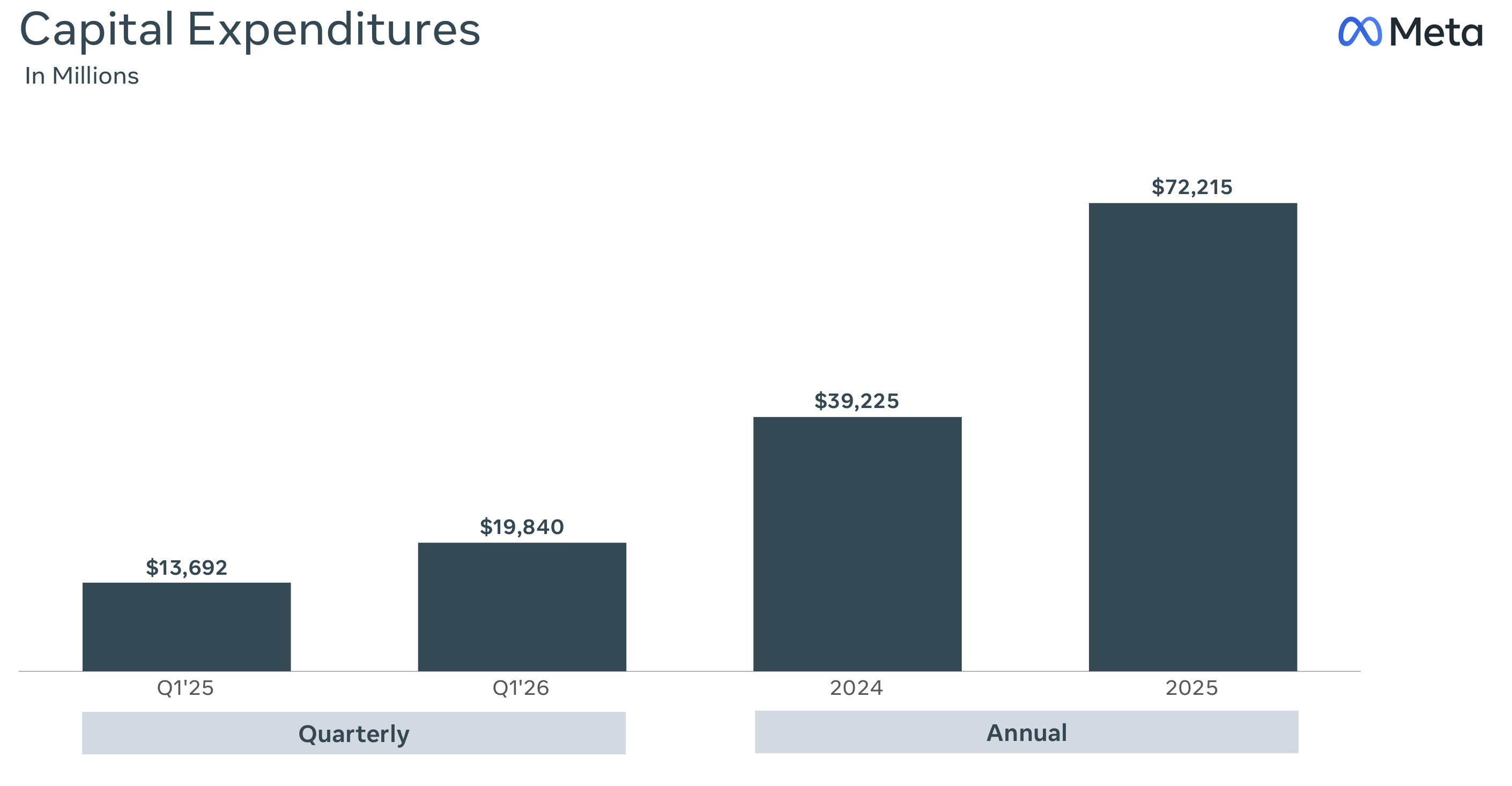
(this is microsoft)

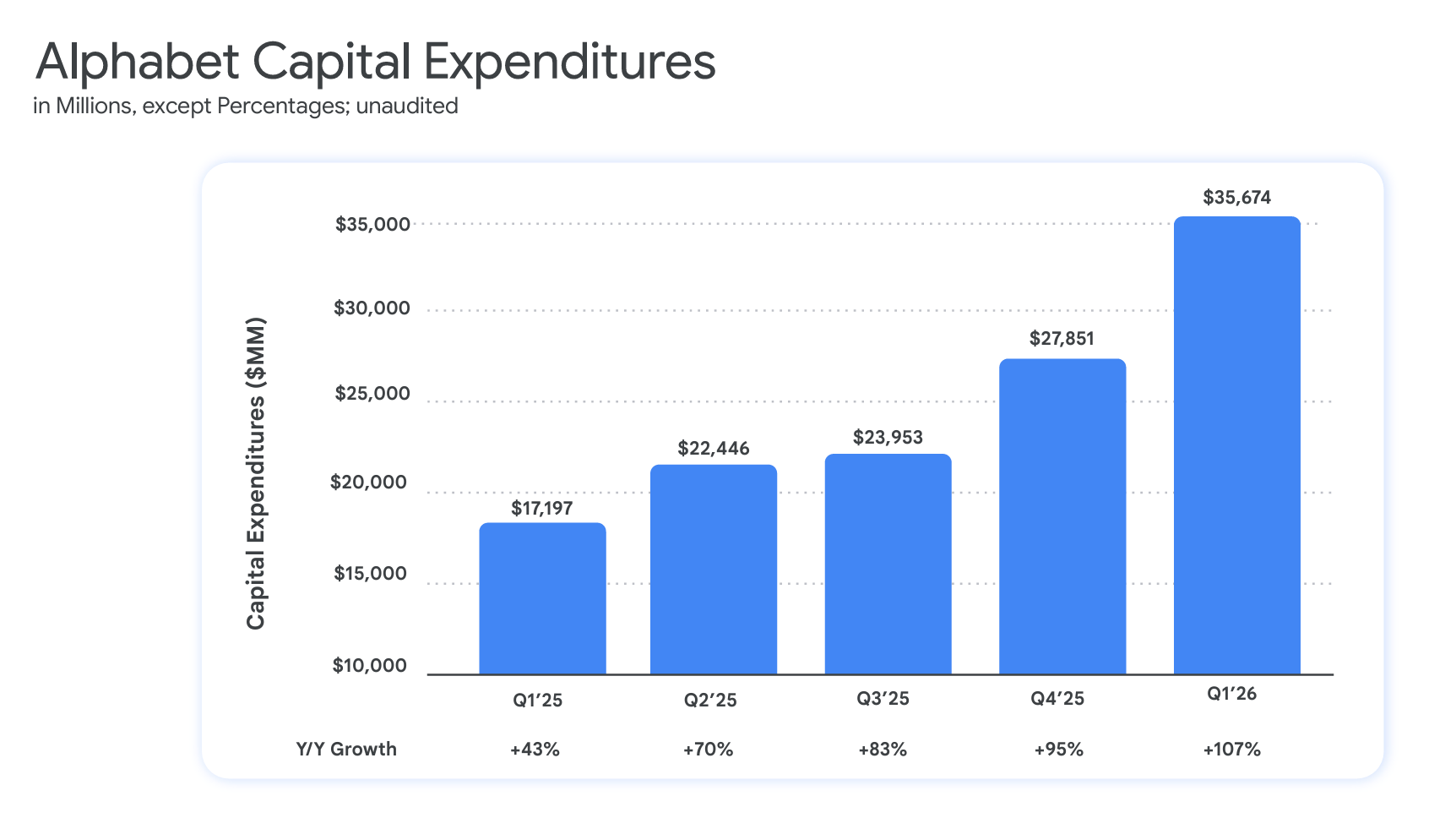
And Google→🤯