


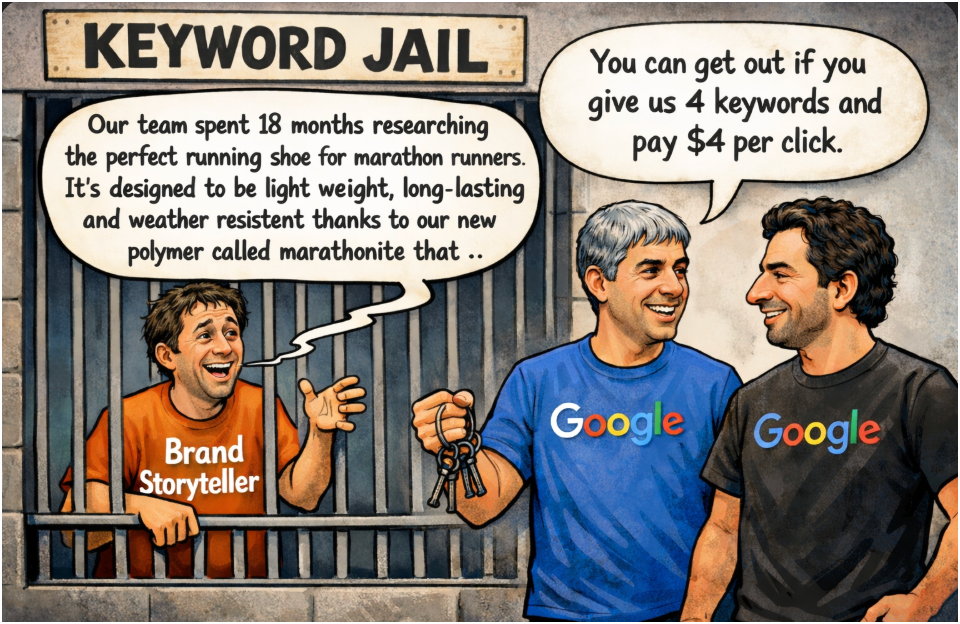
Keyword Jail
Google launched Adwords in October of 2000 and every since we’ve been in what I call Keyword Jail. Whether you are the manufacturer of products or someone building a brand at a retailer and helping your manufacturing partners sell their products, you take these great stories about why the products exist, how they they came to be, the heritage of your firm - stories on top of stories. You take all those awesome stories and in Digital, we then meticulously put them onto the website with the product-level stories boiling down to the PDP. Many of the stories translate into awesome product images, brand-compliant descriptions, etc.
Then when you want to get those products into Google via organic (SEO) or paid (SEM) you boil all those stories into 4 keywords. Two of those keywords drive 99% of the traffice because keywords are distributed on a power-law curve. Then your SEO team tells you to save money if you really shortened the PDP and focused more on those two keywords it sure would help, then you start deleting text and focusing on two or three bullets that really ‘punch up that keyword’.
One day you wake up…it’s 25 years later and realize we’ve gone from storytellers to keyword optimizers/buyers. That is Keyword Jail. There’s other implications too on how we think about products and even how we design and build products.
The Keyword Jail Impact on Product Sales
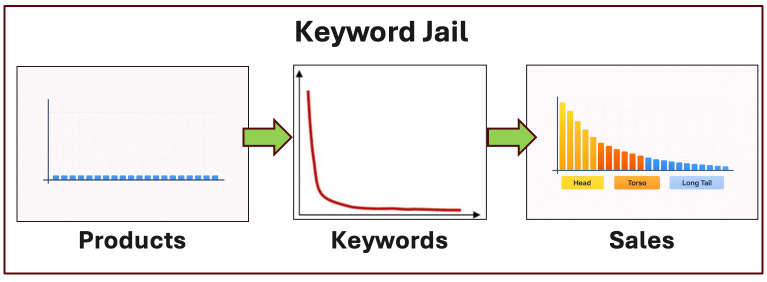
What Keyword jail has done is create this situation:
Products - Every brand and retailer has a long tail of products
Keywords - Because all that delicious search traffic filters through 1-4 keywords it creates a power-law distribution - Pareto is 80/20 this is 90/10 or 5/95. Have a product that fits in the top of this curve - game on. Have a unique product not described by a popular keyword? womp-womp. We all have that set of awesome products that if a consumer ever finds them, they love them, but, sadly, consumers rarely do find them.
Sales - Marry these curves together and you get the head/torso/long-tail curve we all know and love.
The Worst Part of Keyword Jail: CPCs
Because of the keyword distribution power-law curve, that creates a very tight ‘choke point’ which is then the perfect opportunity to setup a CPC toll-booth. On the brand side, now you have to pay up for one of those keywords - big time. Can’t own ‘running shoe’ - you just lost market share.
We went from storytellers to buyers of keywords - and thus, we were stuck in keyword jail. The Google model is so perfect, I thought we were stuck in there forever, but GREAT NEWs. …
ENTER: The LLM Era - The End of Keyword Jail and Start of the Golden Age of Storytelling!
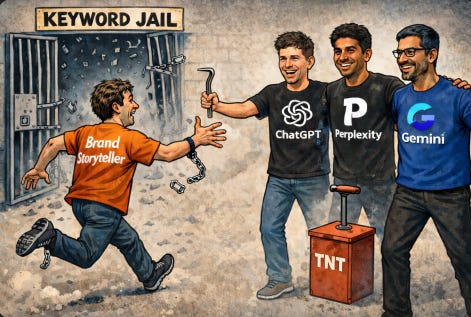
In 2022, ChatGPT (and then others) came along with a big crowbar and some TNT and blew open Keyword Jail. When it was clear Keyword Jail would fall, Google had to join in with Gemini, because if the golden geese are getting out of Keyword Jail, you need to grab the ones you can one the way out.
The Scary Part of Leaving Keyword Jail…
As storytellers, this is exciting, we’re getting out of keyword jail, but wait, look at this chart from SEMRUSH:
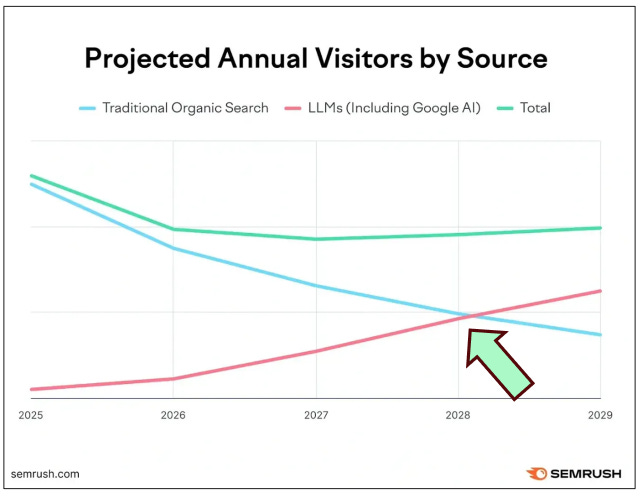
The green arrow (added by me) shows a point in time that SEMRUSH predicts that traffic will cross from majority Traditional Search and be Majority LLMs (including Gemini). Here in 2026 that sounds far away. Ex-Googler, SEO/SEM guru now popular author of a top SEO/SEM newsletter is consistently predicting 18-64% decline in 2026.
When you’ve had 25 years of the ‘buy keywords’→traffic→convert→transactions cycle, a decline of 40% at the mid-point is going to equate to… a decline of revenue around 40%. In our world, that’s the definition of scary 😱.
Keyword Jail Muscle Memory
The other, maybe even bigger, challenge I’ve heard from countless brands and retailers is all of their infrastructure is built around keywords: SEO teams, SEM teams, on-site search engines, PDPs, site structure, on-site search, everything. What do they do now?
The answer is simple - we become storytellers. Here’s why.
The Golden Age of Content and Context
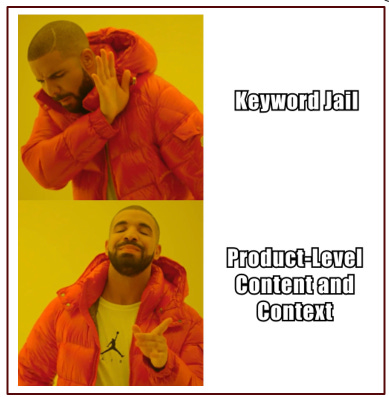
The reason I believe, as storytellers, we are entering a Golden Age, is what we’ve learned in the ~6 months since Product Cards came out and the 3 months since Instant Checkout is that Keywords are out - they don’t work or matter in this era and in fact, the over-optimization on keywords hurts your chances of showing up in LLM conversations. What does work is expanding your product-level content and context.
The Golden Age of Storytelling
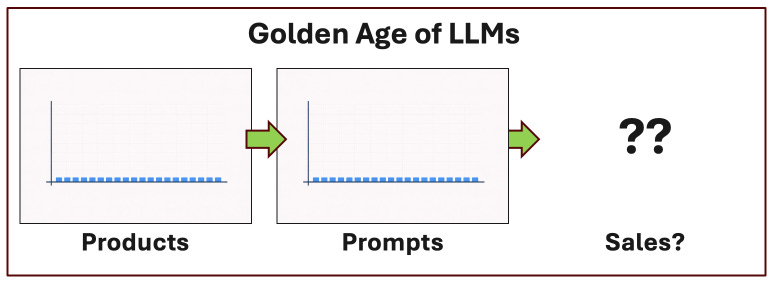
In the post Keyword Jail era, we have this new situation. Consumers using the LLMs, are having these 24+ word, multi-turn conversations. As they do they are increasingly getting comfortable with shopping. At the same time as the LLMs have improved their shopping features and filling this gap we are seeing a new opportunity for digital marketers - we call it Agentic Commerce Optimization (ACO). At the heart of ACO is storytelling.
That’s because the best way to map that long tail of products to that long tail of prompts is to tell all of the stories about each product. Help them navigate your long-tail of products.
Here are some of the stories you need to tell about your products:
Why did you create this product?
What was the inspiration?
Who is it built for?
What’s the perfect customer profile?
Why should the consumer pick this product vs. your other products?
What’s it not great for?
What makes it special?
What do other customers think about it?
What are the frequently asked questions?
What products go great with it?
What are the top questions shoppers ask about this product?
But, Why Do LLMs Need Stories?
2000 era computing was barely able to handle the Google keyword and PageRank algorithm. LLMs, based on GPTs (Generative Pre-Trained Transformers), are an entirely new computing infrastructure - intelligence and tokens on GPUs.
This new structure married with petabytes of training data make LLMs excellent at natural language. That gives them the ability to have hundreds of millions if not billions of detailed 1:1 conversations with users. They also have huge memories and context windows with the end-user.
Want to see an example? Run this prompt on your favorite LLM: “Tell me everything you know about me that would be relevant to recommending products to purchase.”
How was that experience? If you use LLMs as much as the average consumer, you will realize that all of that information is ‘in the digital brain’ (context window) behind every conversation that leads to a product card. Note that most people in corporate America don’t use the top 3 LLMs (Corp Copilot is allowed but not ChatGPT, Gemini, Perplexity) because of strict corporate AI/LLM policies. Therefore, we as an industry also have a critical problem where most digital marketers can use Google all they want, but not the biggest new channel to come along in 25yrs 🤦♂️. But I digress, back to the point.
LLMs have Shopper Context and Content, but…
The LLMs have all of this information about what the shopper is looking for- way way way more than a keyword. If you thought ‘keyword’ was the highest intent signal, you haven’t seen anything yet. BUT if the LLM doesn’t have the content on the other side of the equation - the product side, how is the LLM going to know what product to recommend for this specific shopper’s needs?
Here’s a visual of where we are today at the beginning of 2026:
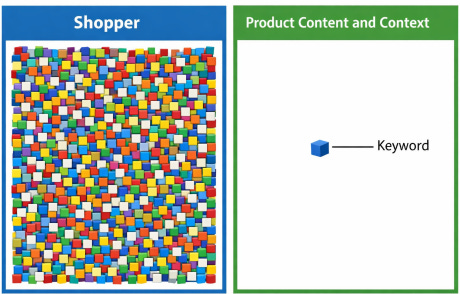
The LLM has a 600-dimension complex mental mosaic of the shopper, but over on the product-side of the equation all it has is a tiny little keyword and maybe 4 attributes (the standard Google shopping feed). If you were the LLM what would you do? What would you do if there was another product from another brand or retailer that looked like this?
When you give LLMs product-level stories…
What you want is this:
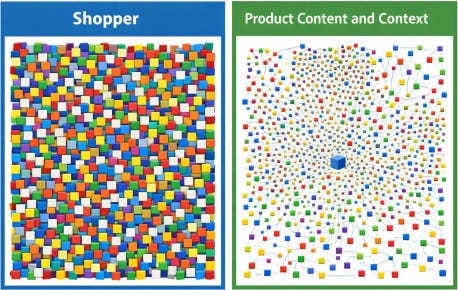
Now we’re talking -now the LLM can start matching up what it knows about the shopper to this very strong set of product details and context to help make the perfect 1:1 match.
To help illustrate this:
In a perfect world, the LLM would love an 80 page PDF with every spec and detail about your product and then it would want ANOTHER 80 page PDF about every story behind this product for context. Compare that with what’s on your PDP today. We have a LOT of work to do storytellers!
One More ‘Re-Frame’ to Help you Break Out of the Mental Keyword Jail
Everyone in retail and for brands that sell direct with their own stores has had this experience. You are doing a store tour and someone in store management introduces you to a store associate that is one of the top producers in your company. You meet them and they just blow you away about how passionate they are about your products, how much they know.
On top of that deep deep product knowledge, when a potential customer comes in, they take time to listen. They ask the right questions at the right time. By the time they are four questions in you can tell they are actually using the questions to narrow down the conversation to two to three products. The best like to offer a good/better/best to let the customer choose, but they’ve narrowed it down for them to avoid the paradox of choice.
Agentic Commerce can be as good (better?) as your best sales associate…
Here’s a slide from my ‘break brands+retailers out of Keyword Jail’ presentation:
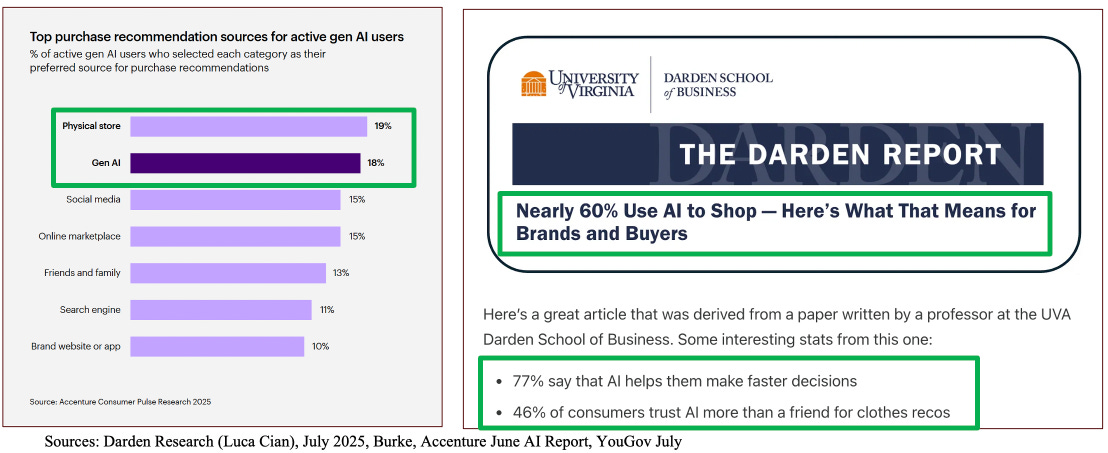
Data from four independent sources (academia, UX researchers, YouGov, Accenture) surveying large sets of consumers consistently tells us:
Consumers trust GenAI/LLMs more than websites, friends, social media
The only thing that scores as high is a physical store.
Plug: Want to learn more, we had Dr. Luca Cian on the retailgentic pod - one of our most popular episodes to discuss this trend in detail including ‘word of machine’ - here.
That’s the opportunity - treat Agentic Commerce LLMs like your best sales reps - arm them with all the product data you can so they can perform like your best human sales associate. Now you have a digital sales associate and where they are ‘better’ than the human best sales associate is they can have conversations about your products.
Conversely, back in keyword jail, it’s like taking your best sales rep that knows all about your products and letting them ask one the shopper one question that they can only answer with less than 5 words. Sounds crazy, but that’s exactly where we’ve been with keyword jail.
Welcome to the Golden Age of Storytelling:
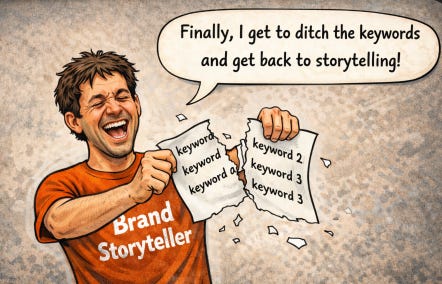
WE ARE SO BACK STORYTELLERS!
Now it’s time to tell stories! I’m a storyteller and I’m super excited for this new phase of ecommerce, it’s going to be fun and exciting. We’re going to light up products that never got the light of day. You’re FINALLY going to have something more than a @!#% keyword to different your products from the competitors and tell YOUR story in YOUR brand’s voice. (Golden Age!)
Examples of Content and Context
You need the basics we’ve talked about here the extra attributes - that’s product content, but the real storytelling happens in context:
Provide the LLMs with a window into the design process
Take the store training materials that your associates use to learn products and cherry pick some content and context from there
Analyze your 5 star reviews - why do people love this product?
Are there negative product reviews out there that the Agentic Commerce engines have picked up that are incorrect and you can correct record’
In the Golden Age of Storytelling you can the stories inside your company about your products and use them as fuel for the Agentic Commerce Era.
Implied in this ‘reset’…
The race is on - if you can get the Agentic Commerce Engines to know more about your products than the competition, you have a critical edge. Everyone is reset to 0 today. Whoever can adapt to this new world the fastest will definitely have a short-term edge and if ecommerce history is an indicator, you probably will have a mid and long-term lead that builds over time. Game on!
What Expanded Content and Context is NOT
I’ve had several traditional SEO folks at brands and retailers assume when I talk about dramatically expanding content and context I’m talking about obviously dubious practices such as keyword inject, AI spam, prompt injection, white on white text - all the SEO grey hat/black hat stuff that everyone knows isn’t good. It’s obvious because the intent is to hack the engine.
For 100% clarity, that is absolutely NOT what I’m saying. In fact, the good news is because at a retailer or brand we have plenty of product-level content (key concept is this is all product-level and is us, as digital marketers, reacting to this new era where we finally now have a digital audience, the Agentic Commerce Engine, and their users, that explicitly wants this information (it’s literally in the feed specs!). Tell your product-level stories, use real content, use real attributes. Help the engines become your best sales rep. Help them recommend your product over competitors where appropriate. Help THEM Help YOU!
I’m also not talking about GenAI generated (aka AI slop) content like listicles and all that. This is actual factual information about your products on the content side and stories about your products on the context side. All human, all legit, all information you already have somewhere in your org. Stories that were told and then lost in the filtering down to keywords and tight PDPs. Find those stories and break them free.
What’s Next?
Hopefully I was able to get you 10% as excited about this new era as we are. In this post we focused on the strategic aspect of Product-level Content and Context.
In next week’s post, we’ll walk through a real-world tactical example with details to illustrate how brands and retailers can leverage the Golden Age of storytelling to
First Luvable, now this. Revenge of the Not Nerds, and I'm here for it.
Scot, I can’t help but express my excitement about this shift in the ecommerce landscape. It’s one of the most thrilling moments for entrepreneurs in this field. As more merchants grasp this change, the joy of storytelling will become more evident, and the frustration of keyword struggles will gradually fade away. Farewell, keywords!