


Here at Retailgentic, we’ve been flooded with requests to cover Shopify in more detail and frequency. We hear you and want to dig in, but we’ve been waiting for some pieces of the puzzle to come together so we’d have a full picture to analyze for you. The pieces are all put together and we’re ready to jump in with a meaty two-parter!
This is a two part series where we’re going to go deep into what Shopify is doing in Agentic Commerce.
8/12: Part 1 - In Part 1, we’re going to start by looking at Shopify’s Q2 results through the lens of Agentic Commerce - it’s a good way to get a handle on what’s going on generally and specifically with Agentic Commerce.
8/25: Part 2 - In Part 2, we’re going to dive deep into Shopify’s Agentic Catalog offering. We’ve talked to hundreds of larger Shopify store operators and there is a LOT of confusion and misunderstanding around what Shopify Catalog.
And without further delay, here’s Part 1:
Shopify’s Q2 Agentic Commerce Highlights
Shopify is really leaning in on Agentic Commerce and mentioned these highlights throughout the release, call and Harley’s comments with press later:
AI-driven traffic to Shopify stores grew 3x y/y.
Orders originating from AI searches also grew 3x y/y.
New-buyer orders from AI channels came in at nearly 2x the rate of other channels.
Half of AI-referred sessions landed directly on a product detail page, 2.5x the rate of traditional search.
75% of AI-attributed orders came from outside Shopify’s top 100 categories.
That last bullet is interesting, Harley expanded:
“These are real Shopify products discovered because an AI agent understood what the buyer actually needed. And that’s a structural advantage for these small specialized independent businesses.”
I’ve talked a lot in these pages (like here) about how Agentic Commerce has now made shopper intent so large that it is swamping product-level information. That’s advantaging Shopify’s merchants right now. They are both more long-tail, but also at the head and torso of the product curve they are more nimble than bigger companies and able to adjust their product catalogs much faster.
Analysis: Traditional ad-based search reinforces winners and given the focus on 2-3 keywords it puts smaller merchants at a disadvantage (e.g. competing for ‘running shoes’) but Answer engines have more prompts to work with (24+ * 4-6 turns of the convo) AND shopper intent which flips the discovery advantage to Shopify’s eclectic long-tail catalog.
The volume is still small relative to Shopify’s $115.6B of GMV - the company said that repeatedly - but this is the clearest set of company disclosures yet showing the Agentic Commerce flywheel starting to rotate.
Financial Highlights from the Q
Wall St. loved the Q - it was a classic beat and raise (beat current quarter’s expectations, raised next Q’s. Here’s the financial highlights from the Q
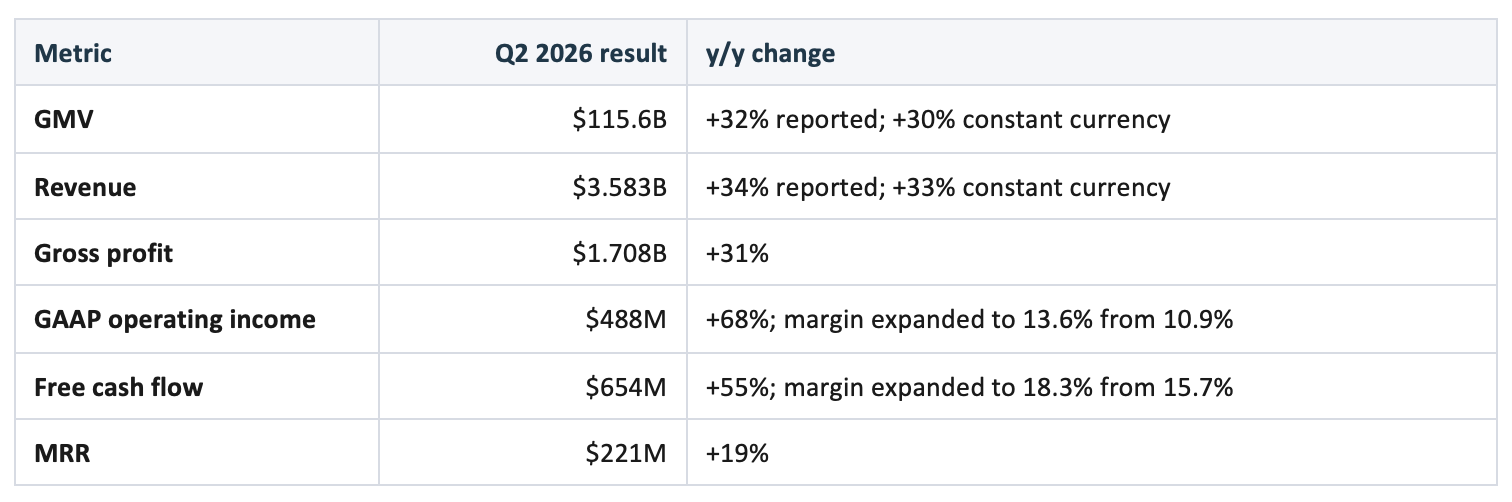
Note: Going forward in here for simplicity, I’m going to report these in non-constant currency because their currency swings are less than 10%
Deeper Dive into GMV and Revenue Growth:
One theory about public Agentic Commerce amongst SaaS companies is that you should be seeing a material acceleration from AI. The logic goes:
if you’re putting AI into your products and customer usage/engagement (merchant and consumer side in the case of Shopify) is increasing.
Revenue should be going up to reflect that investment.
Let’s look at that.
Here we first see Shopify’s y/y Revenue growth over the last 8 quarters (2yrs):
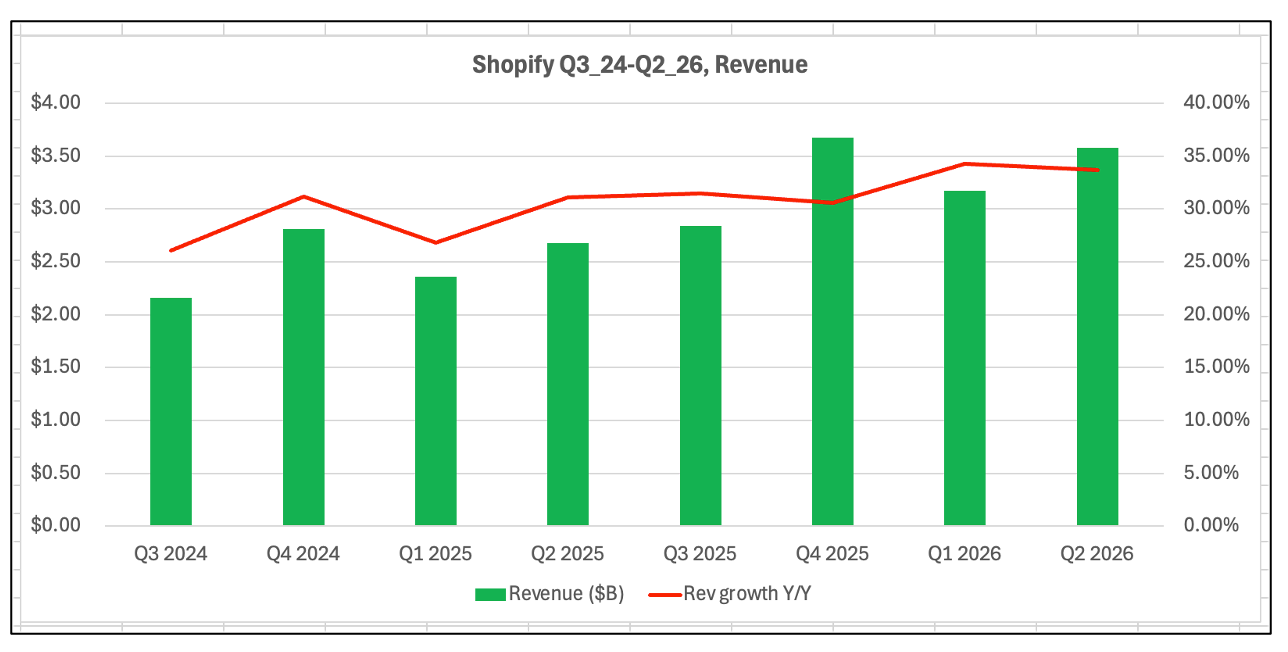
You can see (red line - right axis) that y/y growth for the last year has been in the 30-35% with Q3_24 and Q1_25 the only two quarters in the lower 25-30% zone.
Let’s look at GMV as well:
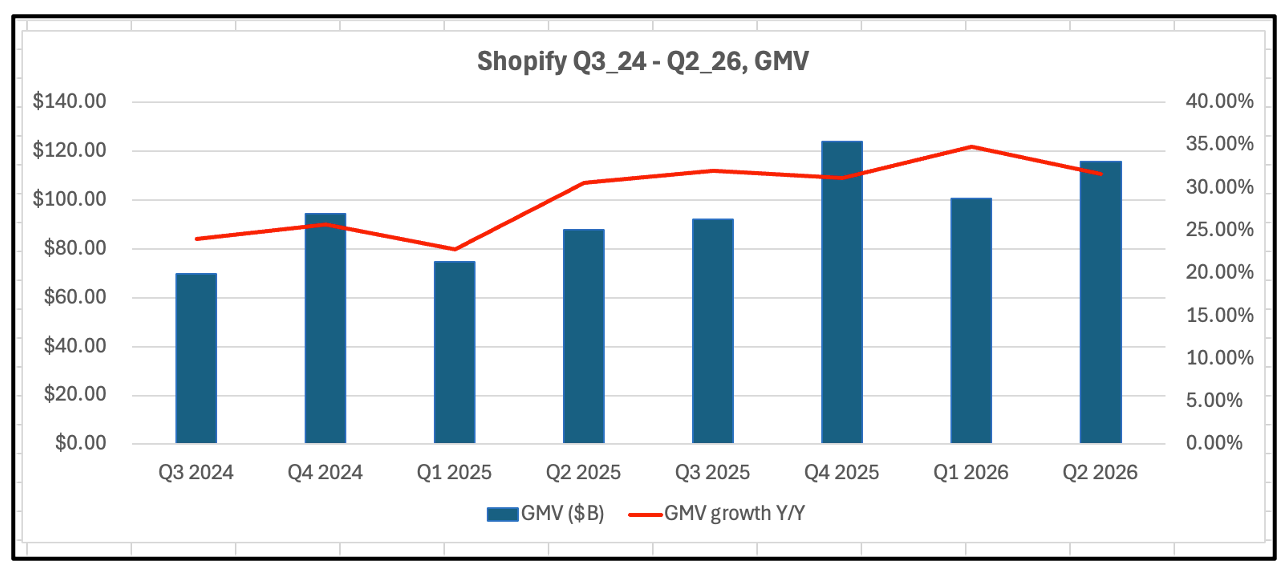
Here we see a similar story - with even a bit of a more pronounced slow-down (Q2 26 GMV grew 31.6% vs. Q1’s 34.8%.
Conclusion: There’s no real acceleration of Revenue or GMV due to Agentic Commerce. To their own points, it’s early, and I predict this Holiday (Q4 26) we’ll see the first material acceleration due to Agentic Commerce, so we have to wait until Late Jan/early Feb to check back in on this one.
To understand what’s really driving Shopify’s ‘beat and raise’, we need to dig into what makes Shopify tick outside of Agentic Commerce.
Shopify’s ‘Real’ Economic Engine: Checkout/Payments (Merchant Services)
A lot of people in my founder circles mistakenly think of Shopify as a software company. Sure they sell software, but that’s one of their two revenue streams (subscription solutions), the lion’s share is “Merchant Solutions” as seen by this chart from their investor presentation:
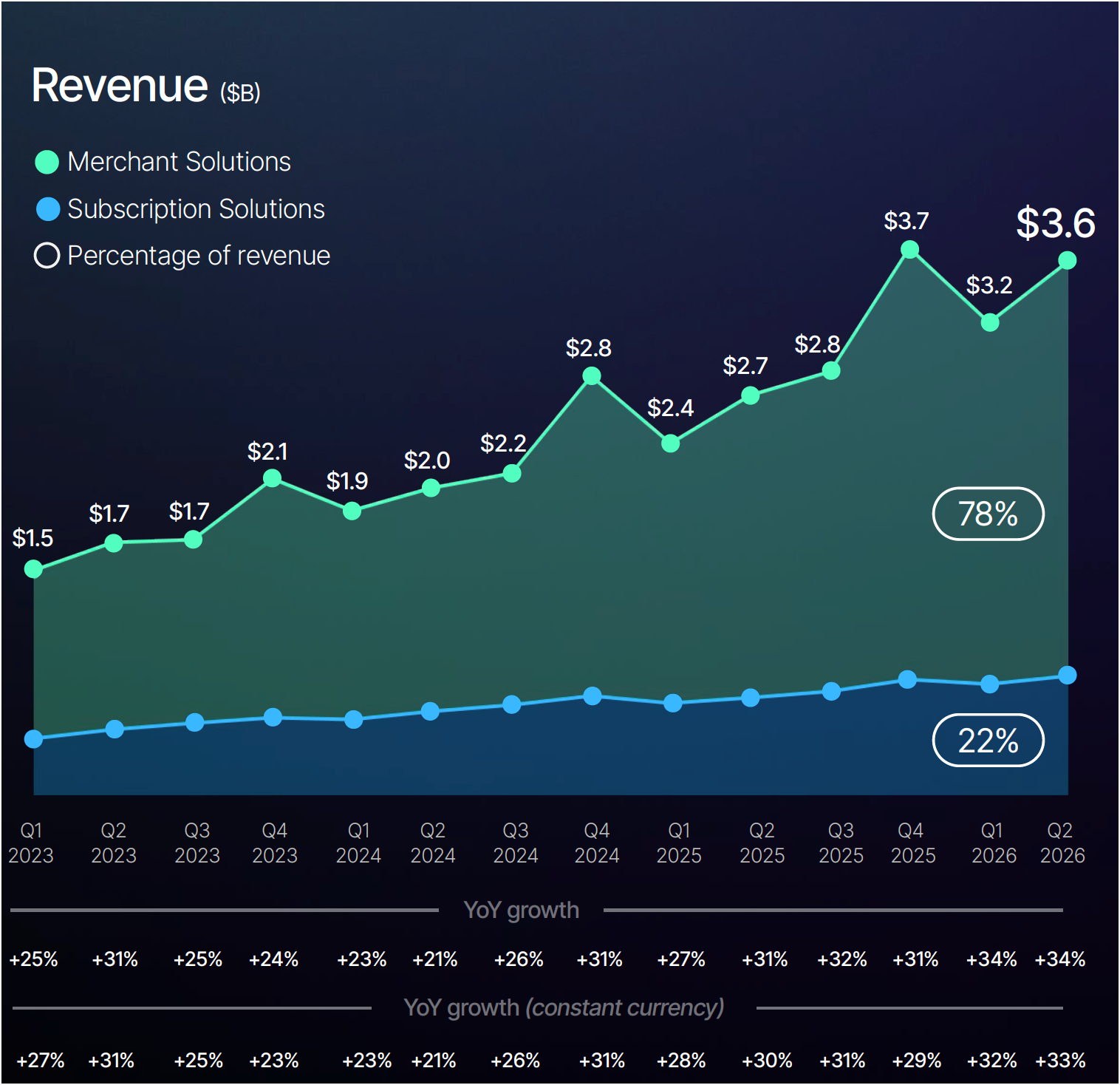
What’s in Merchant Services, according to wall St analysts the biggest pieces are:
Shopify Payments and currency conversion : $2.2b or 82%of Merchant Services
Partners (app store fees, etc.) , Shipping (rev share from usps/ups/fedex/dhl/etc.) , Hardware (POS terminals), Ads (not clear if this is a skim or mark-up) and ‘Other Financial Products’
So the “Lion’s share of the lion’s share” is ‘Shopify Payments’.
It’s growing insanely fast because if you look at the GMV number - the transactional volume flowing through Shopify, a larger and larger % of that (60%→ 68%) is flowing through while growing. Take something compounding ~30% and multiple 8% on top of that - you get two compounding numbers multiplied together which is always a winning formula:
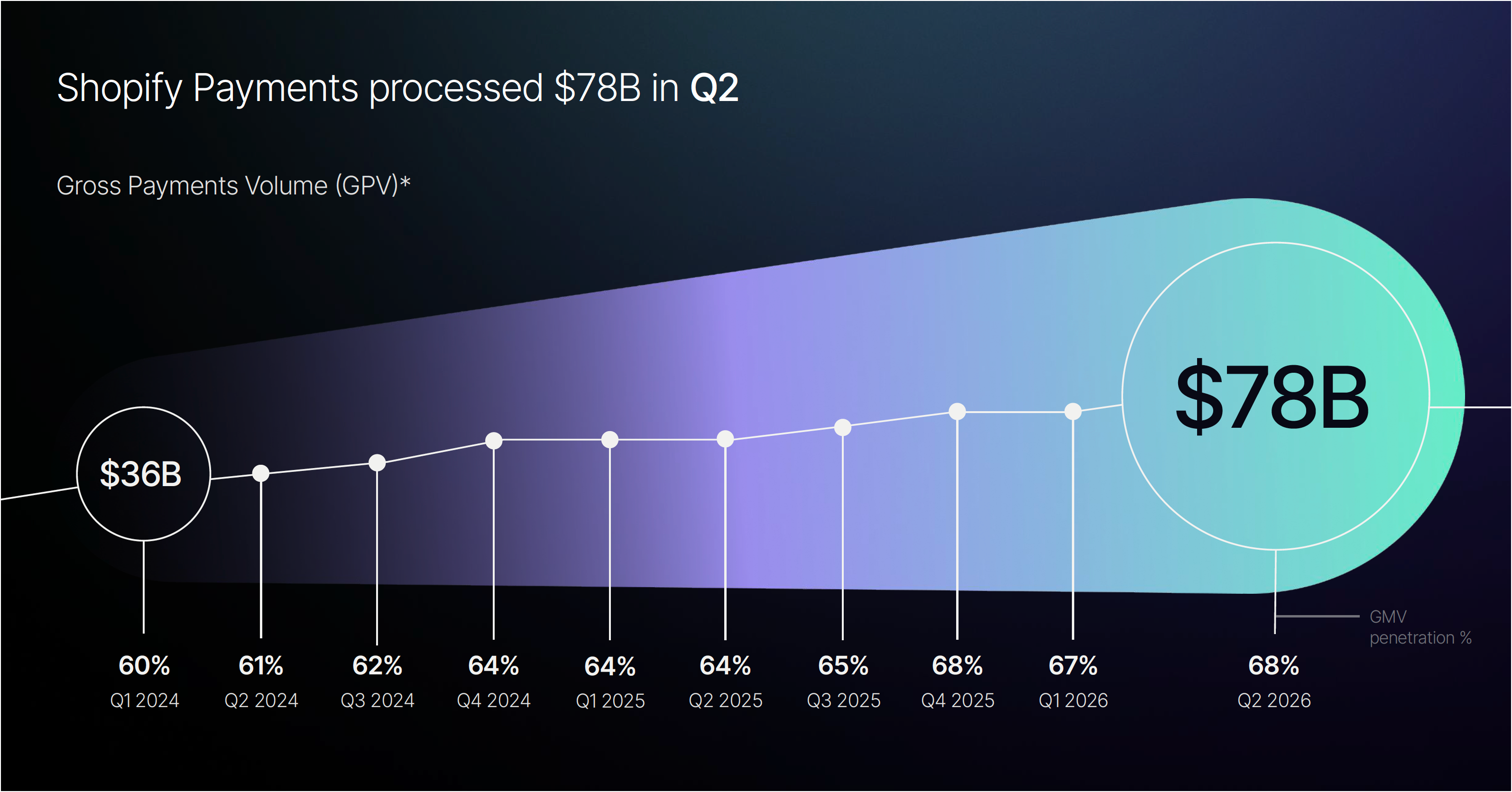
The result: a doubling in Shopify Payments processed from Q1_24 → Q2_26 and the driver of Shopify’s 2026 performance.
Conclusion
This quick ‘highlights’ tour of Shopify’s Q2 results as a springboard into what makes Shopify’s economic engine hum tees us up for Part 2: Deep Dive into Shopify’s Agentic Catalog, coming soon August 25th!
Neat stuff.
I still believe that existing platforms do not have the right kind of interfaces to actually power agentic commerce.
We are not quite there yet.
Here is my take about this - https://ajlewis90.substack.com/p/why-e-commerce-is-not-there-yet-with
The demand side moved in the same week. On 11 August 2026 OpenAI extended ChatGPT Ads to the United Kingdom, Mexico, Brazil, Japan and South Korea, with a self-serve Ads Manager now open and placements limited to logged-in adults on the Free and Go tiers. No CPM, pricing or auction mechanics have been published, and no EU market is on the list or on a stated timeline. For a merchant that is a second surface with its own economics, where paid placement starts sitting next to whatever the assistant would have recommended unprompted.