



Late Wed Oct 21 was one of the newsiest days in the young life of Agentic Commerce, and were digesting all of it. Today we’re going to walk you through the big picture impact of yesterday’s news. We’ll start with two appetizers - the Walmart and Claude news and then go deep on the big Muse news. Let’s dig in!
Walmart Professes Their Love for Agents!

One theme that came out yesterday is a lot of energy suddenly forming around the idea of agents transacting with agents. Long-time readers will remember way back to April 2025 when Google launched an A2A. It started with Walmart’s big news.
Yesterday, Walmart announced here that they were making Walmart even MORE agent friendly.
There’s two parts to this Agent Profiles and the Agent Gateway.
Agent Profiles
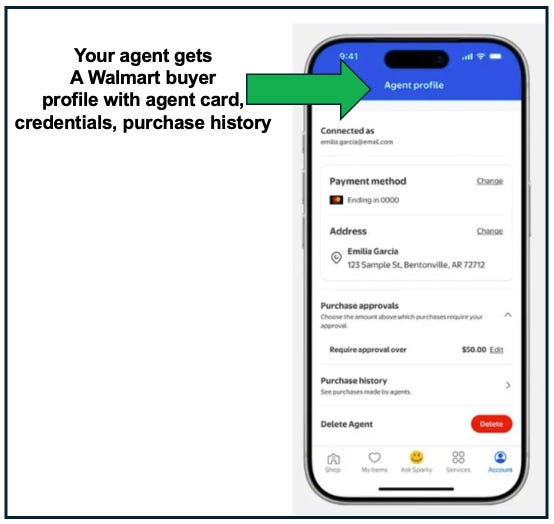
Above you can see a screenshot of what this looks like - your agent can have it’s own profile at Walmart with the card you want used, the permissions(purchase levels you allow), the ship-to/bill-to address, etc. I imagine this will hang off your user profile.
Here, as an example of that duality, we see a purchase history shot→
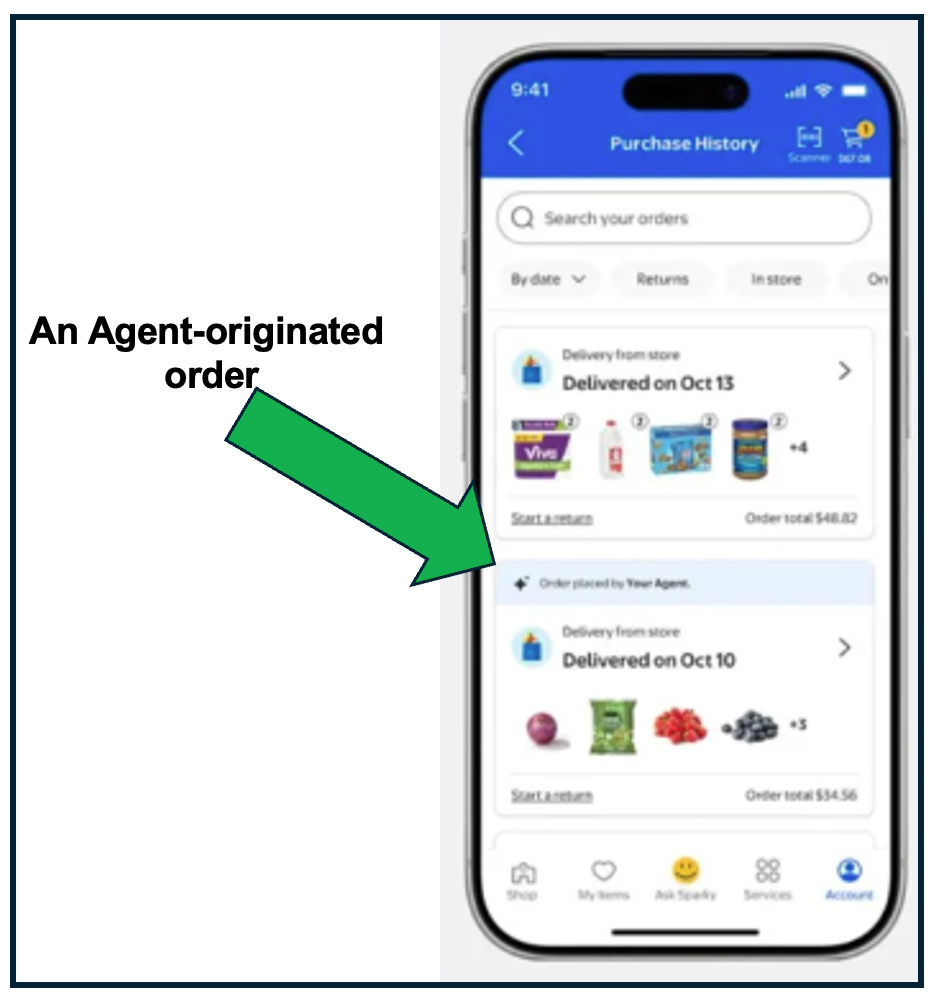
The first item was ordered by a human directly, the second one (the shot is fuzzy, apologies) says “ordered placed by YOUR AGENT”.
Two entities, sharing one account - very cool!
Agent Gateway
Here’s how Walmart described this on the corp blog→
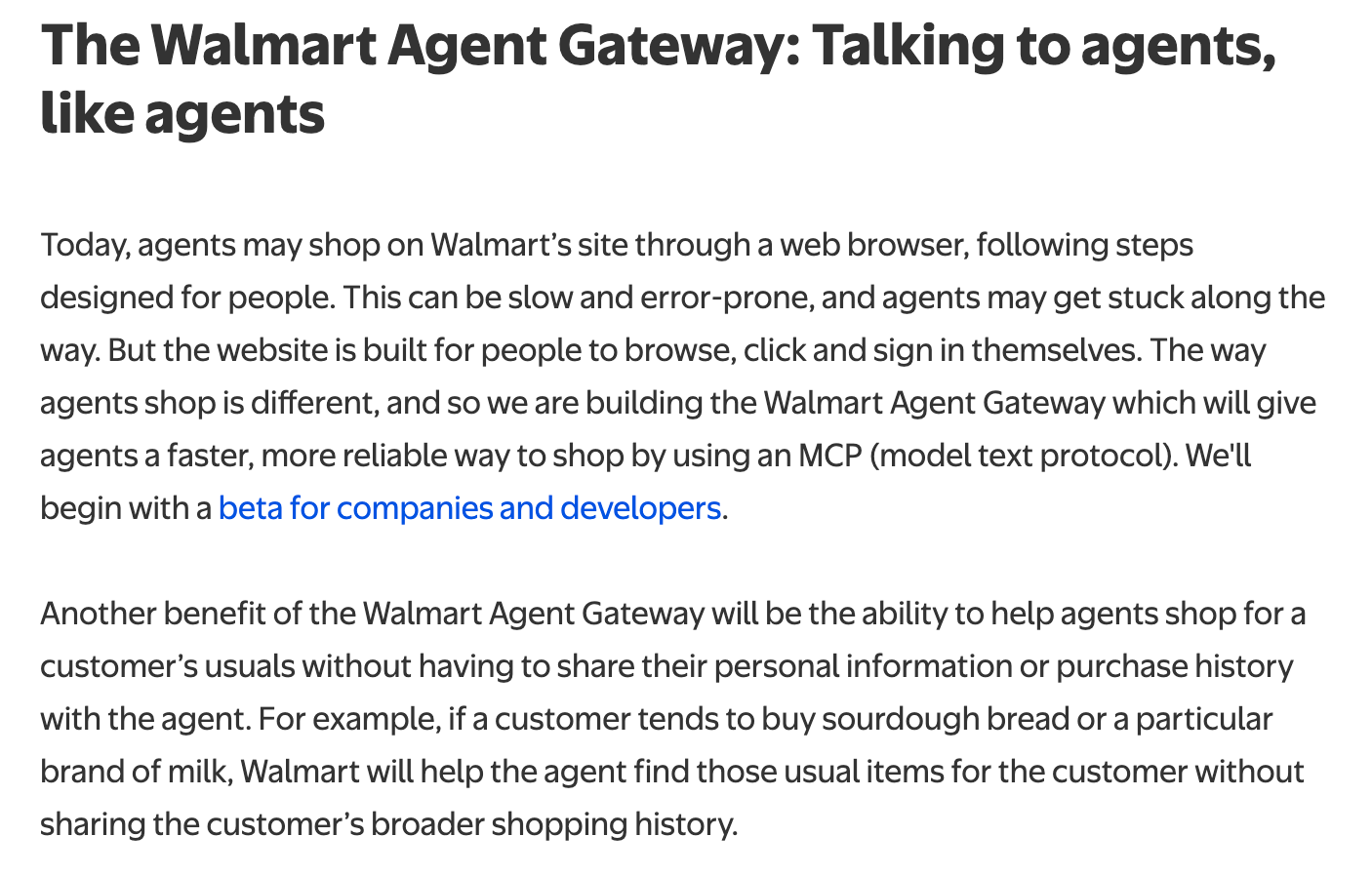
As news came out, it became clear that the vision here is ‘consumer’s agent talks to Walmarts agent for A2A type communication. This is a level above UCP/ACP because it includes more around your order history and you can imagine that the agent may want to ask some questions to a customer service agent. There’s a whole new protocol called PAP - Personal Agent Protocol, that was introduced recently by customer-service agent company Sierra. Details on PAP here. In Sierra’s launch of this protocol, both Shopify and Walmart are in the mix.
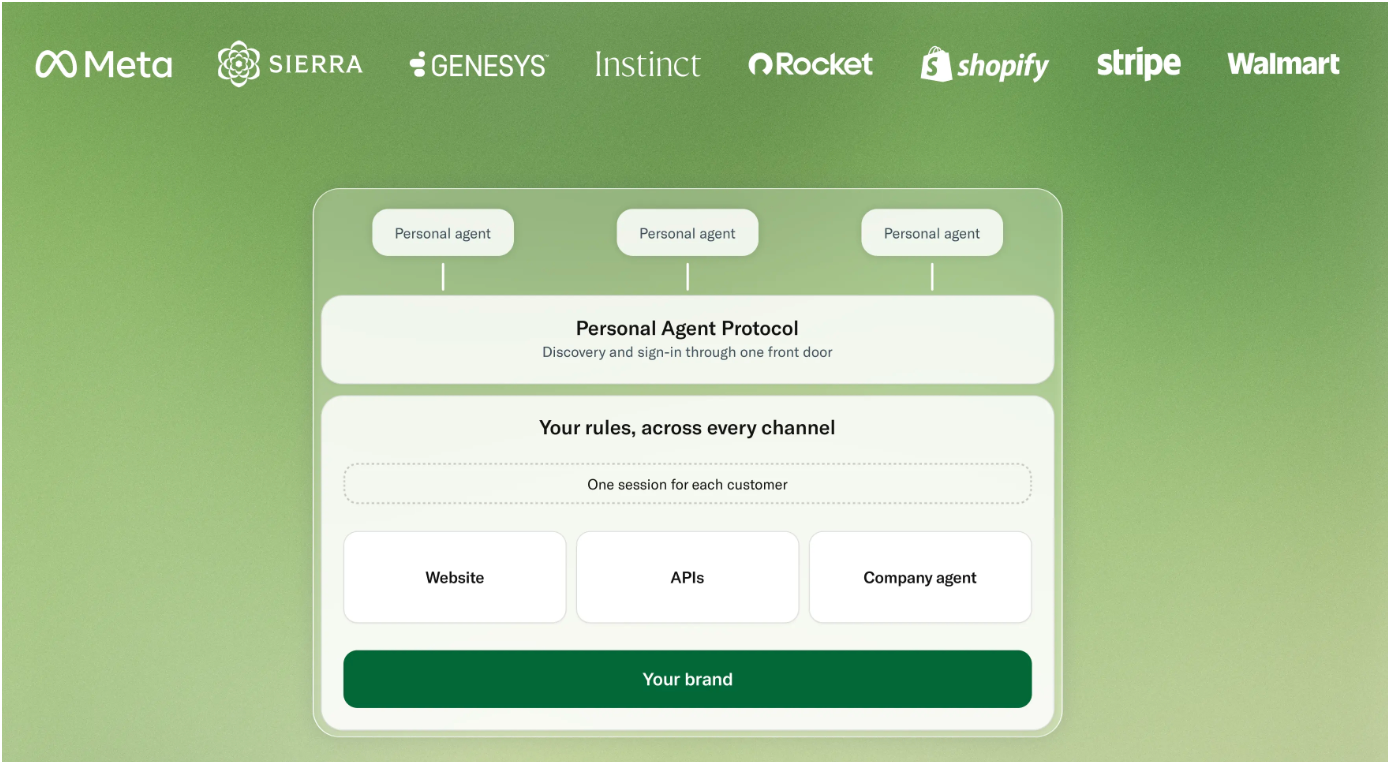
Noticeably missing from these logos are Google, ChatGPT, Grok and Claude. It’s still early, let’s see where this one goes.
Claude Enters The Agentic Commerce Arena with Claude Duet, But There’s An Important Caveat…

Unfortunately Duet is in a waitlist preview mode right now so we can’t show it to you live yet, but enough details have dribbled out we can put together how this is going to work and walk you through it.
The first hint we were going to see Agentic Commerce is from the blog post here→

You can imagine, that caught my attention. We dug through and found this post by Stripe that shows a video of the experience→
Then Shopify posted two videos -one was showing Duet setting up a new Shopify store and adding 4 products, then they showed one where Duet buys from the store and uses Shop Pay→
But wait, there’s a catch: Duet is B2B vs. B2C?
Looking at all the early Duet reviews, one thing becomes crystal clear, Duet is not a consumer-oriented personal agent like Muse or Instinct. It doesn’t even seem to be designed to have one foot in both consumer and business worlds like GrokBot and ChatGPT Dot. Instead, it feels squarely focused on the SMB mainly, but business-user generally.
The starting user-interface is extremely clever - it’s a TO-DO list that your Duet works with you to knock things out, add things from your various communication channels, and connectors.
Even in the stripe example, you see an SMB use case, where Shopify went straight for someone buying a handbag.
We’ll see if there’s some leakage over to to consumer, but for now, this seems a bit late to the game and not consumer at all, so we’ll see.
META’s Q3 Earnings: Welcome to MUSEMANIA!
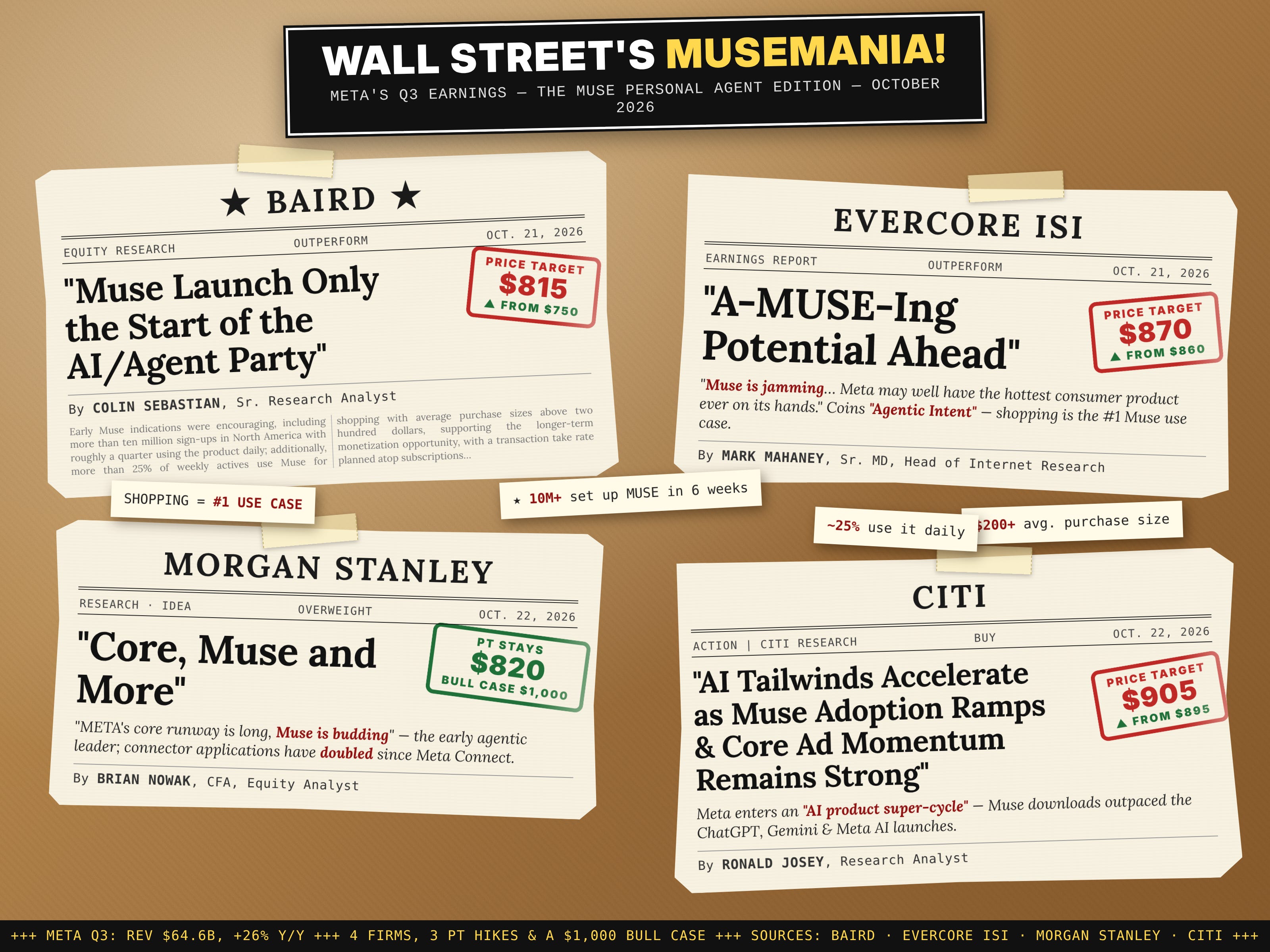
Meta reported Q3 2026 earnings last night and the headlines were all about the beat-and-raise quarter ($64.6B in revenue, +26% year over year).
But on the conference call and in the Wall St notes published later, the real story was the amazing start and enthusiasm that Meta and Zuckerberg have for Muse only 43 days since launch.
MUSE by the Numbers Revealed in Q3
Here’s everything Meta disclosed on the call:
10M+ people in the US and Canada set up MUSE personal agents in the first ~6 weeks, with the app at #1 in the App Store “almost every day.”
~25% use it on any given day - and retention improves the longer people use it. Zuck said that’s more than twice the level Threads started at.
Shopping is the #1 use case. More than a quarter of weekly actives shop through MUSE, with an average purchase size above $200 (and yes, that includes travel - Mahaney asked, and Zuckerberg confirmed travel is itself a top use case).
The commerce plumbing strained under the load: Zuckerberg said Plaid told Meta it had never seen connector activity like this on any other service, and in week one Meta had to work with Stripe to raise credit limits because volumes exceeded everyone’s expectations.
Beyond shopping, the top connectors are personal productivity and linking MUSE to email and calendar, and businesses are wiring in too - connector applications have doubled from ~1,500 since Meta Connect (per Morgan Stanley), with >30% of MUSE users having connected at least one service.
The business model, in Zuckerberg’s own words: MUSE stays free for most people, and Meta will “build commerce tools so we get paid a fee based on the transactions that we help facilitate. We expect this will be paid for by businesses.” A take rate, paid by merchants.
Scale ambition: capacity to serve 1B+ people within a few years, en route to “billions of Muses in a network.” MUSE is compute-intensive today, with a >10x cost-efficiency target over the next year before monetization scales.
One more quote worth pulling out : Meta said average Family of Apps revenue per American user is already several hundred dollars a year, and it expects MUSE ARPU “will reach an even higher level over time due to the amount of commerce that we already see taking place.”
Early SWAG Math on Meta’s GMV:
In take-rate based businesses, like marketplaces, we have this formula:
GMV * Take-rate = Revenue
We now have three things to track - the amount of transactions going through the engines, for payments that’s called TPV or Transaction Processing Value. In marketplaces GMV stand for Gross Merchandise Value - the value of the overall purchases, and then a smaller number (e.g. about 15% for Amazon 3P) is the take rate so for every $100 of GMV, the Amazon revenue is $15, the seller, or merchant keeps the other $85 as their revenue.
We now have enough tea leaves in the Q3 disclosures to do a very rough swag on GMV:
Fact: 10m MAU * This is 6wks but it was scaling up from 0, it’s sticky so feels high trailing, low forward - we’ll use it as a middle-point
Fact: 2.5m DAU
Unknown: WAUs - We know it’s got to be between 2.5m and 10m - let’s call it 7.5m on the high side of mid-point (again Zuck said it’s sticky)
Best guess: 7.5m WAUs
Fact: Zuck said that 25% WAU are shopping (w travel) for $200 sales each user
That gives us 7m WAUs 25% $200 GMV (over that week). 7m * 25% * $200 yields $350m/GMV/week.
That doesn’t seem very high, but the deceptive thing, and it’s not clear if Zuck meant $200 ‘in the life of the user’ or ‘over that week’ - I’m assuming that Zuck is hyper-aware of the differences between DAU/WAU/MAU and how to align metrics to those things.
If it’s what I’m assuming that’s $1.4b/month or $18b/yr GMV run-rate.
To put that in perspective, from 2025 year-end data:
Amazon is at ~$575b/yr (marketplacepulse estimate) for their marketplace
Shopify is at $378b/yr
eBay is at $80b/yr
TikTok is at ~$65b/yr
Could Meta have created a marketplace opportunity that is already 20% of eBay’s GMV in 43 days?
We know that Instinct said they are at $1B/yr run-rate, so that’s out there too.
We’re hearing industry whispers that payment providers are shocked by the amount of transactions coming through these agents now and the ‘stripe had to raise credit limits’ bit and the ‘Plaid hasn’t seen anything like it’ disclosure are other indications.
Shopify reports November 3rd, maybe we’ll get some clarity from them on what they are seeing.
Regardless, the details provided by Meta on the call and the body language started what I’m going to call Wall St’s MuseMania fever…
Wall St. Catches MUSEMANIA!
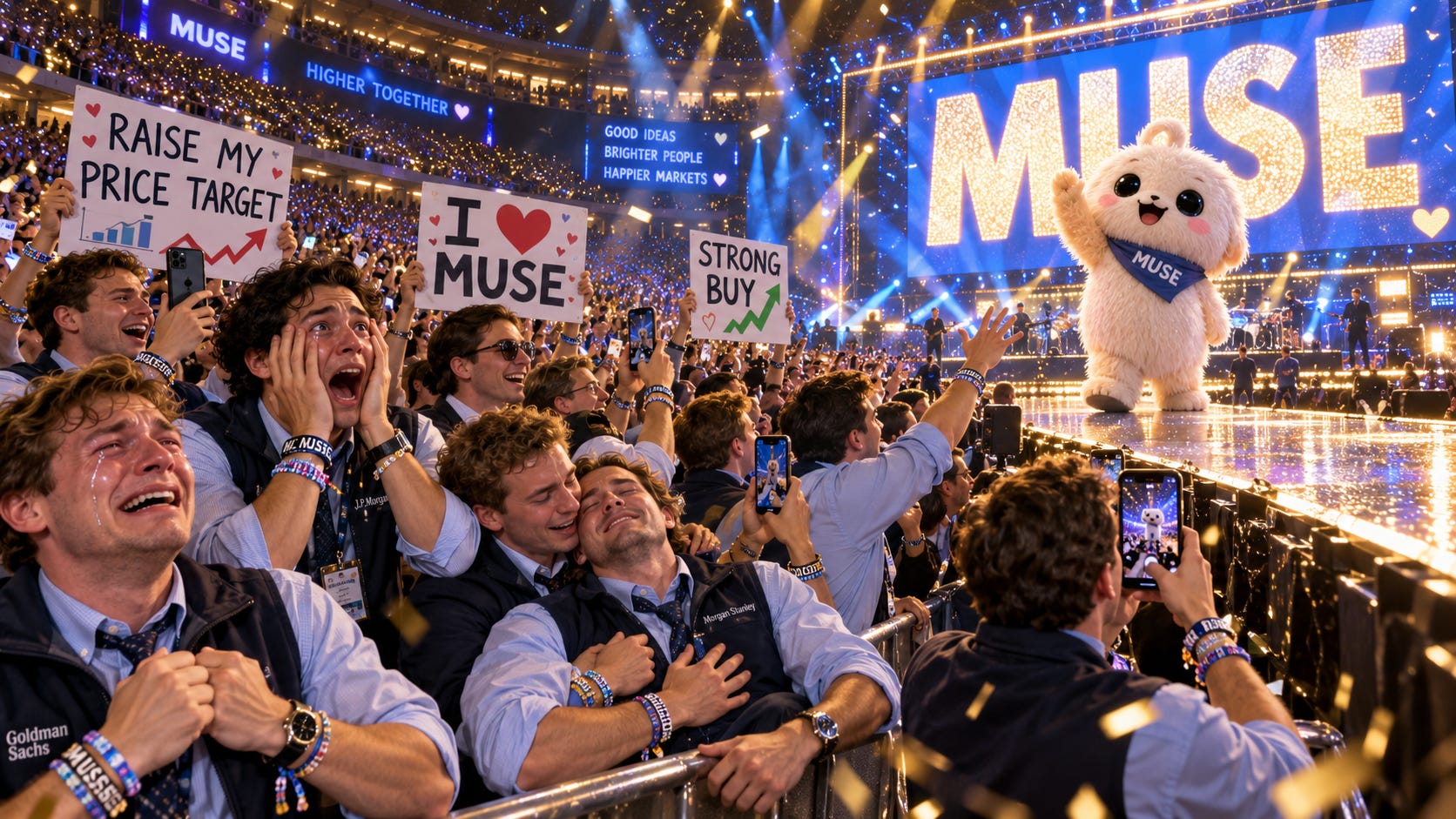
I pulled the MUSE highlights from four analyst reports (Baird’s Colin Sebastian, Evercore ISI’s Mark Mahaney, Morgan Stanley’s Brian Nowak, and Citi’s Ronald Josey). Three of them raised their price target, and every one of them anchored the bull case on the same thing we obsess about at Retailgentic HQ: agentic commerce. One of them even coined a term for it that I suspect will stick.
Most importantly, all four put MUSE at the center of the thesis. Here’s the highlights from their research:
Mahaney (Evercore) coined the phrase of the quarter: “Agentic Intent.” His point: Meta built one of the great ad platforms on reach, frequency, and data - but it never had true commercial intent the way Google has (1P data either). With shopping as MUSE’s #1 use case, that changes. He also flagged management’s belief that MUSE US ARPU can eventually surpass Meta’s US ARPU - effectively a doubling-plus from his estimated $350-400 today - and connected the dots to Meta’s newly disclosed 500M self-identified small businesses: who answers all those MUSE agent requests? Business agents.
Josey (Citi) called MUSE “a search tool” - loaded words for anyone tracking the Google comparison. Citi’s Sensor Tower work shows 11M+ US app downloads in six weeks, US DAUs above ~2.7M and climbing, and a download curve that outpaced the launches of ChatGPT, Gemini, and Meta AI. His sharpest commerce stat: ~20% of MUSE users generate $1K+ in annual Family of Apps ARPU. Citi sees monetization sequencing from subscriptions to transaction fees within the next year, then enterprise, and ultimately advertising.
Nowak (Morgan Stanley) focused on the ecosystem wiring: >30% of MUSE users have connected a service, and connector applications from businesses have doubled from ~1,500 since Meta Connect. He reads the high commercial intent as encouraging for long-term monetization given Meta’s existing relationships with ~500M businesses - and his $1,000 bull case kicks in if MUSE users scale faster than modeled. (He’s literally built a MUSE cost-to-serve model for clients that is really amazing.)
Sebastian (Baird) laid out the monetization stack: subscriptions are the only MUSE revenue stream today, with management planning to add a transaction take rate - timed, he notes, to coincide with the strong shopping momentum - then business agents, and over time, advertising. Baird expects initial contributions from Meta’s new AI businesses in 2027.
The skeptical thread running through all four: compute economics. MUSE is expensive to serve, Meta deferred its 2027 capex guidance, and everyone is watching whether the targeted >10x cost-efficiency improvement arrives before the take rate does.
Agent-to-Agent Commerce Gets Real
What Meta’s Q3 means for retailers and brands:
The intent layer is moving. When 25%+ of a 10M-user agent’s weekly actives are shopping at $200/week six weeks after launch, product discovery is happening inside an agent, not on your site or a search box. Mahaney’s “Agentic Intent” framing is the right one: the scarce asset in the agentic era is knowing what the consumer wants right now, and MUSE is capturing it at a pace that surprised even Meta’s payment partners.
The Muse business model is a take rate on transactions, paid by businesses (aka the marketplace business model, but with the merchant-of-record twist!) Zuckerberg was unusually explicit: free for consumers, with Meta getting “a percent of the value that we are helping to create.” And he said monetization will come sooner than Meta’s usual build-audience-first playbook, both because of compute costs and because “such a large part of what people are doing is commerce.” If you sell online, a new marketplace-style fee line is forming - attached to an agent, not a website.
The protocol fight is on. On the call, CFO Susan Li discussed the PAP (there it is again) “attempting to navigate every digital experience like a human.” Li expects the market to evolve away from screen-scraping agents toward authenticated APIs and approved agent partnerships.
Agent-to-agent is the stated end state. Zuckerberg’s “Muse network” vision: buying something isn’t navigating a retailer’s website, it’s your agent talking to the business’s agent. Meta disclosed 500M self-identified small businesses on its apps and is already shipping MUSE skills and connectors for SMBs (Shopify, QuickBooks, Canva, ad accounts). The supply side of agentic commerce is being recruited right now. I suspect we’ll get some kind of a merchant agent out of them soon.
What this means practically: the questions we ask in these digital pages every week about AI shopping readiness - can agents access your catalog, is your data structured for them, are you present across engines - now extend to a new one: is your business ready to be transacted with by an agent, under a protocol, with a take rate attached? That’s not a 2030 theoretical question any more. Stripe raised credit limits in week one.
Bottom line: There’s Agentic Commerce Substance to MUSEMANIA!
Six weeks in, MUSE is the fastest-adopted consumer AI launch on record by Citi’s download data, shopping is its #1 use case, and the four analysts covering the quarter all moved their targets up with MUSE as the reason. The monetization sequence is now public - subscriptions today, a merchant-paid transaction take rate next (Citi says within a year), enterprise and advertising after that - and the Personal Agent Protocol puts Meta, Walmart, Shopify, Stripe, and Sierra at the same standards table.
What we’re watching for going forward:
Whether the take rate gets a number (best guess somewhere between 5-10%)
When/how fast MUSE goes international (Zuckerberg called the US/Canada-only footprint the biggest constraint on growth)
Which retailers show up next on the PAP partner list.
When do the retailers with connectors launch and what does that look like - is it PAP or UCP or yet another protocol in there?
Six weeks ago Meta was flirting with agentic commerce was our thesis. As of this earnings call, it’s Meta’s business model going forward for the company.