


We’ve been super busy here at Retailgentic HQ and want to catch you up on four important Agentic Commerce feature leaks (2 Google and 2 Rufus with 3 sharing a common theme) we have discovered and some big news items that came out in the last two weeks while we were busy conferencing and raising capital at ReFiBuy.
Up first, Google as been absolutely COOKING, as we say in the AI World, and we have two new feature Leaks that we’ve discovered that we wanted to share.
Editorial note: As with past leaks we’ve surfaced, these could very well be tests that don’t become perfect or change substantially. We surface them as more ‘directional’ information than ‘this is coming to production soon’. Only when the companies make formal announcements do we know we’ve crossed that threshold.
Leak 1: We Spotted Google’s New Ad Unit Live in the Wild
On Feb 11th, we covered the Google blog post that focused on UCP being live in AI Mode, but in that same blog post, Google announced a new Agentic ad format that I coined Agentic PLAs (still don’t know the official name). As a refresher here it is.

Here it is:
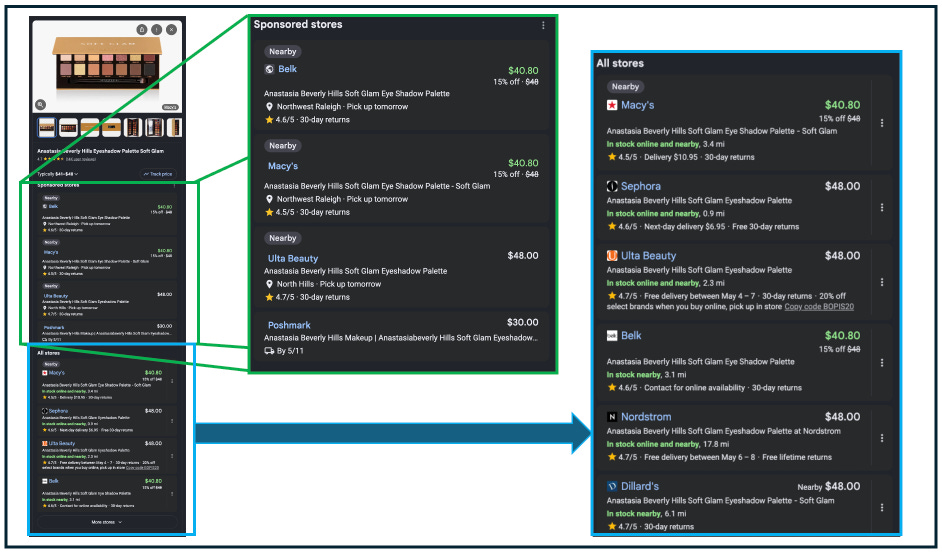
In this example, we did a search for a popular beauty product - a makeup palette and clicked on one of the items. The offer card is now clearly segmented into two sections:
Sponsored stores - In this example (super-sized in the middle) there are 4 stores (Belk, Macy’s, Ulta, Poshmark) that are paying to be sponsored and featured above the..
All stores - here we have BOTH the sponsored stores listed again and then non-sponsored. In this example (bolding indicates sponsored): Macy’s, Sephora, Ulta, Belk, Nordstrom, Dillard’s. (Poshmark is in there, cut for brevity).
My guess from the screen shot in the blog post was that there would be only one sponsored store, this is quite a surprise first that there are more than one and second that they are duplicated in the ‘all stores’ - they get both top-billing and ‘re-billing’ again. This is quite a valuable ad unit, it’s not clear how much the merchant’s are paying for it and in what format (CPM/CPC/?)
Leak 2: Google moves UCP-powered Agentic Commerce checkout to ‘main Google’! 🤯
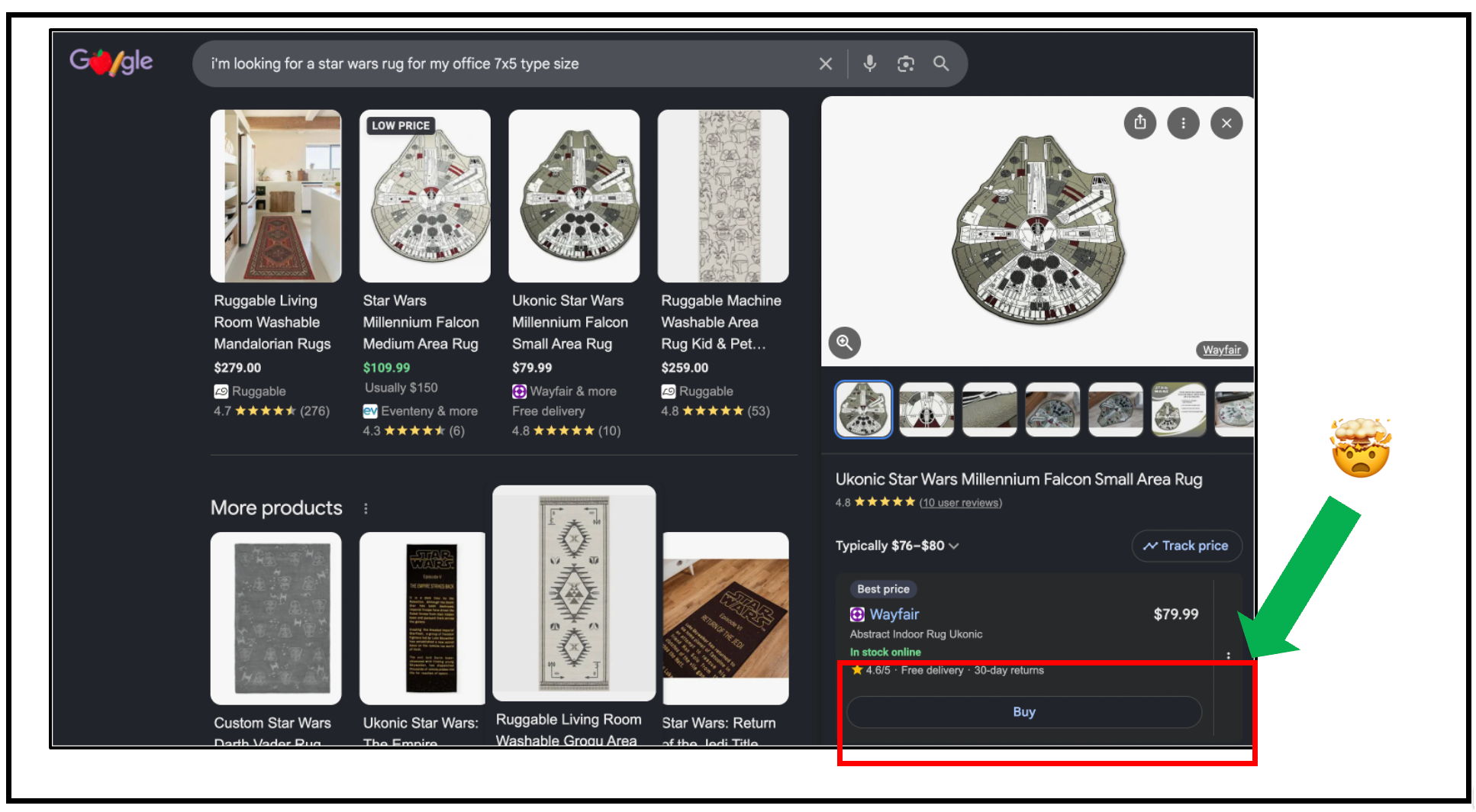
This one is wild! Previously, the UCP product search experience live in ‘AI Mode’, not Gemini mode or what I call core or traditional Google mode. In core Google mode, there was the traditional Google shopping experience.
Now somewhat reliably across devices, logged in, not logged in, we are seeing the AI mode UCP-powered shopping experience show up for core google.
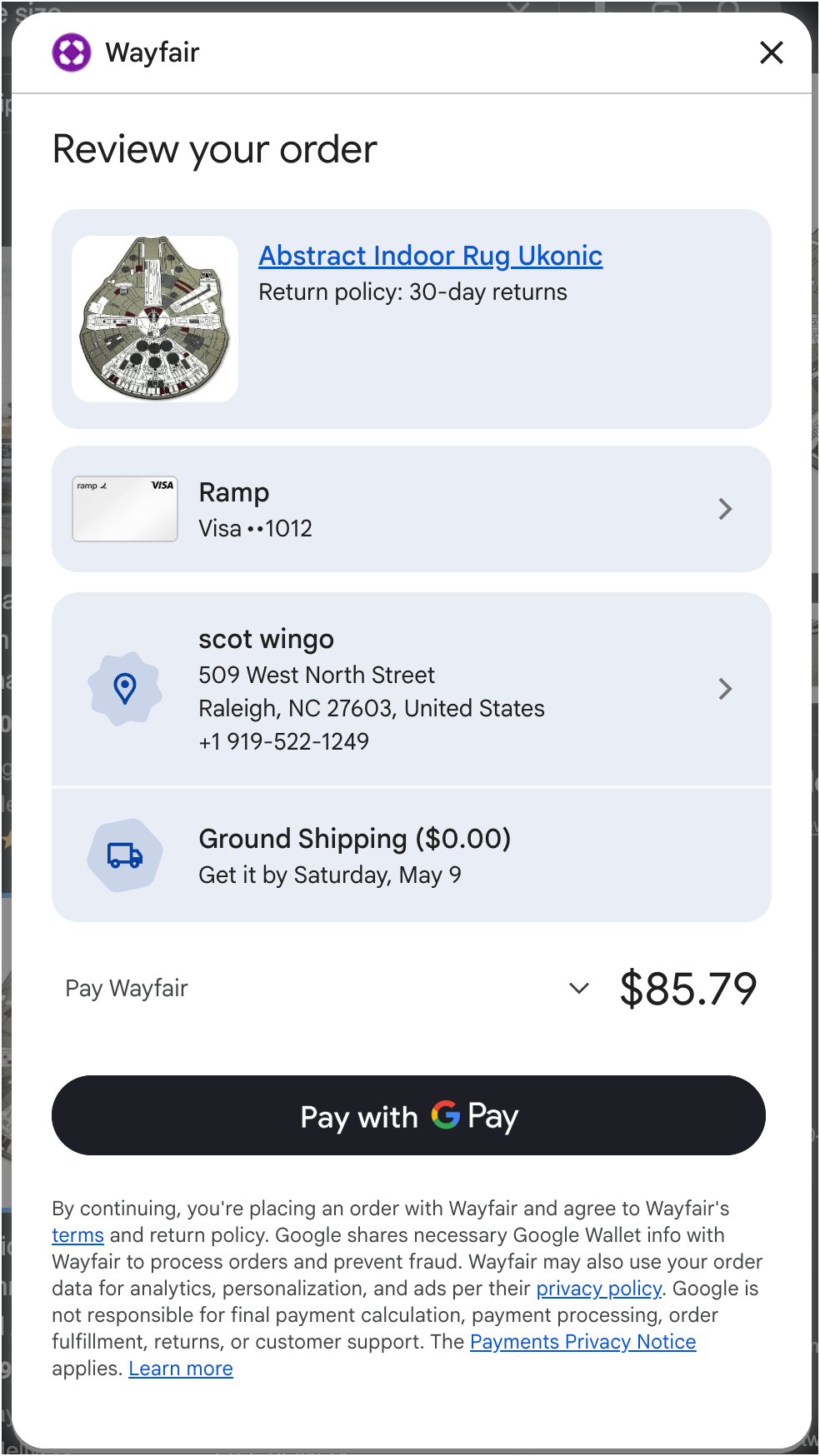
In the example above, I’m looking for a Star Wars rug and here we see the Wayfair listing has a fully functional UCP Buy button activated. Example:
Leak 3: Rufus: RAIOs→ Rufus AI Overviews
This one is thanks to our super-sleuth Joe. For certain ‘vague’ searches in the core Amazon search engine, they are now showing what looks relatively similar to a Google AI Overview - or what we’re calling Rufus AI Overviews. Here’s a screen shot and a video of how it appears→
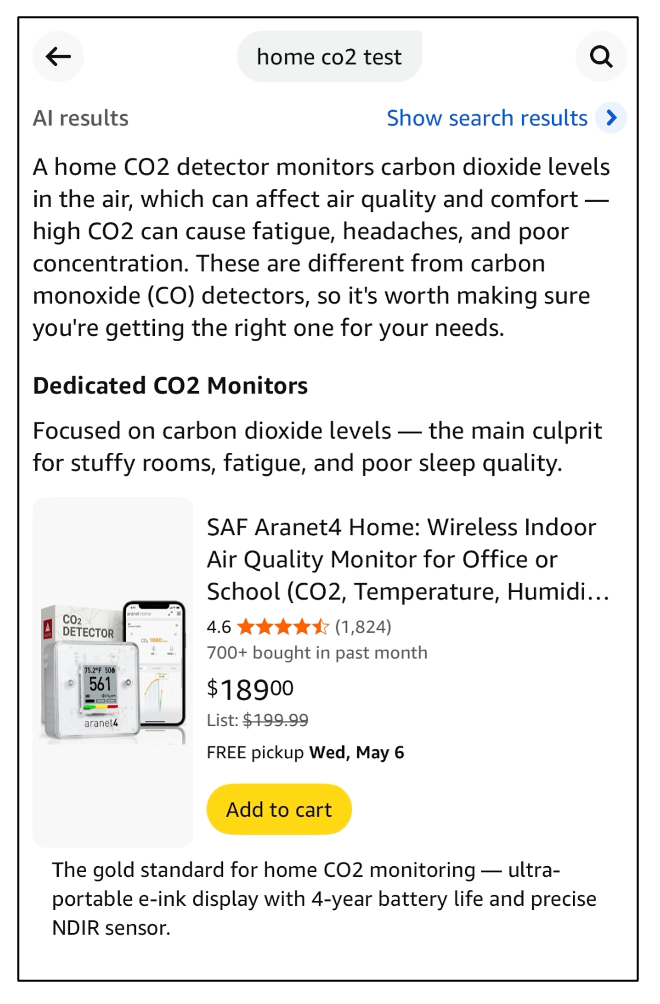
Note that it is clearly labeled: “AI results’ and it has a SKU that is surfaced. Up in the top left there’s also what we call an ‘escape hatch’ back to the OG experience. My guess is they are now using an AI to example inputs into the search box and starting to route them to different tools - ‘trad search results’ is tool 1 and now we have tool 2: “AI results” that seems to receive search terms that are ‘largely information or vague’ requiring more context.
Here’s a video for how they show up:
Leak 4: Rufus: Skip search go directly to Rufus
We discovered this one with a happy accident. I was entering a prompt in rufus and the focus had changed to the search when I wasn’t watching. The result - a long prompt resulted in the search box ‘auto routing’ (the third tool?) the search term (which was an accidental prompt) to Rufus→
The short video is the best way to see this one in action.
The Theme of These Leaks
Leaks 2, 3 and 4 share a common theme I’ve been wondering about. Here’s the logic path:
Both Google and Amazon on their quarterly earnings calls in Q4 and Q1 have talked about the high conversion rates of Gemini and Rufus, later in this report we’ll have some third-party data that supports this.
Therefore, if you have a better experience than the old one, wouldn’t you want to at least test or start moving more significant percentages of your traffic to that new upgraded experience?
EVERYTHING in our world rotates around the holiday selling season. Therefore the best time to test the theory is in the relatively slower May/June/July and even August time before we ramp into Q4.
I believe these leaks, are testing this theme. If you’re Google and Amazon you want to start learning about what happens when you pour hundreds of millions instead of single/double-digit millions and even into the billions of queries into these newer systems. Questions they would want to answer:
Do they higher conversions and economics continue with scale
Do they systems scale well, or do they get more expensive and slow with massive scale?
How do you run some tests that prove without a show of a doubt the causality of the lift. For example, was it self-selecting higher intent shoppers that caused the higher conversion or via random sampling - where they don’t have the choice - A and B have the same dynamics?
We’ll know if these are going well if/when we see a big move toward Rufus and AI Mode/UCP taking increasing percentages of traffic heading into Holiday 26.
Speaking of Rufus: Fresh Sensor Tower Data
In Feb we had Retailgentic friend Ian Simpson from Sensor Tower on the pod and he introduced their fresh Holiday 25 data here:

Late last week Sensor Tower dropped more data here. Two charts tell the story:
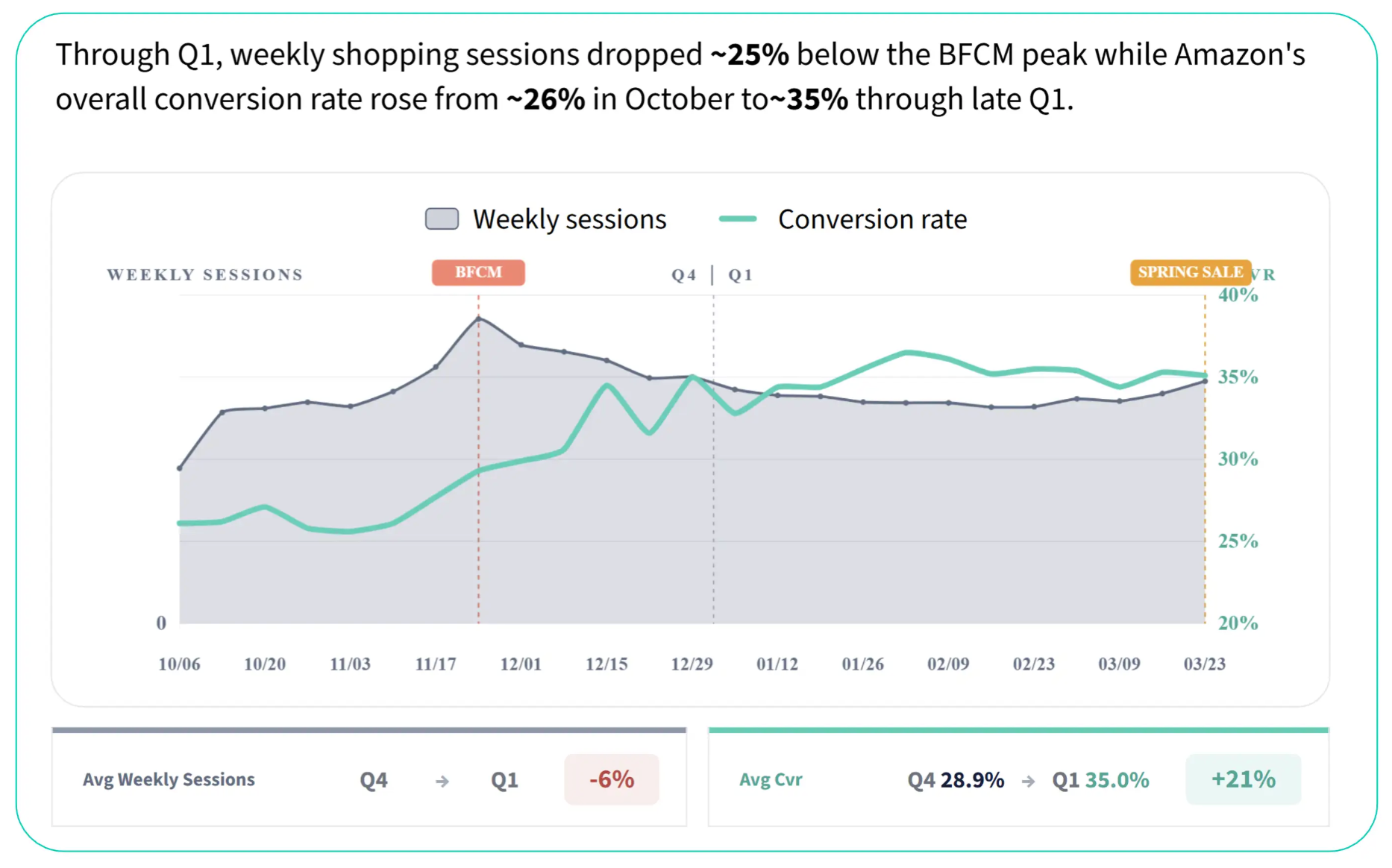
Here we now can see two quarters worth of data. And what’s super interesting is, as you’d expect with extreme seasonality the volume of sessions has dropped from peak (25%), but counter-intuitively you are seeing the conversion rate LIFT from that period from 26^ to 35%. Historically conversion rates peak during peak holiday season and then back off significantly more than traffic declines because there is less urgency outside of holiday.
Over that 6 month period of time we’ve been cataloging here on Retailgentic the massive improvements and features Amazon has been rolling out relentlessly in Rufus. There’s obvious ones (like new user interface features) and this indicates less obvious changes- the data quality, speed and algorithm of Rufus has to be improving at the same time to generate these counter-cyclical results.
Finally, Sensor Tower revealed this data:
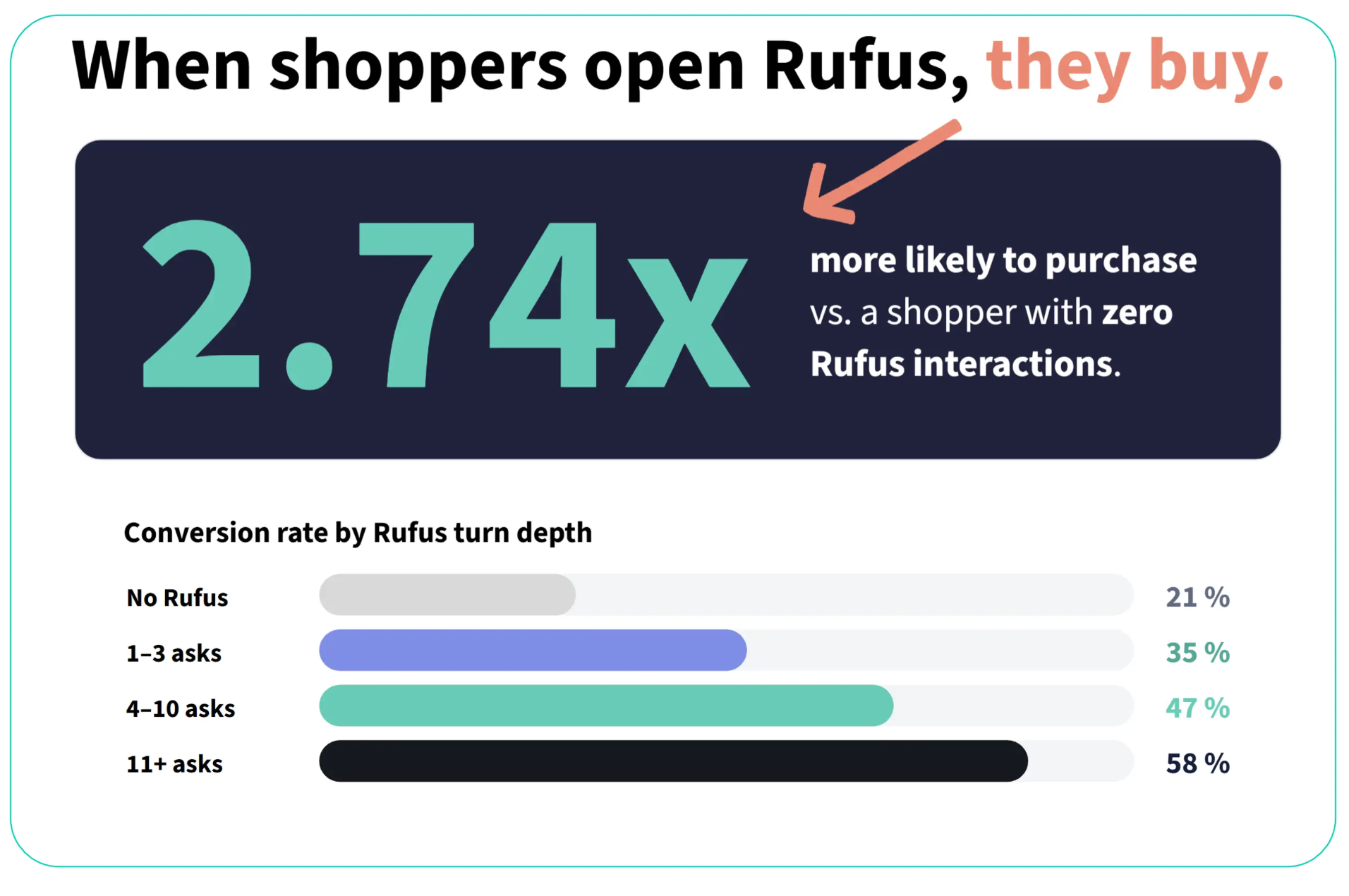
Rufus shoppers are 2.74X more likely to purchase vs. a shopper without Rufus interactions. As mentioned in the leak section, if this stat is true and you’re amazon and GMV is the core driver of your economic engine - you want more more more traffic going through Rufus and if it holds, all of it. We just don’t see conversion rate bumps like this in ecommerce. Big companies invest millions for .5% in their search engines. This equates to 247% increase in conversion rates. At Amazon’s scale, if this holds and if the causality is the Rufus experience, this feature alone could double Amazon’s GMV. That’s two big “IFs” which I think is what they are likely testing with Leaks 3 and 4.
SimilarWeb AI Ads Report
Keeping on this theme of interesting new ‘observed data’ reports, SimilarWeb came out with detailed analysis of ad performance across ChatGPT, Gemini and Google AI Overviews. It’s a great report and pretty dense. My TL;DR, these new ads are nascent and already showing signs they are more performant than traditional search. Once they are optimized on the RLAIF exponential feedback loop, by Holiday 2026, we could also see Agentic Ads scale up as well as search changes.

Anthropic Releases Detailed Claude Observed Usage Data
If you recall, OpenAI released some usage data back in October of 25 and we had OpenAI Chief Economist, Ronnie Chatterji on the pod to discuss:

At that moment in time, it was disclosed that ChatGPT has 2% of prompts related to products/shopping.
In the Anthropic report here. they show that 6% of the conversations fall into ‘consumer’ which anthropic describes as “Product comparison + purchase decisons. Rental decisions. Vehicle purchase and repair.
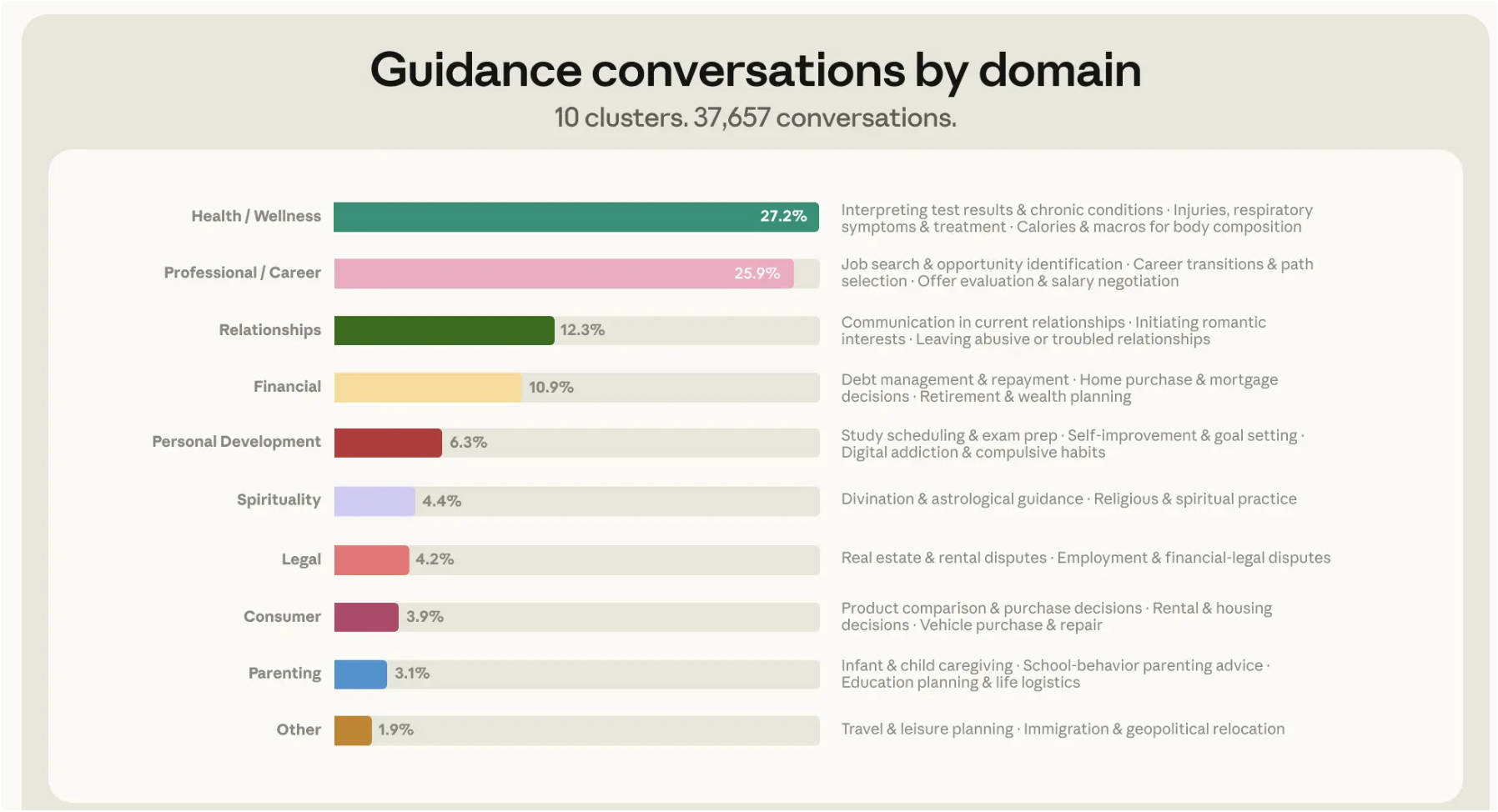
Like the ChatGPT data, when you dig into how this classification, it reveals to me that this is understating the shopping queries. The way it works is they look at the START of the multi-turn conversation. Fo an example, if someone starts talking about say their weight, this classifies as a ‘health/wellness’. But let’s say on turn 3 the answer engine suggests they try some protein bars, a heart/sleep monitor, etc. Products are surfaced and purchased. You guessed it, still Health/Wellness.
The engines take privacy so seriously they are reluctant to point a categorizer at anything but the first convo, but I believe the unintended impact of this is an understating of the Consumer bucket.
They don’t really dig into the data other than this chart. We have a theory at Retailgentic (one of my 2026 predictions) that Anthropic will enter Agentic Commerce. If you look at their jobs area, you’ll see they have three vertical teams.
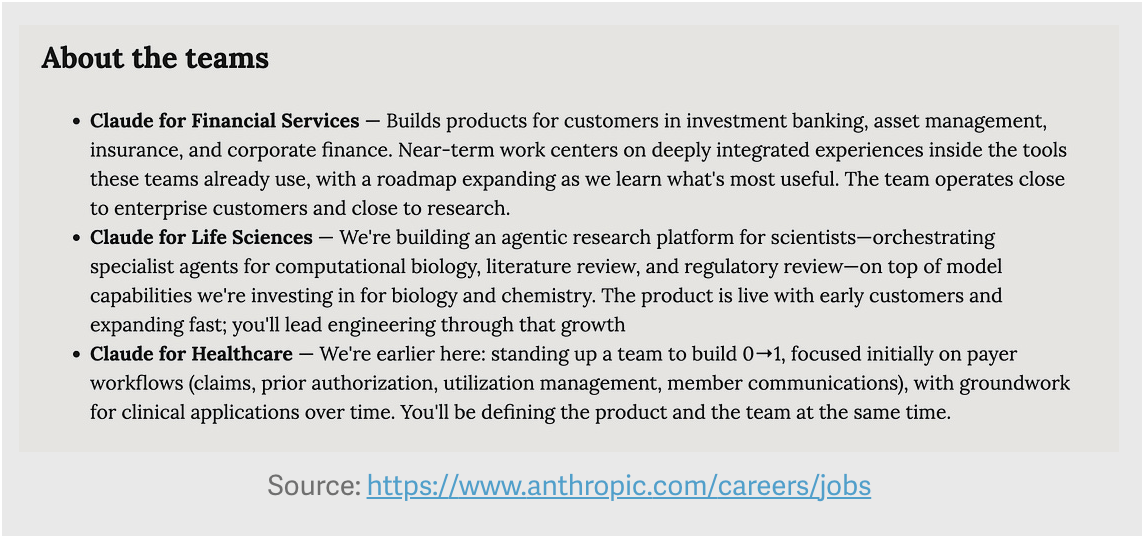
You’ll note that the number 1 category (Healthcare) now has a team and the number 4 (Financial) has a team. How long before they get to number 6? Could they already be there and just not transparent about it? If they are going to do something, we’ll see it before Holiday 26.
It’s a Wrap
I realize that’s a LOT to digest in one update, but this is how we’re going in Agentic Commerce - these are the top seven items we wanted to surface because on the surface they may seem tactical, but they point to the bigger strategic direction we’re going to see Agentic Commerce go in the next 2 quarters.