


August did not slow the Agentic Commerce news, so we could all take a rest. Instead It kicked down the door with inter, a wave of fresh consumer surveys, new platform moves and some very spicy predictions about what happens to checkout.
The theme this month that comes through: Discovery (what we call Research → Find) is mainstream, Buy is accelerating and the infrastructure race is officially on and moving across many different paths, protocols and systems. Let’s dig in.
2 EDITORIAL NOTES:
Data statement - Observed data describes measured behavior (from panel data). Stated-preference data describes what surveyed consumers say they do or plan to do. Both are useful, but they answer different questions - we like to triangulate here at Retailgentic - look at all the data, pick out the trends that start to form. We’ll include in our synopsis of stories what type of data we’re talking about.
Vocabulary - We use Agentic Commerce with a ‘big tent’ definition to encapsulate all consumer digital retail influenced through the Research→Find-Buy. We use ‘Answer Engines’ to designate ChatGPT, Gemini, Claude, Grok, CoPilot, etc. We use Retailer Shopper Agents to designate chat bots that live on a retailer’s site like Alexa for Shopping (Amazon AFS), Walmart Sparky, Lowes MyLow, etc.
We have a plethora of news that we consider top-tier for this curation, but they fall into three themes so we’re going to cluster them together:
Theme 1 - The Retail Shopper Agents Strike back - examples of datapoints indicating there is a lot of engagements and wins coming from retailer hosted shopper agents.
Theme 2- A Cornucopia of Consumer behavior trends from lots of different surveys
Theme 3 - Interesting Industry Moves that didn’t rate a big FLASH/BREAKING standalone Retailgentic alert, but still something we think you should have on your radar.
August Trend 1: Retailer Shopper Agents Strike Back
In these pages, we talk mostly about Answer Engines, and if you want to go DEEP on AFS (and soon) Sparky, etc. check out our sister publication Retailplaybook by Andrew Bell.
News-wise, there was a nexus of stories on this topic of shopper agents that I thought you’d find interesting and actionable.
Evercore’s AI survey: shoppers LOVE AFS and they spend more when using it.. Raises PT to $335, stock pops 4% on the call.
Friend-of-Retailgentic, Evercore analyst Mark Mahaney, dropped a major consumer survey focused on Agentic Commerce that’s a dense ~20 pages, chock full of insights.
The core findings are very bullish for Alexa for Shopping, formerly Rufus, which we’re going to call Amazon AFS or just AFS going forward.
66% of respondents are satisfied or very satisfied with how agentic AI affects online shopping (generally)
Only 3% are dissatisfied or very dissatisfied
Then the survey turns to retailer hosted shopping agents and AFS specifically→
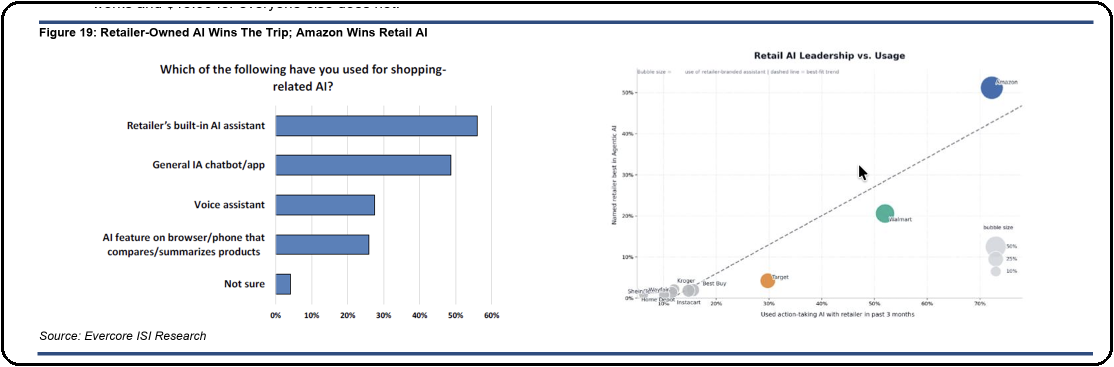
55% of respondents said they use ‘Retailer’s built in AI assistant’ (vs. 48% for ‘General AI ')
Then they turned to AFS specifically:
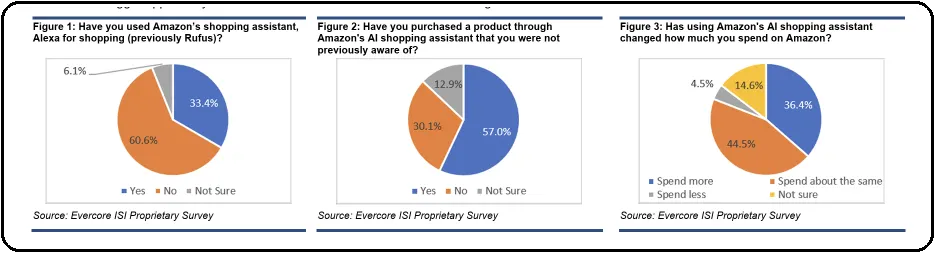
57% say Amazon’s AI shopping assistant helped them purchase a product they were not previous
36.4% say the assistant increased their Amazon spending, while 44.5% say spending stayed about the same
And in the first table you can see how this ranks against Sparky and other Shopper Agents (AFS stands alone in the upper right quadrant for this survey).
Keep that 57% number in your head for this article. AFS is not just compressing a journey that would have happened anyway, AFS is creating incremental product discovery and new demand.
Why is Amazon moving AFS into the center of the experience and it’s eating the ‘old search’? Follow the incentives, they must be seeing the same lift in their own transactional data.
Walmart’s Earnings Highlight: John Ferner 🫶 Sparky 😃 (and so do Customers!)
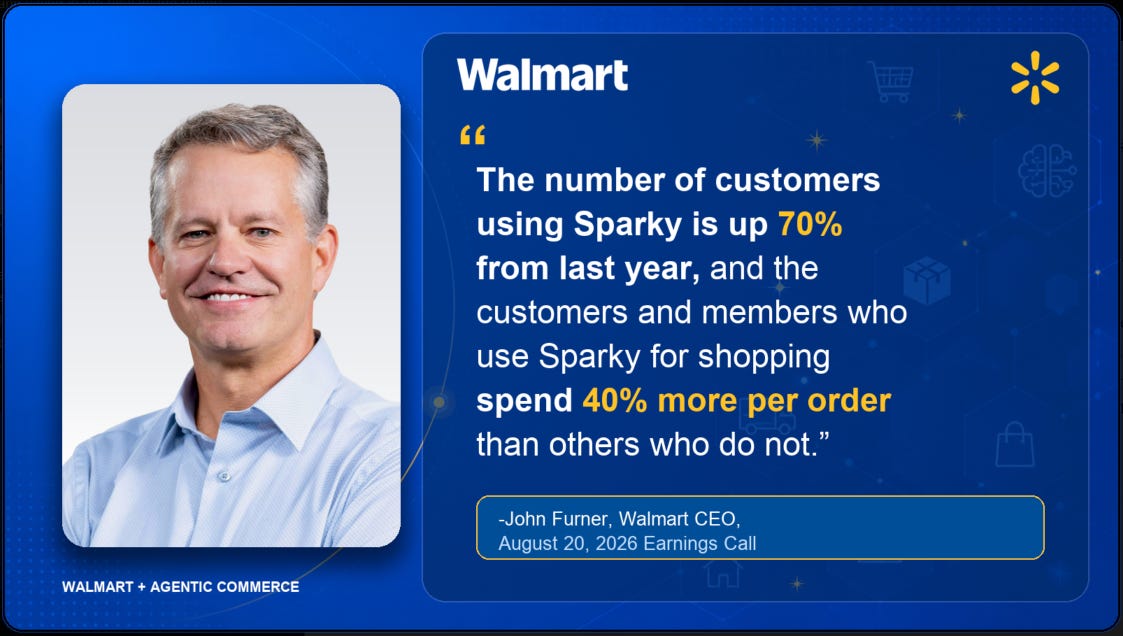
Amazon’s not alone in their love of the shopper agent, both John Furner, Walmart’s CEO and Target’s CEO, Michael Fiddelke had positive things to say:
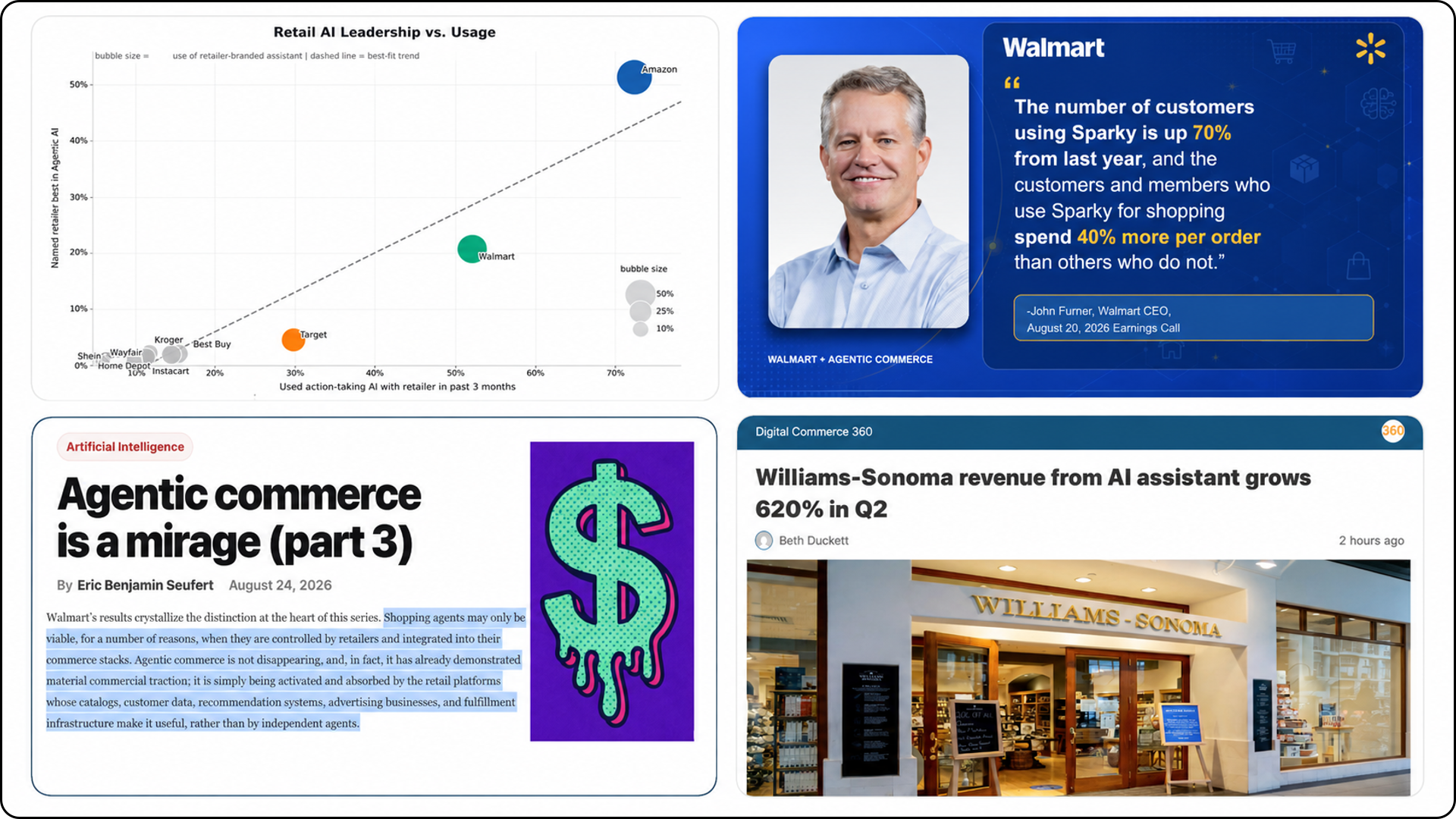
“The number of customers using Sparky is up 70% from last year, and the customer s and members who you use Sparky for shopping spend 40% more per order than others who do not.” - John Furner, Walmart CEO
Note, John did not talk about the causality, but we get that from Evercore where the consumers in the survey explicitly tell us they spent more and/or found a new product they hadn’t considered using AFS. That points to perhaps Sparky seeing the same here.
“While still small in total today, as more consumers begin to explore the benefits of agentic shopping, Target’s digital traffic sourced from external AI platforms is growing more than 3.5x the industry as compared to a year ago.” - Michael Fiddelke, Target CEO
Michael also announced they have a new CAIO who is going to up their AI game. They need it, look at where Target lands on the
Eric Seufert, Mr. “Agentic Commerce is a Mirage”, is now Mr. “Ummm, yeah, I like 😍 LOVE 😍Agentic Commerce when it’s Shopper Agents.”
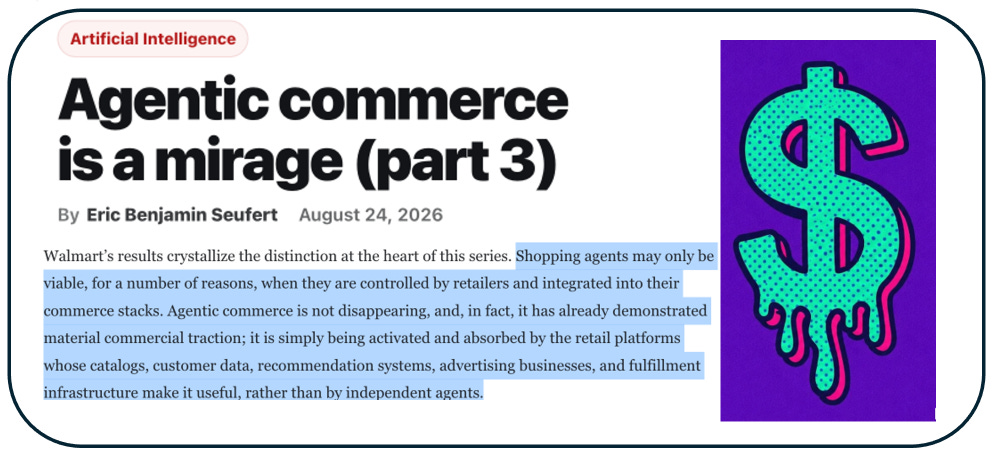
Eric Seufert publishes the very popular “Mobile Dev Memo”, who is closely followed by Wall St, Stratechery’s Ben Thompson and pretty much everyone (I get a lot of ‘what’s your take on Seufert’s agentic commerce mirage piece’ comments from that group) outside of retail. Wellllll…. since his March ‘26 intro of this concept, he’s softened it a bit with every update and today, well, he hates answer engines and Agentic Commerce, BUT, he love love loves shopper agents (Sparky and AFS specifically). See highlighted area (highlight mine).
→ Agentic Commerce is a mirage (part 3) on Mobile Dev Memo (Sub required)
But he’s still hedging: “may only be viable”. Come on Eric, you have one foot on the Agentic Commerce Maximalist bus, come on aboard. Maybe by ‘update 4’ he’ll be there. Eric’s going to come up later, remember this one too!

Next stops: Andrew Lipsman, Sarah Marzano and Jason Del Rey 🚀
Williams-Sonoma 🫒: Hey Walmart and Target, hold our 🍺 (or I guess 🍷+🧀)
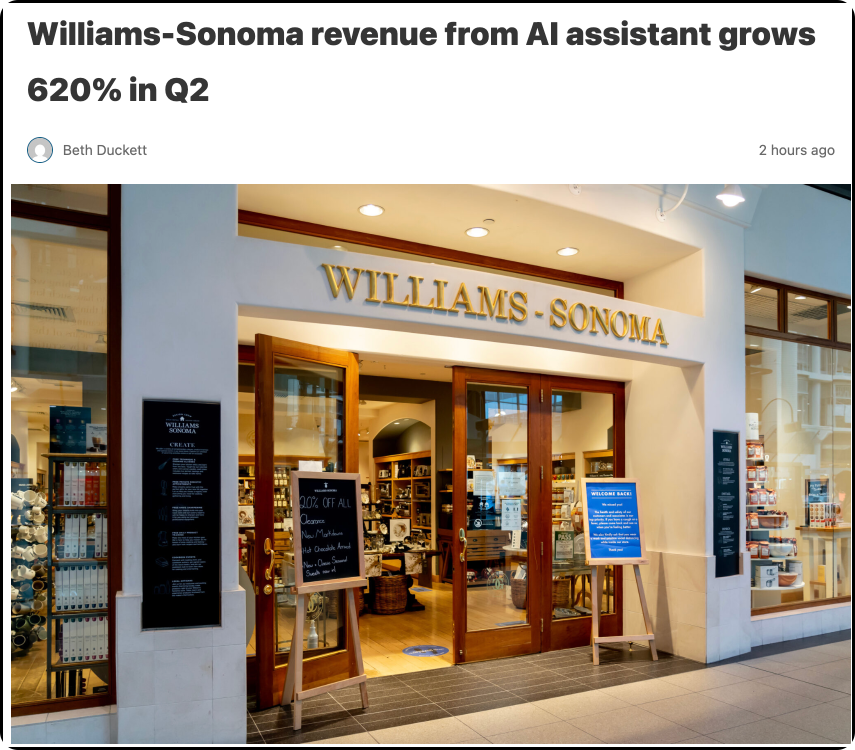
If you’ve been reading Retailgentic for a while, it won’t surprise you to see mass-market retailers AFS and Sparky in these pages, but what surprised me was specialty retailer Williams-Sonoma throwing their hat in the Agentic Commerce ring from their earnings call where they gave an update on their
What caught my attention: Williams-Sonoma says revenue associated with its Olive AI shopping assistant grew 620% since the start of the year.
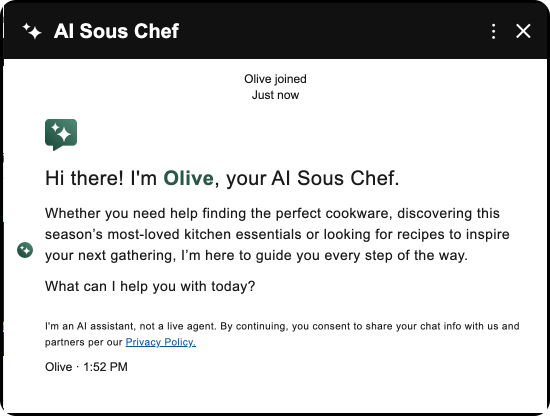
Olive has joined the chat (and they are a Sous Chef!)
And that’s not the only number. Engagement with Olive grew 700%, shoppers who use it convert at 3x the rate of other visitors and personalized visits now generate roughly 9x the revenue of an average visit.
Olive engagement: +700%
Revenue associated with Olive: +620%
Conversion rate for Olive users: 3x other shoppers
Personalized visit revenue: roughly 9x an average visit
Pottery Barn’s Otto assistant (looks exactly like Olive - maybe they are cousins?) resolves more than 70% of engagements without an employee handoff
→ Digital Commerce 360: Williams-Sonoma revenue from AI assistant grows 620% in Q2
I really like that olive emoji, here it is again so this is a 2 🫒 news item! 🍸
Summary: Retailer Shopper Agents Strike Back
The big picture from these August news hits: Agentic Commerce across Research → Find → Buy is showing up not just in discovery, but it’s hitting mass-market AND specialty retailer P&Ls→
Consumer use of shopper agents is growing rapidly
Shopper agents are driving incremental sales
Shopper agents save money too by getting shoppers answers to their questions faster so the human associates can focus on the higher-level questions.
Those trends that are becoming very clear now, are the highlight of August’s news for me.
If I were a retailer, I would implement a parallel path here for Holiday 26:
Path 1 - Prepare your catalog for consumption both externally and internally.
Path 2 - Get a high-quality shopper agent live ASAP.
August Trend 2: A Veritable Cornucopia of Consumer Surveys
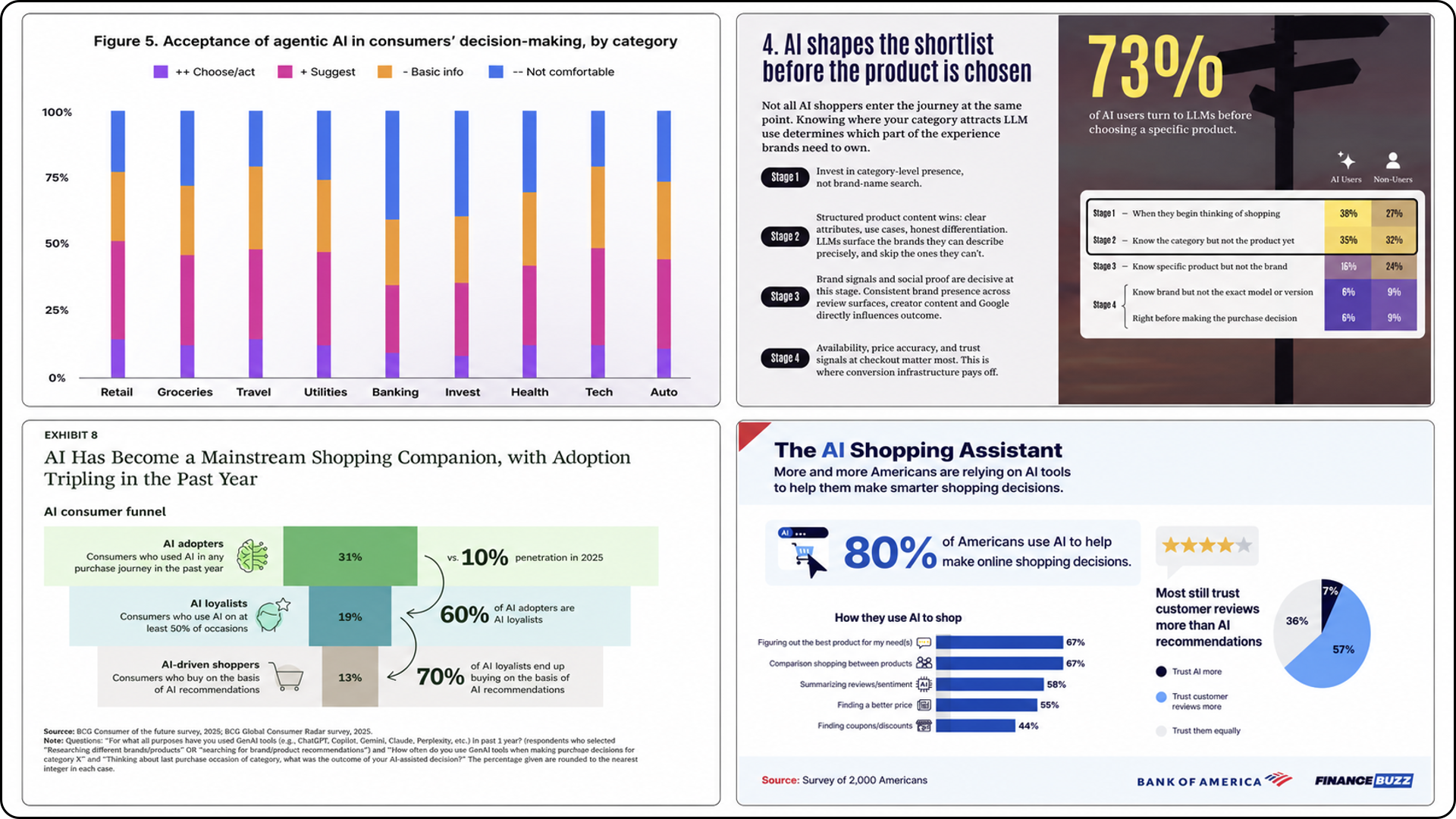
At this point, you’re probably thinking: “Wow, that’s pretty compelling data for retailer, bummer it’s only for shopper agents, and we’re not seeing ANYTHING like that for answer engines. Gosh, if only Retailgentic had some data around THAT…”
Well, funny you ask that I have good news dear reader….
BCG: AI Expands the Brand Consideration Set
STATED PREFERENCE PLUS OBSERVED BRAND ANALYSIS | 13,000+ CONSUMERS, 12 MARKETS, 1,000+ BRANDS
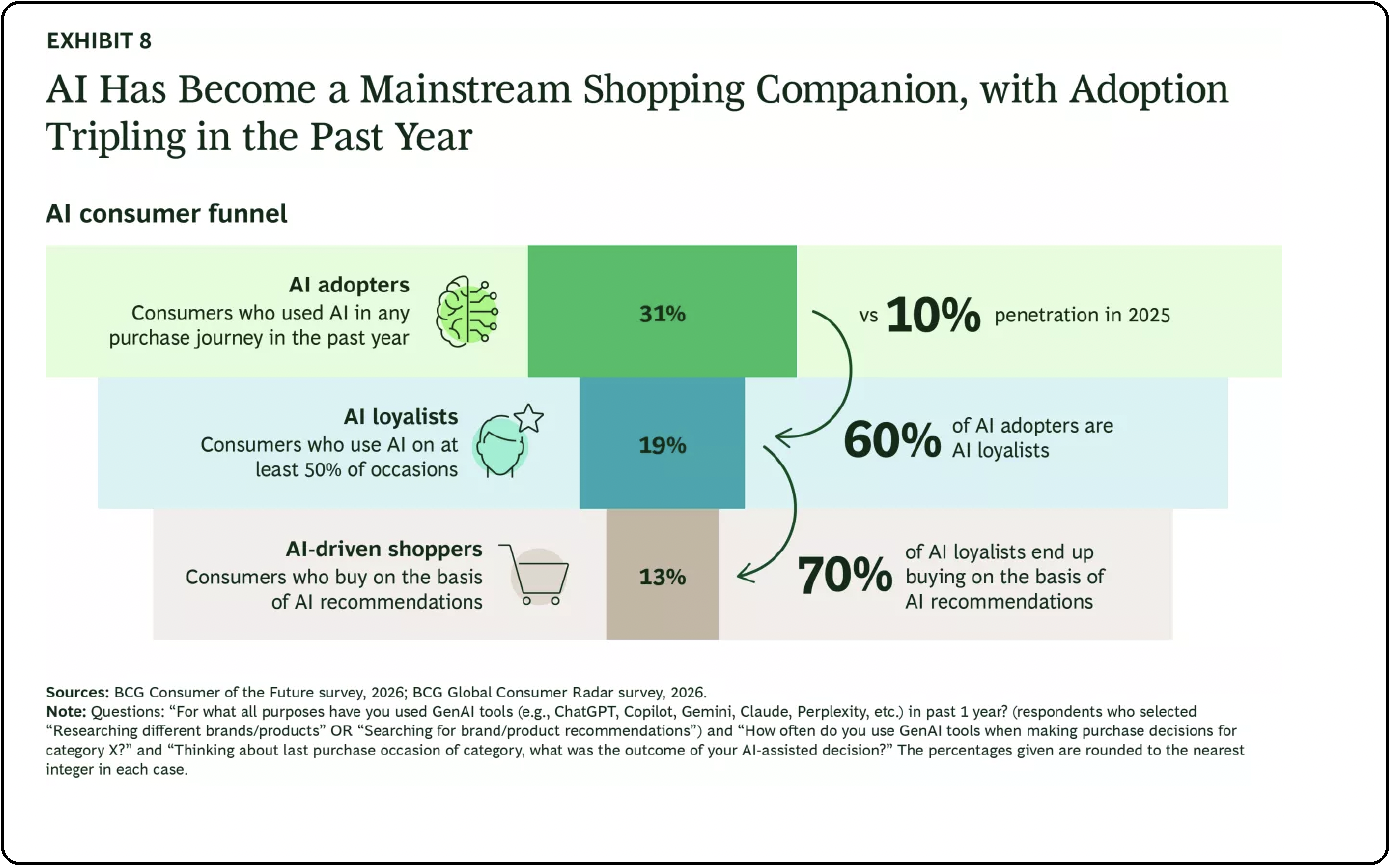
BCG (Boston Consulting Group) released a big global consumer report and the AI section is 👨🍳😘. The TL;DR: 31% of consumers now use AI somewhere in the purchase journey, 19% are AI loyalists and 70% of those loyalists ultimately buy the products AI recommends.
BUT….. the most important finding is about incremental demand.
BCG says: AI introduces shoppers to brands they otherwise would not have considered in 63% of AI-assisted journeys.
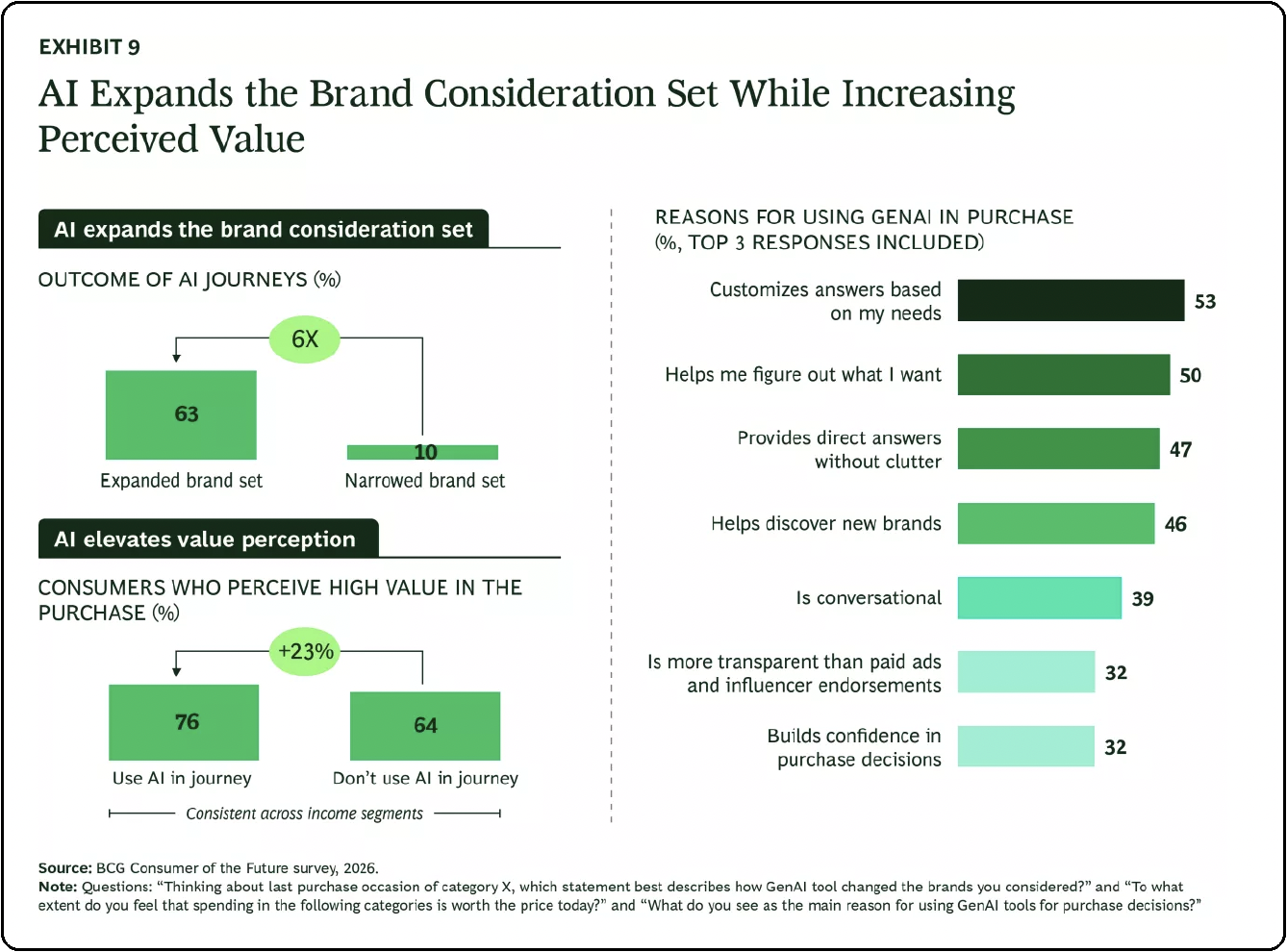
This is the opposite of the ‘Agentic Commerce creates a race to the bottom’ argument. Agentic Commerce expands the consideration set and increases perceived value because it explains why a product fits the shopper’s needs. This data dovetails very nicely with the Mahaney Evercore report.
Here’s what this means for retailers →
Agentic Commerce is becoming one of the fastest-growing sources of trust
The answer engine increasingly builds the shortlist before the shopper reaches a brand site
Clear product data along with evidence and a verifiable value proposition matter more than brand advertising
Brands need to measure whether Agentic Commerce answer engines recommends them, to whom and why and when in the funnel.
This 100% validates our theory that you need to be doing GEO for top-of-funnel/sentiment side of things, but also ACO to make sure in the 3-4 turn discussions around product features, your products are still in the game.
Need more data on that, well, let’s shoot from Boston to Seattle for that…
→ BCG: Five Consumer Behavior Shifts Reshaping Growth in 2026
Microsoft Says Product Data Is Your Most Valuable Marketing Asset
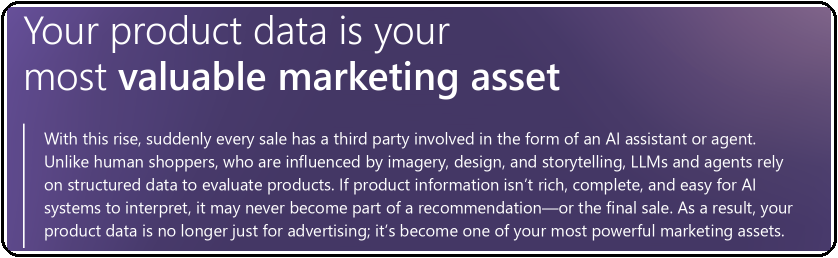
Microsoft’s advertising group (CoPilot/Bing) published a practical guide for AI shopping, and the advice is almost exactly the ACO playbook:
·Upgrade and enrich your product catalog
Implement UCP
Upload your complete feed to Copilot Merchant Center
Use Microsoft Clarity to understand behavior (this is their Google Analytics plus more competitor)
Microsoft may be a Tier 2 search engine today, but it is a Tier 1 enterprise distribution machine. When Microsoft tells retailers that product data has become a marketing asset, the idea has officially moved from an early-adopter conversation into the enterprise mainstream.
→ Microsoft: Prepare for the Age of AI Shopping
Narvar Finds a Huge Holiday AI Readiness Gap
STATED PREFERENCE | N=1,348 US CONSUMERS AND N=100 RETAIL DECISION-MAKERS

Holiday 2026 is shaping up to be the first truly agentic holiday, and Narvar’s fresh survey shows consumers are moving faster than retailers.
65% of consumers plan to use AI for at least one part of holiday shopping
Only 8% of retailers are very confident in their ability to use AI to improve the shopping experience
43% plan to use AI for gift discovery
33% plan to compare products and summarize reviews
29% plan to use AI for budgeting and spend planning
15% plan to use AI after checkout for tracking and return reminders
The 65% versus 8% gap is the big story. Consumers are bringing agentic commece into the journey whether retailers are ready or not.
→ Narvar: 2026 Holiday Shopping Report
Morgan Stanley Adds Another Big Number to the 2030 Consensus
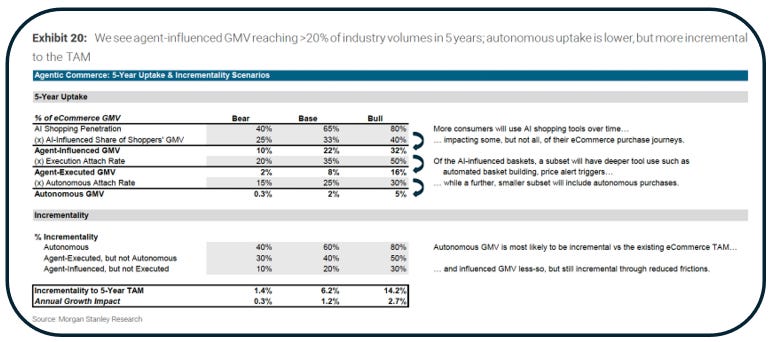
Morgan Stanley now says agentic commerce could expand the total ecommerce market by roughly 6% and materially influence about 20% of global ecommerce volume.
Their base market goes from nearly $5 trillion today to about $7 trillion within five years, with annual growth accelerating from roughly 7% to 9%. In their updated models, Agentic Commerce isn’t just taking share from ecommerce, it’s growing the pie.
That 20% influence number keeps showing up. Morgan Stanley, Bain, PayPal and Juniper all use different paths, but they continue landing in the same 15% to 25% strike zone by 2030.
Consensus estimates are formed, now the debate is moving from ‘if’ to “who is going to capture all this?”
→ Morgan Stanley: Is Agentic Commerce AI’s Next Catalyst?
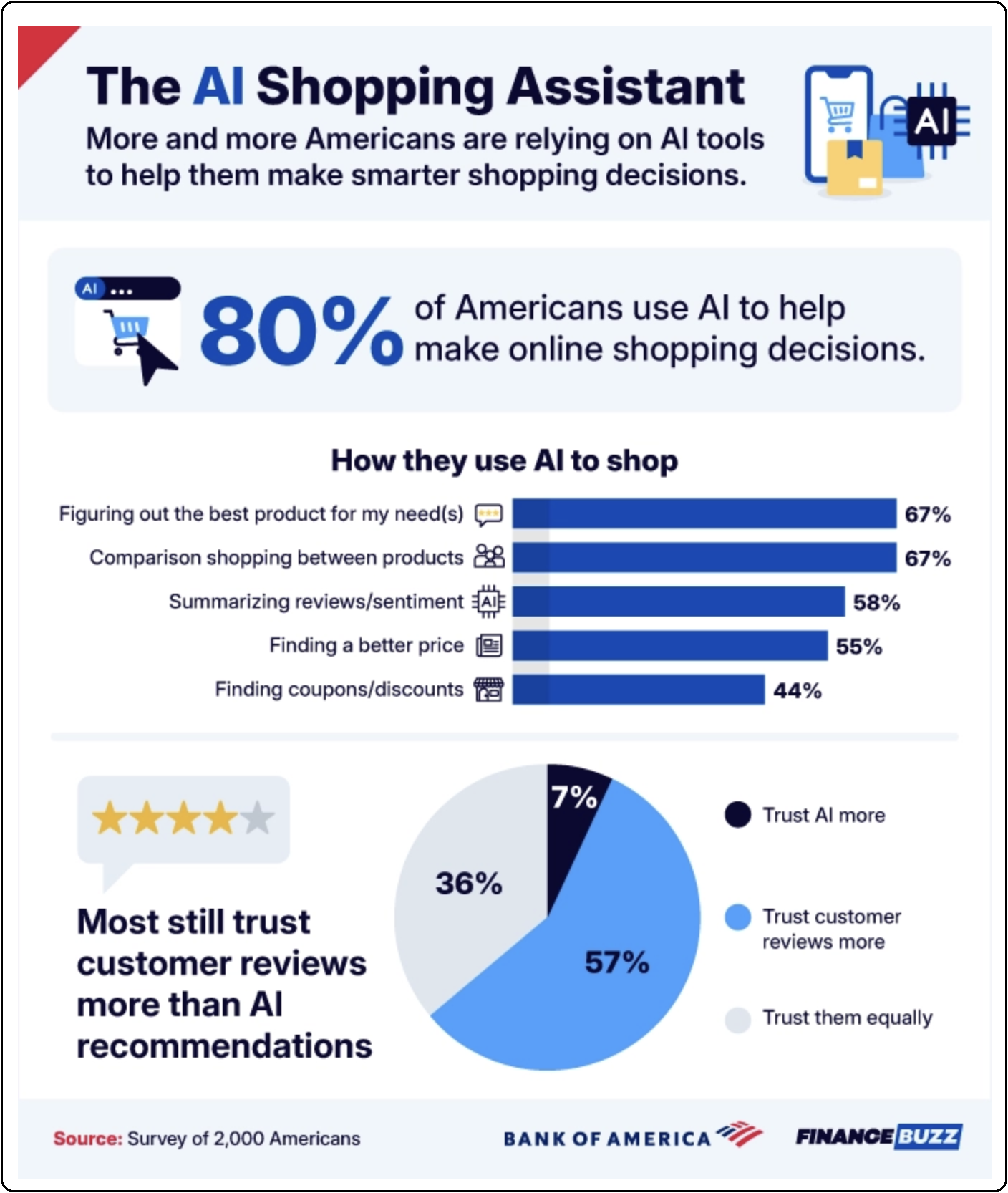
FinanceBuzz Says 80% of Americans Use AI to Help Shop
STATED PREFERENCE | N=2,000 US ADULTS VIA PROLIFIC
FinanceBuzz and Bank of America surveyed 2,000 Americans and found that AI has already become a mainstream shopping tool:
80% have used AI to help make an online shopping decision
67% use it to find the best product for a need
67% use it to compare shopping options
58% use it to summarize reviews or sentiment
55% use it to find a better price
Trust still has a gap. Only 7% trust AI more than customer reviews, 36% trust them equally and 57% still trust reviews more.
That is not a contradiction. Consumers can use AI heavily without handing it complete authority.
Koddi Finds Consumers Want a Co-Pilot, Not Full Autopilot (yeah, which is what we’ve been saying 🤦♂️)
STATED PREFERENCE | N=750 CONSUMERS AND N=150 COMMERCE-MEDIA PROFESSIONALS
Koddi’s 57-page State of Agentic Commerce Media report is one of the first rational looks at the intersection of agents and commerce media.
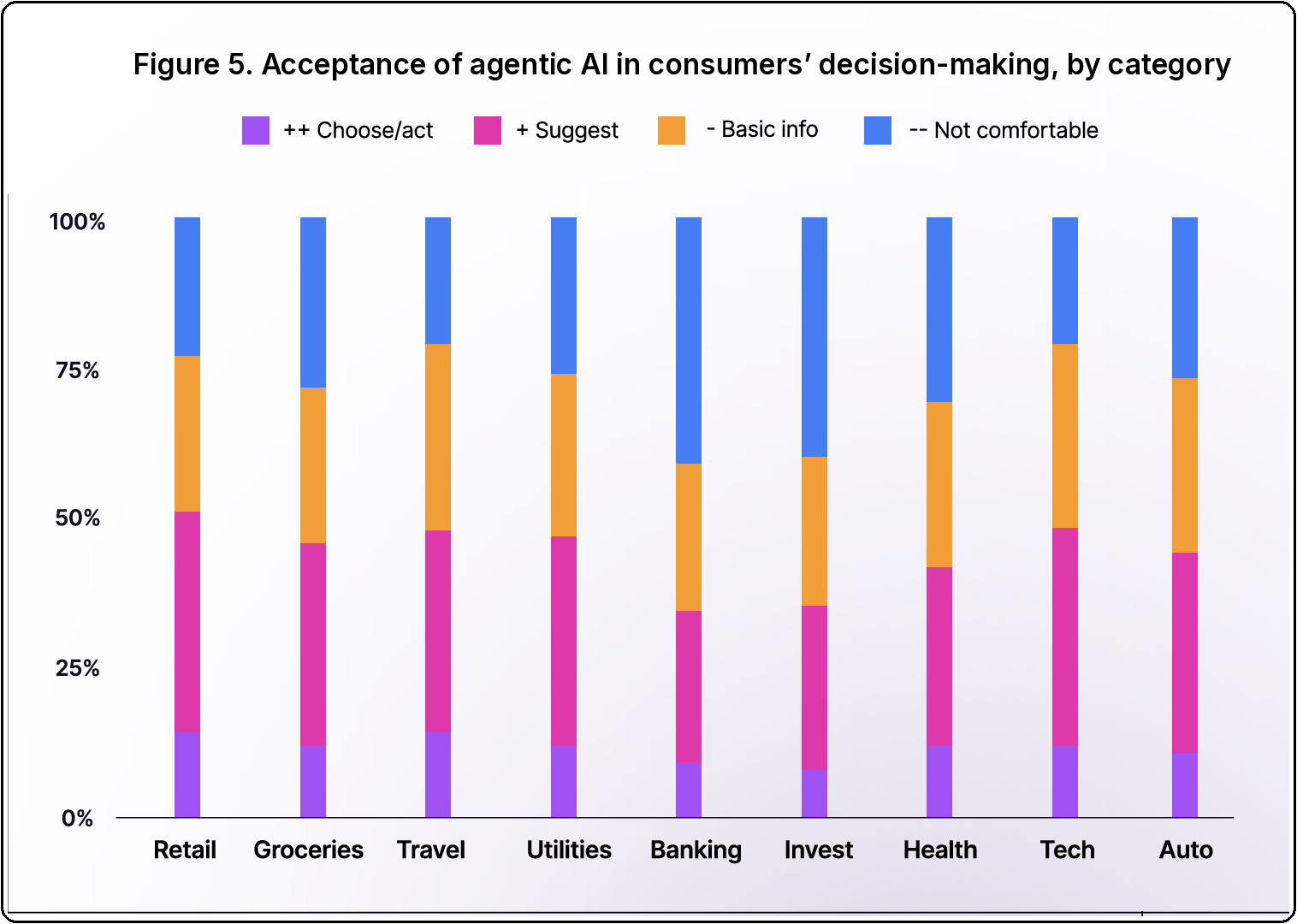
The consumer message is permissioned delegation: 72% want AI to be a co-pilot rather than full autopilot, and 75% of US consumers are comfortable with AI helping choose what to buy or book. Only 32% have ever let a service automatically complete a purchase beyond a simple subscription.
The industry side is already moving. Nearly two-thirds of surveyed advertisers expect to invest between $50,000 and $999,000 in agentic commerce products over the next year, while 92% plan to spend on agent-specific measurement and diagnostics.
Commerce media is moving from visibility to selection. The new questions are not just ‘did the shopper see the ad?’ but ‘was the brand eligible, trusted, recommended, shortlisted and chosen?’
→ Koddi: The State of Agentic Commerce Media
Croud Shows AI Building the Shortlist Before the Product Is Chosen
STATED PREFERENCE | N=2000 CONSUMERS
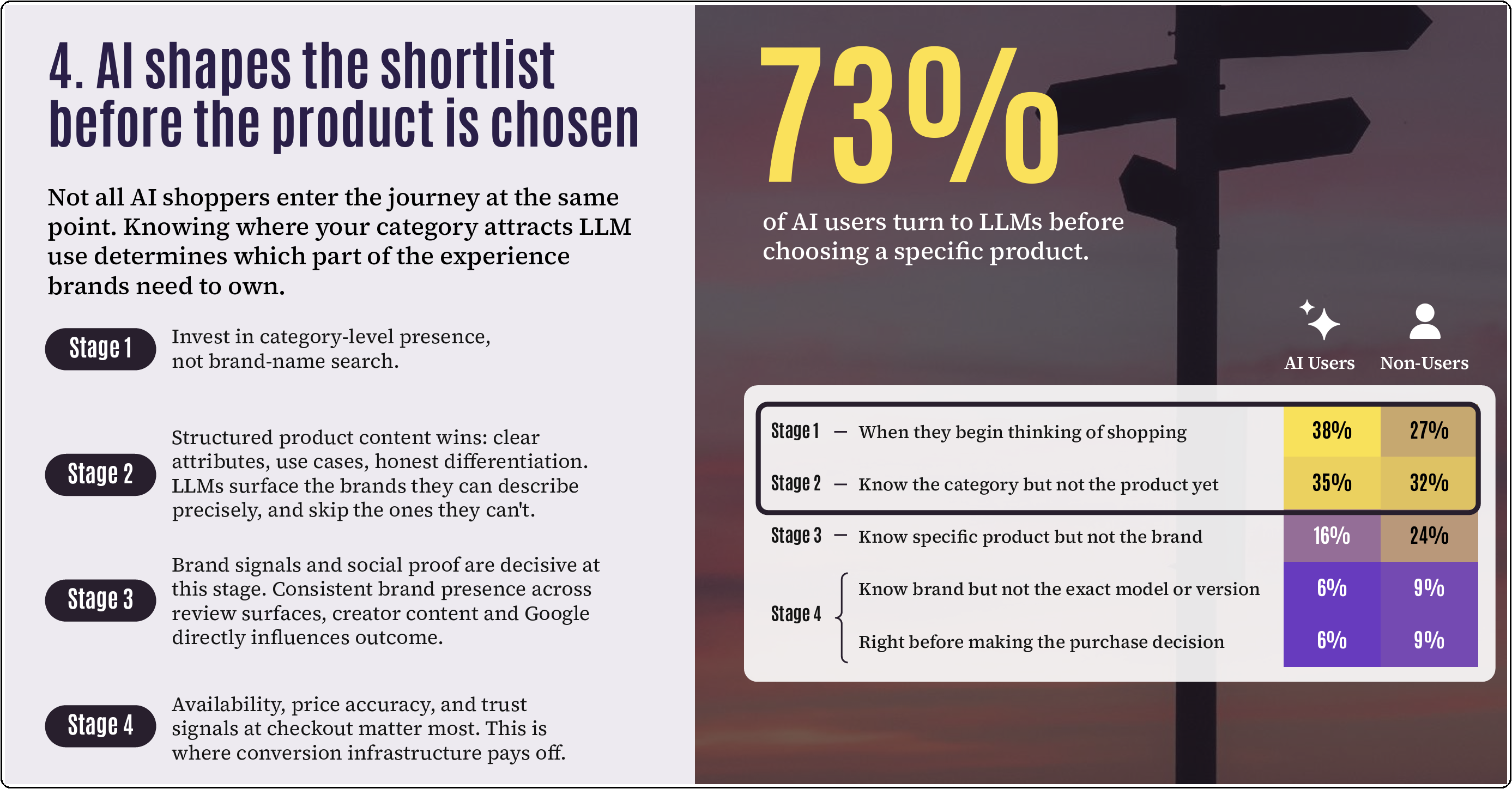
Croud’s Validation Economy report has a clean way to think about the new journey: AI shapes the shortlist before the product is chosen.
Seventy-three percent of AI users turn to LLMs before choosing a specific product. They are not just searching for a SKU, they are asking by price or deal, need or use case, brand, style and then specific product.
The autonomy data is also moving faster than many people expect:
69% are open to AI buying without approval in at least one category
50% are comfortable with AI purchasing across three or more categories without approval
75% would use instant checkout where AI acts with final approval
This is the bridge between today’s assistant and tomorrow’s agent. Consumers do not flip from zero autonomy to full autonomy all at once, they grant permission by category, task and risk level.
The brands that build for instant checkout today are building the trust and product-data foundation for autonomous purchasing tomorrow.
→ Croud Consumer Index: The Validation Economy
Summary: Cornucopia of Consumer Surveys
The highlights:
Evidence is piling up that Agentic Commerce is incremental to the industry overall (Morgan Stanley and to retailers individually (BCG). Agentic Commerce isn’t a mirage, hallucination or myth, it’s real, the ‘race to zero’ is the fake news.
Trust is growing with consumers and Agentic Commerce
Consumers want a shopping assistant (a shopping GPS is my preferred metaphor), not a ‘hands off the wheel’ solution - this fine. The hallucination crowd will use this data to say that Agentic Commerce is over (because they are the only ones that define it this way).
Structured product data is the foundation for everything (remember, not all enrichment is created equal - details here).
August Trend 3: Interesting Industry Moves
OpenAI and Ads part 1
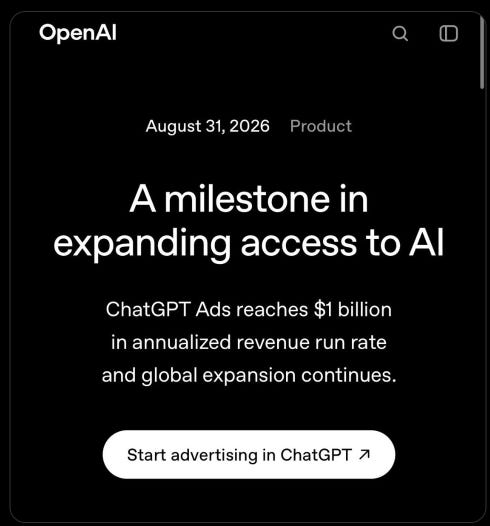
OpenAI announced that their ad platform has crossed $1B after launching only 200 days ago. To put that in perspective, it took Amazon about 5 years (2012-2017) to get there. That’s a good framing for this story, which answers the question…why?
Mr. “Hates Answer Engines and Agentic Commerce…But 🥰 Answer Engines and Ads…”
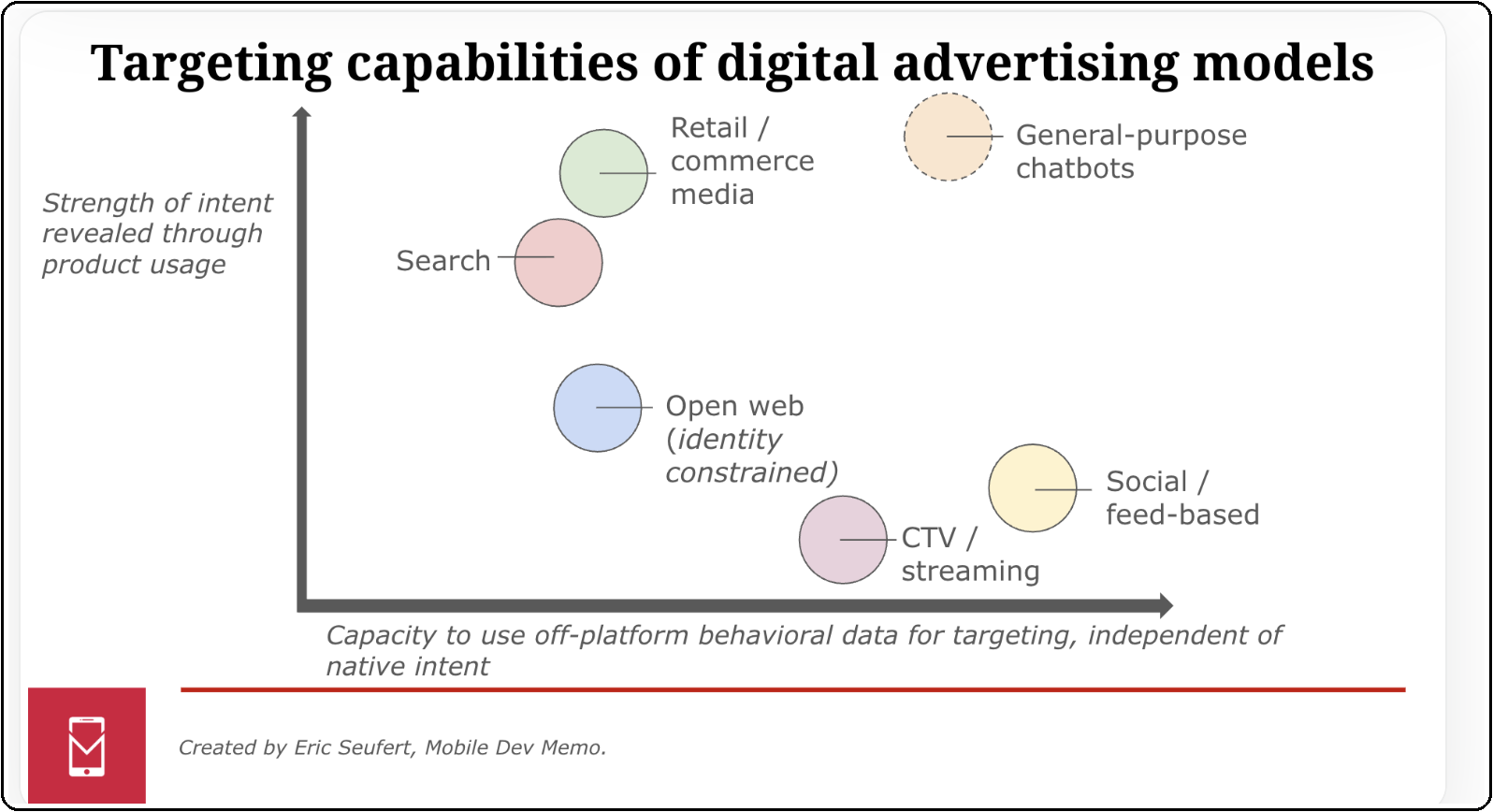
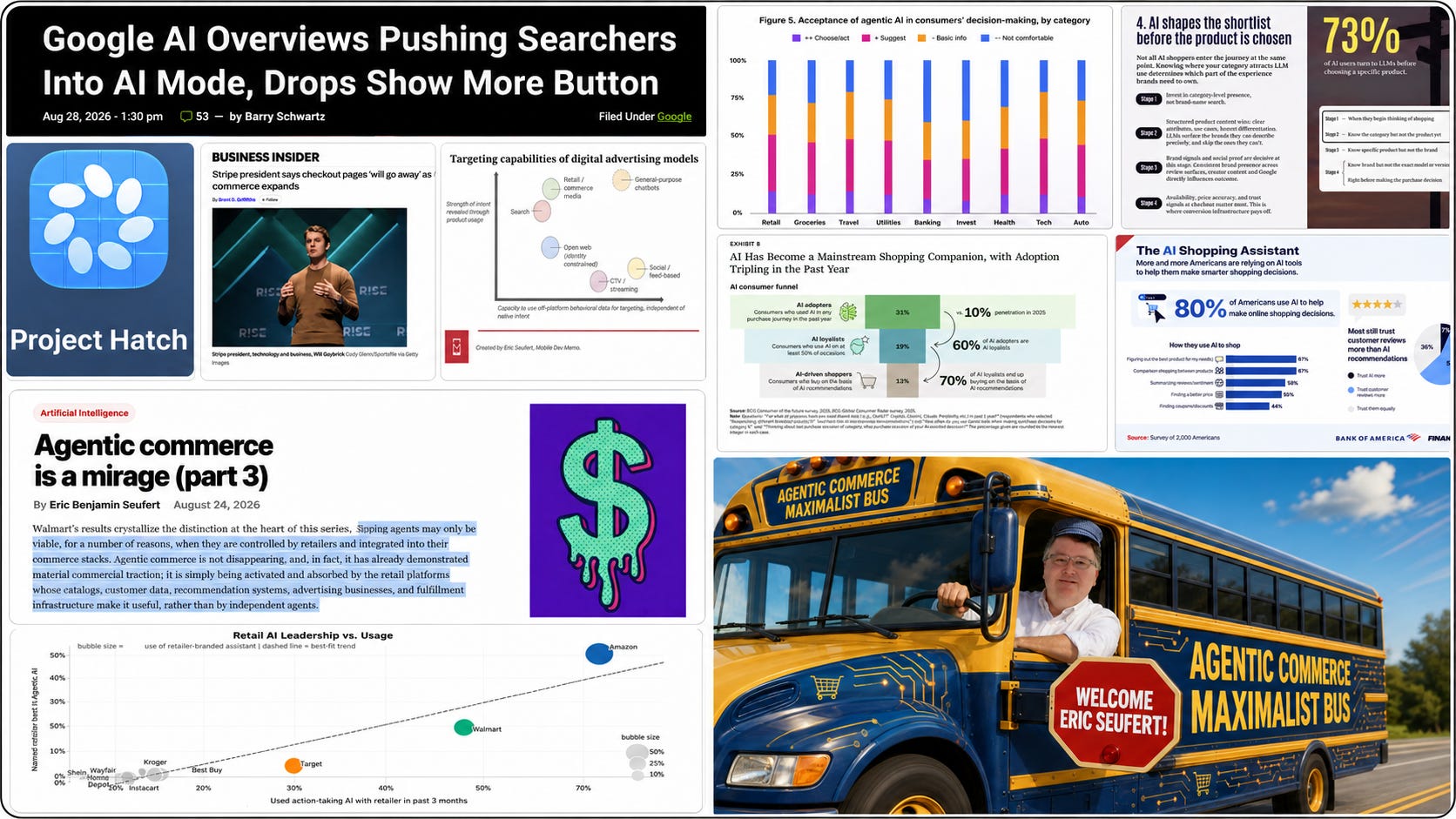
Eric Seufert (told you it would come up again!) has a piece out that has a great analysis of which platform is best for ads. It’s a matrix of “capacity to use off-platform behavioral data for targeting” by “strength of intent revealed through product usage.” The result - Chatbots come out on top. They combine the best aspects of commerce media (intent through use of product) and social networks (behavioral targeting) to create a super ad platform unlike anything we’ve ever seen.
→ Mobile Dev Memo: The Privileged Position of chatbot advertising
🌶️ Stripe Says Checkout Pages Are Going Away…🌶️
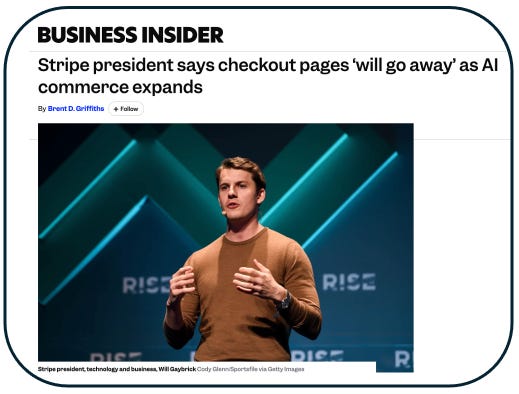
A Stripe interview went viral for a very spicy take: ‘Eventually checkout pages will go away.’
That does not mean checkout disappears. It means the visible page gives way to agent-controlled transaction flows where identity, intent, payment credentials, shipping information and approval travel through protocols and APIs.
The bigger picture? Platforms that own the checkout page today could lose a major control point, while the companies that own agent identity, payment orchestration and verifiable intent gain one.
We just wrapped our big Shopify 2 parter, this is the biggest question I get from Wall St: What happens to Shopify when checkout goes away? Only time will tell, Will think it’s coming pretty quickly.
→ Business Insider: Stripe says checkout pages face an agentic future
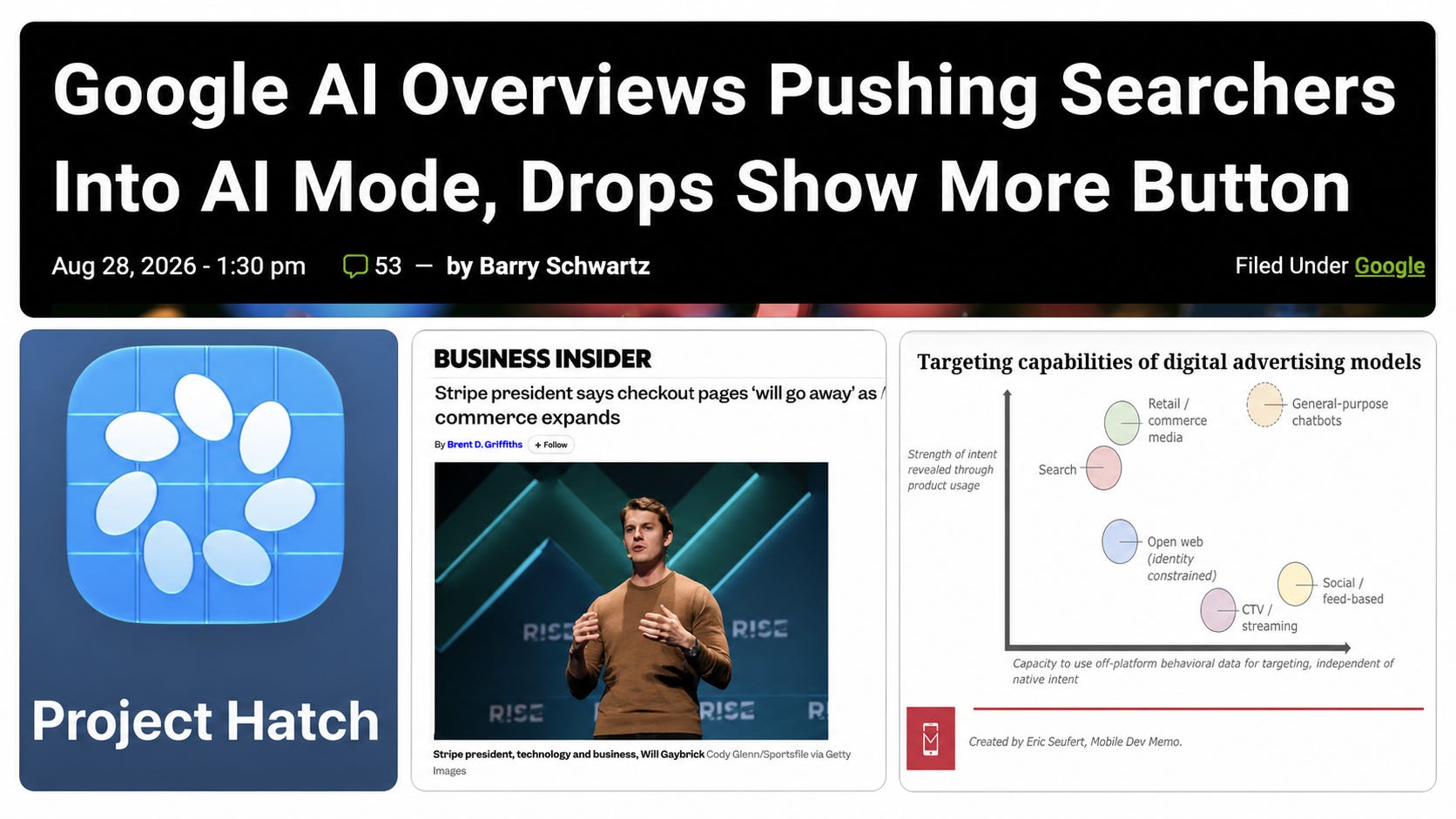
Meta’s Hatch Could Put a Consumer Agent Inside Instagram and WhatsApp
Meta is reportedly preparing a consumer agent called Hatch that could compare products, book restaurants, follow deliveries and coordinate tasks across apps. A separate agentic shopping experience for Instagram may bring conversational discovery and buying directly into Meta’s commerce and creator ecosystem.
When I put the pieces together, Hatch looks like a consumer-friendly OpenClaw mixed with TikTok’s Tako and Meta’s massive distribution. The big question is whether the commerce layer will run on product feeds, browser actions, UCP or a combination.
This one is still speculative, so keep it in the watch bucket. This seems close as several pieces of Hatch are starting to appear. I expect it in early September.
→ YourStory: Meta is building Hatch, an AI agent that can act for you
Google is Morphing Core Search Into AI Mode

Google keeps moving AI Mode closer to the center of Search. Each interface change looks incremental on its own, but the direction is unmistakable: AI-generated answers are becoming the primary discovery layer, not a side experiment.
For retailers and brands, this means the classic blue-link playbook keeps losing surface area. If the answer engine builds the consideration set before the consumer clicks, your product data, brand evidence and agent readability determine whether you make the list at all.
We’re seeing a pattern here. Google is not replacing Search overnight, it is steadily teaching billions of people to shop through an AI-mediated interface.
→ Barry Schwartz on Google’s latest AI Mode interface test
That’s a Wrap
These three trends point to a continued rise in Agentic Commerce from all angles: Answer Engines are growing nicely and consumers are getting deeper in their adoption. The same thing is happening with Retailer shopper agents. Finally, industry players continue to expand existing offerings and Holiday 26 could give us META and Claude in the market in a big way, and maybe even Grok.
We’re taking the week of Labor day off for a last break before it gets crazy. We’ll be back in your inbox with a pod on 9/10 and a fresh content 9/15 (unless there’s something FLASH worthy, then all bets are off!).
Everyone have a great Labor Day!