


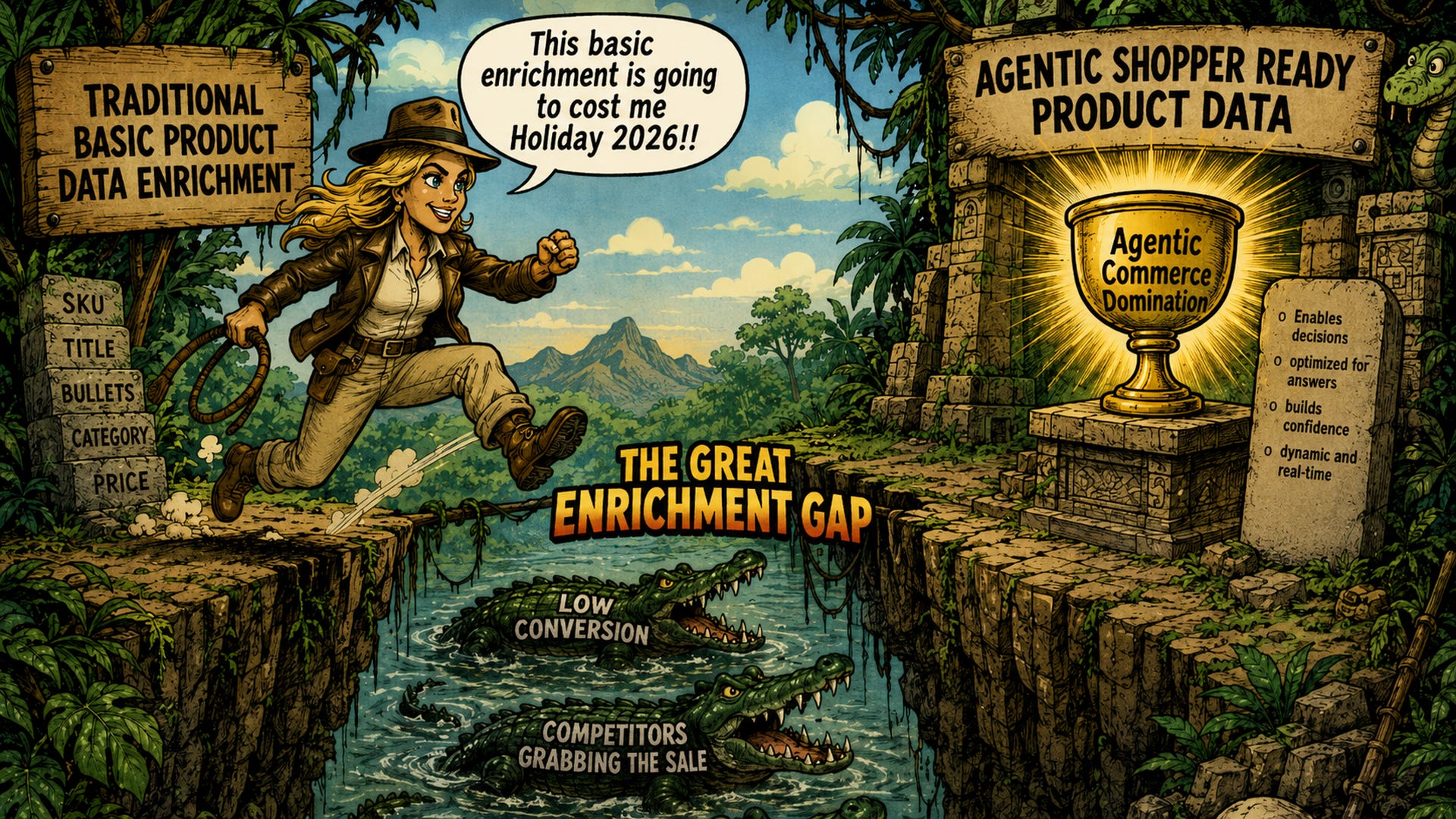
Here at Retailgentic, we just completed our 4-part ACO Everywhere series (starts here if you missed it) and fundamental to that series was the concept of context capture. Once we wrapped it up, I hopped on a plane and went out to NRF Nexus to speak and hang out with all my favorite brand and retailer people and talk about all things Agentic at the Think Tanks and in the halls.
After the first several conversations, I realized we have a big problem in the industry that spans across brands, retailers and all the vendors…
The Problem
Ask ten vendors, ten brands and ten retailers what “product enrichment” means.
You’ll hear:
Attribute completion
PIM automation
Image tagging
Catalog distribution/endpoint publication/MCP-ification
AI-generated descriptions
Taxonomy mapping
That thing my PIM does?
They’re all called Enrichment, yet they are all solving different problems and actually taking very different actions around your product catalog.
What I discovered is that like “Agentic Commerce” itself, we have overloaded one phrase (enrichment!) to describe five completely different capabilities.
The Enrichment Gap: Introducing the 5 Levels of Product Enrichment
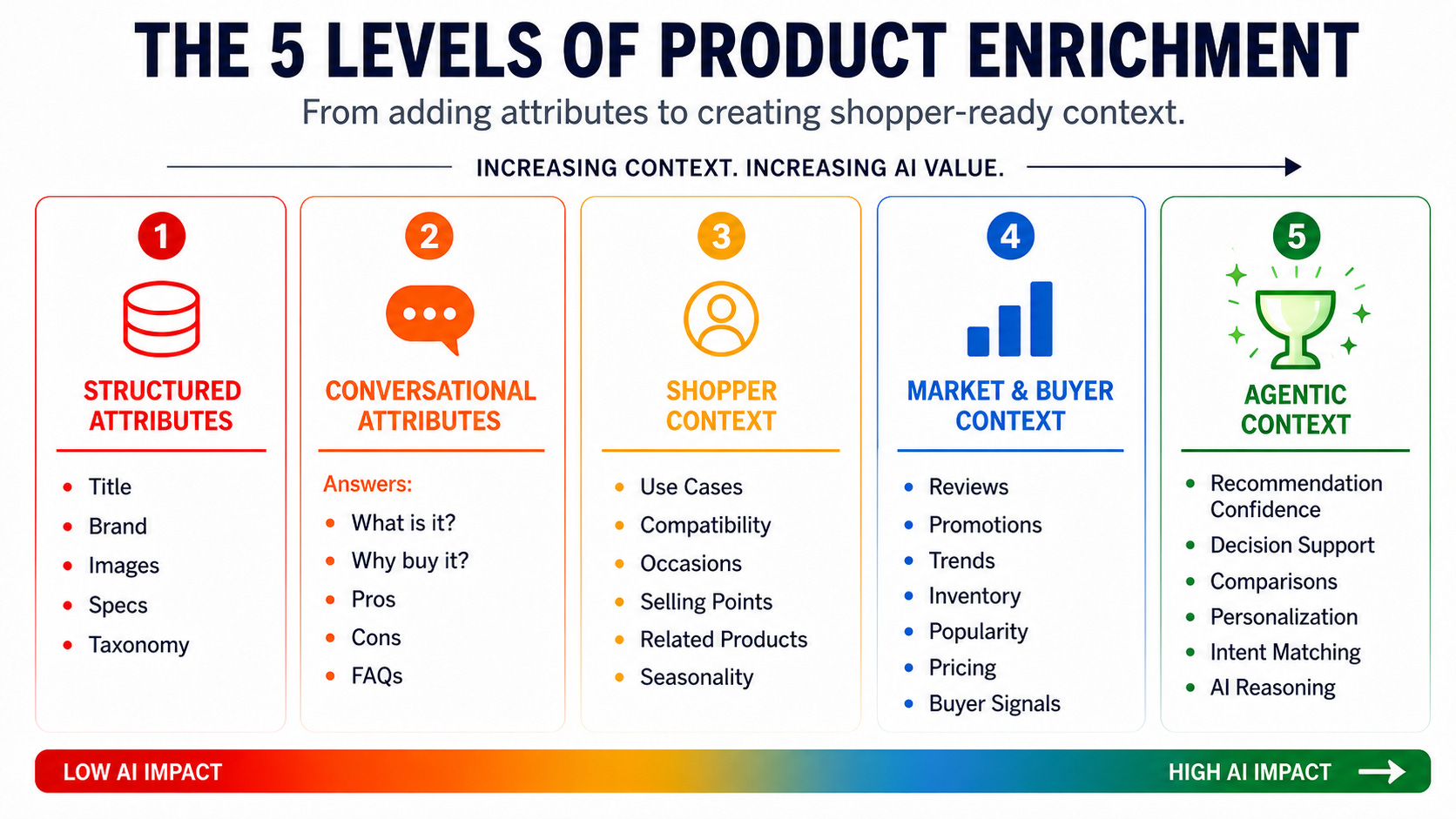
Instead of thinking about enrichment as “better data,” think about it as increasing levels of shopper understanding coming from the marriage of shopper intent and product data.
Level 1 — Structured Basics
This is what most vendors do and where merchants, especially brands, are investing today:
Examples:
Dimensions
Weight
Color
Material
Brand
UPC
Images
These basic attributes are obviously necessary table stales, but add zero differentiation.
Level 2 — Conversational Attributes
In Level 2 - it’s starting to get interesting because in giving robotic: “material=cotton” …now we’re answering questions.
We’re answering:
Is this breathable?
Will this shrink?
Does it wrinkle?
Is it comfy?
Can I wear it in the summer?
Is it good for travel?
The shift from Level 1 to Level 1 is we’re now enriching conversations, not just product data.
It’s important to note that this is just not me ‘guessing’ or making a prediction - Google is focused on getting this data from merchants for getting brands and retailers to this level and it’s part of UCP.
Level 3 — Shopper Context
Because the Answer Engines have tons of shopper intent, on top of basic product data and conversational attributes, they are looking for product-level shopper context from authoritative sources (like the brand and their retail partners).
Shopper context like:
Use cases
Occasions
Compatibility
Seasonality
Product lifecycle
Pros
Cons
Selling points
Related products
At Level 3, we’re past attributes and into buyer context.
Level 4 — Market Context
Products don’t live in isolated, they exist in markets, markets that change a lot and that rate of change is accelerating.
Market Context includes:
Promotions
Popularity
Inventory
Trends
Reviews
Price changes
AI agents care enormously about these and it’s a top input into who wins the offer card.
Level 5 — Agentic Context (new)
At the final, most advanced level of enrichment, it isn’t about products, it’s about decisions.
Examples:
Which product best fits this shopper
Which product best fits this prompt
Why should the AI recommend Product A over Product B?
What objections must be overcome?
What evidence supports those claims?
Which customer segments respond best?
Now you’re optimizing for reasoning instead of 2002 basic database filtered navigation.
Why This Matters
In these digital pages we’ve covered these first principles of agentic commerce:
Consumer behavior has changed more in the last 3 years than 20 years of keyword jail, causing us to over-optimize for keywords
Agentic commerce optimizes to matching the large amount of shopper intent with the product context.
Multi-surface context capture is your competitive advantage and your moat.
All of this has to be done in a closed loop, or you aren’t optimizing, you’re guessing.
The New Definition of Enrichment: Agentic Enrichment
Product enrichment is no longer the process of plugging in missing attributes.
In the Agentic Commerce Era, it is now the process of continuously adding decision-ready context that enables AI to confidently recommend, compare, explain, and sell the product.
How to tell if you aren’t enriching for Agentic Commerce…
Each product doesn’t have a detailed and growing FAQ (substantially longer than what’s on the PDP)
Your vendor/team doesn’t know that UCP/ACP also have a product catalog spec in addition to the payments piece
You’re using an off-the-shelf AI model to recommend and fill in data (it will not make good recommendations and it will fill your catalog with reddit-fueled AI slop)
They aren’t talking to you about how to get access to more context
You aren’t enriching in your company’s ‘voice of brand’
You’re sending the same data without channel customization to Google, ChatGPT, CoPilot and Meta.
Conclusion
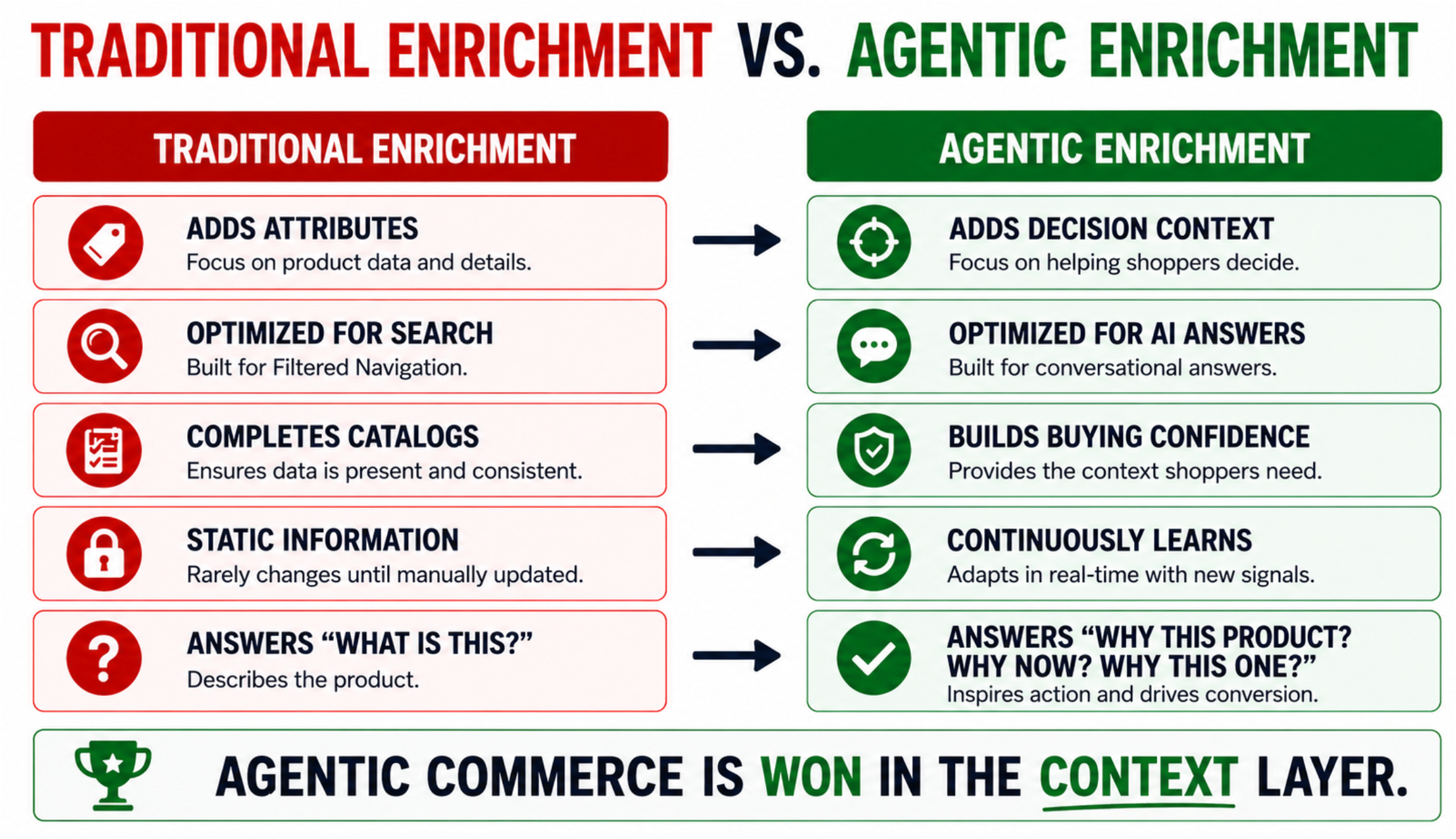
The companies that win Agentic Commerce won’t necessarily have the biggest catalogs or the happiest PIM that has every mandatory field filled out to perfection. They will have the richest context that is continuously optimizing and responding not only to underlying product changes, but shopper behavior and market dynamics fueled by context capture across as many surfaces as possible.
THAT’s the enrichment gap.