


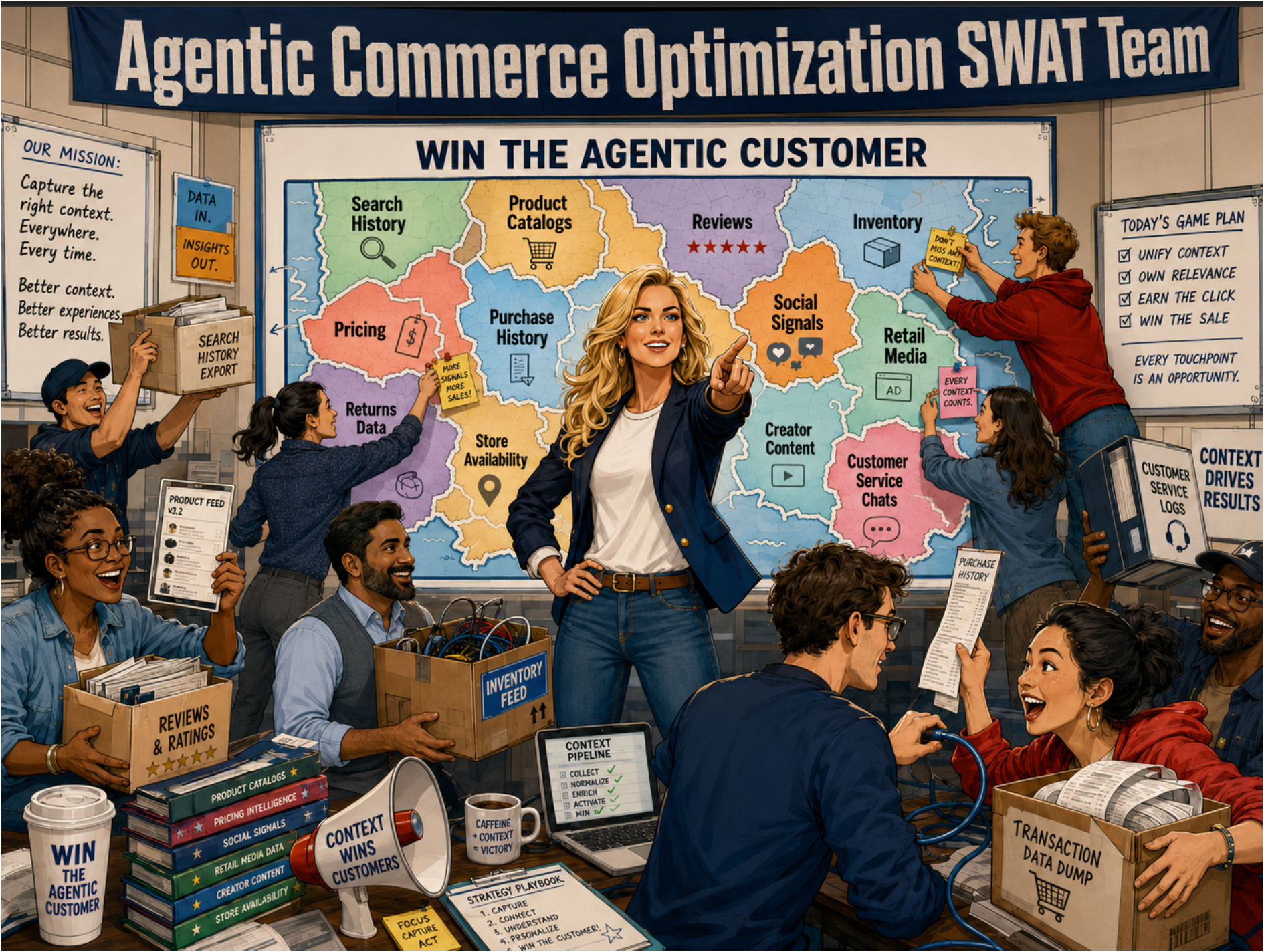
Here at Retailgentic, we operate on the bleeding edge of Agentic Commerce and Agentic Commerce Optimization. Back in September 2025, we first introduced the concept of Agentic Commerce Optimization in this 4 part series:
Part I: The Next Phase of Agentic Commerce Optimization: Context Capture <YOU ARE HERE!>
Part IIA: “Product-Level Context Capture: Where, How and When?” is here.
Part IIB: “Recursive Context Capture Loop Tactical Example” is here.
Part III: Introducing ACO Everywhere 🚀 is here

Starting today we’ve going to expand upon the original 9-step ACO diagram and introduce a new framework. This new framework is from real-world experiments we ahve been performing with partners and customers to prove some theories we have had about where ACO is going. We now have enough evidence and quantifiable improvements we can confidently update the original ACO strategy with some new important changes.

After dozens of conversations with commerce leaders, one pattern kept emerging: nobody owns Agentic Commerce Optimization, and most teams believe they’re much further along than they actually are. The ReFiBuy Guide: “Building Your ACO Organization” breaks down how early ACO adopting merchants are organizing their teams, workflows and governance structures to build a great ACO Org. Access here (no signup needed)
Context Capture is the Great Unlock - The Strategy
In this post we’re going to focus in on the foundation of these new recommendations which is what we’re calling Product-Level Context Capture. In this series we’re going to reveal the next-level Agentic Commerce Strategy and the tactics that you should start implementing to support the strategy. Regardless of if you are a retailer, a DTC brand or a wholesale brand or a hybrid of those three, you will be able to start implementing this strategy now and have impact by Holiday 2026.
Context Capture Strategy in a Nutshell
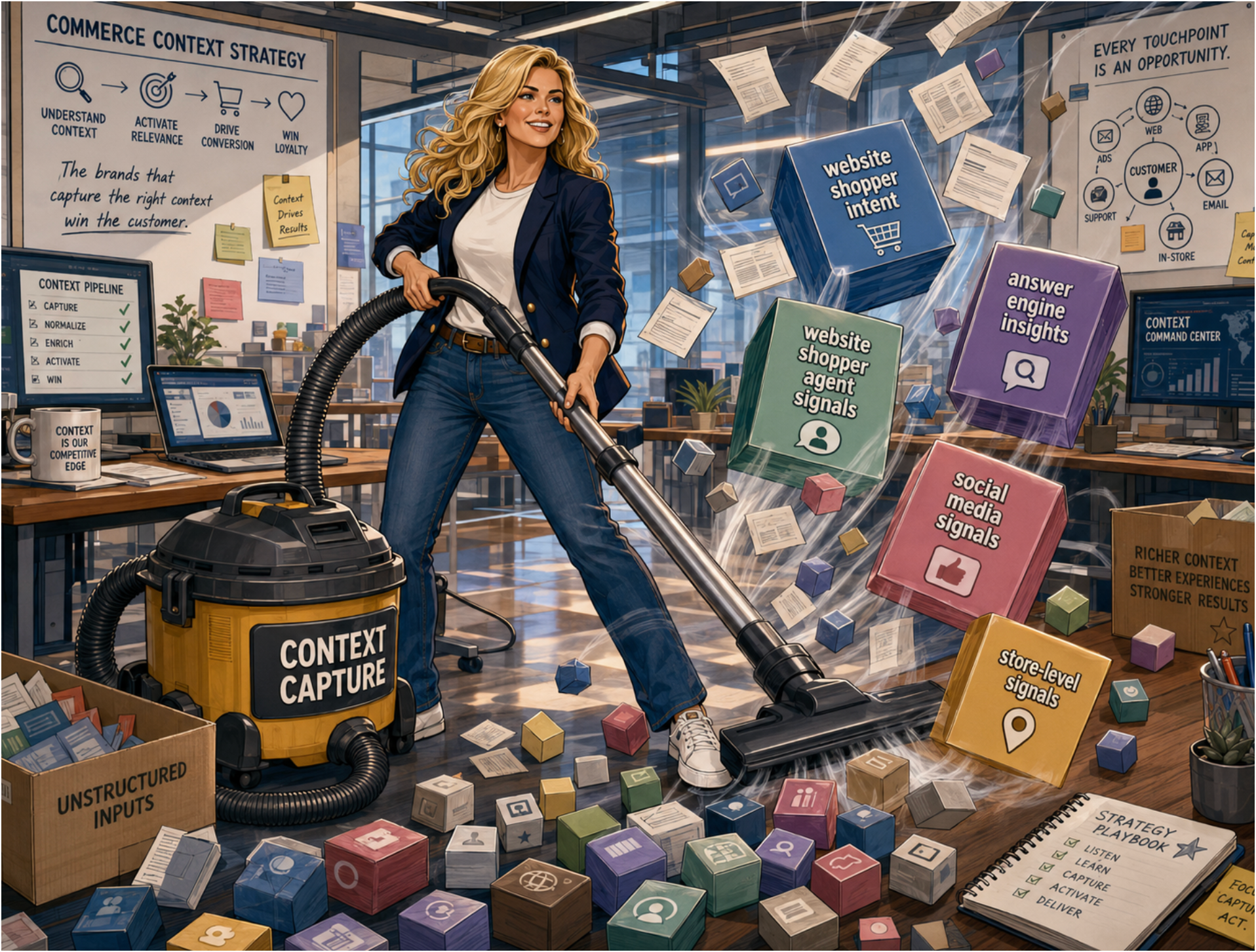
At a super high level, because of the power of LLMs - they are very good at mapping shopper intent with products, but due to 20yrs of keyword jail, we are very far behind on the side of giving the LLMs the product-level data they need to satisfy the dramatic growth in shopper intent we are seeing.
Context Capture Strategy: Merchants need to vacuum up all of the product level context across every possible surface. Context Capture enables LLM-based shopper agents to connect the dots between your product catalog and the exploding amount of shopper intent - supercharging conversions and sales.🚀
Before we dig deep into this in more detail, to give it…context… for you briefly let’s recap the 9-step Agentic Commerce framework and some other additions to the Agentic Commerce world that lay the groundwork for where this is going.
ACO Recap
Back in September 2025, before ChatGPT announced their checkout plans that they have now shelved, we proposed a 9-step Agentic Commerce Framework:
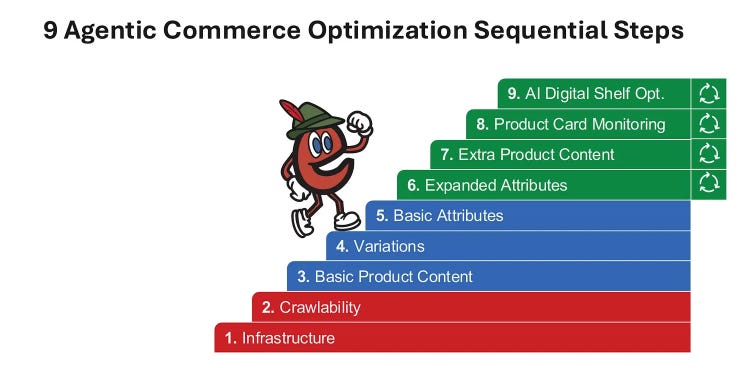
To summarize:
Steps 1-2 - Get your Catalog to the Agents - It’s increasingly rare that we see merchants in the top 7 Agentic Commerce categories blocking bots, but when merchants from categories outside of those big 7 reach out, it’s still happening. For example, we just had this come up in the automotive category. This framing has been resonating with both brands and retailers I’ve talked to: Think of your product catalog as the ‘payload’ - the valuable information we are trying to get into the agent unfiltered and with maximum integrity. Your brand.com/retailer.com website is the primary delivery vehicle. We need to figure out the multi-layer strategy so humans get a great PDP, GoogleBot/SEO doesn’t break and for ACO the agent has unencumbered access to that payload. We can also deliver that payload directly via datafeed, but we have a ton of real-world evidence that you 100% need to do both - datafeed and optimized PDP to belt-and-suspenders the delivery of this super important ACO optimized product catalog payload.
Steps 3-5 - Do the Basics right - ACO is a linear progression, and after making sure you are getting the product catalog into the LLM, the highest impact thing you can do is to expand the content inside each existing attribute. 20yrs of Google Shopping where brevity was rewarded is reversed, now verbosity is rewarded. Authentic+appropriate verbosity - not AI slop verbosity.
Note: Do not make the JV mistake of using an off the shelf LLM for this, 80% of their source materials (Reddit/Youtube transcripts) are unhinged and this will work into your product catalog and cause more problems than doing nothing. This is 100% not vibe-codable.
Steps 6-9 - Expand, widen and continuously optimize- Once you are through Steps 1-5, the real optimization begins. Here you’re elevating and looking at the entire process: how are your product showing up on product cards, are they mapped right, if yes, where are you on the offer card? who is competing with you, what are they doing, why are they ahead of you. What are the product-level negatives and competitors the engines are surfacing about your products, optimize into all of that. It will be overwhelming at first, but when you start to see results, it will ring the register faster than you would think.
4 Super Lanes of Product Catalog Information Available in ACP/UCP
In steps 6-9, Merchants that are well versed in the legacy datafeed world sometimes have a hard time with the tactics of ‘what do I do’. If some Redditer in 2007 left a 100% false review, what do you do? The good news is you now have tools to at least tell your side of the story and as a merchant, you have a lot of authority with the engines and can headway in the war of ‘brand vs. Reddit crazy’ for the first time.
At Google Marketing Live, Ashish Gupta in his fireside chat with Agustina Sartori, Head of Agentic Commerce at Ulta. In that talk, one summary item I wrote down came from when the host asked the panel: “What’s your number one recommendation for merchants looking to optimize for Agentic Commerce. Ashish’s simple answer packed a big punch: “You need to supercharge your product catalog.” That’s it. For Agentic Commerce, it always, ALWAYS comes back to the first-principle that your catalog is the core asset, it’s the new Agentic Commerce gold-dust. The lowly old catalog -we’ve been hacking at it for decades using excel, pushing it around antiquated CSVs and now here it is - the driver of our future.
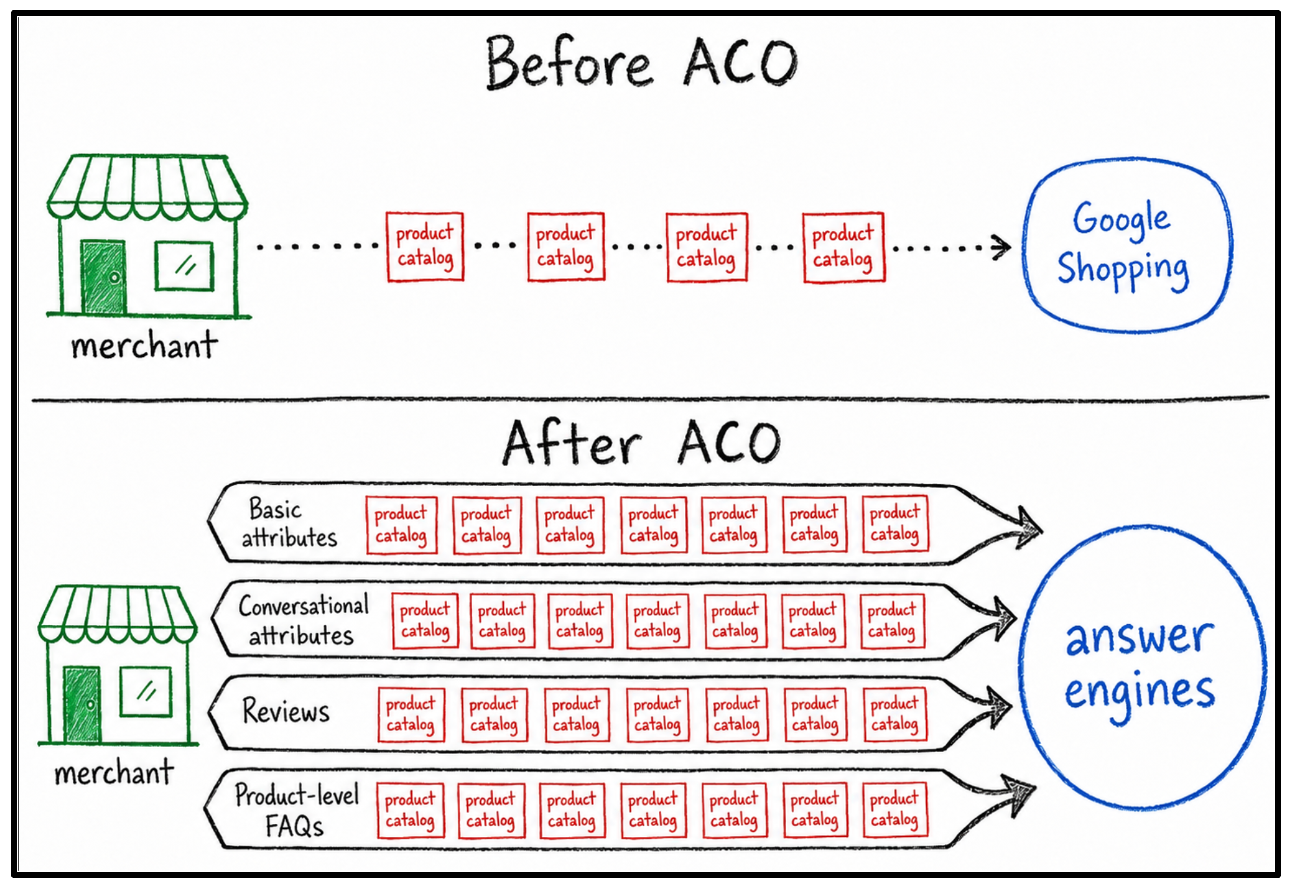
What’s starting to emerge over the last year from the initial release and updates to the two core protocols is four lanes of product catalog information that the engines want:
Lane 1: Your pre-agentic basic product attributes -but beefed up and expaned for ACO
Lane 2: Conversational Attributes - Google/UCP has added a set of, for now, 6 expansion attributes that add critical context for the agent to pick up on: pairings, sales-rank indicators, occasion, the ‘mysterious’ document link,
Lane 3: Product-level reviews
Lane 4: Product-level FAQs
ACP has many of these same features, but uses different nomenclature and structure.
What we’ve learned after doing some real-world experiments is you canuse the product-level FAQ and document links tell your authoritative side of the story and thus continuously optimize your product cards (steps 7/8/9), and counter the negativity out there and tell your side of why ProductX should be picked over a competitor or even in your product line who the perfect customer is.
On top of THAT, you can also further super-charge your catalog through a process we are calling product-level context capture.
Why Do You Mean Shopper Intent is Expanding?
Earlier I mentioned ‘shopper intent is expanding’. Long-time Retailgentic have seen evidence of this as we’ve gone from LLMs added memory and upgrading it 2-3x, as well as past prompts, browser connections for page history and much more. The best and most current examples and datapoints came out of Google I/O // Google Marketing Live a couple of weeks ago - I’m particularly tuned into this and here’s what I captured:
The average AI Mode search is triple the length of a traditional Google search query — people are writing in full sentences rather than keywords.
Follow-up queries in AI Mode have grown 40%+ per month on average in the U.S., showing real back-and-forth conversational behavior rather than one-shot searches.
Top first words have shifted to “What,” “How,” “I,” “Is,” “Can”, and top embedded keywords are “find,” “information,” “identify,” “explain,” “summarize” — conversational, not keyword-stuffed.
More than 1 in 6 AI Mode searches in the U.S. are now voice or image (non-text).
Image-based searches are growing 40%+ month-over-month.
Planning queries (itineraries, fitness routines, dinner parties, budgets) have grown 80% faster than AI Mode queries overall in the past 6 months.
Brainstorming queries are growing 30% faster than overall AI Mode usage since launch.
Decision-making queries — searches starting with “which,” “which of,” “which one” — are growing 40% faster than overall AI Mode queries; this is the language of someone narrowing a purchase.
As a merchant, we’re all merchandisers, and you can see these examples (e.g. “which is a bottom of funnel product comparison”).
Summary:
We’re at a moment in time where:
We know definitively the unlock for the future is Supercharging your Product Catalog (Ashish@Google is building the future, he has explicitly told you what to do, couldn’t be clearer) He sees all the data we can’t see.
We know the steps and the sequence to do the basics (9 step ACO Framework)
We have the supercharged product catalog delivery mechanism now (the 4 lanes). We can now deliver a LOT more product catalog information into the Answer Engines.
Consumer Behavior is racing ahead of us - consumer queries are getting more wide and deeper. Shopper intent is ahead of product-context. We need to level up.
What’s Next in ACO? Context Capture
That brings us to our newest discovery. What happens when you’ve looked under every nook and cranny for information to enhance your product catalog? You’ve thrown open your virtual doors to the bots and you’ve made sure that across ChatGPT, Gemini, Meta and CoPilot all of your product cards are properly canonicalized and your offers are optimized. Now what? Now we need to move on to the next Phase that begins with Context Capture.
Give Me Examples of Product-Level Context?
At it’s most basic level, Product-level context is anything and everything you can learn about how humans are shopping for, discovering, researching, describing, comparing and evaluating your products. Because each human shopper is as unique as a snowflake, the surfacer area of this is immense and you’ll never capture all of it. But today most merchants are capturing 0% of it. If you can get that up to just 10-20% you are going to be adding infinitely more product-level context to your product catalog.
Context Capture: For the next level of ACO, merchants need to programmatically and continuously pull in context from all available locations. Think of it as the most valuable asset that’s currently falling on the floor.
Examples of product-level context we’re going to want to capture and how it ties to shopper intent.
Projects/usage signals - What projects are being done your products are being used for?
Search terms - What are the search terms people are using to find each products.
Prompt intent - When people are talking to agents, what are they saying, what products are being surfaced, are they the right products, if not why - what was missed in the prompt that could have been in the product data to make the perfect match?
Unsuccessful (zero results, zero convert) search terms- what are search terms or prompts users are entering that aren’t finding products?
Cart abandonment - If someone abandons a cart, why Was it the product, was it the price, was it?
Social proof - When people are reviewing the products, there is a ton of context in the social proof. What are they using it for, what did they like, what did they dis-like and why?
Trend signals - Is this product popular on wishlists, is it getting a ton of social media love, what search terms/topics is it trending for?
Influencer information- has an influencer endorsed the product? Have they been seen in it at a big event?
Up Next
In the next issue we will dig deeper into the ‘how’ of Context Capture. How and where can you get this, and what do you do with it all? In part 3, we’ll reveal a new strategy we’ve pioneered that builds on this concept of Context Capture, what we like to call: ACO REDACTED UNTIL NEXT WEE (redacted until next week, stay tuned!).
Great post, Scot. This lines up with what we keep seeing: the catalog isn't just under-fed, it's often written in the wrong language. The richest context to capture is how shoppers actually phrase the need, because that's what the agent matches on. A capable model can make the 'hot summer hike' to 'breathable mesh upper' leap one-off, but across thousands of SKUs it won't do it reliably, so the safer bet is feeding it the shopper's language directly instead of hoping it bridges the gap at scale.
The 'conversational attributes' shift is real and more disruptive than it looks on paper — we're seeing retailers with 5,000+ SKUs where the bottleneck isn't catalog size but attribute coverage: only 12–18% of products have enough contextual data to actually match mid-funnel AI queries, even after basic feed optimization. The four-lane model maps almost perfectly to what Ashish's team calls 'data strength' in the merchant health signals, which is now surfacing in Merchant Center Next diagnostics alongside the usual feed quality flags. The hard organizational problem is that Lane 2 (conversational attributes) requires product-level input from merchandising teams who have never thought in terms of 'occasions' or 'pairings' — that's where most implementations stall before they even test Context Capture.