


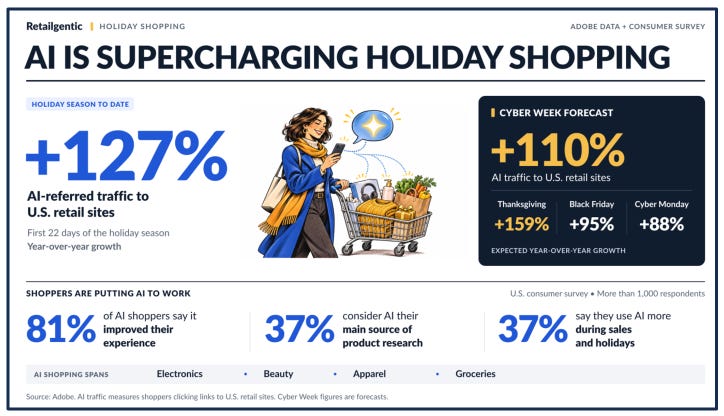
Let’s start with the big news - Adobe this AM announced that from Nov 1 - Nov 22, in 2026 ecommerce sales are up 9.1% compared to the same period last year (2025) - Holiday 2026, is off to a fast start! 💨
The details…
First 22 Days of Agentic Holiday 2026…
9.1% is great, but we’re here for AGENTIC COMMERCE!! Good news fellow Agentic Commerce Maximalists, this is our time, because it’s about to get 🚀 Adobe reported:
AI traffic to retail sites increased 127% y/y (Adobe observed data)
81% of consumers who used Agentic Commerce say it improved their experience (fresh survey data)
37% consider it their main source of product research (survey)
Top Agentic categories: Electronics, beauty, apparel and grocery (survey, this will come up again, remember these!)
As a reminder, Adobe expects Agentic traffic to be up 110% y/y for the Cyber-Five, so these first 22 days are trending a good bit ahead of that. Day-by-day they expect:
Thanksgiving: 159%
Black Friday: 95%
Cyber Monday: 88%
That’s today’s breaking news, now some fresh November curated news we thought you’d find helpful.
November’s Curated Agentic Headlines
We haven’t even made it to Black Friday and November has already given us plenty to chew on. Hopefully you saved some room next to the turkey. 🦃
November’s news has retailers loving their on-site shopping agents, business strategist Ben Thompson finally embracing Agentic Commerce, Google helping fill the Thanksgiving grocery agentic cart, and two awesome data drops for a yummy dessert.
Let’s dig in…
$5 from ReFiBuy and Amazon, ok mostly Amazon.
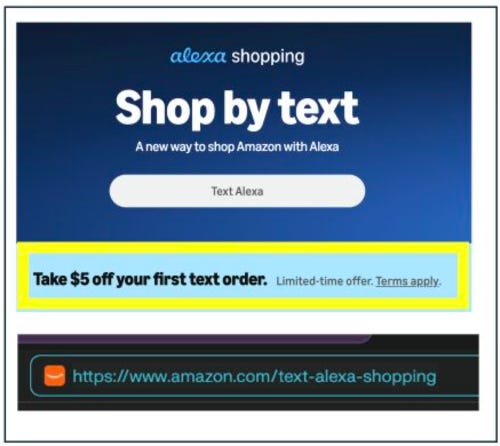
First, you should definitely try Alexa for Shopping (AFS) because a. it’s very good and b. You get $5 off your first qualified purchase. To claim your $5→
Sign up at https://www.amazon.com/text-alexa-shopping
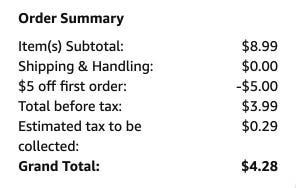
Make a qualified purchase. When you do, Alexa takes $5 off that first order. Here’s an example of where I saved 55% off a $8.99 item! (fun with math) with this promo!

Agentic Commerce Highlights From Retailer Earnings: Walmart, Lowe’s and Target 🎯
Last week brought a slew of retailer earnings from Target, Lowe’s and then Walmart. Walmart isn’t a surprise because they have been investing in Sparky and Agentic Commerce since the earliest days, but what was a surprise was that Target and Lowe’s got in the game.
Target
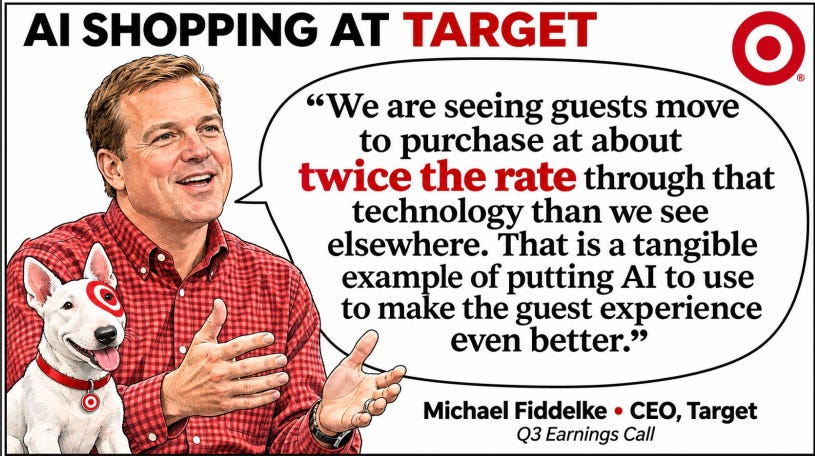
It started with Target on Wed Nov 18th, led by CEO Michael Fiddelke. Target started with the Target Shopping Assistant and since has introduced a new assistant (not clear if a rebrand or re-start, feels like a re-start) called Ask Target→

After mentioning the launch of Ask Target in prepared remarks, there was this exchange in the Q+A→
Rupesh Parikh (Oppenheimer) asked: “Just given all the interest out there in agentic commerce and search, just curious how you feel Target is positioned today. On the agentic search part, curious if you’re starting to see traffic to your website.”
Fiddelke answered with some more meaty quotes: “we’re still early in the journey, and volumes are not high yet. But it’s important for us to be at the forefront of any changes to the consumer purchase funnel.”
“We think curation being such an important part of our strategy, we like our odds of standing tall as consumers are looking for the best product at the best value.”
“That’s with our key tech partners, the likes of tools like ChatGPT and Gemini and Copilot, and being kind of front and center of how that evolution occurs, I think, is critical for the learning that’s in front of us.”
The real big quote of the call came at the end of the answer, where he finally revealed:
“We are seeing guests move to purchase at about twice the rate through that technology than we see elsewhere.”
Lowe’s
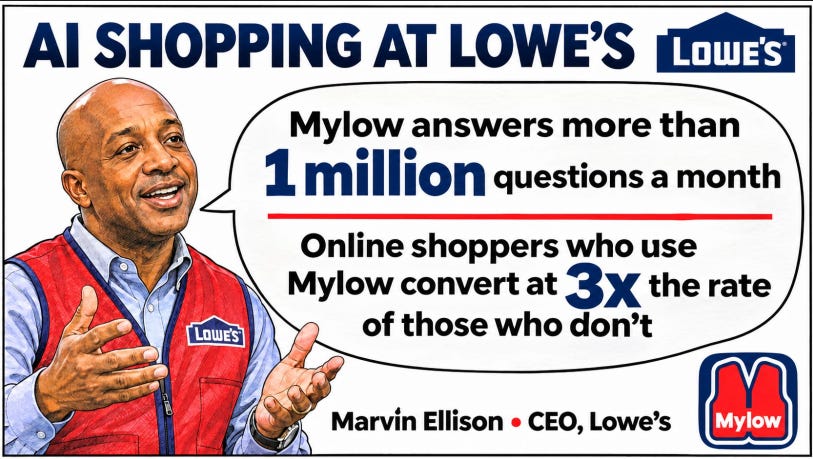
Up next was home improvement retailer Lowe’s, their assistant is branded for the Lowe’s red and blue vest and is called Mylow:

Lowe’s didn’t mention Agentic Commerce in the prepared remarks, but as we’re seeing, Wall St is very dialed in on this trend, so it came up in Q+A→
Seth Sigman (Barclays) asked “And then on e-commerce, the growth there has really stepped up meaningfully over the course of this year. What is driving that unlock? Is that DIY? Is that Pro?”
Lowe’s CEO, Marvin Ellison, volunteered in his response: “when you think about our AI agentic tool online that we call Mylow, this is creating great conversion for our customers. As a reminder, this is a virtual assistant, the first one in home improvement. It is launched on an OpenAI platform.”
Later in the answer, he said Mylow answers more than a “million questions a month” and added: “when our online customers leverage Mylow, we’re seeing triple the conversion rate versus customers that don’t.”
Walmart
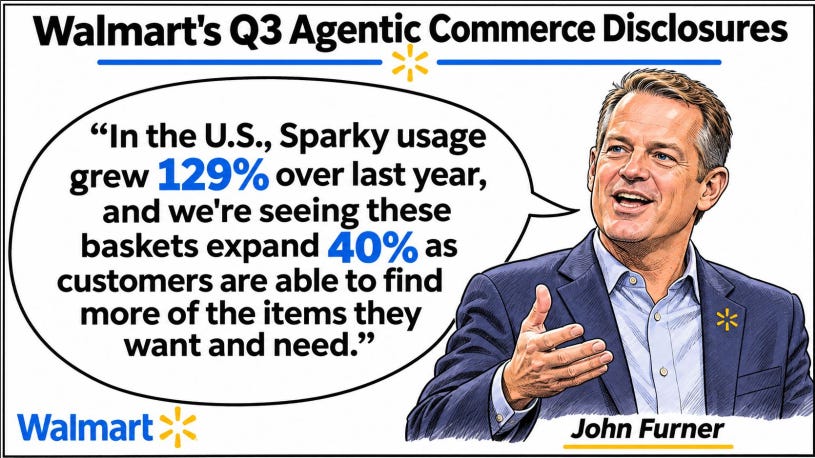
Unlike Target and Lowe’s where Agentic Commerce was largely covered in the Q+A part of their earnings calls, Walmart is fully embracing Agentic Commerce and clearly enjoying the fact that Amazon is 100% absent from this critical new market.
In his prepared remarks Walmart CEO John Furner said:
“Agents are beginning to play a bigger role in more shopping journeys, and we believe Walmart is well-positioned as these new ways of shopping develop.”
On Sparky he said: “In the U.S., usage grew 129% over last year, and we’re seeing these baskets expand 40% as customers are able to find more of the items they want and need.”
On customers’ own agents: “By assigning profiles to agents, customers will be able to set permissions and spending limits, see agent purchases separately, and turn access off at any time. Our new Walmart Agent Gateway gives approved agents a better way to interact with us while helping protect customer information.”
“Whether customers shop directly with us or through an agent, they should be able to count on accurate pricing, reliable availability, and clear delivery options.”
The Walmart agent to agent piece is genius and yesterday we had our Retailgentic Live Look - check it out here→
Welcome Ben Thompson to Agentic Commerce Maximalism!

One of my long-time favorite writers in business strategy is Ben Thompson who writes the Stratechery newsletter. He has started doing interviews and frequently interviews Eric Seufert who writes Mobile Dev Memo. Eric is the most famous Agentic Commerce naysayer (I guess next to Andy Jassy), and he famously coined the ‘Agentic Commerce is a Hallucination’ phrase and series of articles.
In the last two interviews (I listen to the pod), I was shouting at them in my car because they just didn’t get how powerful it is - frequently saying it saves no more time and is a step back from ecommerce 🤦♂️
Well, this time, guess who is neck deep in using Claude and Codex to get work done on some home projects - Ben - and his agent had the list of things he needed and he wanted to just place an order somewhere while in his agent - Claude in this example. Much to Ben’s surprise…
a. He wants to always shop this way because it’s so amazing and convenient
b. He now sees what I’ve been calling the horizontal risk to Amazon’s vertical approach
c. He was frustrated that like 4 out of 5 non-Amazon hardware stores he tried to order from block bots - probably without knowing they are making this choice, because something at the infrastructure layer (Cloudflare, Akamai, etc.) has decided ‘all bots bad’ and they are causing their retail customers to lose sales.
Finally in this week’s interview with Eric, Ben came at him and it was so satisfying to see SOMEONE challenge this guy with some basic pro-Agentic Commerce observations. Of course, Eric leans on his definition to weasel out of it, but it’s obvious now that he was wrong and is tucking into a word/definition argument to save face.
That is subscriber only content that sadly I can’t post, BUT Ben does do a weekly YT video now and at minute 47 he goes into his Agentic Commerce ‘awakening’ story and now I can stop yelling at Ben and Eric in the car in my morning commute ;-)
Two Interesting Agentic Commerce Protocol Use Cases: Agentic Marketplace? and Agentic Ads
These two unrelated stories caught my attention because they protocols like MCP, UCP, PAP to achieve things that weren’t possible in the pre-Agentic Commerce era.
Zalando Goes Beyond Its Own Catalog with Agentic Protocols
Zalando Extended will let shoppers buy from other retailers through Zalando. Its first test is with home and living retailer Westwing. Today, shoppers discover the products on Zalando and click out to buy. Agent purchases without leaving Zalando are planned for 2027.
Think about what that could mean. A retailer can expand what it helps you buy without having to stock every item itself. To this former marketplace guy, that starts to look like a much lighter way to build a marketplace. 👀 Zalando was an early EU pioneer in marketplaces and this could be quite disruptive. It’s almost like Amazon’s ShopDirect, but where you can pay for items right in Amazon’s purchase flow.
I have a lot of questions - what’s this mean for traditional marketplaces? How does it integrate with the search/browse experience? How will the checkout work - will it be cart integrated and intermix with the 1P items? What’s this do to the Mirakl business model?
I propose we call this Agentic Marketplaces and abbreviate it A3P (Agentic Third Party).
Agentic Shoppable and Try-on-able Instagram ads?
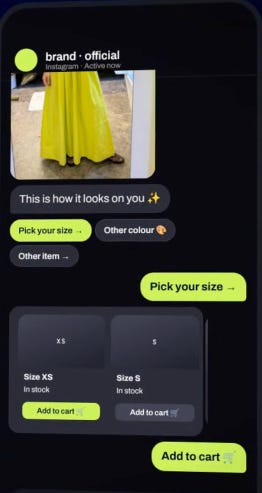
Now put that next to another story from this month: VibeDM launched an agentic shopping experience inside Instagram DMs. The startup says brands can offer product conversations, virtual try-ons and checkout without sending shoppers out of Instagram. It launched with eight brands across fashion, beauty, wellness and home in the U.S. and Europe.
These are different approaches, but they point toward the same merchant question: can your products be understood and purchased wherever the shopper is having the conversation?
We spent years optimizing the path from an ad to a PDP to a cart. More of that journey can now happen inside the conversation itself, and eventually the ad. That creates a whole new set of places where your product information needs to do some selling (I know, I know - it always comes back to product catalog and data!)
Google Offers to Help With the Thanksgiving Grocery Run 🛒🦃
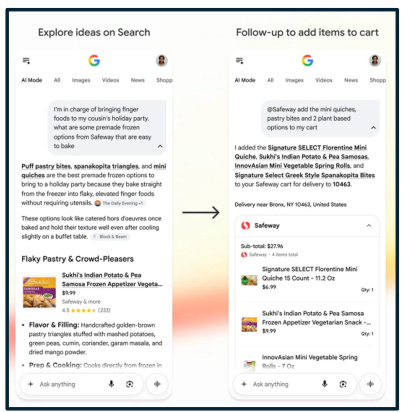
Google announced new Connected Apps for Search and Gemini on November 20, including Albertsons, Safeway, Shaw’s and Target. The U.S. rollout uses Universal Commerce Protocol (UCP) to help shoppers build orders and check out.
Grocery is a useful test for this stuff. A holiday shopping task can start with a meal, a guest count and a dietary requirement. Turning that into a basket requires the agent to connect the shopper’s needs to actual products, quantities and availability.
For example, imagine asking for appetizers for eight people, including two gluten-free guests. The merchant’s data needs to support a useful answer all the way down to the specific items you can buy. A vague product description isn’t going to carry that conversation very far.
Google’s distribution is the other piece I keep coming back to. This puts another shopping capability into places consumers already use. They can encounter agentic commerce while doing an ordinary holiday errand.
My take: watch how well these experiences handle the messy details. Substitutions, dietary needs and stock availability will tell us a lot more than a perfect demo basket.
Daydream: Your Stylist Can Keep Shopping While You Sleep 😴
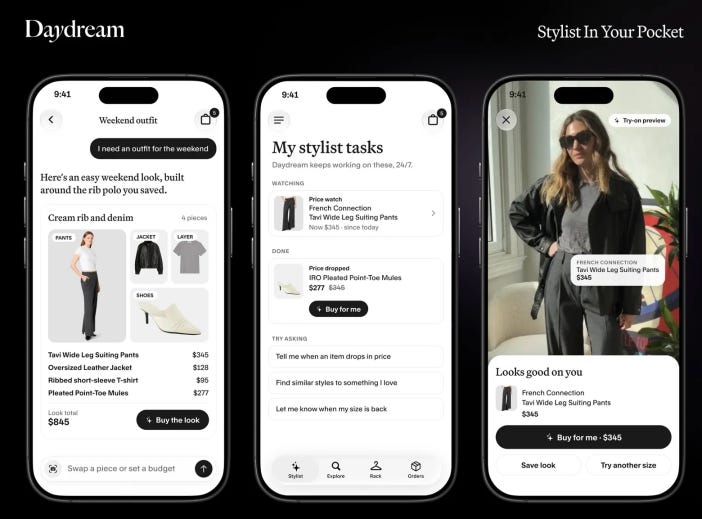
Retailgentic podcasters recently met Daydream co-founder Lisa Yamner. Now there’s a new chapter.
Daydream’s new shopping agent works through its app and SMS, remembers preferences, assembles outfits and can keep working on a request in the background. Purchases still require shopper approval. Its fashion knowledge graph and input from human stylists help inform recommendations.
Lisa foreshadowed this was coming in our convo and it’s great to see it realized. Fashion asks a lot of an agent. Finding something in your size and budget is a start. Finding something you actually want to wear is where it gets super personalized.
For a brand, think about the difference between supplying a category label and helping an agent understand the occasions, aesthetics and combinations your product works for. The second set of data gives agents much more to work with when someone describes a need in their own words.
Forter Gives Us Another Window Into Agentic Orders 📊
Here’s one for my fellow data nerds (you know who you are).
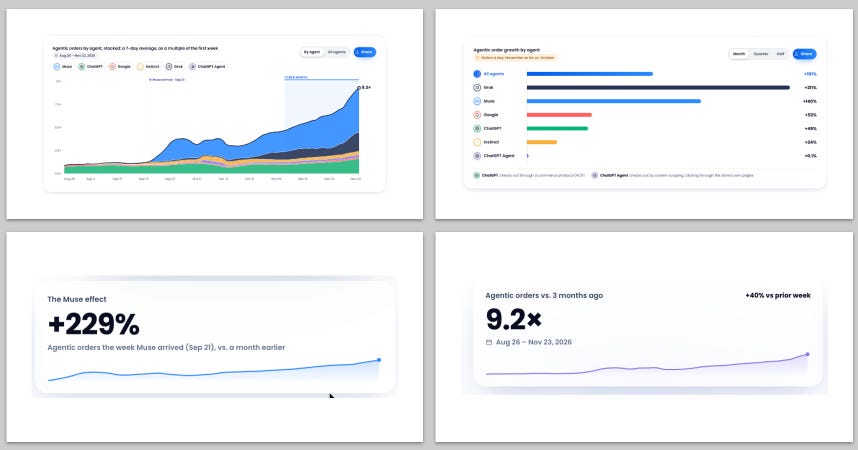
Forter’s public agentic commerce dashboard lets us look at orders, agent mix, average order value and where agents are shopping across its merchant network.
As checked on November 23, Forter reported:
8.6× growth in agentic orders against the first week of its August 24–November 21 window.
Muse at 51%, Grok at 23% and ChatGPT at 19% of agentic orders for November 15–21.
A $229 average agentic order across the August 24–November 21 period.
Those are observations from Forter’s network, so keep the sample and date ranges attached to the numbers. They don’t establish market-wide agent share or tell us what percentage of all ecommerce is agentic.
Still, this is useful! It gives us another view of Buy to put alongside the discovery research we’ve been following.
When I first looked through the charts, Grok’s presence caught my eye. I’d also be careful comparing average order values without understanding the category mix. An agent doing more travel bookings could look very different from one buying beauty products.
I’ll be watching how this develops over BFCM. The interesting questions are how the mix changes, which categories show up, and how the results compare with other datasets.
Stripe Drops Amazing Agentic Transaction Data
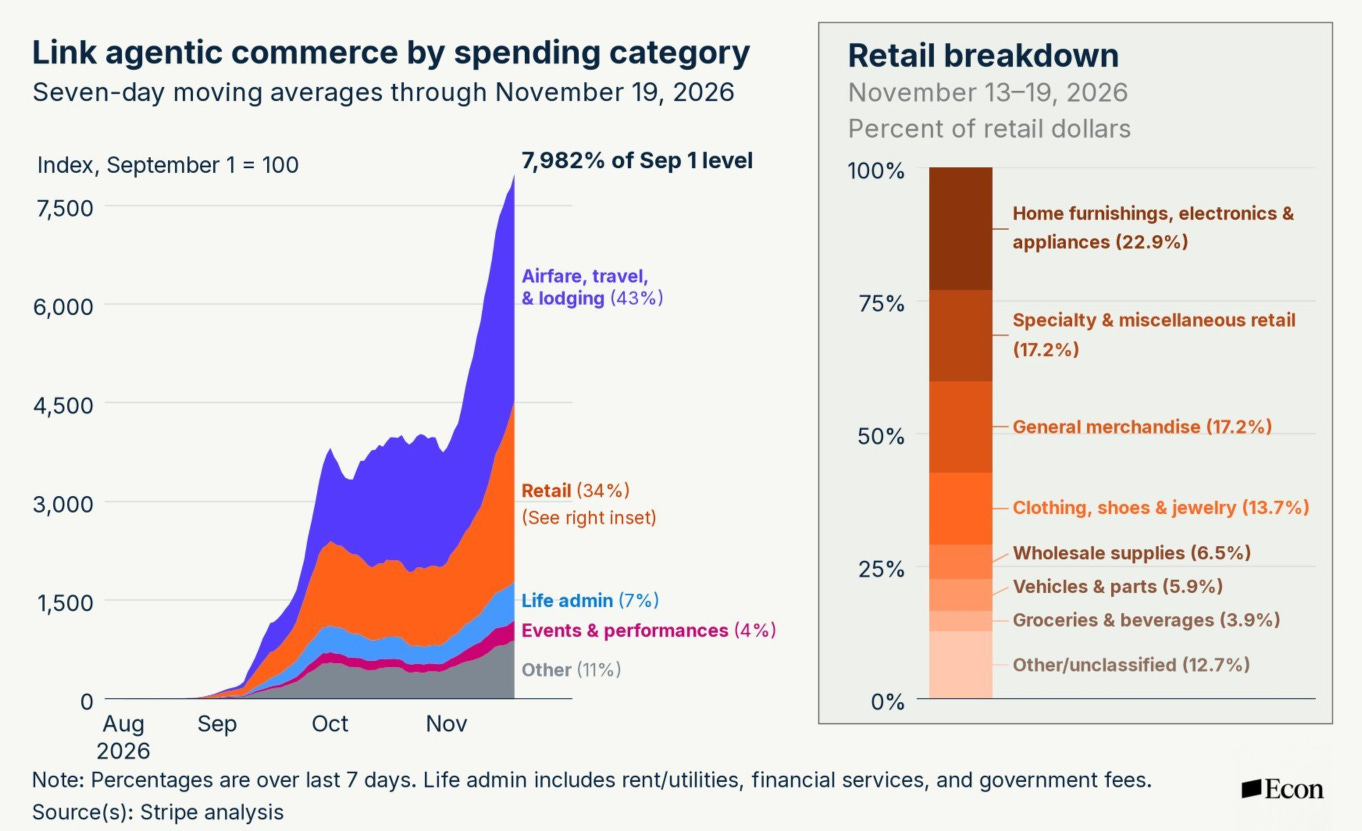
Wow look at that - the left chart shows a time trend of Agentic Commerce transactions through Stripe Link Wallet. We have the early days which were basically Instinct from Sept to late Oct and then it took off vertically - presumably due to the launch of Muse.
The right chart shows the breakdown inside the retail piece. If you are a home furnishing, electronics, appliance, specialty, general merch, apparel, shoe, jewelry retailer and aren’t meeting your customers where they are (in Muse), you are already losing a lot of transactions and you can see the trend here.
This third chart comes from the same data→
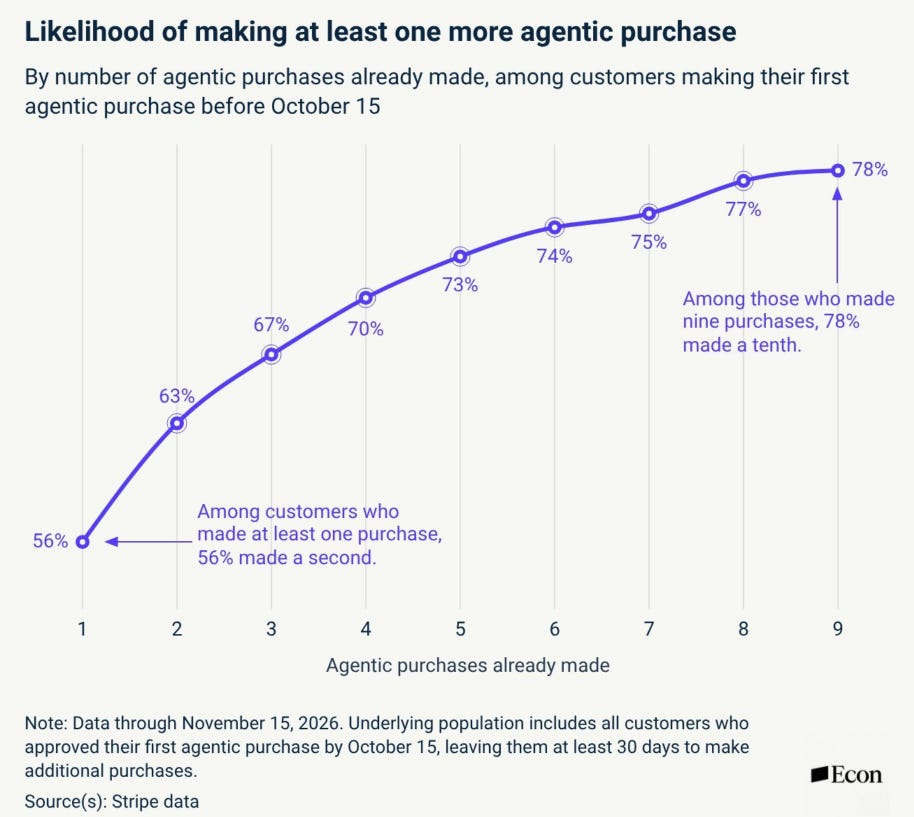
It shows the stickiness of Agentic Commerce transactions - If someone tries one time, they are 56% likely to come back, then the second time pushes them to 63% and so on. Four transactions in and they are hooked. This tells us that the early cohort of adopters are really finding the experience useful and come back over and over which bodes very well for this new buying experience.
The single biggest thing you can do is get a feed to Meta.ai going! Do this ASAP! Then up-scale your data catalog.
Have a Happy Thanksgiving Everyone!!
The Agentic Commerce table is set for the big BFCM kick-off. We’ll be back in your inbox with any breaking news we think is worth a quick note so when you’re back at work watching the Cyber-Monday meter showing green across the board, you’ll know what’s going on in the Agentic World!