



Let’s start with the big news, then go over the ‘why’ plus the ‘what does it mean’ and then wrap with the Amazon Frenzy 😵💫.
Introducing Product Feed Campaigns
Long-time Retailgentic friend Joe was poking and prodding at the ChatGPT Ad management user interface and was able to surface this feature. Note in the past this has indicated, this is a feature either coming soon for a test or already being tested by an audience using what’s called a feature flag that allows a vendor to ‘opt in’ one set of customers in a feature and the others don’t see it.
Background: Retailers and brands are able to upload datafeeds to ChatGPT now through their Merchant Center. Many brands/retailers may have multiple feeds and it’s good data hygiene for feeds to have a unique identifier (feed ID)
The first tell is here in the Ad Campaign creation flow, there’s a new ad type:
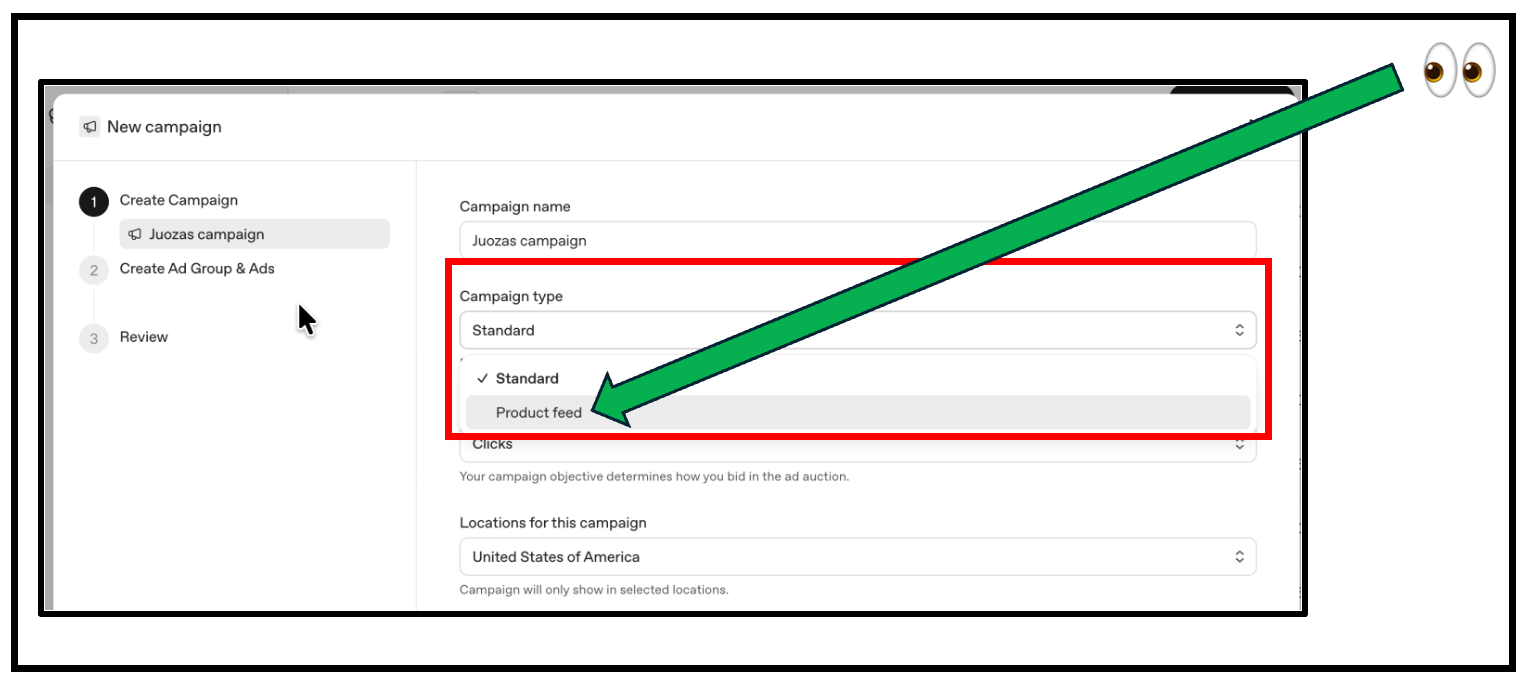
Here we have a pretty typical ‘campaign builder user interface with a 3 step wizard:
Create Campaign
Create Ad Group + Ads
Review
(Publish!)
Once ‘Product feed’ is selected as the ad type, the ad builder moves to step 2
Product Feed ID and Product Filters?!
Here’s what step 2 looks like:
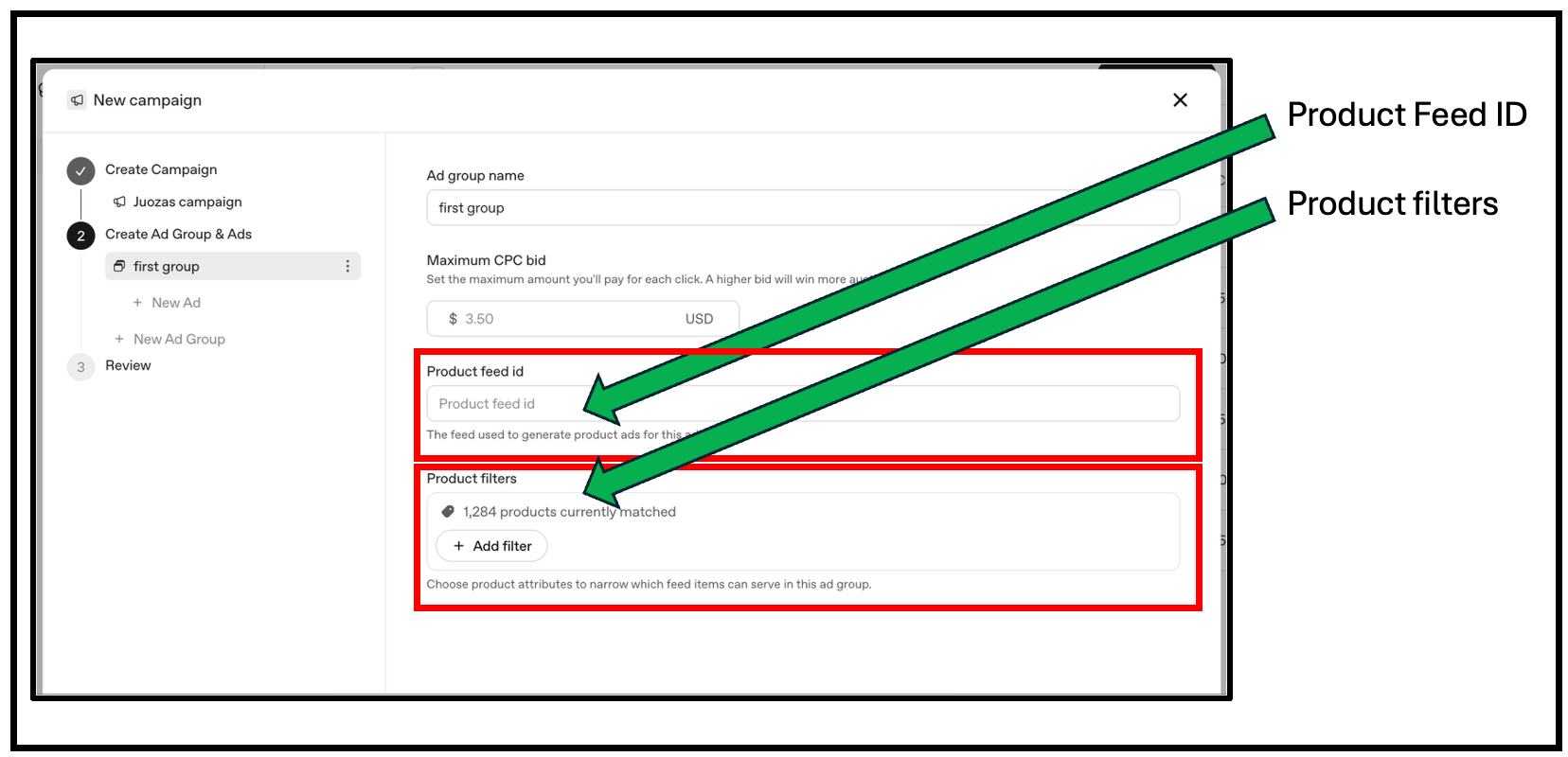
Now we see the ability to create ad groups inside of the campaign, but with the exciting new twist, they are built on a Product Feed foundation.
Here’s how it works:
First, you have to provide the product feed id (see backgrounder above for why).
When the feed is found the UI pings Merchant Center and tells you there are X products loaded from that feed (in this example, 1,284).
Then you can either run those ads against the whole feed (highly unlikely - see Analysis section for why), or you can carve off a set of products and run ads against that subset. ChatGPT is calling this ‘Product filters’ and the help text says: “Choose Product attributes to narrow which feed items can serve in this ad group.”
Available Product Filters
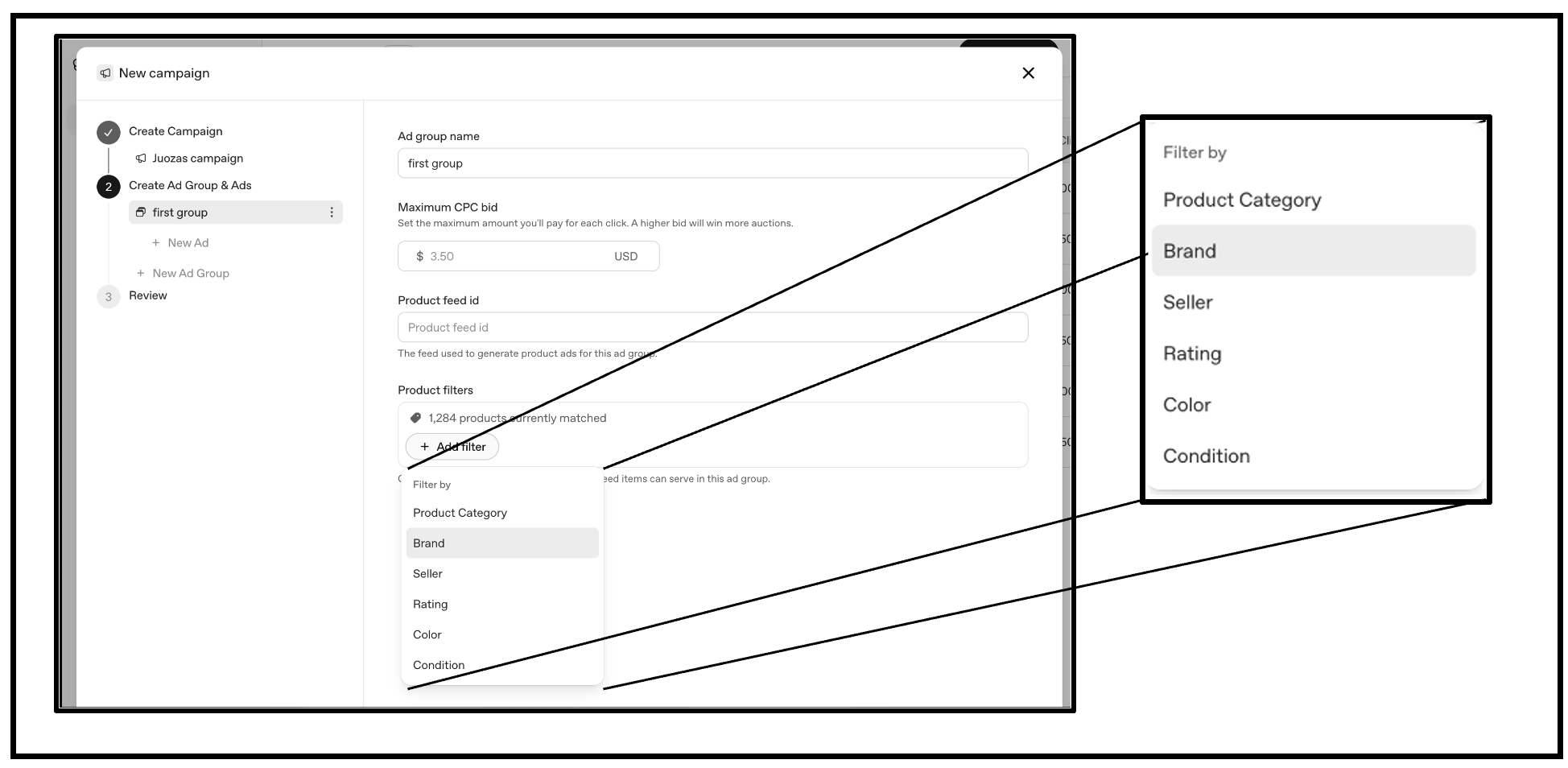
When you click on the Product filters selector you get 6 filter choices (today - I’m sure this will expand rapidly):
Product Category - Here you can choose to advertise shoes, accessories, men’s, women’s whatever. and it’s a multi-picker.
Brand - You can choose to runs ads against specific brands.
Seller - This is a third-party marketplace setting. Etsy is an early launch partner with all the Agentic Commerce companies, so my bet is they are a design partner here and this was added at their request. They have some featured sellers they want to promote or they have a list of sellers that are paying to be promoted (down in the Etsy merchant center) which would allow Etsy to ‘pass them up’ to ChatGPT for ads.
Rating - You may want to run ads against highly rated products (this is a weird one, I bet nobody uses it).
Color - Also a weird one, nobody runs ads against ‘red’ only.
Condition - A huge growth area in ecommerce is ‘circular fashion’ or recommerce. This feels like a setting where you could run ads against your new and recommerce categories or exclude refurbs if you were an electronics retailer, etc.
Long-time ecommerce marketers will immediately see that there are some key atributes obvious missing! We’ll cover that in the Analysis section.
‘Stacked’ Product Filters
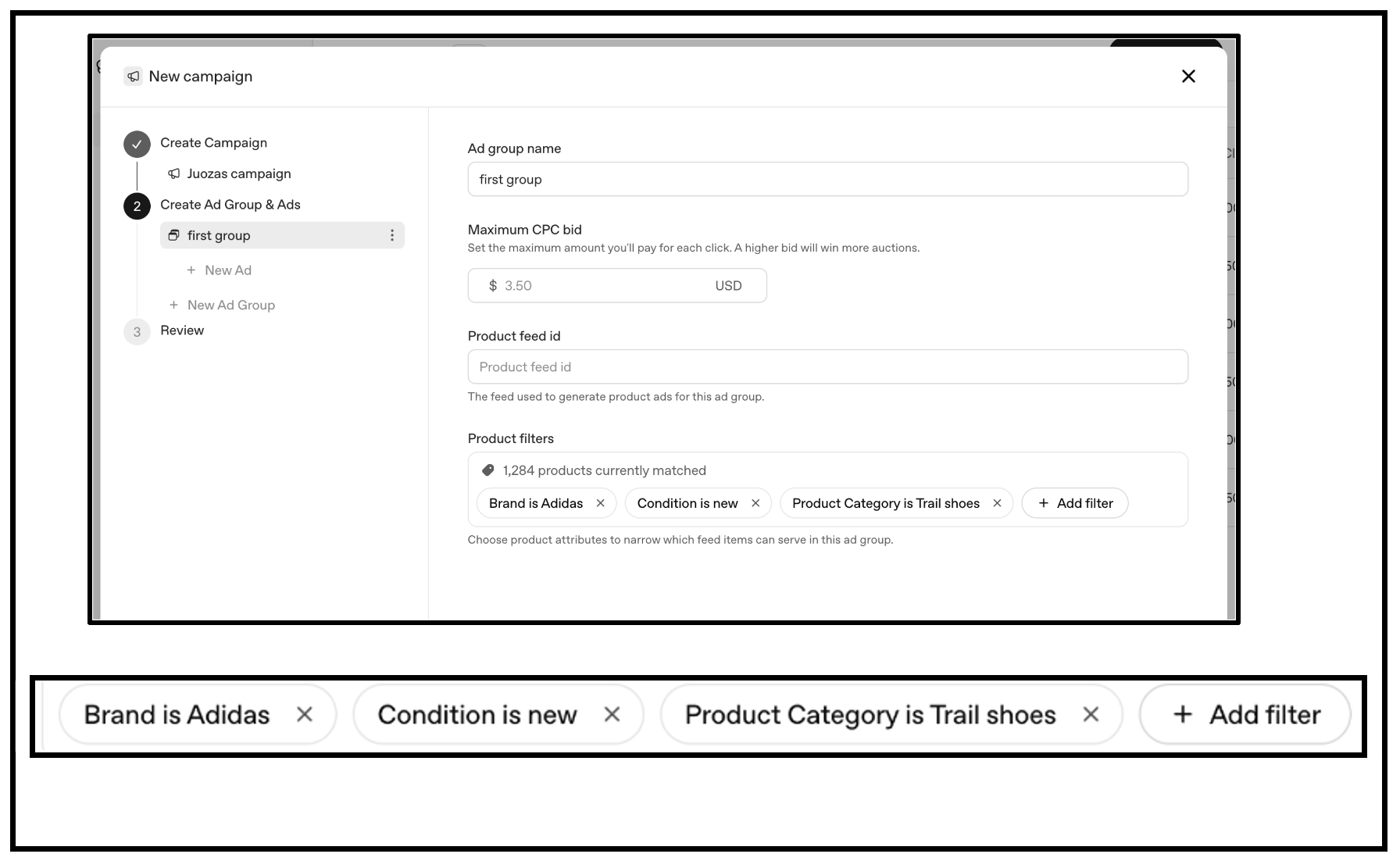
In this example, we’re only going to run ads for products that meet three criteria: Brand=Adidas, Condition=New, Category=Trail shoes. That’s a pretty narrow ad group, but maybe it’s hiking season or we’re running a special promotion in partnership with Adidas. Regardless of why, it shows the power of ‘stacking’ filters like this.
Final Step: Ad Creative
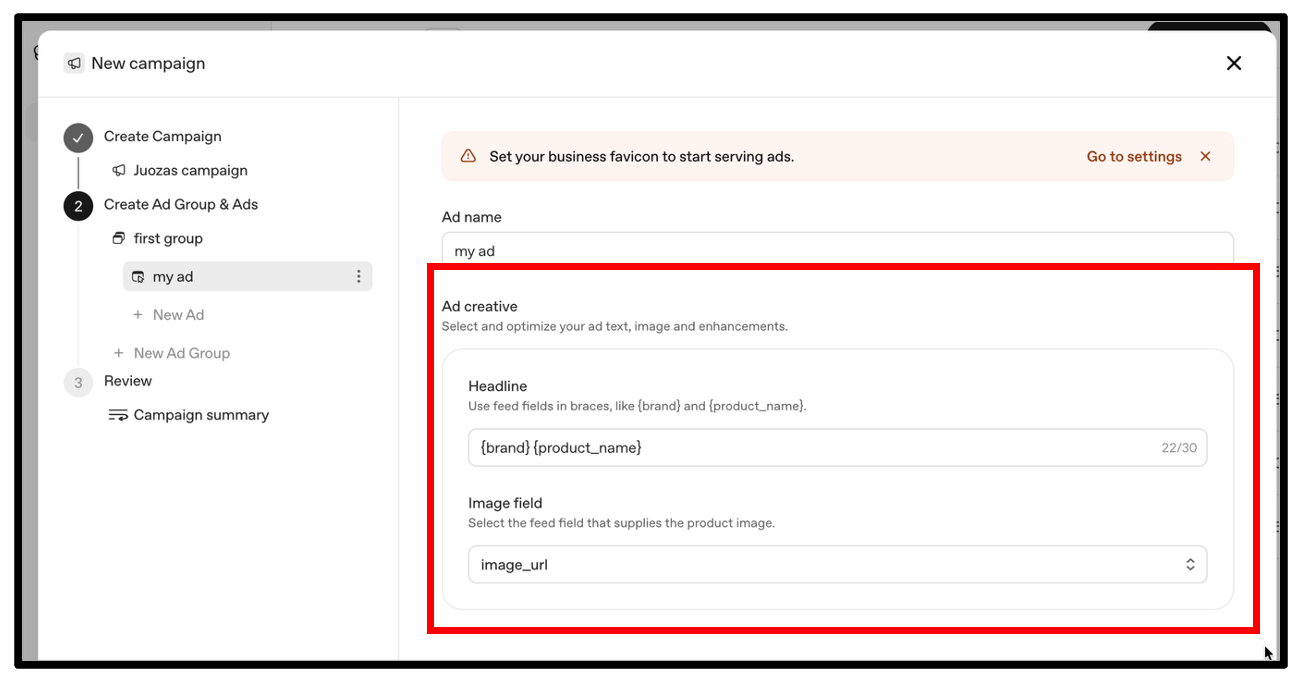
Now you need to give ChatGPT a ‘recipe’ for how to merge in your product data with the ad creative. Do you want the product image? if so, which one? Do you want the brand mentioned, the color, the condition, the price, etc?
This simple ‘builder' allows you to do that create a mail-merge like setup where your product data feed data is married with the ad creative template to generate a pragmatically individualized ad for each SKU.
Now that you’ve seen what it looks like in teh UI, let’s analyze what this means for ChatGPT, the Digital Ad market and Agentic Commerce.
Analysis of ChatGPT’s Product Ads Feature
If you’re not familiar with this concept, the first question you may have is:
Why would you want to run ads against a datafeed?
The challenge marketers in ecommerce have is four-dimensional:
Scale: Your average brand has 2-20k SKUs and the average retailer has 20k-100k+ SKUs
Price Variation: Your price in that assortment most like varies wildly from sub $10 to over $300 or higher. (30x delta)
Margin variation: Your margin (either $ or %) for these products is usually not 100% correlated to price or color, or category.
Ad Copy: Creating bespoke Ad copy for 2-100k SKUs is tedious if not impossible.
Therefore ONE CPC ad for all your products doesn’t work. You’d be significantly overpaying for your $5 pair of socks and under investing in your $300 hand held vacuum cleaner.
The Solution:
The solution is you chunk up the datafeed into pieces that have similar margin/revenue/ROAS goals (and conversion rate) into a bucket and bid the same across that bucket. BOOM! Product Ads are born.
Note: The reason this was predictable is we have seen this movie before. Raise your hands if you remember when Google Product Listing Ads, Amazon shoppable ad units, or Meta dynamic product ads. We’ve got our PLAs, our SAU’s and our DPAs! Let’s call these CPAs (ChatGPT Product Ads) - unfortunately this is going to cause a lot of chaos with your friends in accounting.
Complexity Awaits
The hidden complexity challenge of this approach is advertisers start to request near infinite ways to slice the data into buckets - what about by price range, what about by margin, what about X/Y/Z? May of these interfaces then either go into that being in the datafeed, or totally algorithmic (e.g. Google PMAX, etc.) where the advertiser just has to trust that the algorithm will hit their blended goal.
One last point:
Why is ChatGPT Moving so fast on ads?
I can boil this down to one picture:
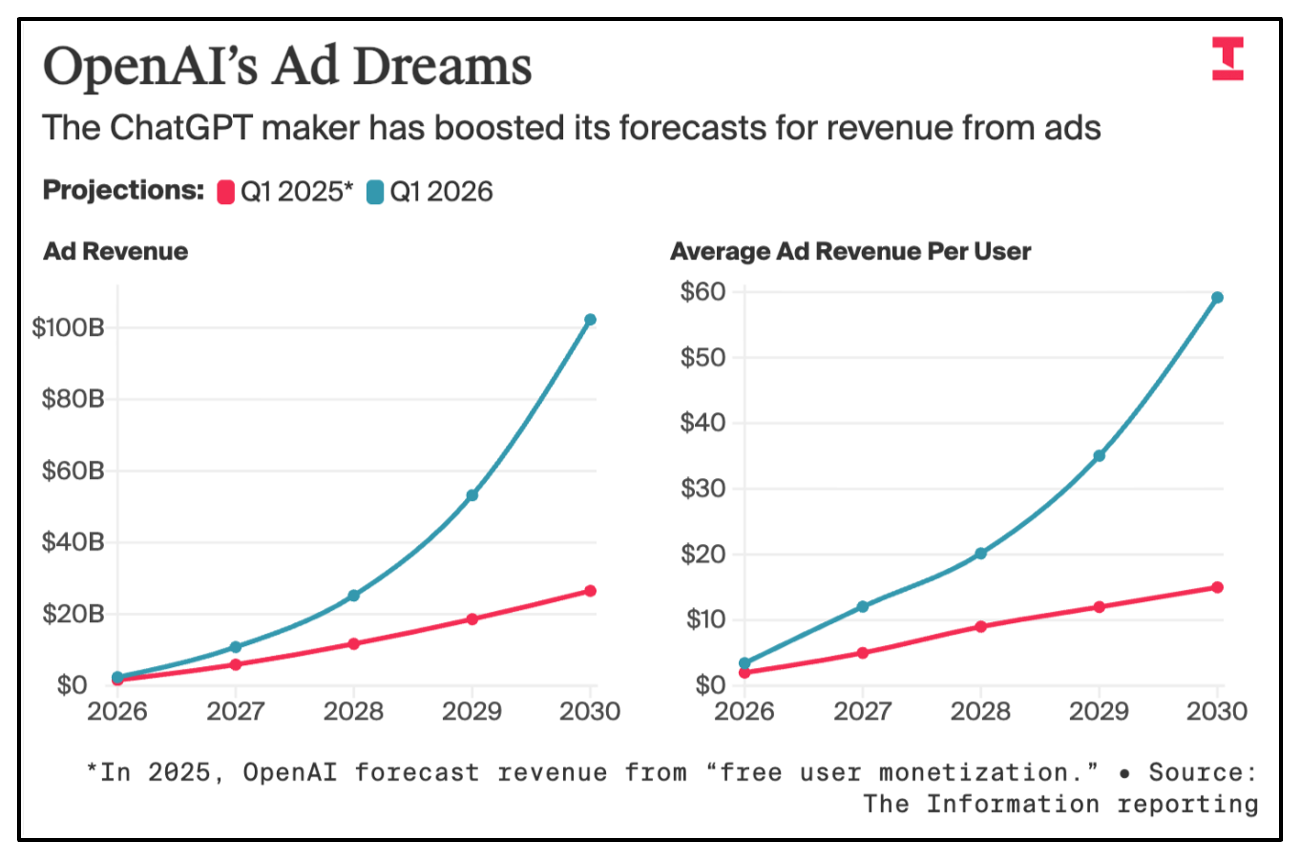
According to Axios and The Information, OpenAI raised their last round on projections of $100B ad revenues by 2030. To put that number in perspective here it is against where the Big Ad Three are today:
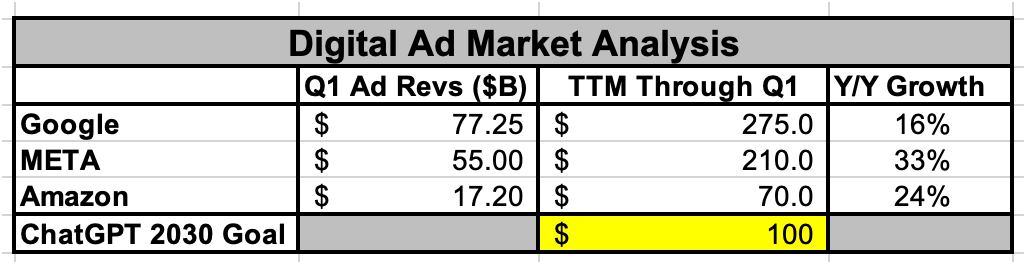
ChatGPT is starting at 0. It took Amazon, with their giant distribution 20yrs to get to $70b (started in 2006). It took META 12yrs and Google 17-18. Can they do it? We’ll see. Life on the exponential only guarantees one thing: predictions are very very hard for humans to wrap their heads around.
Amazon’s Job Posting Frenzy
Earlier in the week, Joe found this job posting on Amazon’s website→
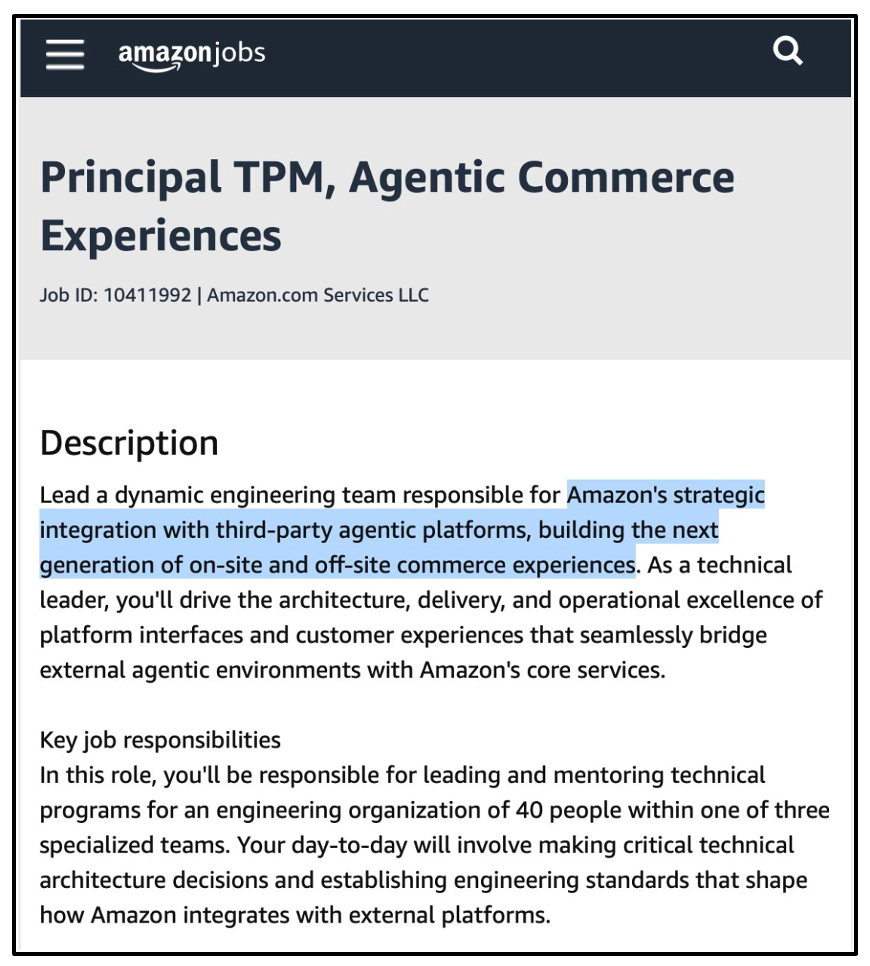
Retailgentic friend, Jason Del Rey covered this in the Aisle here (usually paywalled but his one is free - try it out and sub!)
Both Joe and JDR are assuming this means that Amazon is about to embrace one of the Agentic Shopping Engines like Gemini, ChatGPT, Perplexity, Meta, Claude, etc. The most eye popping part of the job listing is this part, that I think is causing the frenzy: “leading and mentoring technical programs for an engineering org of 40 people" within one of three specialized teams. More on that in a sec.
I’m going to diverge on this one and take the ‘under’. Let’s parse through the job listing closely with a bit of background first:
Background
Key datapoints for my thesis from the last 60 days:
3/11: Amazon Expands the Shop Direct program - adds a merchant center and we’ve heard though the grapevine they are out selling this program to brands not on Amazon (1P or 3P) aggressively. In fact Tuesday I’ll talk about Amazon being at Digital Shelf Summit which has to be a first.
4/28: Amazon announced they have joined UCP - Way back then (haha) I predicted a UCP checkout will be what replaces the browser-based Buy-for-me implementation that is a sub-set of Shop Direct. (I suggest they brand it UCP-for-me ;-) )
4/29: In the EPIC Quad Earnings Day Jassy was 100% NOT complimentary on ‘horizontal search engines’ and was giddy over Rufus. They also mentioned Shop Direct in prepared remarks/PR.
One more background item. Amazon has a famously different management setup than traditional companies - they believe in a flat org with lots of two-pizza teams tackling opportunities with loose coordination. The role that sits off independently and attempts to herd these cats is called the TPM role. It’s quite unusual role and I’ve never seen anything like it. It’s also insanely hard because you are held accountable for shipping things and hitting KPIs, but none of the people report to you. It’s best described as a ‘influence and persuasion’ job with a mix of project management. Want to learn more? Amazon’s job site has a complete guide the the TPM role here.
Fun Fact: I have a lot of unusual hobbies. I met my first Amazon exec in 2005 (Sebastian Gunningham) and it blew my mind how they operate compared to Google/Facebook/eBay. Ever since then I have been studying their management principles as closely as possible. It’s really fascinating stuff and it will be interesting to see how it changes through the AI era.
Amazon is playing Defense, not Offense here.
To summarize the Retailgentic 4/28 article into one picture:
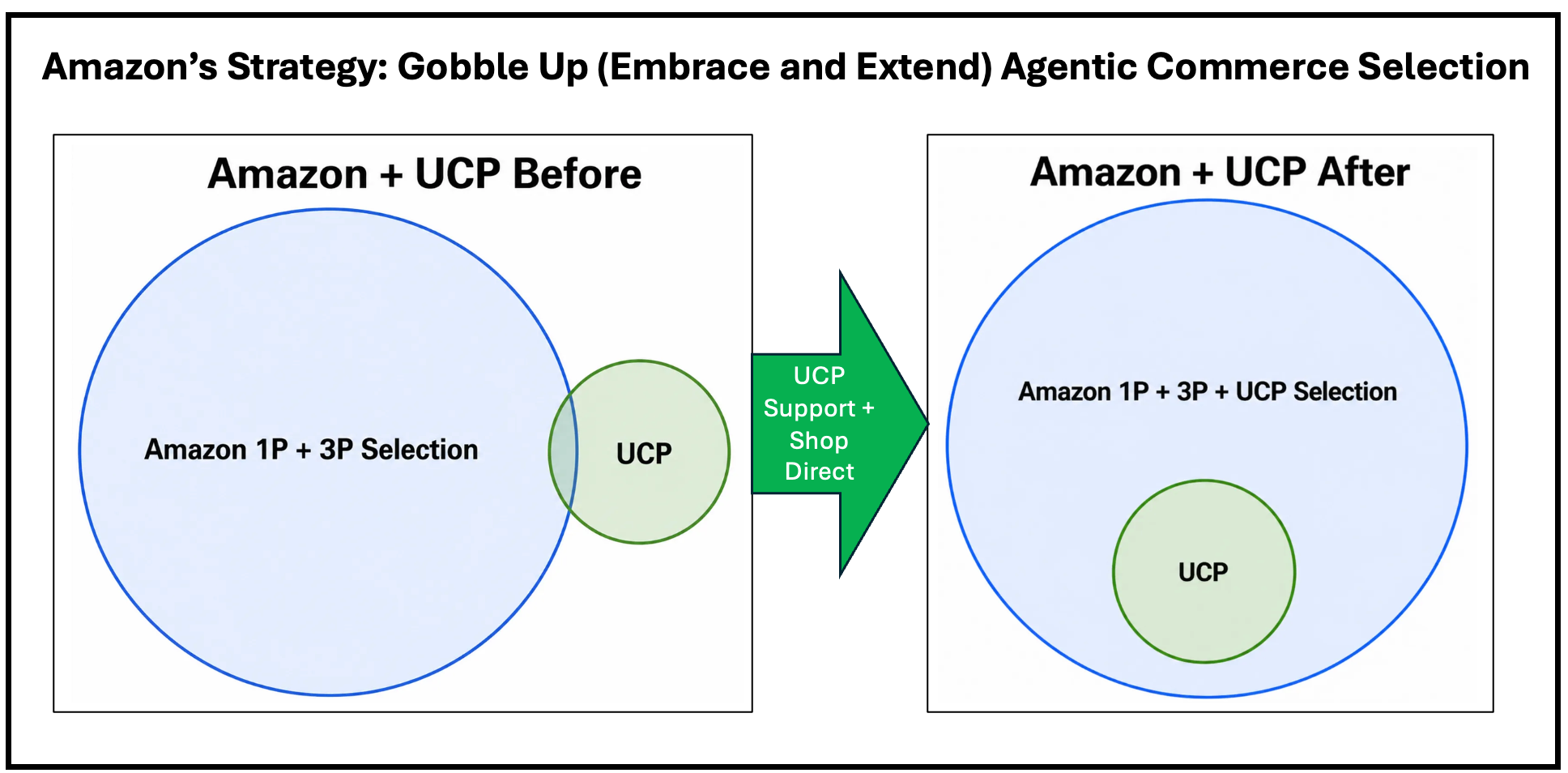
I believe Amazon sees UCP/Agentic Commerce as a threat - a viable alternative to Amazon 3P with cheaper economics, but most importantly, a set of great inventory that is not available on Amazon. (The left side of the diagram).
By really leaning into Shop Direct and UCP they ‘eat’ the threat by making the selection effectively available to the Amazon shopper via Amazon.com and taking away any reason what-so-ever to leave the Amazon ecosystem. In business strategy this is called ‘Embrace and Extend (and sometimes…Extinguish).
My Big Amazon TPM Agentic Commerce Prediction….
My prediction sits on the fact that Amazon could easily have 40 devs working on both Shop Direct (SD) and Buy-For-Me/UCP programs. You could sketch-out people working on: Merchant Center, SD sales support, SD account management, SD feed processing, SD→ Rufus integration, SD→ Search integration, SD→Mobile, SD/BFM front-end, SD/BFM back-end, etc. Heck maybe you even want to integrate it with Alexa+. That’s like $10m to protect the $743B (TTM as of Q1) cash cow? Jassy can find that in the couch cushions up in Jeff’s old office.
Therefore, I believe this TPM person is coordinating the Shop Direct teams rapid growth in functionality and merchants as well as the move from the browser-based checkout in Buy-For-Me to the UCP which has the side benefit of allowing them to slurp up all the delicious selection that currently sits outside the Amazon Empire.
What confuses me the most is the stated fact in the ad that it’s 40 people across 2-3 teams. That’s a range of 13-20 people per team. Those are either massive pizza’s or they now have a 3-4 pizza team rule. I have heard from insiders that after Covid and RTO the previously religious 2-pizza team rule has flexed a lot.
Only time will tell, but the good news is I can guarantee you we’ll know before November 26th (🍗)! Stay tuned.