


One of our most popular articles this year was my daughter Rory’s story on how she and her friends did their back-to-school shopping by ‘just asking chat’.
Then during Fall break when she was home, I watched her stand in front of a wall of lip liners at Ulta, point her phone at the display and give ChatGPT three criteria. It told her which product fit and where to find it. Third up from the bottom, fourth from the right. Pretty good directions for something that doesn’t work at Ulta.
Now put yourself in the shoes of the brand two slots over. At what point did you lose the shopper? Was it the register? I’d argue it happened right there in the aisle. By the time somebody taps a card, your chance to win that recommendation has already passed.
In fact, our proprietary ChatGPT user behavior research showed that 84% of the time, the consumer ended up picking one of the products from the product card.
What got my attention this earnings season was seeing a version of that same behavior show up at Google and Amazon, two companies with a very expensive front-row seat to how people decide what to buy with extremely high consumer shopper distribution.
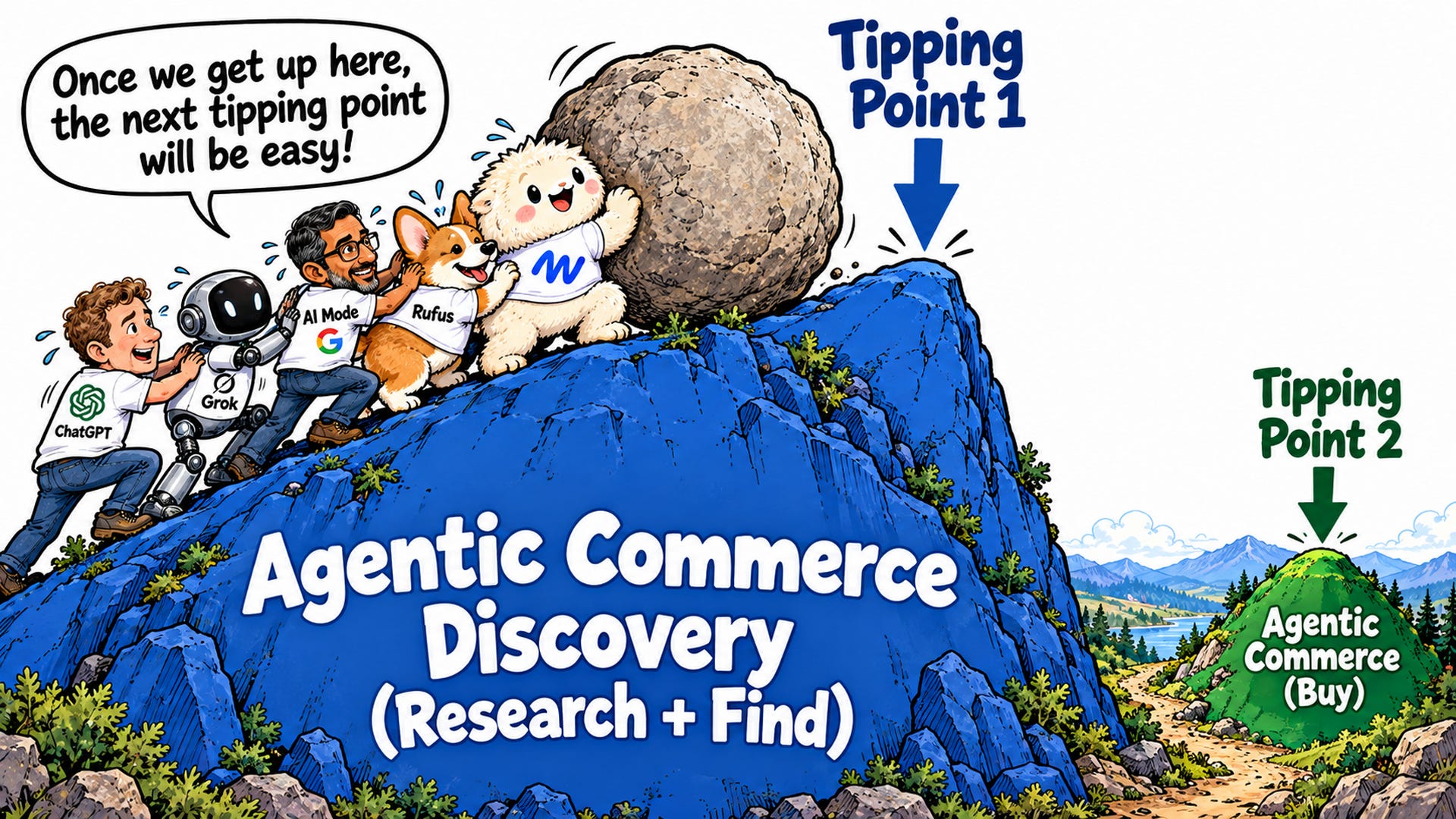
Longtime Retailgentic readers know my three steps of the shopper’s journey. Research → Find → Buy. Research is figuring out what fits your needs. Find is narrowing the field to a specific product and offer. Put those two together and you have Discovery. Buy can be, and frequently is, a separate step in the shopper’s journey. I can ask an agent to find the right product and still be perfectly happy to complete the purchase myself, knowing I’ve found the right product that matches my specific criteria and is the best competitive offer out there.
My thesis is that Q3 was the tipping point for Discovery. Buy will come later, but not too far behind. The handoff will happen fastest where the shopper already trusts the retailer (Amazon/Walmart) with an address, a payment method and the inevitable return. Then, ironically, they will help consumers become comfortable and they’ll move that behavior outside of the retailer’s walls to answer engines and personal agents.
Exhibit 1: Fresh McKinsey Data
McKinsey published its new Agentic Commerce Consumer Survey where they surveyed ~21,000 consumers across 11 markets in June. So this is a look at the shopper heading into Q3.
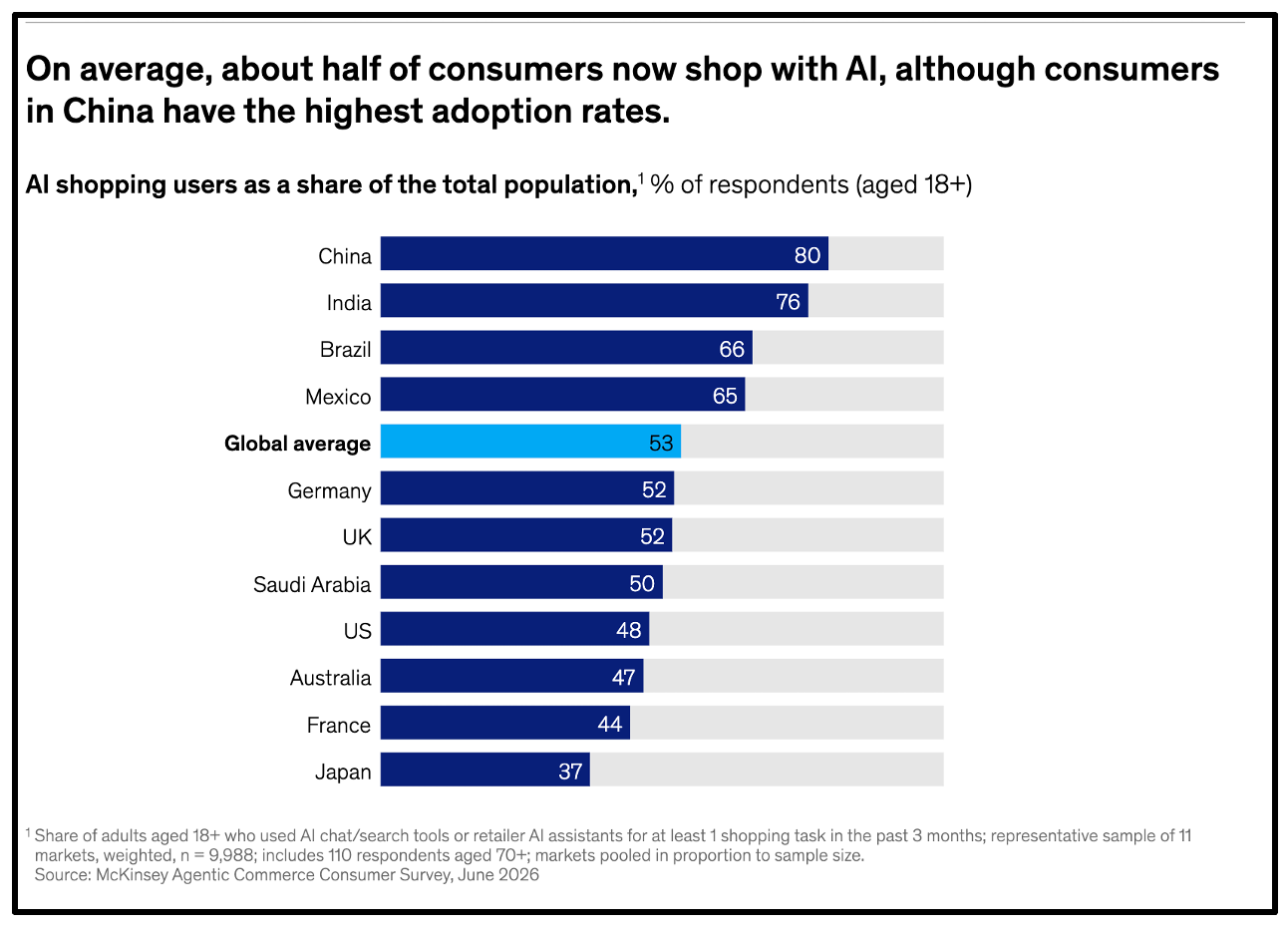
The headline number was 53%. Across the markets surveyed, just over half of adults had used AI for at least one shopping task in the previous three months. In the US it was 48%. “Shopping task” covers a lot of ground. Turn to Exhibit 4 on page 7 and you can actually see where shoppers put AI to work.
Sidebar: ACO Everywhere
In July we introduced the concept of ACO Everywhere here. The TL;DR is that there is increasing evidence that not only are consumers adopting Agentic Commerce quickly, they are using multiple ‘ACO surfaces’ in their shopping journeys.
McKinsey has fresh new data that supports this and shows a fascinating global picture:
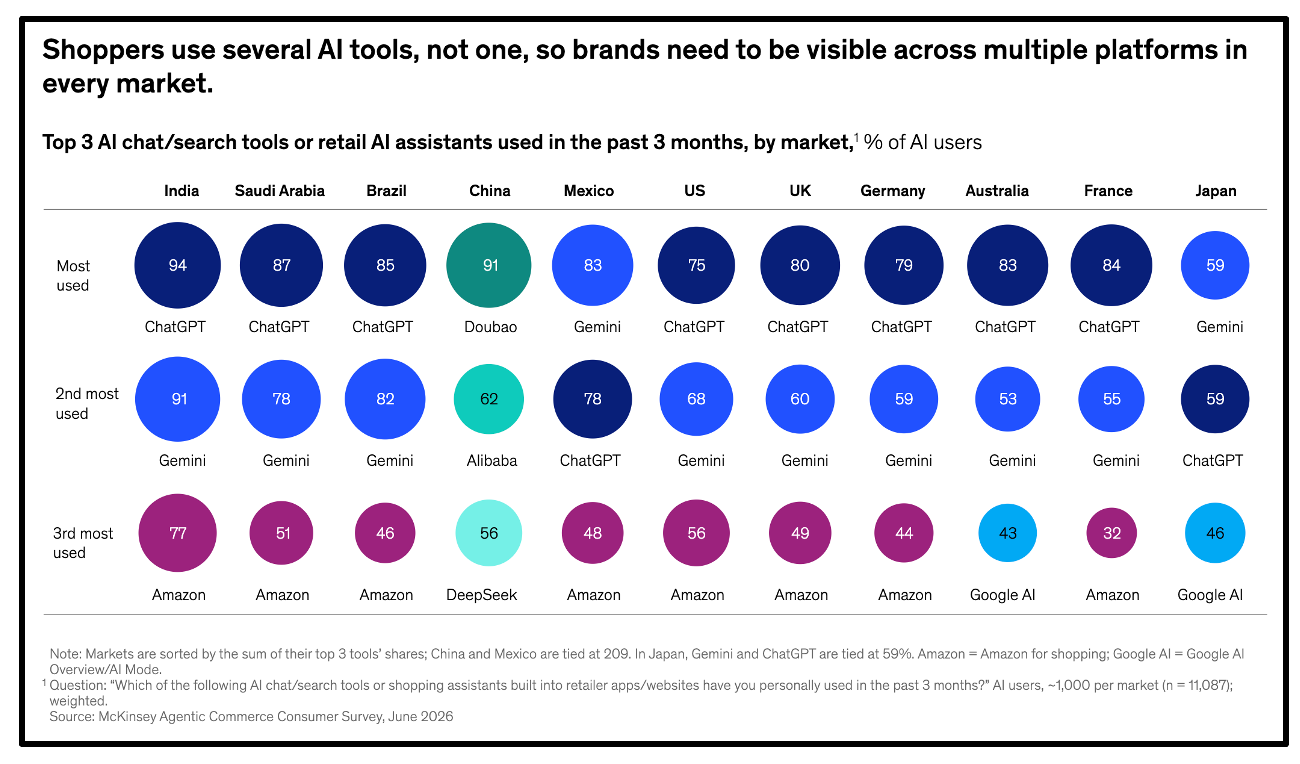
For most countries we are settling in on ChatGPT, Gemini, Amazon but you can see there’s a wide diversity especially in China and Japan. But ChatGPT has the ‘most used’ pole position in 8/11 countries measured.
Compare Products.
Among AI users, 50% had used a stand-alone AI platform for this, versus 29% who had used a retailer’s assistant. Think about what that means if you’re a merchant. Before the shopper ever thinks about your site, there’s a coin-flip chance that an agentic commerce surface has already explained the differences between your product and the one next to it.
Complete Checkout
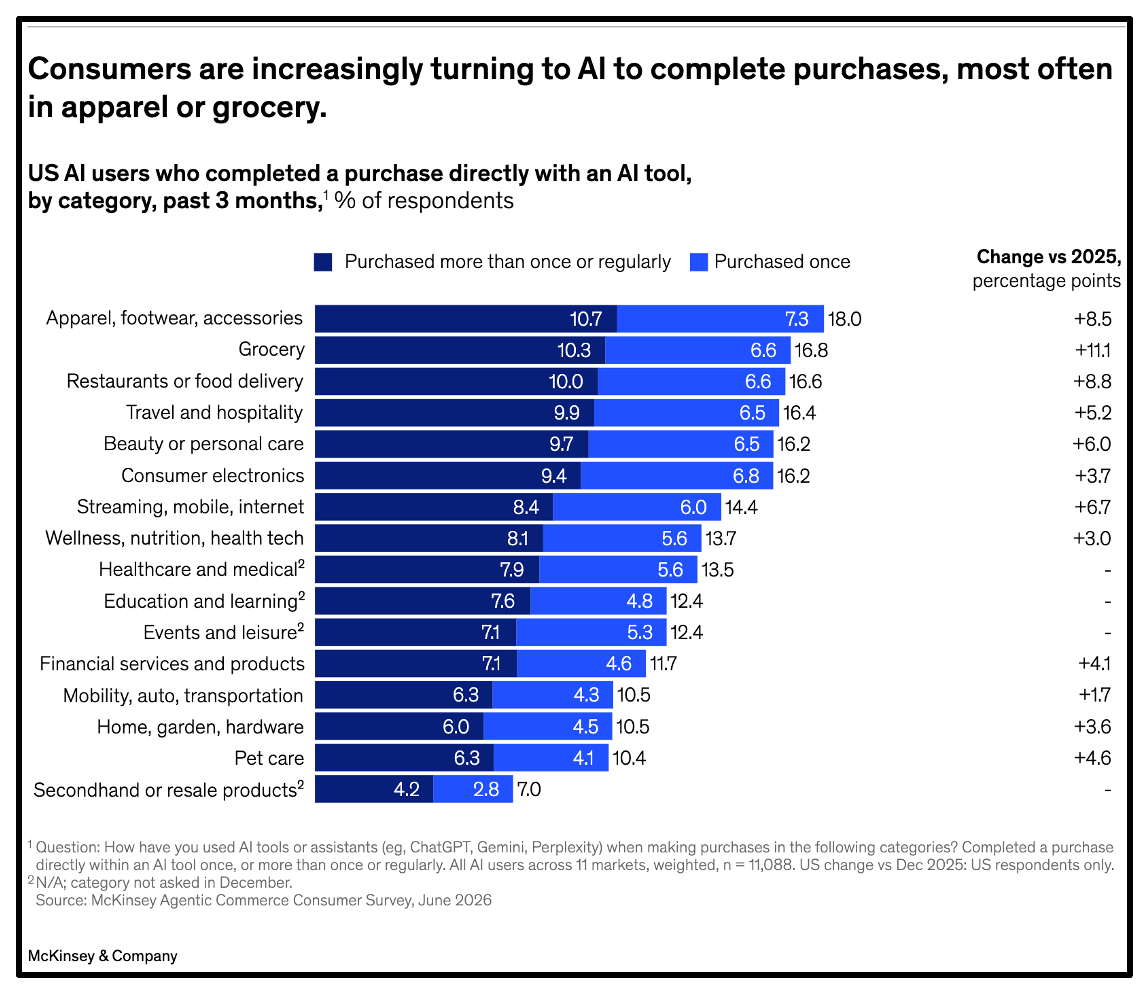
Now for the early Buy/Checkout data. Across comparable categories, McKinsey puts the average share of US AI users reporting a purchase directly within Agentic Commerce at 17%, up from 10% in the earlier comparison.
We saw the stakes play out in our own ChatGPT clickstream study. When shoppers reached the list of offers for a product, 76% picked the first offer and only 14% picked the second and 84% of the time, one of the product cards won the purchase, regardless of where it completed.
Those are the highlights from that report, but I recommend reading the whole thing, it’s one of the best of the year. That being said it’s stated preference as we love to point out. The next two exhibits are observed behavior through the lens of Google and Amazon’s earnings.
Exhibit 2: Google’s Q3 Results
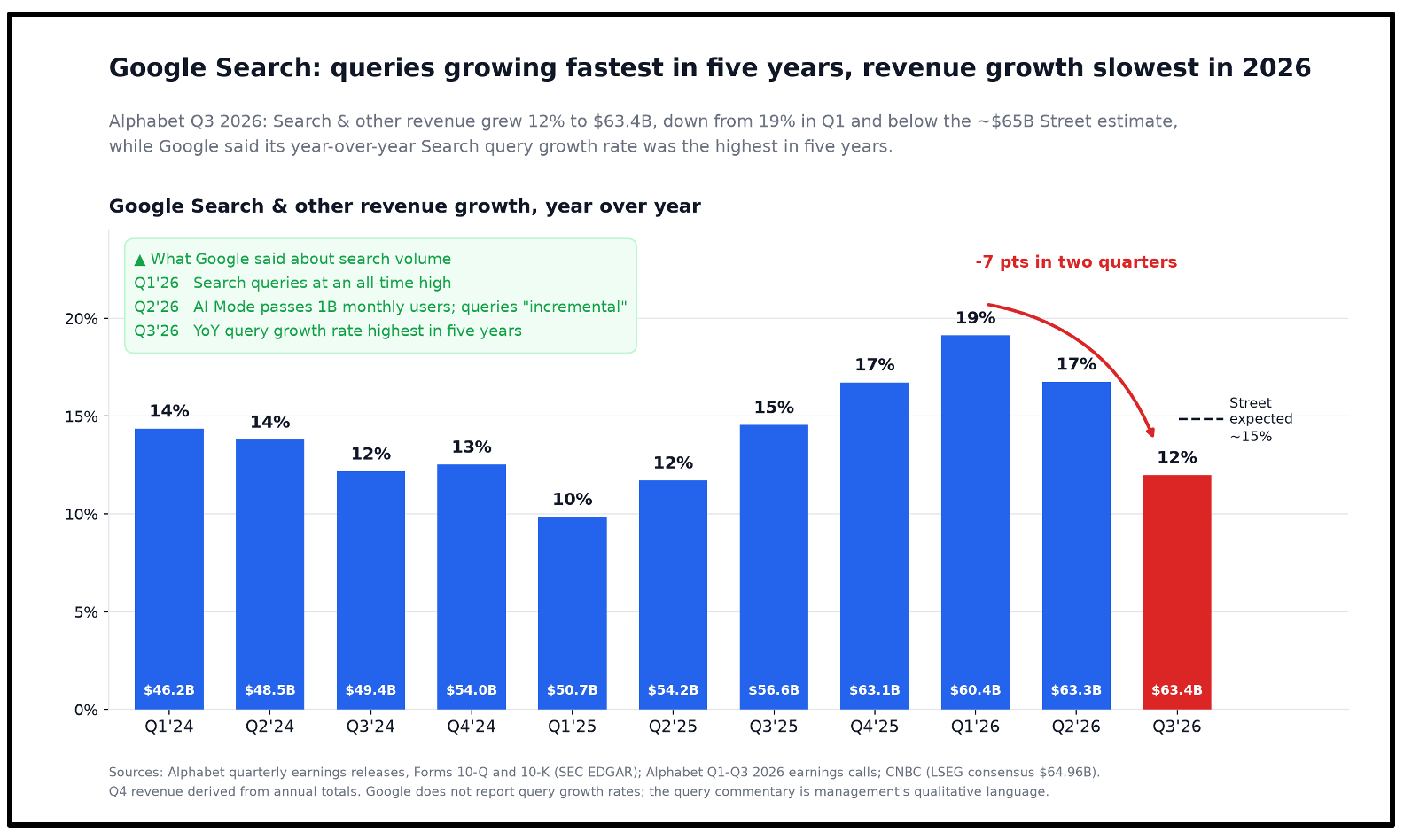
In Google’s earnings (Wed Oct 28), there was a mystery: Google stated very clearly that the year-over-year growth in Search queries was the fastest in five years. But at the same time, Google Search & other revenue grew 12% to $63.4B, down from roughly 17% growth in Q2. This was well below Wall St. expectations and since then the stock has traded down 14%.
Looking at the absolute dollars highlights how extreme this change was:
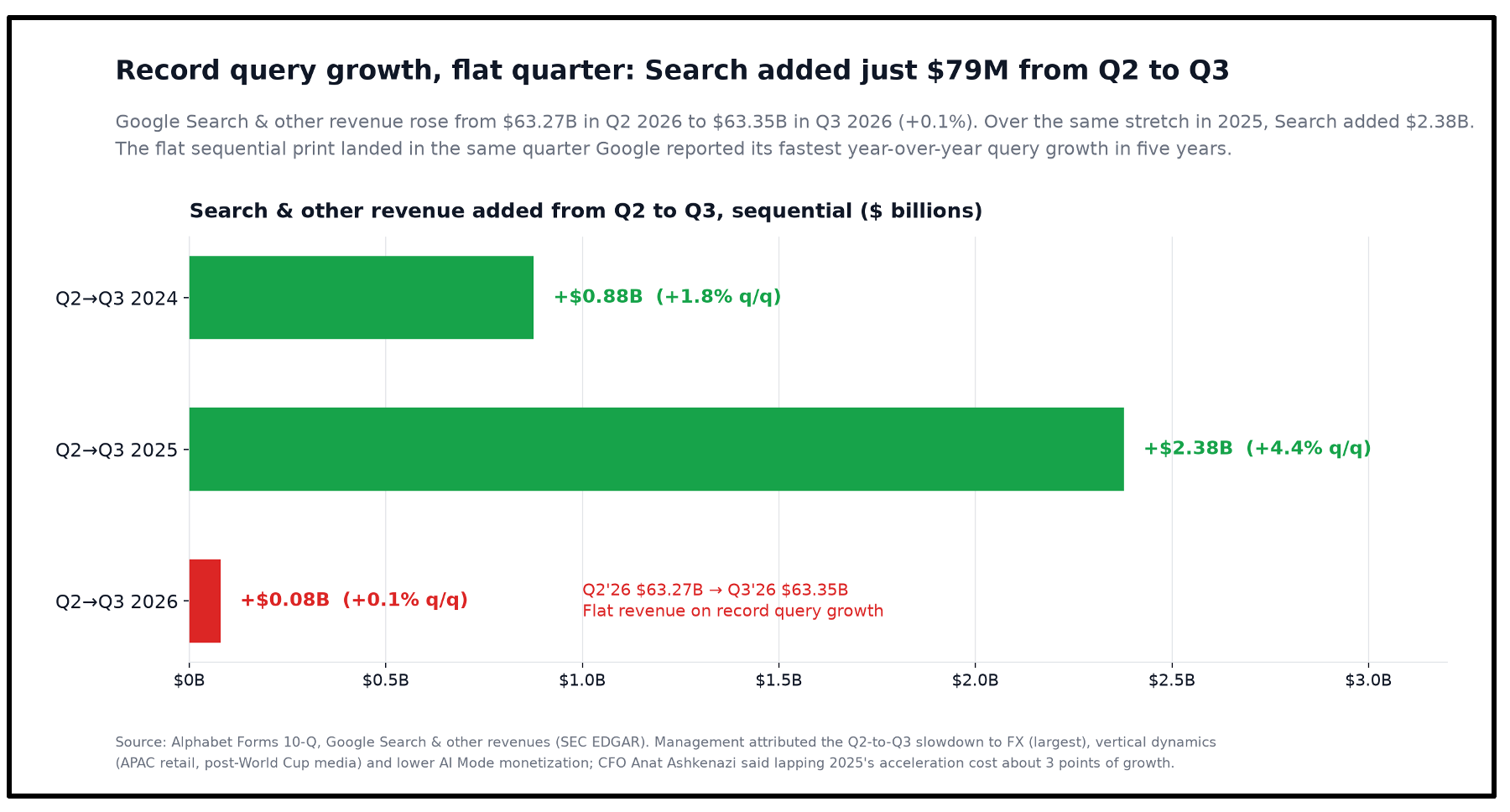
Here we see the incremental new revenue:
2024: Q2→Q3 - $880m - 1.8% q/q
2025: Q2→Q3 - $2.38b - 4.4% Q/Q
2026: Q2-Q3 - $80m - 0.1% q/q - basically flat growth on record query growth.
Here’s what’s going on..
The Solution
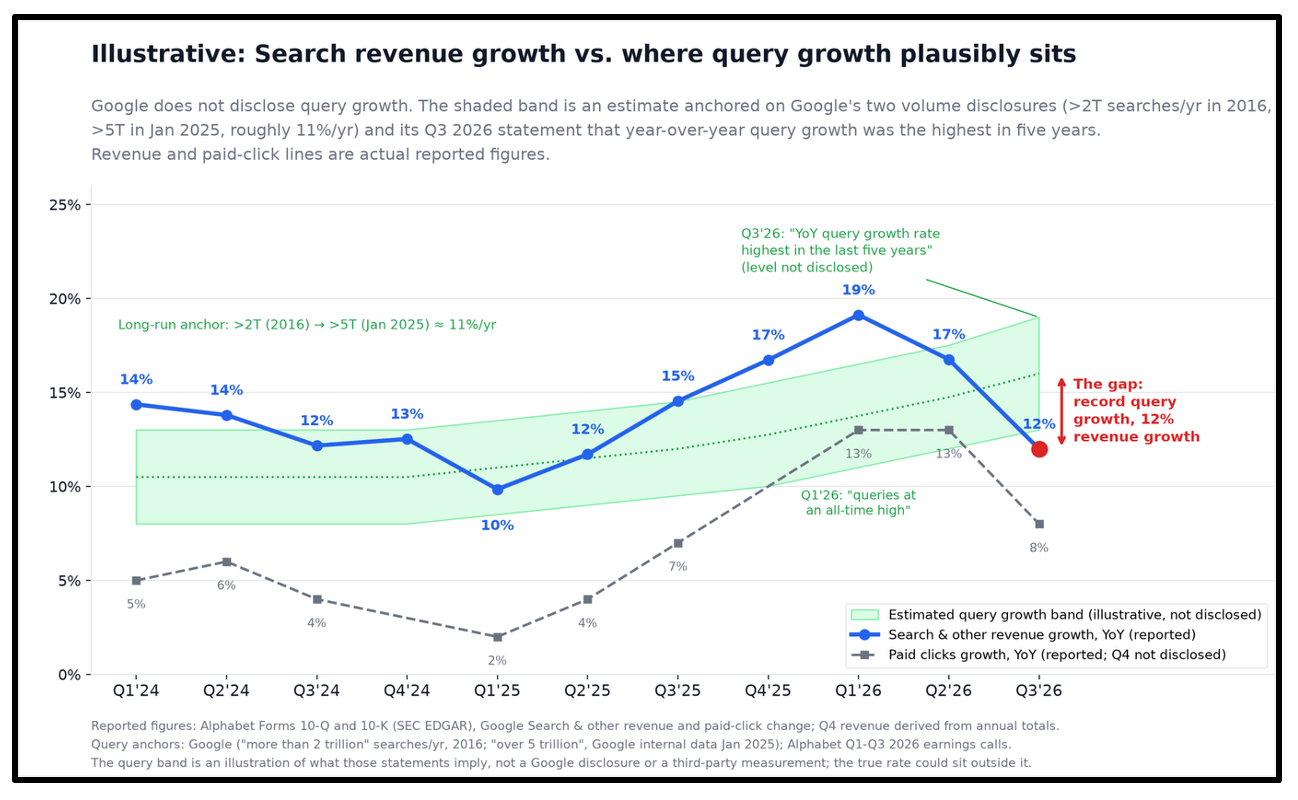
Unfortunately, Google doesn’t give us anything quantitative on search volume other than the occasional hint (e.g. fastest growing ever), so we can’t show you the lines diverging, but above is an illustrative example. What we have is searches surging, but monetization going down rapidly.
In the Q+A part of the earnings call, Google’s chief business officer, Philipp Schindler, pointed to the answer: AI Mode queries were growing fast, BUT monetizing at a lower rate than traditional Search. There are also some FX elements and y/y World Cup comps, but I’m guessing what’s happening here over the arc of the trend forming is that consumers are moving faster to AI Mode than Google anticipated.
But Why?
We’ve stated on these digital pages that the first principle in our world is consumer behavior, and in both the Google and Amazon results, we see first principles at work - in the form of rapidly changing shopper behavior.
Why is AI Mode surging? Easy: because AI Mode is objectively better than traditional Google. Answers are better than search results. On top of that,iIn the last 3-4 months Google has made several UX changes that make it easier to slide right into AI Mode.
Examples include clicking ‘more’ in AI Overviews, which now goes to AI Mode; Universal Cart and UCP-powered discovery in traditional search mode; and changes to how the ‘AI Mode’ box works and where it’s placed.
What interests me is that shopper behavior can change inside Google’s own network so quickly that it’s out-pacing the best monetization engine ever invented. You can hear that the execs are blown away by the characteristics of the AI Mode searches too. Here’s a sampling of reasons to love this move long-term:
Longer queries: Pichai said AI Mode queries are, on average, three times longer than traditional searches, reflecting more personalized and complex questions.
Multimodal usage: One in five AI Mode searches globally uses voice, images, or documents - not just typed text.
A unified Search experience: Google is building “one seamless experience across AI Overviews, AI Mode, and traditional search,” rather than treating them as separate products.
Incremental queries and commercial intent: Schindler said the majority of AI Mode queries are incremental, and many are upper-funnel queries that capture “new high-value commercial intent.” Management sees this as creating more monetization opportunities over time. FWIW, I agree, but Wall St probably won’t be too patient waiting for it to materialize.
Sidebar: Google is Working on a Consumer Shopping Agent (My prediction: It drops 11/12/26)
Outside the scope of this article, Sundar was pretty clear on the Google call that ‘later this year’ they will launch a shopping agent. We’re 23 days out from Thanksgiving. Last year on 11/13 they announced ‘agentic checkout’. I suspect we’ll learn more about this agent in the next 3 weeks or sooner. That was the Thursday 2 weeks before Thanksgiving. Mapping that to 2026, I’d put the most likely day at November 12th. Predictions are hard, being super specific is 1000X hard, let’s see how this goes.
Exhibit 3: Amazon’s Q3: AFS and the Amazon Ads Business Slow Down
Alexa for Shopping (AFS, formerly Rufus) starts with an advantage any independent agent would love. Amazon already knows what you ordered and where to ship the next one. Back in Q2 it reported 350M+ customers had used AFS in the trailing year. On Thurs 10/29, Amazon announced Q3 results and revealed that number surged to 400M+, plus interactions were up 570% year over year.
Jassy also said US customers who used AFS spent 50% more per order than customers who didn’t. As I asked last quarter, how much of that is Amazon’s best shoppers being the first to try the thing?
Ready for Deja Vu?
But get this, at the same time Amazon’s AFS Agentic Commerce’s usage is surging, you sitting down, the Ad system has slowed down. Where have we heard this exact same thing before?
Cleaning out the y/y noise…
Right after the earnings dropped and before the earnings call, I posted about the steep drop in y/y Amazon Ad Revenue:
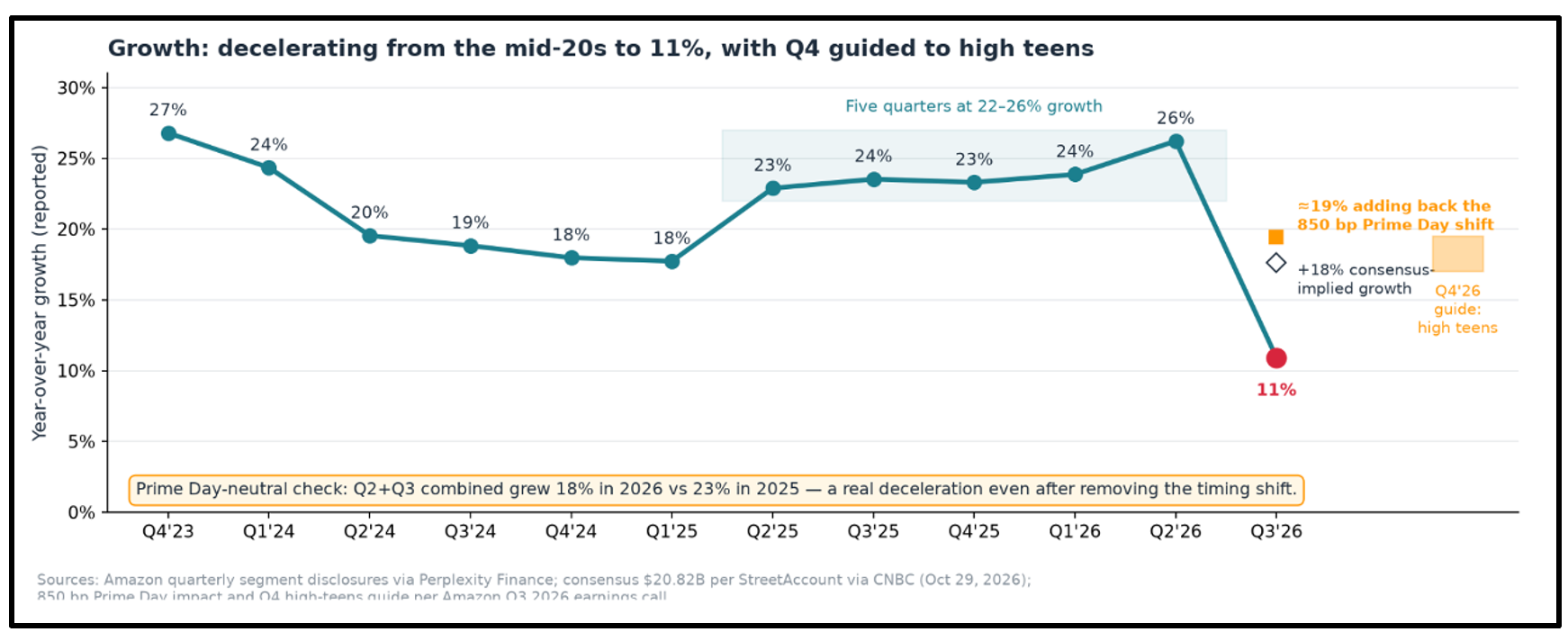
Over 50 LinkedIn commenters were quick to point out that with the pull-forward of Prime Day from Q3 in 2025 to Q2 in 2026, it created a huge comp, but when I did back of the napkin math, it still didn’t add up. There was also a very unclear SEM piece and an NBA piece referenced on the call.
Regardless, my macro point was - you can see Amazon Ads humming along at 22% and sure you see the surge to 26% and then dip to 11, but even moving the $ manually, you have a sudden new normal much lower than the 22-24% y/y growth we’ve gotten used to since Q2 2025.
After earnings, and digesting all the Wall St. reports, here are the details that emerged that point to what’s going on and, I believe, validate my theory.
Clearing out the Prime Day Move
First, Mark Mahaney had a great idea, to get rid of the Prime Day move - why not look at Q2+Q3 in 2024, 2025, and 2026 to get back to ‘apples-to-apples’ comps. Great idea and here’s what that looks like:
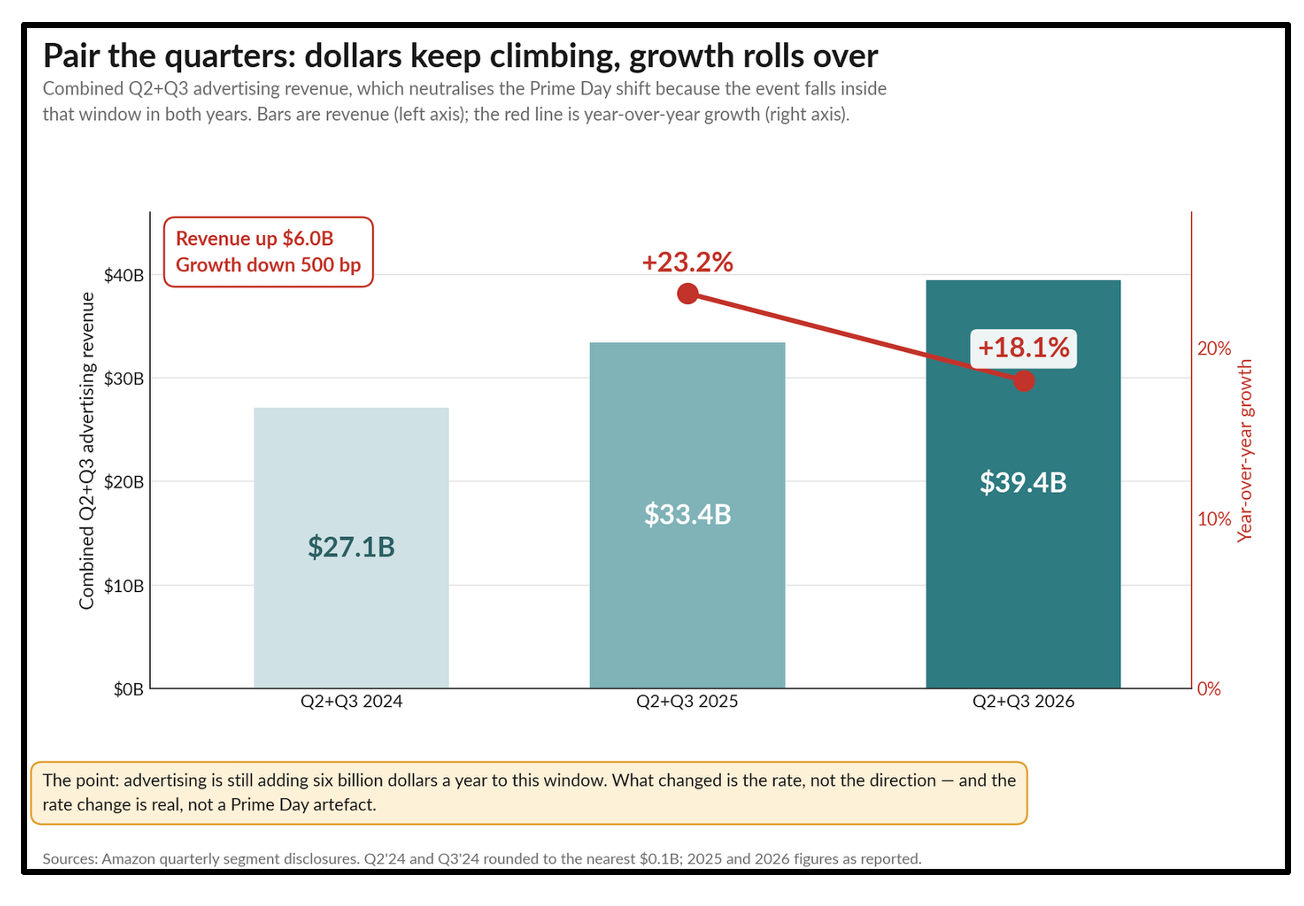
Now you can see we went from 23% y/y growth in Q2+Q3 25 to 18% apples-to-apples.
That gets us the story for Q2+Q3, but then Amazon not only guided Q4 and forward to ‘high teens', but Wall St gave their Amazon Ads line in their forecasts a serious haircut into 2027 and beyond:
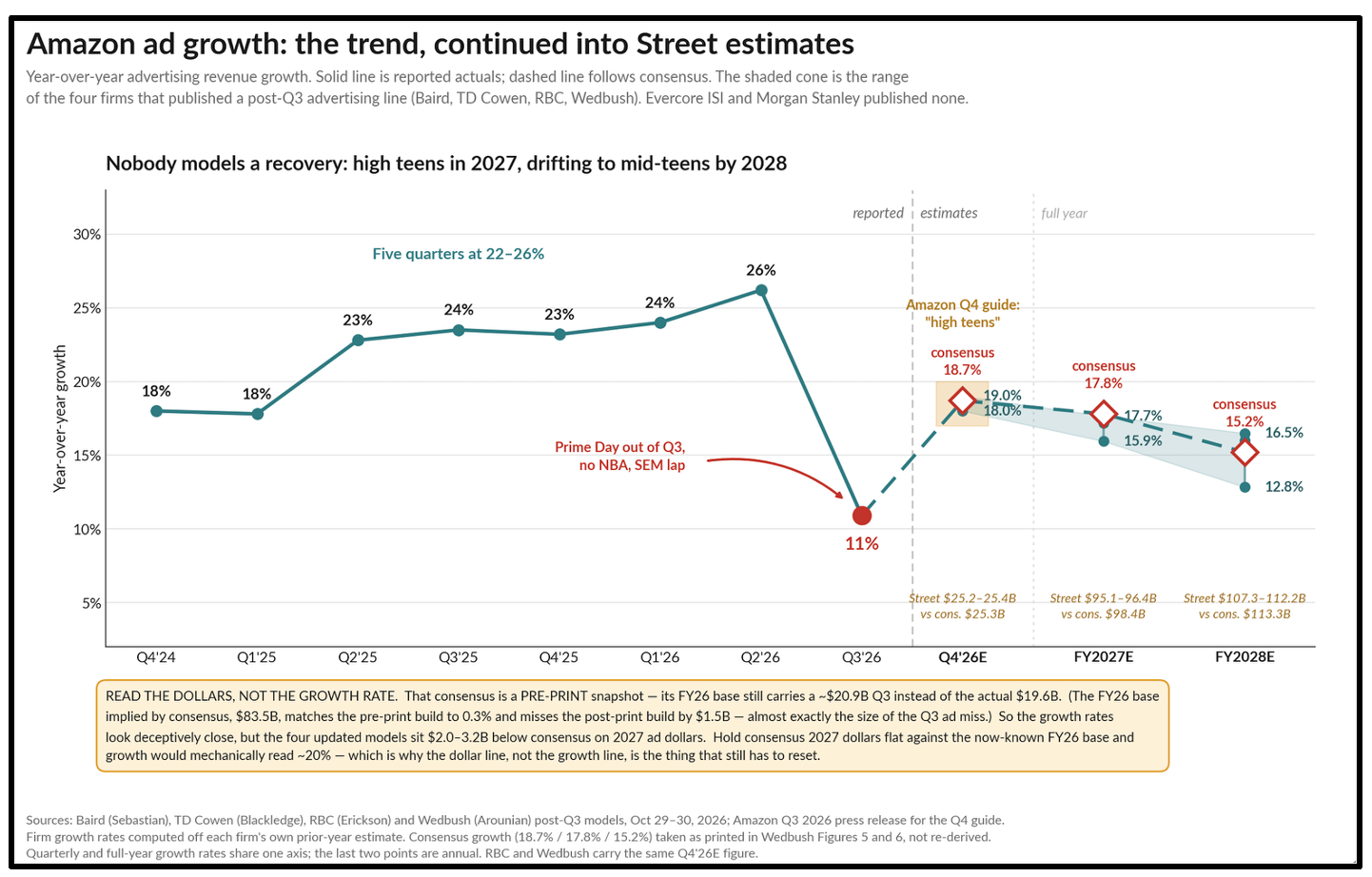
This happened just days after Google saw a similar situation: a surge in new consumer behavior and a reduction in monetization. I think it’s too much of a coincidence for it not to be the same thing.
Consumers are moving from traditional Google and Amazon search experiences to their new AI-powered experiences (AI Mode and AFS) and it’s putting monetization pressure on the highly monetized mature discovery surface.
Which agent should Amazon be watching?
Could some of that be driven off system by ChatGPT, Muse, etc? Look at that data from McKinsey - 53% and while Google is in the mix, you don’t see Amazon there. We’ll never know because Amazon won’t disclose, but these three things coming out at the same time really made me 🤔.
On the Jason & Scot Show Episode 354 Q3 Amazon deep dive (here) , Jason pointed out that I am looking at Amazon’s ad slowdown and trying to figure out whether ChatGPT or Muse was stealing the traffic. Jason’s candidate for the agent responsible: AFS. I count that as Agentic Commerce, so sure.
But my Spidey sense says that Muse’s 10m extremely active users and ChatGPT’s 1.2b and even Google’s surge in AI mode have to be causing some up-stream disruption. What do you think?
The Agentic Commerce Naysayers Chime in: Eric, Andrew, Mirages, Hallucinations, Definitions and their Buy Button Obsession
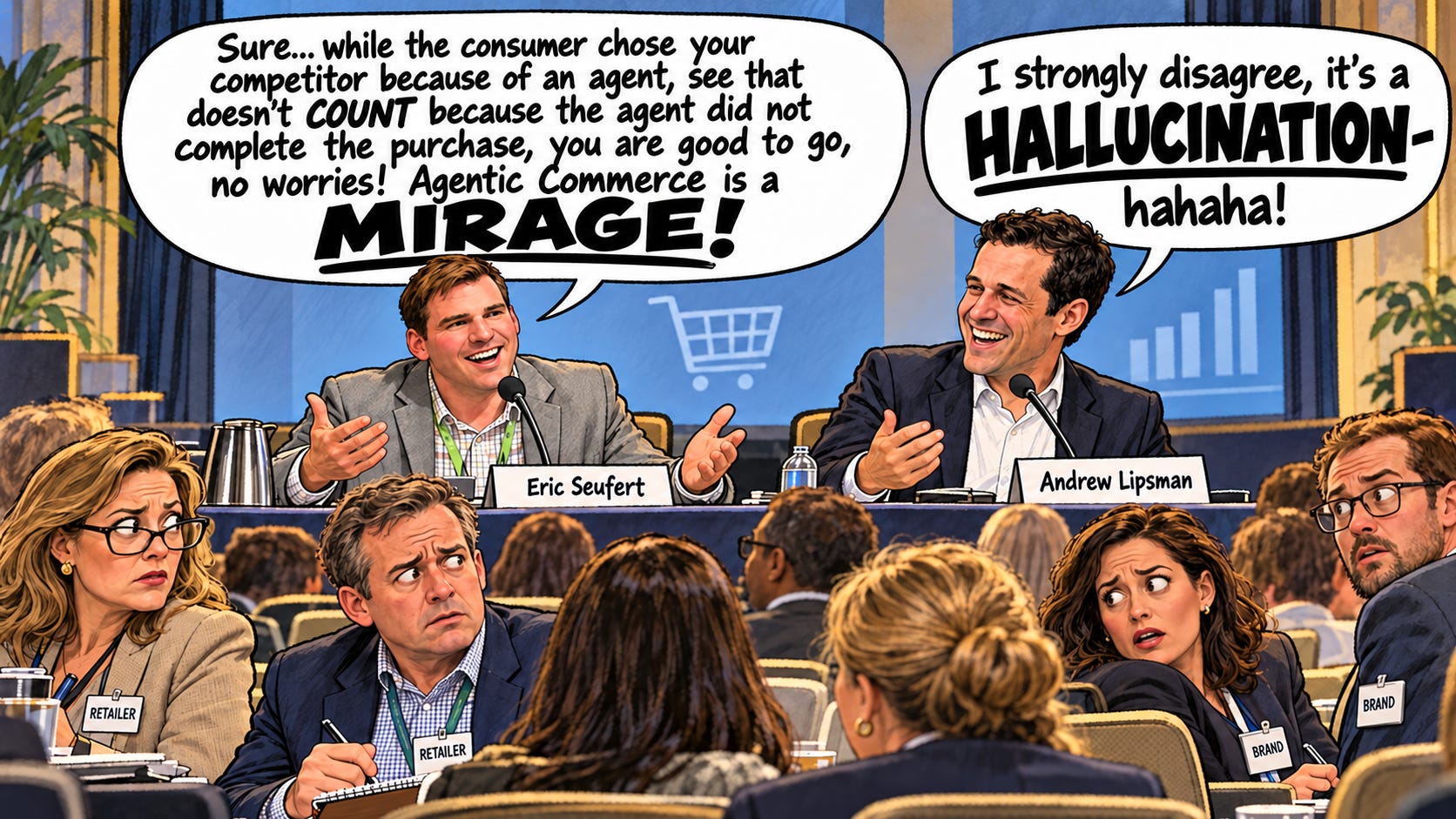
I’ve read with great interest all previous installments of Eric Seufert’s ‘Agentic Commerce is a Mirage’ series - he recently came out with part 5 on the back of Walmart’s new gateway and Amazon’s Q3 surge in AFS supports his position. Eric’s actual position (really a definition imho) is more interesting than the attention grabbing title of the series. Right there in part one, he says retailer-owned agents make economic sense. He doubts an independent agent can get between Amazon and its customer, take a fee and keep the data and advertising opportunity for itself. Amazon blocking Muse and the trouble with OpenAI’s Instant Checkout are pretty good exhibits for the defense.
Where we part ways is what a brand should conclude. Let’s give Eric the whole economic argument. Walmart sets the rules, Sparky handles the transaction and Walmart keeps the payment relationship. Now suppose an outside assistant has already helped the shopper pick three blenders before it asks Sparky which ones Walmart carries. If your brand’s blender doesn’t make the list, how much comfort do you take in knowing Walmart still processed the payment? Walmart’s announced Agent Gateway makes that division of labor possible. We can argue about the eventual fee split while brands worry about losing the game up-stream.
Eric’s original thesis · Part 3 on retailer agents · Part 5 on Walmart · Walmart’s announcement
Hallucinations
Andrew Lipsman’s ‘Agentic Commerce is a Hallucination’ objection starts with the shopper. In his original piece, easy purchases save too little time to bother delegating, while hard purchases are exactly the ones where you want to exercise judgment. His October follow-up catches a genuine sleight of hand. Meta telling us people used Muse to shop and that completed purchases averaged over $200 tells us precisely nothing about how many of those shoppers bought something.
But my daughter at Ulta is a pretty good example of what’s missing from Andrew’s easy/hard split. She had opinions about the product she wanted. She gave the agent three criteria and what she was happy to delegate was discovery for the one item on a crowded shelf that met her criteria. Buying it herself at the counter is entirely consistent with letting AI decide which brand gets the shot. Andrew’s test would record no agent purchase. I would count it as Agentic Commere; Andrew does not.
But, from the brand’s perspective, something pretty important happened - AI played a HUGE role in the zero-sum game.
I’m focused on optimizing for the seller of the product, and they 100% should count Research and/or Find and/or Buy as part of Agentic Commerce, which is why I do.
Andrew’s original case · His October headline rewrites
What Can YOU do for Holiday 26?
If you agree with my definition of Agentic Commerce and that the entire shopper journey from Research→Find→Buy is important, my recommendation is to pick a holiday SKU you care about. Give Google AI Mode, Muse, ChatGPT and AFS the actual constraints a customer will bring to the journey in this AI Era.
Does your product make the shortlist? Is the reason accurate? Can the agent find an in-stock offer that will arrive in time? Is the offer right? Are you happy with the product card(s) that pop? If you wait for autonomous checkout to get big before you care about Agentic Commerce, you may be scratching your head for the next couple of years, wondering where all the shoppers and traffic to your site went, while that checkout button starts to get pretty lonely - at that point it maybe too late to make up lost ACO ground.
"Third up from the bottom, fourth from the right."
The new shelf placement is an answer, not an endcap.
Agents find. Shoppers still decide what goes in the basket.