


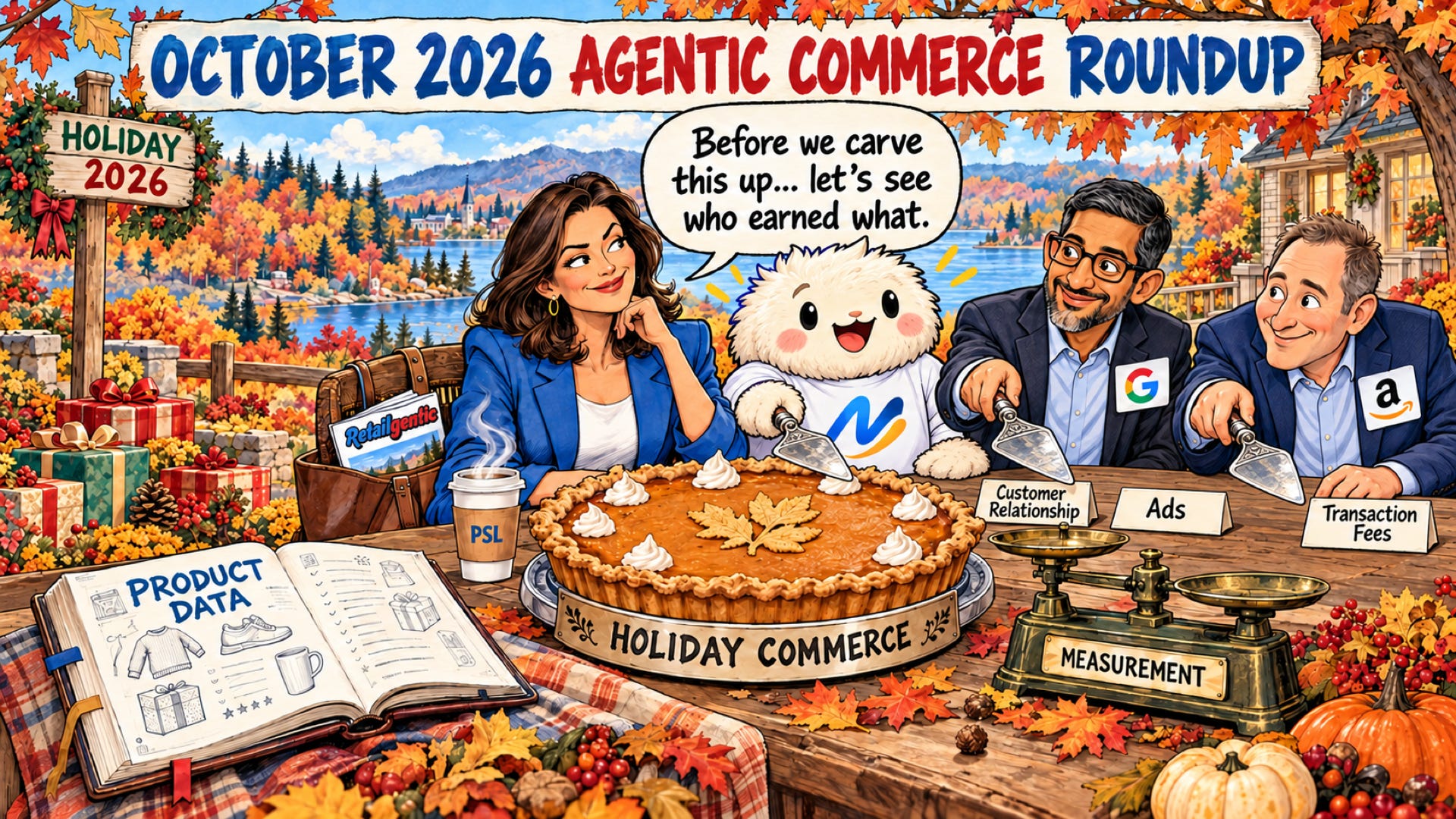
Just when we thought the Agentic Commerce news peaked in September, October said - hold my Pumpkin Spice Latte! In October at Retailgentic we covered all the breaking Muse data and stories and then META’s Q3 blow-out, pivot to Muse: In this 2 part series called Deep Dive into Meta Muse (Part 1 is here and Part 2 is here). The Earnings shared the stage with the big Claude Duet news and Walmart’s new open-door policy for agents here. Meta’s earnings put us into a new gear, I call: Musemania - welcome to the start of the MuseMania era!

The other breaking news in October was the General Availability of Google’s Univeral Cart - it’s not only in AI mode, but I’ve gotten excited DMs from readers seeing it in their trad Google and I see it there as well - it’s a full-on agentic commerce Google take over for Holiday 26!

The other big October news came from the launch of our new podcast and companion substack, Adgentic featuring the amazing Kiri Masters. The stats for the first episode (snack size at only 13mins) are 🤯 - thanks for the support everyone. But remember, sharing is caring, tell all your colleagues that are interested in ChatGPT Ads, how RMN and AI are going to intersect, or even folks that deal with Google AdWords, Amazon Ads and TikTok paid media, about it because it’s all going to be impacted (hopefully positively, but could also be negatively - the topic of the first ep!) - so they need to track it.

Finally, our most popular post for October came from our in-house research into consumer shopping behavior on ChatGPT (here) . We partnered with the esteemed research firm Clickstream Solutions (led by Erik Van Buskirk). The TL;DR: ChatGPT Product cards drive 84% of the product choice influence. They basically behave very similarly to the Amazon ‘Buy Box’, but with a lot of Agentic Commerce twists along the way.
As if that wasn’t enough:
But Wait There’s More…
Those were the hair-on-fire, we have to alert people breaking news stories and important trends top-of-mind with merchants. One level down there were a ton of interesting stories - in fact we tracked over 40 that met our criteria we discussed internally. We’ve taken that, curated it down to the top stories we think you should track.
This month they fit nicely into three trends:
October Trend 1: Holiday Agentic Commerce Shopping Gets Real in 2026
October Trend 2: Are the platforms coming for the shopper AND the economics of the transaction? What’s this mean for retailers and brands?
October Trend 3: Retailgentic readers have an edge on this one, but the rest of the World is catching on that Product Data and Measurement Move to top priorities
I would say another theme running through those three trends is we see more and more evidence (swirling together stated preference and observed preference datapoints to triangulate as is our practice) that the agentic-savvy shopper is moving faster than the merchant’s ability to measure, merchandise and serve the new journey.
Consumers are asking AI what to buy. Platforms are figuring out how to get paid. Meanwhile, retailers are trying to answer a deceptively simple question: “Are we getting any of these customers?” and “what are they worth?”
Sometimes the answer is yes, but the analytics don’t show it. Sometimes the agent can’t get through the front door. And sometimes the product never makes the consideration set because the catalog can’t answer the shopper’s question.
All three are fixable. Let’s dig in.
Two quick editorial reminders if you’re new or were forwarded this by a colleague:
Data: We’ll distinguish consumer surveys, forecasts and observed behavior. Someone saying they would let an agent buy a gift is different from an agent completing the purchase.
Vocabulary: We use Agentic Commerce broadly across Research → Find → Buy, including answer engines, personal agents and retailer shopper agents.
October Trend 1: Holiday AI Shopping Gets Real 🎁
Here’s a summary of Holiday forecasts, reports and survey’s that had an Agentic Commerce angle.
The holiday research flood has arrived

Apparently everyone’s corporate calendar had the same reminder: “Release holiday AI research.”
Shopify’s US holiday survey give us a useful view of the delegation curve:
60% of consumers are likely to use AI for at least one shopping task.
48% are comfortable letting it recommend the right product.
40% are comfortable letting it build a cart, provided they complete the purchase.
31% trust AI to make a purchase on their behalf.
That US consumer sample was 2,000 adults surveyed in July. The broader research covered 18,000 consumers across nine countries, with a separate merchant survey conducted in August. These are stated behaviors and intentions, not checkout records. (Shopify research PDF, Shopify holiday research).
As personal agents gain more adoption, it will be interesting to see if the 60% ‘usage’ to the 30% ‘let it buy for me’ rise rapidly.
The wider holiday outlook adds several different perspectives:
Adobe: Forecasts AI-referred traffic to US retail sites rising 130% year over year during the holiday season. This measures shoppers clicking through from AI tools. (Adobe)
Accenture: Finds shoppers expect generative AI to influence 45% of category spending, with roughly four in ten planning to use it for holiday shopping. Its survey also puts the average amount shoppers would allow an agent to spend without approval at $102. (Accenture)
Salesforce: Forecasts 20% of holiday ecommerce traffic originating from AI chat agents, but its definition includes consumer-facing bots, autonomous tasks and competitive scraping. Don’t read that as “20% of human shoppers arrive from ChatGPT.” (Salesforce)
Practical Ecommerce: Predicts AI-referred shoppers will convert at least 25% better than shoppers arriving through other channels during peak season. That is a forecast, not the holiday result. (Practical Ecommerce)
Triangulate these datapoints together: AI has a meaningful role in holiday discovery, comparison and purchase consideration. The interesting question is how much of that influence makes it all the way through to ‘Buy’. We’ll only know the answer when the dust settles - stay tuned.
CivicScience: 37% adoption, and a BIG attribution clue
CivicScience launched an ongoing Agentic Retail Report, and its Q3 headline numbers are worth watching:
37% AI shopping adoption, rising for an eighth consecutive month.
61% of AI shoppers research on a platform and then purchase elsewhere.
48% name ChatGPT as their primary AI product-research destination, versus 21% for Gemini.
Grocery and electronics each register 32% for AI-assisted shopping.
These findings come from ongoing surveys of opt-in US adults. They describe reported behavior rather than transactions observed directly. (CivicScience)
Keep that 61% in your head.
A shopper can discover a product through AI, compare it there, and then buy through a retailer’s app or website. The influence happened before the transaction, potentially before any measurable referral.
My takeaway: Merchant’s looking only at traffic labeled “ChatGPT” are missing a substantial part of the story.
Amex: merchants see the opportunity, but need help
Amex released a merchant playbook and new research that captures the readiness gap:
83% of surveyed businesses view agentic commerce as an opportunity.
41% report actively experimenting with or implementing it.
86% expect to need at least moderate support from payment providers and partners.
On the consumer side, 66% say they are likely to use agents for price research in the next year and 61% for recommendations. Comfort with delegated purchasing varies sharply: 52% for everyday, low-cost items versus 15% for high-value purchases.
The August research surveyed 502 US business leaders and 2,005 US adults who shop online. (Research announcement)
That last comparison is interesting. A shopper may welcome an agent’s help researching a refrigerator while keeping a much tighter grip on the Buy button.
Amex’s five-part playbook covers discovery, transactions, trust and standing out, alongside a new pilot merchant advisory council. That’s useful groundwork for moving merchants from “we should do something” to an actual operating plan.
→ Amex’s business playbook announcement
EMARKETER: don’t lose sight of Google’s distribution
With all the personal-agent excitement, here’s a chart that caught my eye.
EMARKETER’s August forecast projects Google AI Mode reaching 41.5% of US internet users in 2027, moving ahead of the other generative-AI platforms shown, and reaching 50.1% by 2030.
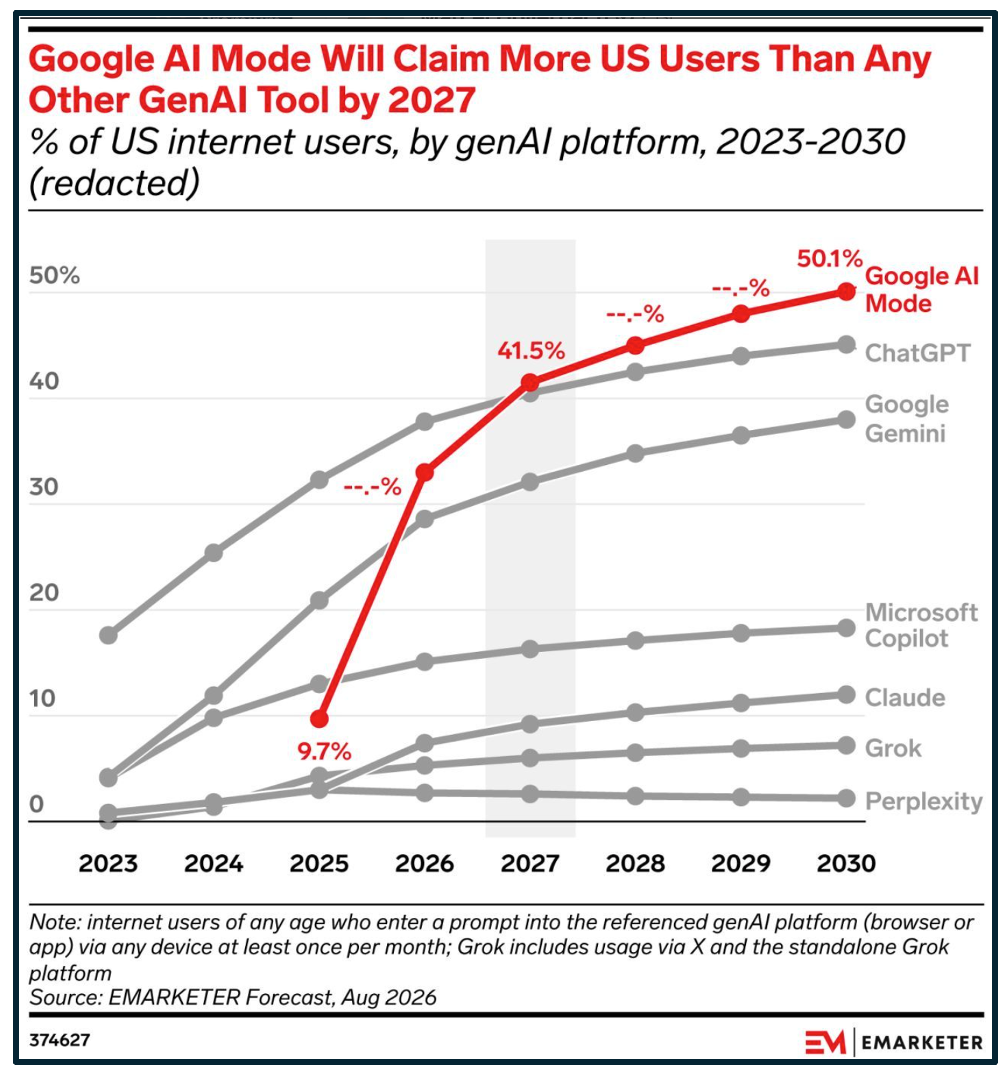
This is a forecast of monthly platform use, not shopping share or GMV (but platform use and shopping/GMV share have historically been very correlated).
My take: Google will work to bring Agentic Commerce into a behavior consumers already repeat constantly. That distribution advantage deserves attention even when another company has the more exciting demo that week.
For brands, the practical implication is to always prepare product information for multiple destinations. A strong presence in one answer engine leaves plenty of shoppers elsewhere.
October Trend 2: The Platforms Want the Shopper AND the Economics
Now let’s pivot to platform economics and the discussion there. Anchoring this point was Zuck on Cheeky Pint and earnings talking about Muse taking an un-specified % of GMV and the announcement of 10
TikTok adds a shopper assistant and UCP-powered Buy Direct

TikTok announced two connected pieces:
Shopping Assistant: Answers product questions using merchant-provided information inside TikTok’s in-app browser.
Buy Direct: Provides native checkout using saved payment and address information, while the brand remains the merchant of record.
Buy Direct requires a UCP integration. TikTok names commerce and payment partners including Salesforce, Shopify, Shoplazza and Stripe. (TikTok) Here’s a demo:
The interesting part is where the conversation starts.
A shopper sees a product, gets interested, then asks about fit, materials or availability. TikTok wants to answer those questions while the shopper is still engaged and give them a shorter route to purchase.
That puts merchant product information directly into the conversion path.
If your data can explain why those boots work for a particular hike, the assistant has something useful to say. If all it gets is a title, price and a vague paragraph about adventure…well, good luck with that.
Seven shopping agents, compared from the retailer’s side - Roger Dunn
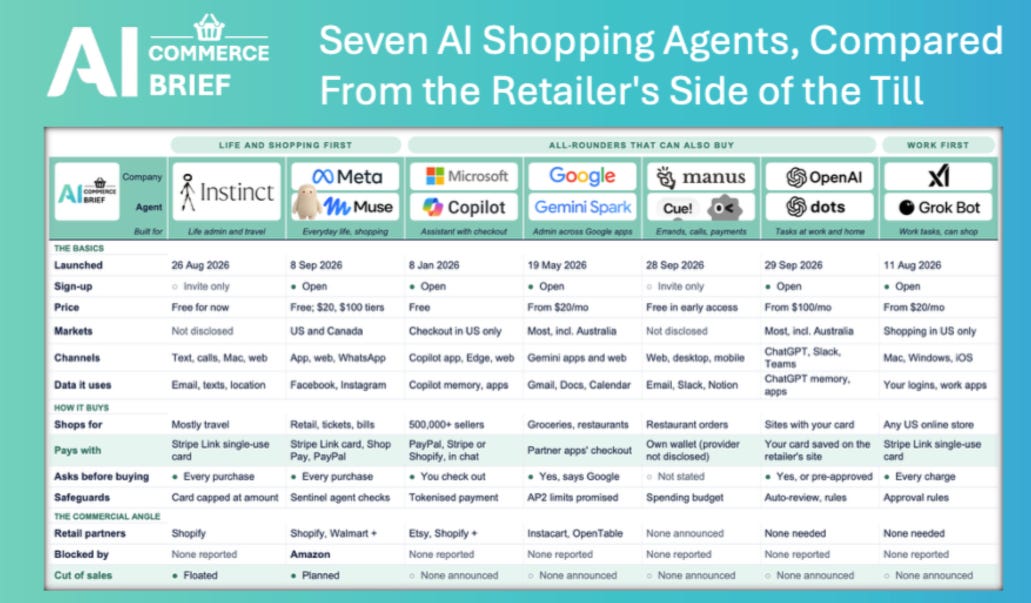
Retailgentic friend, Roger Dunn, published a useful comparison of seven shopping experiences: Muse, Instinct, Dots, Gemini Spark, Cue, GrokBot and Copilot.
I liked that he approached it from the retailer’s side of the transaction. How does the agent pay? What arrives in the order system? Does the purchase stay connected to the shopper’s account?
His comparison shows different payment approaches, from virtual cards to merchant-stored credentials and checkout integrations. It is a snapshot of a fast-moving market, but a useful one. (Roger Dunn)
We tend to put all of these products in the same “agentic commerce” bucket. For an operations team handling orders, loyalty and returns, the differences can be material.
This one is worth forwarding to whoever owns ecommerce operations, alongside the person tracking the shiny new Personal Shopping Agents.
ChatGPT adds visual ads and keeps expanding
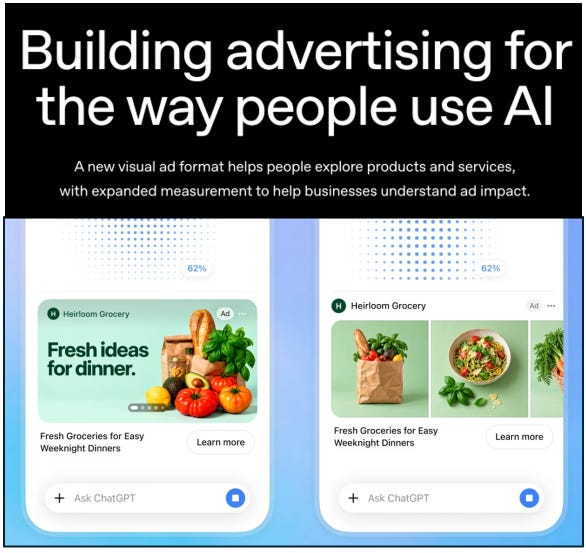
OpenAI introduced a visual ad format for testing during image generation on the Free and Go plans, with ads separate from the image being created. It also expanded conversion, attribution and incrementality measurement partnerships. (OpenAI)
Then came another geographic expansion: 26 additional countries, taking ChatGPT Ads to 89 countries. OpenAI says more than 100,000 advertisers have run campaigns since launch. (OpenAI)
The visual format is interesting, but the measurement work may matter more to the people approving budgets.
An advertiser needs a way to understand whether a channel helped acquire customers, what those customers cost, and whether the result was incremental. Connecting into familiar measurement systems makes that conversation easier.
I also noticed the grocery/CPG example. It’s another reminder that the commercial opportunity extends well beyond someone explicitly typing “buy running shoes.”
→ New formats and measurement
→ Expansion to 26 additional countries
Amazon’s sponsored questions bring ads into the shopping conversation
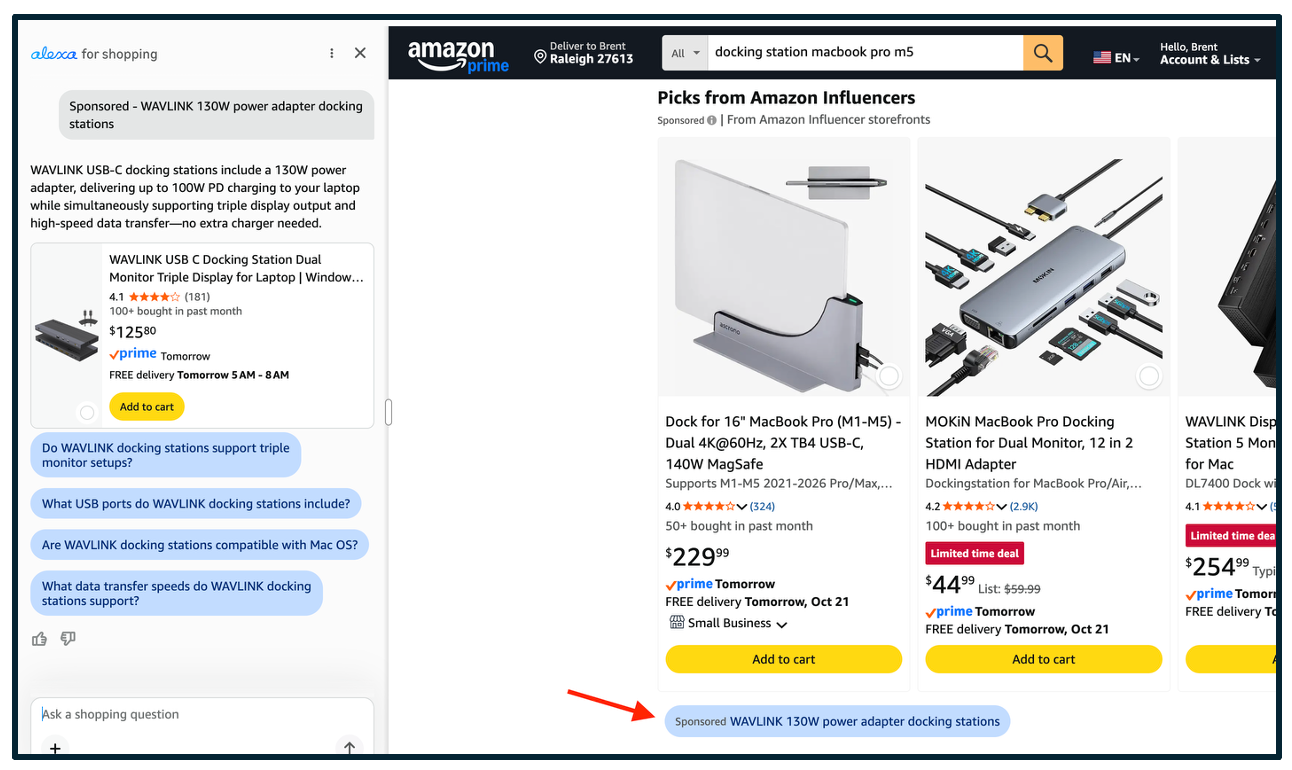
Our team also spotted examples of sponsored questions in Amazon’s shopping experience, including a live-search example shared internally.
The format is interesting: a question can invite the shopper into a product conversation at the moment they are evaluating alternatives.
For advertisers, that introduces another creative question. Which product question is most useful to a shopper considering this item?
For catalog teams, it introduces a familiar obligation: make sure the answer is accurate, specific and supported.
I’ll be watching how these placements develop and how Amazon measures them. A sponsored question could occupy a different role in the journey from a conventional sponsored product tile. Feels more top-of-funnel, but we’ll see.
The Wallet Wars: how do these agents get paid?
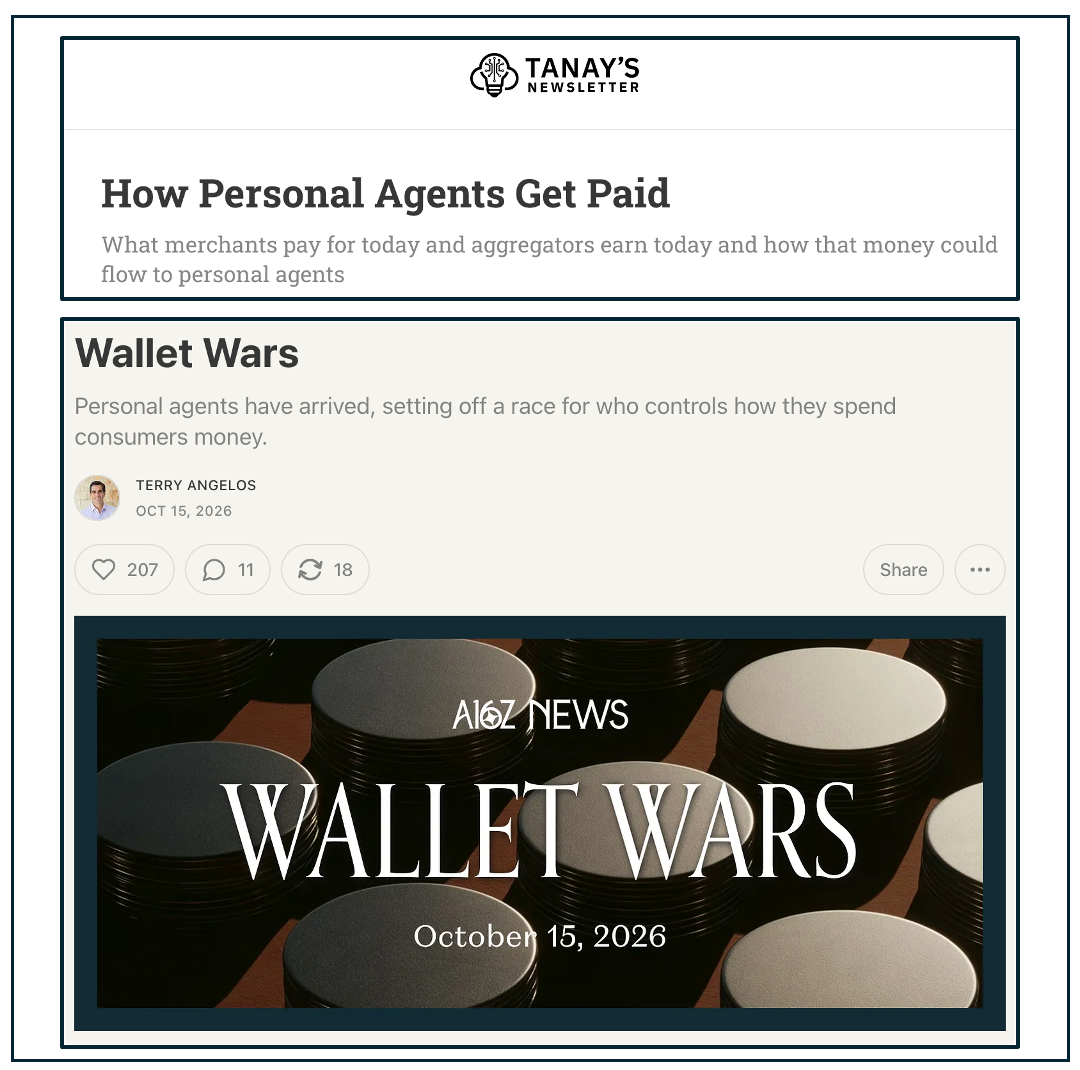
Two pieces are worth reading together: Tanay Jaipuria’s How Personal Agents Get Paid and Terry Angelos’ Wallet Wars.
Tanay lays out four possible revenue streams: subscriptions, convenience fees, merchant or partner fees, and advertising. He then explores how the economics might change as an agent moves from executing a purchase to generating demand or taking on more of an aggregator’s responsibilities. His take-rate scenarios are illustrations, not established industry pricing. (Tanay Jaipuria)
Terry focuses on the payment mechanics and makes a useful distinction: completing a payment does not necessarily preserve the customer’s original card benefits or merchant relationship.
For example, a wallet that charges the shopper’s card and pays the merchant with a different virtual card may complete the order while changing how card-linked benefits work. (Wallet Wars)
Follow the incentives.
An agent that helps a merchant acquire a customer has a different argument for compensation from one that simply executes an order the shopper already specified. And a shopper may consider rewards, returns and account history part of the task, even if the instruction was only “buy it.”
There is a lot of commerce detail and plumbing to get right hiding inside those two words.
October Trend 3: Product Data and Measurement Move to the Front
Forrester: product data needs to answer real shopper questions
Forrester’s Emily Pfeiffer and Tony Plec published a piece on the missing dimension in product data: helping shoppers understand real-world fit, use and outcomes, beyond conventional attributes. (Forrester)
This connects directly to what we’ve been discussing here as conversational attributes.
Consider a hypothetical carry-on bag. Dimensions are necessary, but a shopper may ask whether it works for a three-day business trip, fits a laptop and a second pair of shoes, or meets a particular airline’s limits.
Some answers can be derived from specifications. Others require additional evidence or product knowledge. The job is to make those answers available and accurate, without inventing capabilities the product doesn’t have.
For retailers and brands, I’d start with the questions customers already ask before purchasing. Which can your current catalog answer? Which require someone to consult reviews, manuals or customer-service history?
That gap is a useful enrichment backlog.
ChatGPT traffic goes dark, and the product shelf may be changing too
We’ve been seeing discussion in the time line about ChatGPT referral traffic declining or becoming harder to identify. We also were early on this calling it Dark Agentic Commerce Traffic (DACT) here back in April.
In our own team’s testing, Link noticed missing tracking parameters on some desktop links. He also reported fewer prompts returning product cards and fewer cards in some responses.
Those are observations from testing, not a quantified market-wide study.
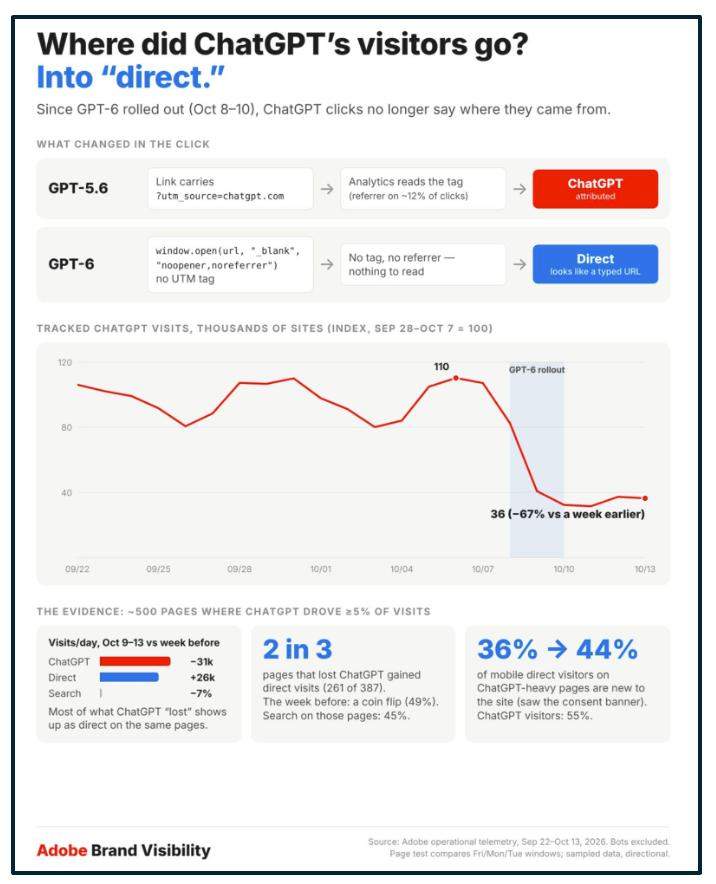
There are two things to investigate here.
First, a tracking change can reduce reported referral traffic without an equivalent decline in shoppers. Second, a change in the interface or product-card frequency can genuinely change the opportunity to be discovered and clicked.
Both could happen at once.
My advice: before concluding that AI shopping has stalled, test the journey. Look at the recommendation, the link, the landing session and the transaction. Then compare that with what the analytics report says happened. Be sure to test all modalities - a lot of the ‘traffic tracking stripping’ comes from mobile app users and desktop users.
CivicScience’s (covered earlier) research-elsewhere, buy-elsewhere finding makes this even more relevant. AI influence and identifiable AI referrals are different measurements.
Block the agent, and someone else will get the order (aka Agentic Commerce is a zero-sum game)
Olivia Moore at a16z shared a real-world shopping example that makes the access issue very concrete.
In her account of a winter-coat search, Patagonia blocked Muse. The agent considered other retailers, and REI emerged as the preferred option, with accessible inventory, pickup and pricing contributing to the recommendation.
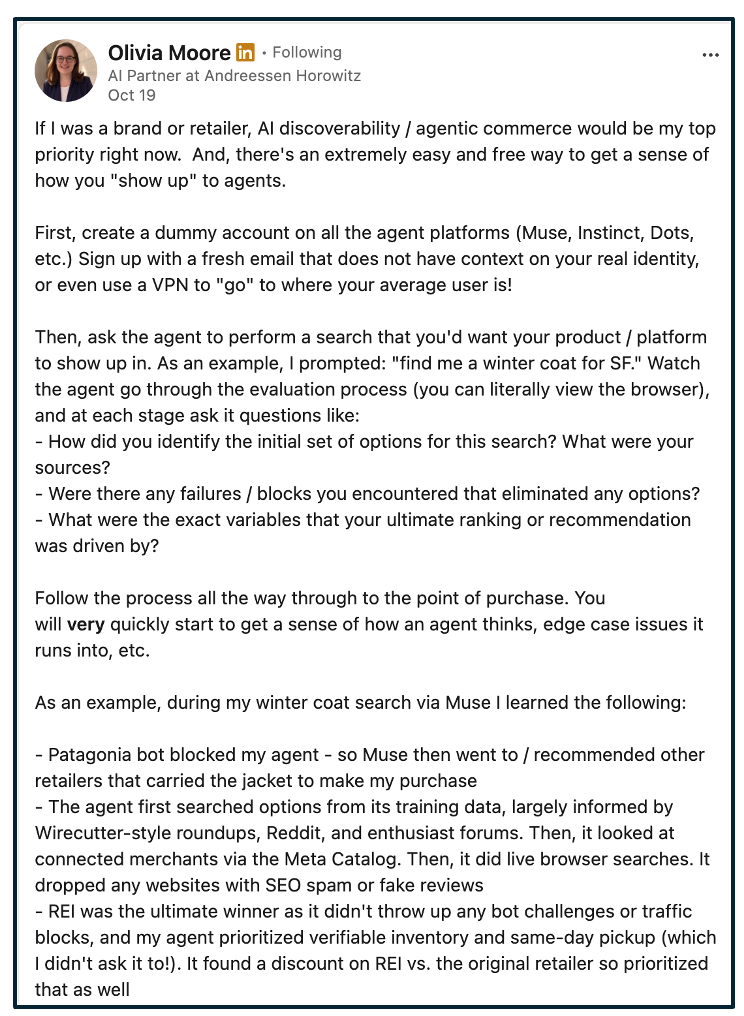
It’s one example, not a detailed conversion study. But it is an excellent prompt for a conversation between ecommerce and security teams.
A brand can be desirable enough to make the initial list and still lose the direct purchase opportunity if the agent cannot complete the journey there. The merchant won discovery, but lost the transaction (sad trombone sound ).
Retailers need to make intentional decisions about agent access. They also need to know what their current systems are doing, because a default bot rule may already be making that decision for them.
Try a few real shopping tasks against your own site. Watch where the agent succeeds, where it gets confused and where it gives up.
That’s a much more useful starting point than another slide declaring the company “AI ready.”
That’s a Wrap
Across this month’s news, the same operational questions keep coming back:
Can the agent find your products?
Can it determine whether they fit the shopper’s needs?
Can it verify price, inventory and delivery?
Can the shopper or agent complete the purchase?
Can you tell what happened afterward?
The holiday surveys suggest plenty of consumers are ready to try. TikTok, ChatGPT and Amazon are creating more places for those interactions to happen. The wallet companies are working on the transaction, and the advertising teams are working on the economics.
For retailers and brands, there is already useful work to do.
My Holiday 26 priority list: test your agent shopping journey, fix the product-information gaps, and check that your measurement can recognize the results.
We’ll learn a lot when the holiday data arrives. In the meantime, your next customer may already be asking an agent which product to buy.
Let’s make sure yours is not only considered, but wins the transaction! 🎁🏆