
Guide to this Meta Muse Deep Dive Series
This is Part 2 of a 2 part series:
Part 1 (here) We reveal the 5 Muse Optimization Best Practices you can implement today to optimize your products to maximize discovery in this new personal agent
Part 2: (YOU ARE HERE!) What’s all the buzz about? In Part 2 we look at the various signals that Muse is catching on with consumers and look at detailed usage data.
Before We Jump In: Announcing our new Podcast: AdGentic!

One area of Agentic Commerce we find very interesting that cuts across all the ACO surfaces (Answer engines, Retailer shopping agents, Personal Agents and on-site agents) is the intersection of pre-AI ad models, AI and Agentic Commerce. The opportunity is huge, the disruption is even bigger. What’s the latest news, technological advances and how are brands, retailers and publishers thinking about this.
We’ve partnered with Kiri Masters who will be our primary launch contributor. Hear directly from Kiri her vision for AdGentic→
If you are interested in tracking the intersection of Advertising, AI and Agentic Commerce, subscribe to the newsletter and podcast (audio and video available) today:
Substack Newsletter: here
LinkedIn Newsletter: here
Apple Pod: here
Spotify: here
All other podcast apps: here
YouTube: here
Keynote Video and Presentation
Our Q3 ‘State of Agentic Commerce’ presentation was quite popular, so when time allows we’ll be supplementing these more strategic series with a companion video and PDF. This allows you to consumer the content in audio/video and many readers ask for high-res copies of the images for integration in their board/management team decks. We’re happy to provide both and had the opportunity to put both parts 1 and 2 together into one ~30min presentation here:
Slides are here→

Detailed Muse Data Deep Analysis
Even though we’re super early in the life of Muse, if you’re obsessed about data, like we are here at Retailgentic HQ, there’s a goldmine of early indications of what’s going on at a Macro and Micro level with Muse. As is our tradition at Retailgentic, let’s go deep!
Muse Audience Trends
We have two sources of data for Muse’s audience trends. First up we have downloads (this is worldwide, probably iOS/Android and mobile app only - no mobile web, no desktop app)→
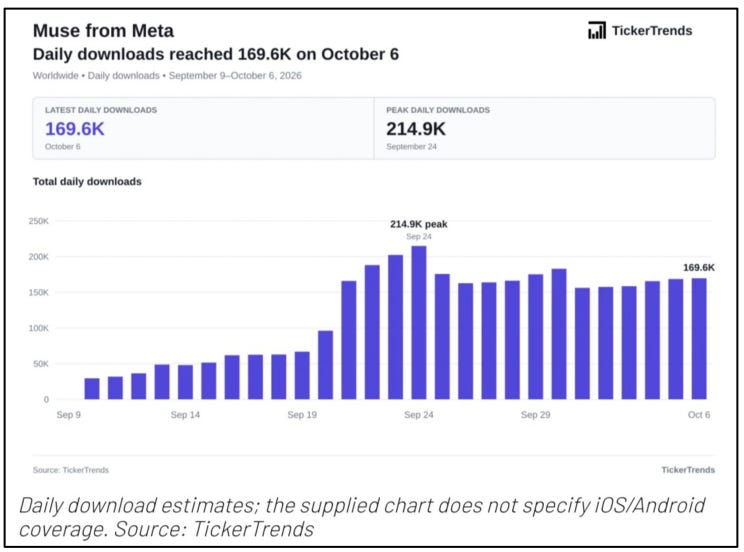
Here you see an early surge, followed by consistent 150k/day downloads through launch to Oct 6th.
SensorTower also has download data, but compared to the data above, tracks cumulative downloads and aligns that trend to the launch of ChatGPT for an apples-to-apples comparison:
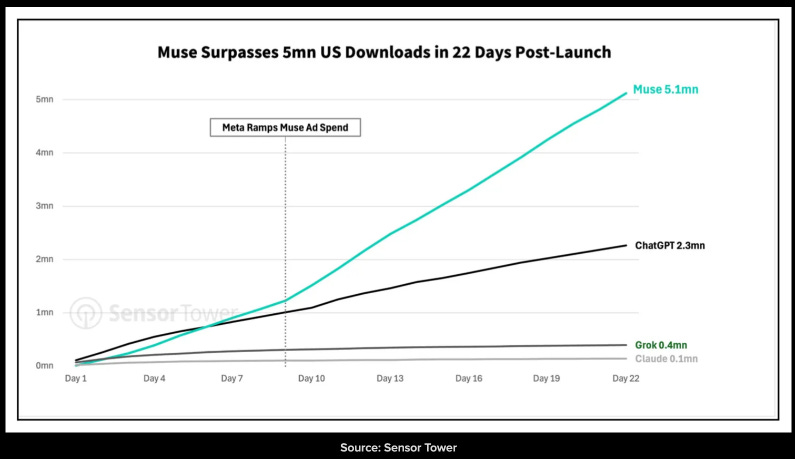
About 9 days in, Meta must have decided they had a hit on their hands and started pushing paid advertising and also flexing the distribution of their massive network as illustrated in the next datapoint. The SensorTower data shows that as of Day 22, Muse was at ~5m downloads which was more than 2X ChatGPT at the same number of days after launch.
Meta Flexes its Distribution Muscles
Meta has 5 properties with over 1B users: Facebook (>3b), Instagram (>3b), WhatsApp (>3b), Messenger (~1.3b) and Meta.ai (~1b). On top of THAT they have a bunch of tier-2 properties like Threads (500m) and FB Marketplaces (not disclosed separately but widely known to have over 1b shoppers). Swirl all that together and Meta has an extremely large footprint to launch a new service into.
The SensorTower data below illustrates the in-house property being promoted as a % of impressions across the network:
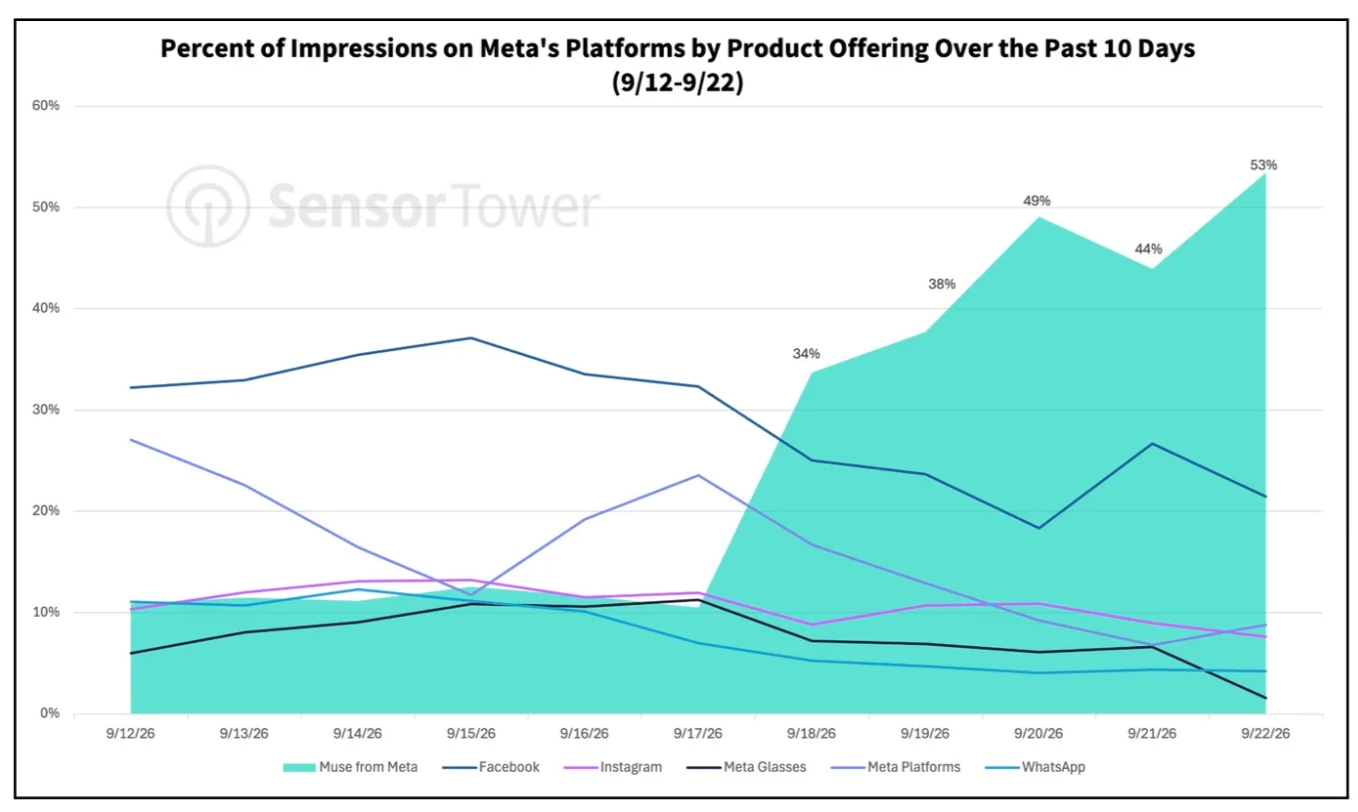
Here you can see that around 9/17, Meta started turning up the heat on Muse, pointing the distribution firehose at it to drive adoption.
The Information has reported citing anonymous internal sources that Mark Zuckerberg rushed the launch of Muse out of concern that Instinct was rapidly gaining traction, inferring a desire to get out both offensively to get in the game and compete and defensively to slow it’s exponential adoption curve.
Note: Because Instinct’s primary interface is iMessages, it is not in any clickstream data, we’ll have to rely on stated preference surveys for anything on that.
Early Retention/Churn Curves
On X, there’s a popular VC/data analyst, Deedy Das that focuses in on the ‘smile curves’ also known as user retention/churn curves of Answer engines like ChatGPT and Claude.
He analyzed early SensorTower data→
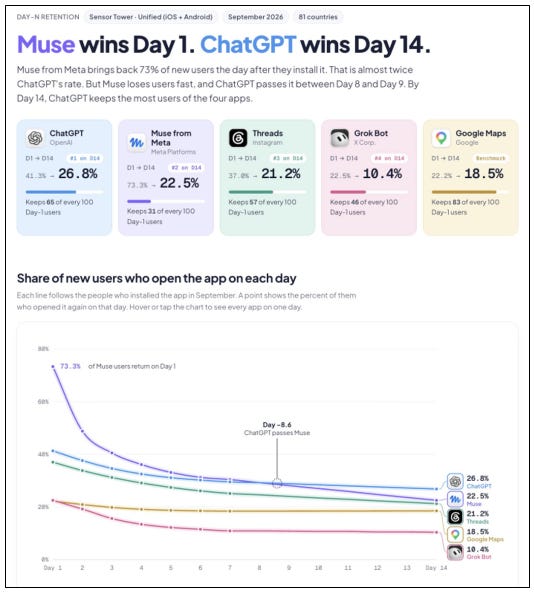
And came to these conclusions→
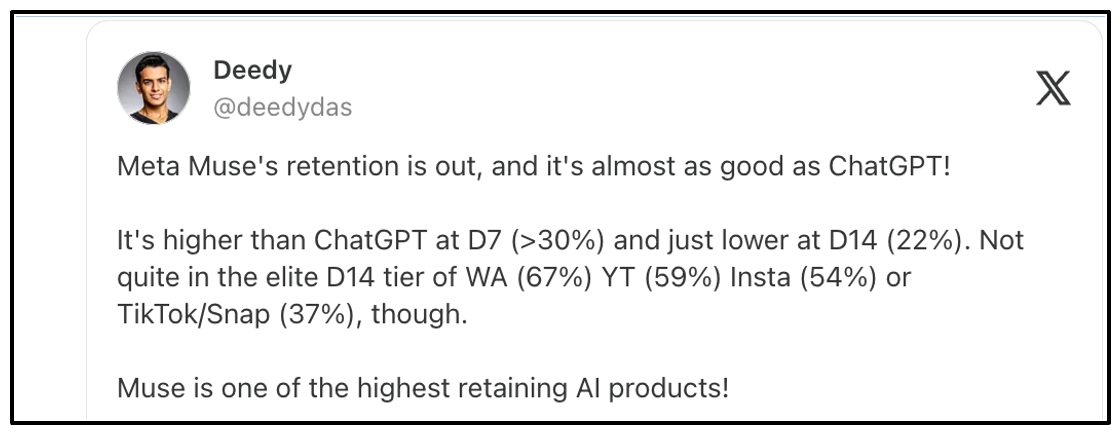
That’s shocking, especially when you consider that it’s a v1 battling it out against much more mature ChatGPT….and ahead early, but behind slightly at D14! More on how people are using Muse that is driving such high levels of activation and engagement already coming later in the post. Nobody, and I mean nobody, knows how to growth hack like Facebook, they created the term. I can assure you they know exactly how to get these curves to ‘smile’ - the holy grail of growth.
Wall St Analyst Perspectives
First, ‘friend of Retailgentic, Ron Josey, internet analyst at Citi, released an epic 54 page super deep analysis that we highly recommend spending time with. Some highlights:
TAM - They calculate that Muse has a $4T TAM
Muse Revenue Potential - If you take that $4T and assume Muse gets 4% quickly and can achieve a 5% take-rate, that’s $8B potential revenue.
Retailgentic Wall St friend Mark Mahaney, the internet analyst at Evercore ISI. On 10/12, Mark put out a an epic 24 pager all about Muse. In there they have a very detailed analysis of the cost of Muse (~$100/yr) and note that across the Meta network, they generate $380/user. They then math out how with a % take-rate type model, Meta could get Muse to break cover the $380+100=$480 through driving GMV * take-rate. For example at a 5% take rate it would take $10k/yr in GMV to clear that hurdle, not crazy when you look at the metrics coming out of Instinct and remember that includes travel, tickets and other non-physical good transactions.
Both Citi and Evercore are extremely enthusiastic about the user experience, the incremental revenue opportunities and where Muse is going even though it’s early.
HUMAN: Muse Agent-traffic Level Trends
September 28th, infrastructure-level security company HUMAN, released an analysis of AI agent traffic focused on what they are seeing from Muse. This is all based on traffic observed by HUMAN.
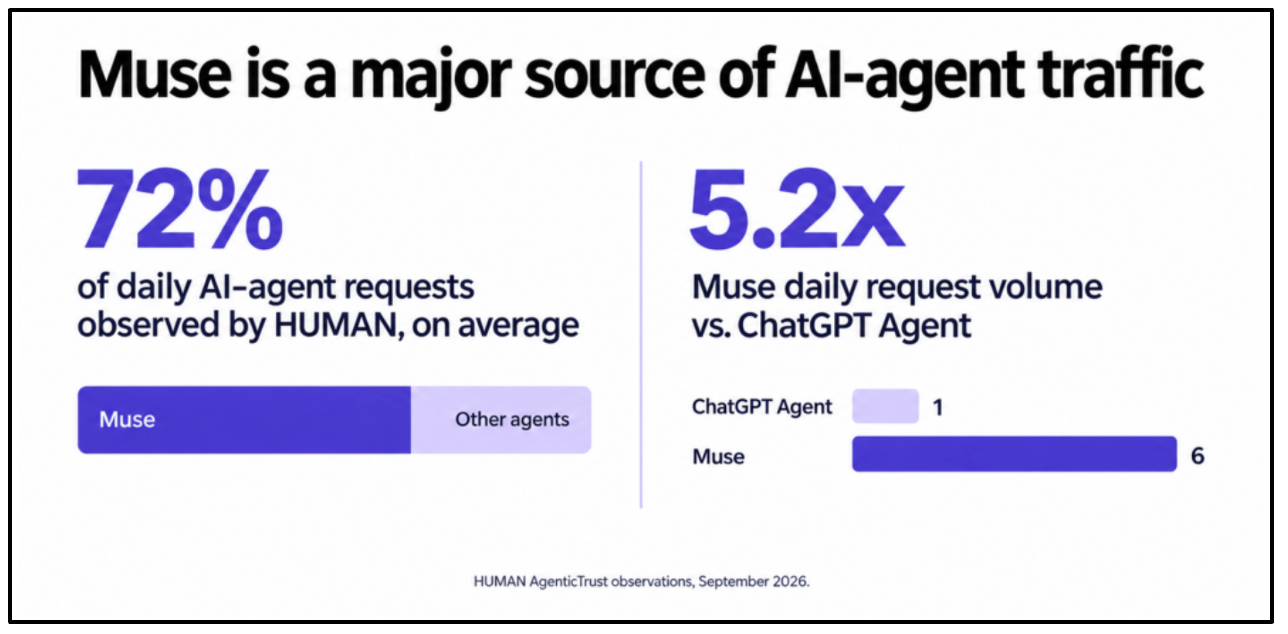
Even though Muse is starting with a small audience, they are already generating 72% of agent requests and Muse’s volume is 5x the bot request volume of ChatGPT’s agent.
The implication that either Meta is a ‘chatty’ agent (lots of bot traffic per comparable task) or consumers are using it for a LOT of tasks compared to ChatGPT (or both!). Put a pin that question.
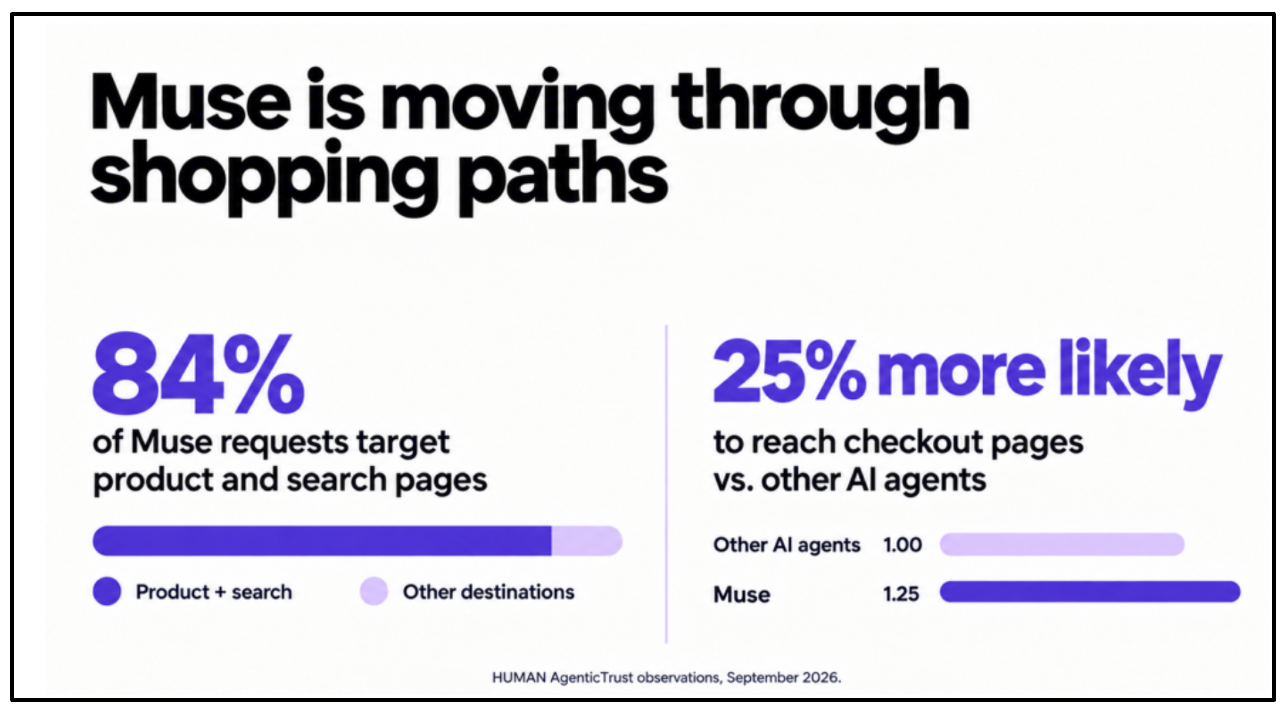
The other interesting analysis HUMAN provided is tracking how Meta’s bot(s) are moving through sites. 84% of the requests are shopping-oriented hitting product and search pages. It’s also 25% more likely to make it to checkouts compared to other agents. The implication is a bit of reverse engineering that Muse users are doing a lot of shopping and going through to completion (checkout).
If you want to learn more about Muse, I strongly recommend watching Cheeky Pint, it features John Collison (President, Stripe), Mark Zuckerberg (CEO, Meta) and Alexandr Wang (CAIO, Meta Superintelligence Labs). I bring it up here, because in it, there are a couple of revelations that make sense to cover at this point:
Zuckerberg talks about the business model combining some subscription/token usage with % of sales. Note he doesn’t mention ads which is interesting and if you’ve used Muse, there’s not really an easy place to inject an ad without it being disruptive to the ux. Collison casually drops this in there:
“It's very interesting to look at the agentic commerce stats at Stripe because we started developing all this stuff and we had a whole bunch of announcements at Sessions back in May, and then it only, as of September, basically started going vertical.” - John Collison, President, Stripe.
If we tie this together with the HUMAN information about checkout activity, we’re getting our first inclination that Personal Agents could be driving some real transactional volume.
Note that ‘reaching checkout’ does not mean 100% of consumers checked out - personally when I have my Muse heading into checkout, I’m all the way down the funnel and personally have completed 100% of those situations. As more data comes out, this is where we’re really focused.
Gener8’s Muse Panel Data
Gener8 is another ‘friend of Retailgentic’ - they have a huge panel and gather detailed clickstream. Note for this dataset it is an Android user data set.
On October 9th, they released a very detailed Muse report, you can download here.
Some of the highlights and key learnings follow.
Gener8: Adoption Rate
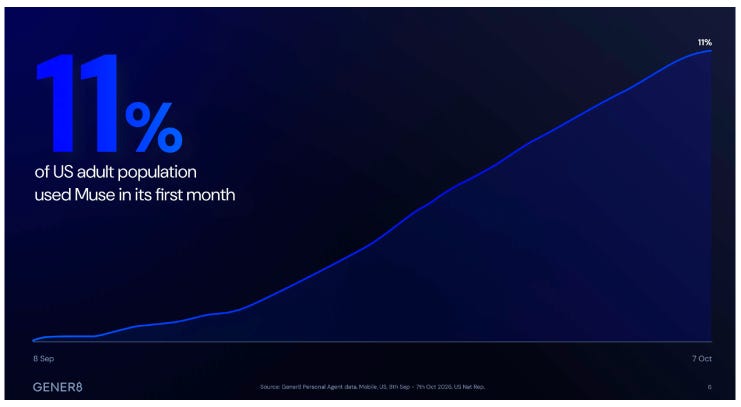
According to Gener8’s analysis 11% of the US adult population used Muse in the first month. There’s approximately 270m US adults, and 11% of that is 29.7m which is way off from the download data. My best guess on this misalilgnment:
This is an android audience
It’s well known that the android audience has an older and value-oriented bias
Muse has two value props: value-orientation and convenience. The value-orientation messaging has really resonated with the android audience.
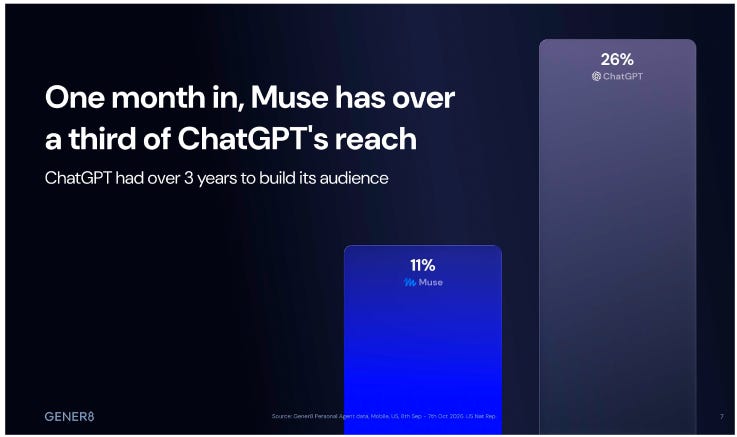
Gener8 estimates that conversely ChatGPT is used by 26% of US adults, putting Muse’s usage already at 42% of ChatGPTs after 30 days!
Gener8: Muse vs. ChatGPT Prompt Volume
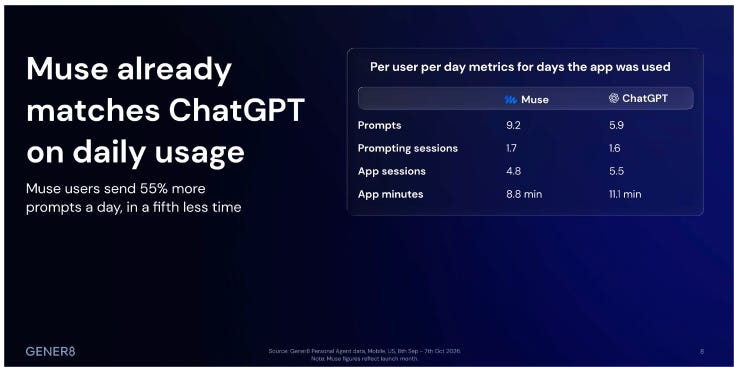
That’s uses. Gener8 then looks at the prompt per day for Muse which is at 9.2 and ChatGPT at 5.9 - Muse users are prompting 55% more than ChatGPT users.
Gener8: Muse Demographics
This was the most surprising analysis, the demographics:
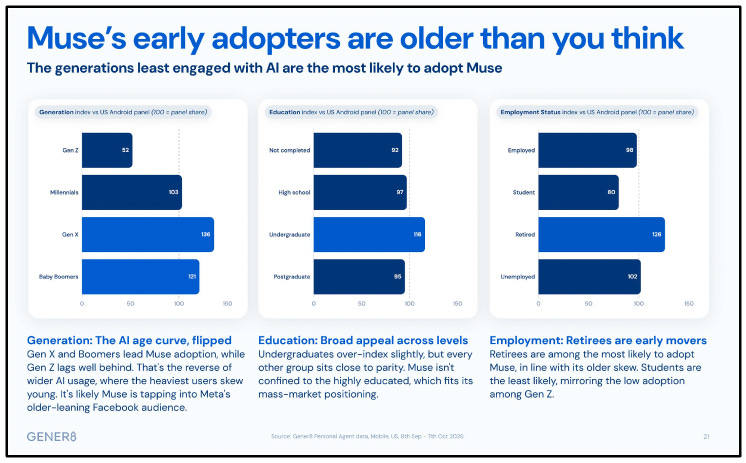
Usually the demographic curves for Answer Engines skew younger - what we call Zillennials - GenZ and Millennials, but here (table on the left) you see the older generations of Gen X and Boomers are leading the charge. Perhaps it’s the blue Facebook audience getting there before the Instagram’ers (or the Zillennials are on TikTok?)
Gener8: Muse Usage Types
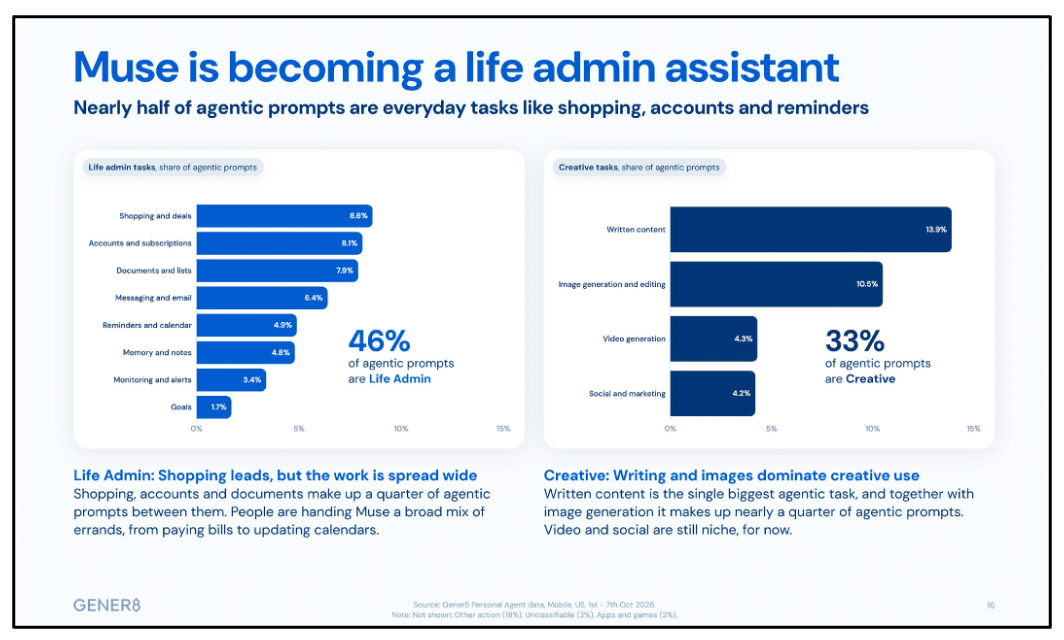
Gener8 analyzed the clickstream data and put the various Muse activities into buckets. Shopping is the highest life-admin activity at 8.6% (Note ChatGPT has disclosed that 20% of their prompts are shopping related)
Gener8: Muse’s Top Mentioned Brands
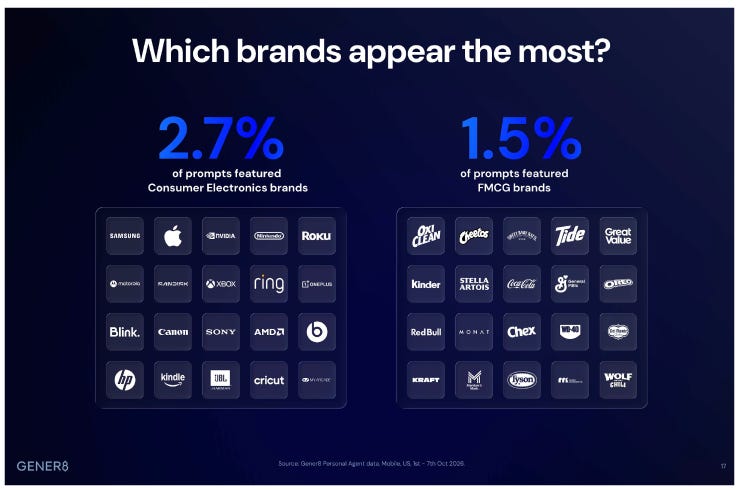
Within those shopping prompts, Gener8 saw Consumer Electronics brands as a group with the highest share at 2.7% and CPG came in at 1.5%. The brands that came up in prompt results the most (kind of a Muse visibility metric) are detailed.
Conclusion
When we swirl all this together we start to see a picture:
Muse has had one of the fastest consumer launches ever, based on a short first 42 days.
While they have leveraged the massive Meta distribution advantage and layered ads on top, there’s a ‘there there’.
The engagement/stickiness curves are as good/better as ChatGPT has now
The prompt volume is through the roof
Muse’s agents are going crazy across the internet swamping previous bot sources
The Muse bots are hammering shopping category and PDP pages and then finding their way to checkout
Stripe saw payments go Vertical in September (probably a double whammy from Muse and Instinct both hitting their growth curves simultaneously). Reminder: Instinct’s founder disclosed they are at $1B GMV annualized and growing 10% m/m.
The demographics skew older than we would have anticipated
We’ll be watching closely for more information and probably be back in 15-30 days with an update. We do expect Meta to discuss Muse on their 10/21 Q3 earnings call and I can virtually guarantee given Mark and Ron’s enthusiasm and what I’ve heard from others, that a large % of Wall Street questions are going to be around Muse.
If anything important drops, we’ll let you know - stay tuned!