


Welcome to part 2 of this 2 parter. In Part 1 (here), “Personal Agents enter the arena”, we looked at the newest category of Agentic Shopping that we have classified as ‘Personal Shopping Agents’. These horizontal Personal Agents, such as Muse, GrokBot and Instinct, all feature shopping as a key component of their value proposition to consumers. In that post, we gave some background that answered the ‘why now’ question about the surge and talked about these important concepts:
Exponential growth in capabilities of underlying models
The frontier labs focus on training for long-running agentic tasks
They are also training for ‘computer use’ across hundreds of domains including ‘shopping’
What is a harness?
A brief history of personal agents
Browser use: server vs. local and why it matters
Detailed demos of Muse, Instinct, Grokbot and Gemini Spark
Rumor: OpenAI ‘o’ or ‘Dots’ on the way later today?
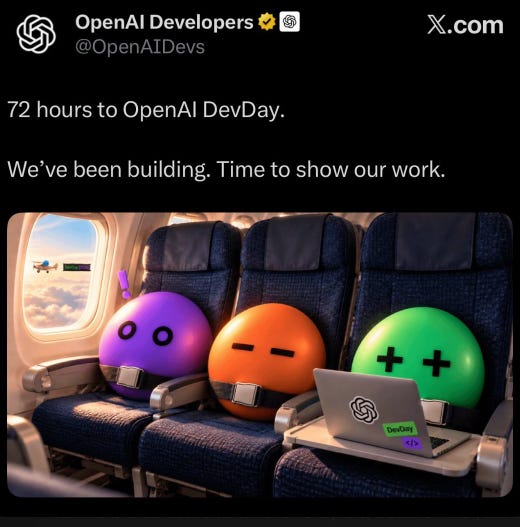
Note: We’re not even close to being done with the surge in Personal Shopping Agents, stay tuned for news later today from OpenAI’s Dev Day 2026 where it’s largely rumored that they will release their ‘Muse killer’ mysteriously called “o’ (lower case o and teased with this image which features 4 agents, one of them with ‘o’s as eyes. Microsoft has rebranded theirs to be CoPilot AutoPilot (🤮 on that branding) and Google is expected to re-launch Spark or something totally new when Gemini 4 drops later in Oct.
Updated Agentic Commerce Datapoints
When we started Retailgentic in May of 2025, there were 2-3 firms doing surveys about consumer AI adoption and they updated the datapoints every 6-12 months. We were starving for data!
Today, there are at least 2 and sometimes as many as 6-10 surveys to pick from each WEEK! For example, if you look at the Retailgentic August Agentic News Roundup, you’ll see we cherry picked 7 great data points from BCG, Microsoft, Narvar, Morgan Stanley, FinanceBuzz, Koddi and Croud.
That was 30 days ago and we could flood you with more survey data here. Instead we’re going to highlight 3 new datapoints.
NielsonIQ: Majority of US Consumers Now Use AI to Shop
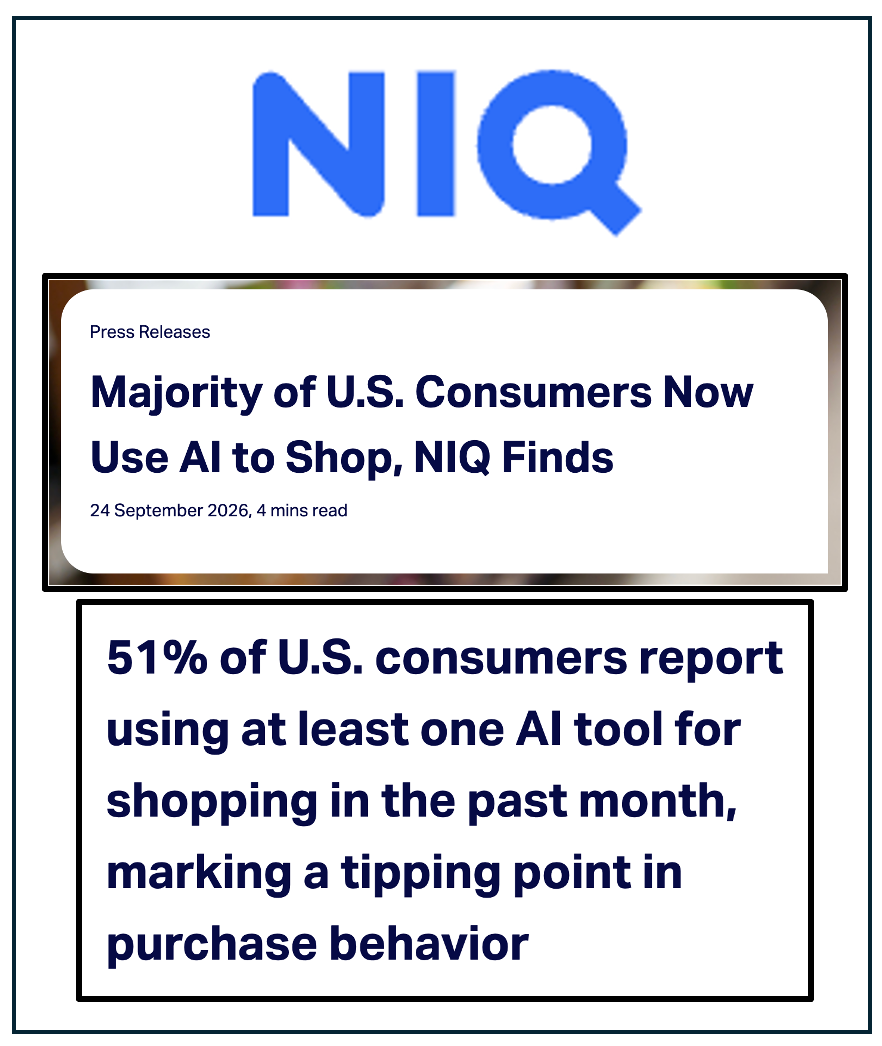
NIQ, one of the most trusted measurers of consumer behavior announced a big milestone in their tracking - more than half of US consumers actively use AI to shop.
SimilarWeb: AI in the path-to-purchase is up >2X since 2024
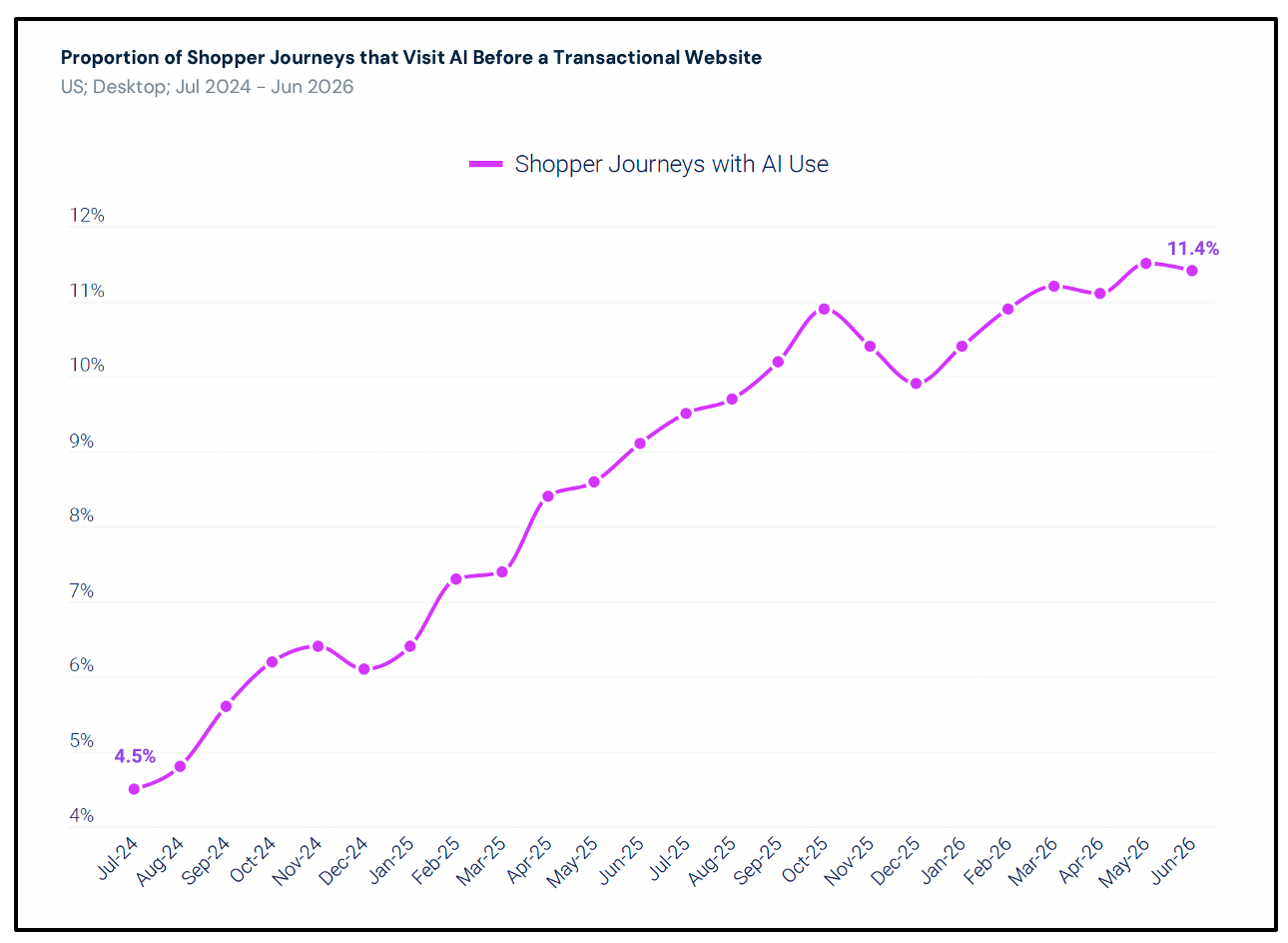
This chart shows:
Only visits that end in a transaction
The % of movement goes 4.5% in July of 2024, to ~9% then now at 11.4%
Because they have panel data, this most likely includes AFS/Sparky and shopper agents as well as answer engines and they should be able to also track mobile apps. With the proliferation of dark agentic commerce traffic, this is the most reliable datapoint and it aligns with what we see at ReFiBuy when we’ve worked with clients to detect and track DACT.
Similarweb: Answer Engine Share Trends (August 2026 Update)
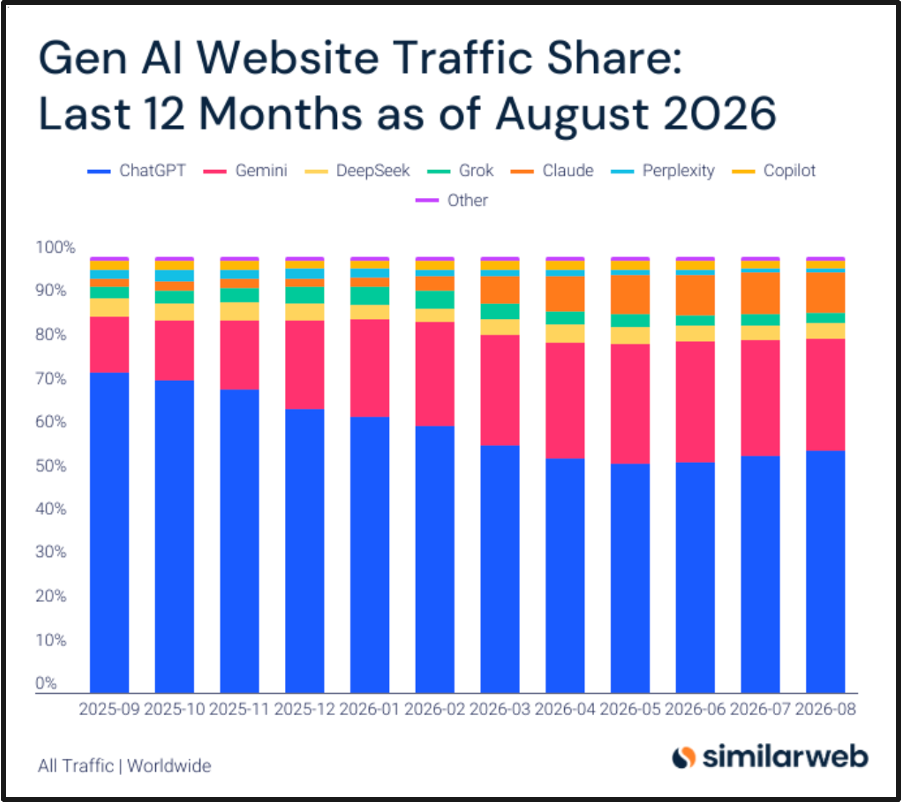
Similarweb used to publish an every 2-week AI Traffic tracker and now only publishes this view monthly. What we see here is:
Web only (mobile apps, desktop apps not captured which is a material part of how Answer Engines are now used).
That being said, you can see ChatGPT bottoming out at 50% and starting to claw back some share. You can also see Claude moving into a third slot behind Gemini and Gemini shrinking a fair amount.
The deceptive thing about this chart is it does not show the growth of the whole industry because it’s basically a percentage chart always capped at 100% to show share.
Fortunately, they just published an Anthropic deepdive that gives us this tidbit: (again web only)
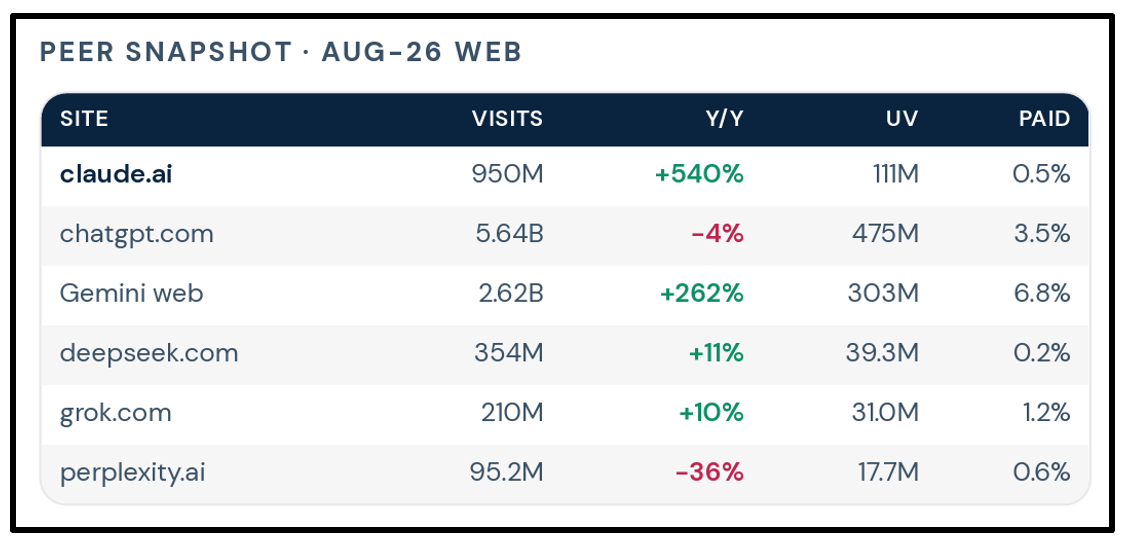
Here we can see Claude closing in on 1b visits per month and their tremendous 540% y/y growth followed by Gemini at 262%. While ChatGPT is showing flat to slightly down y/y, that’s probably seasonality because they are in the stratosphere at 5.64b visits/month.
Those are the three biggest datapoints - Agentic Commerce has crossed 50% usage of US consumers, it’s driving transactions and it’s branching out into new areas. Let’s dig into those details and that will inform what Retailers and Brands can do to optimize Agentic Commerce for Q4.
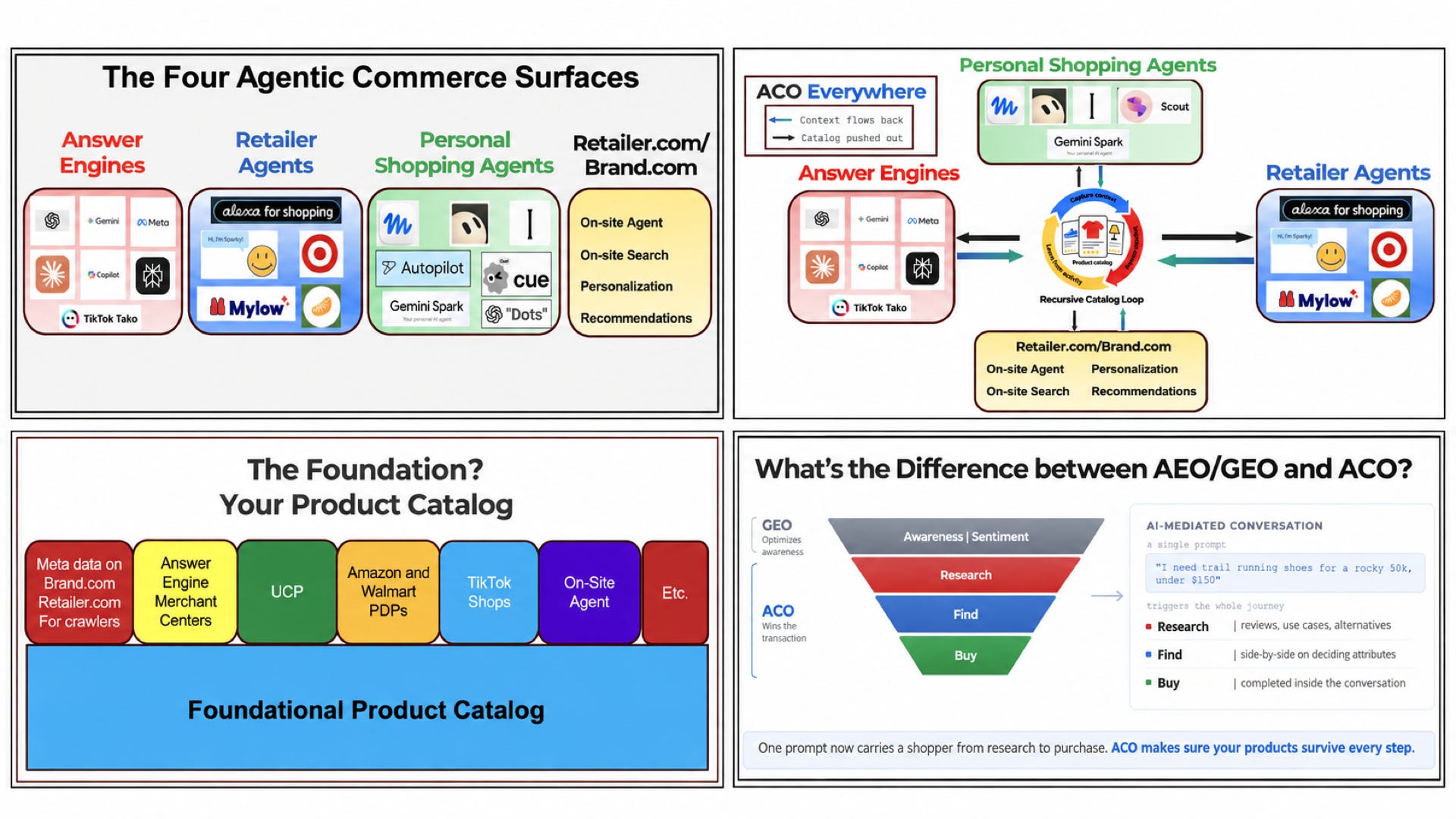
The Four Agentic Commerce Selling Surfaces
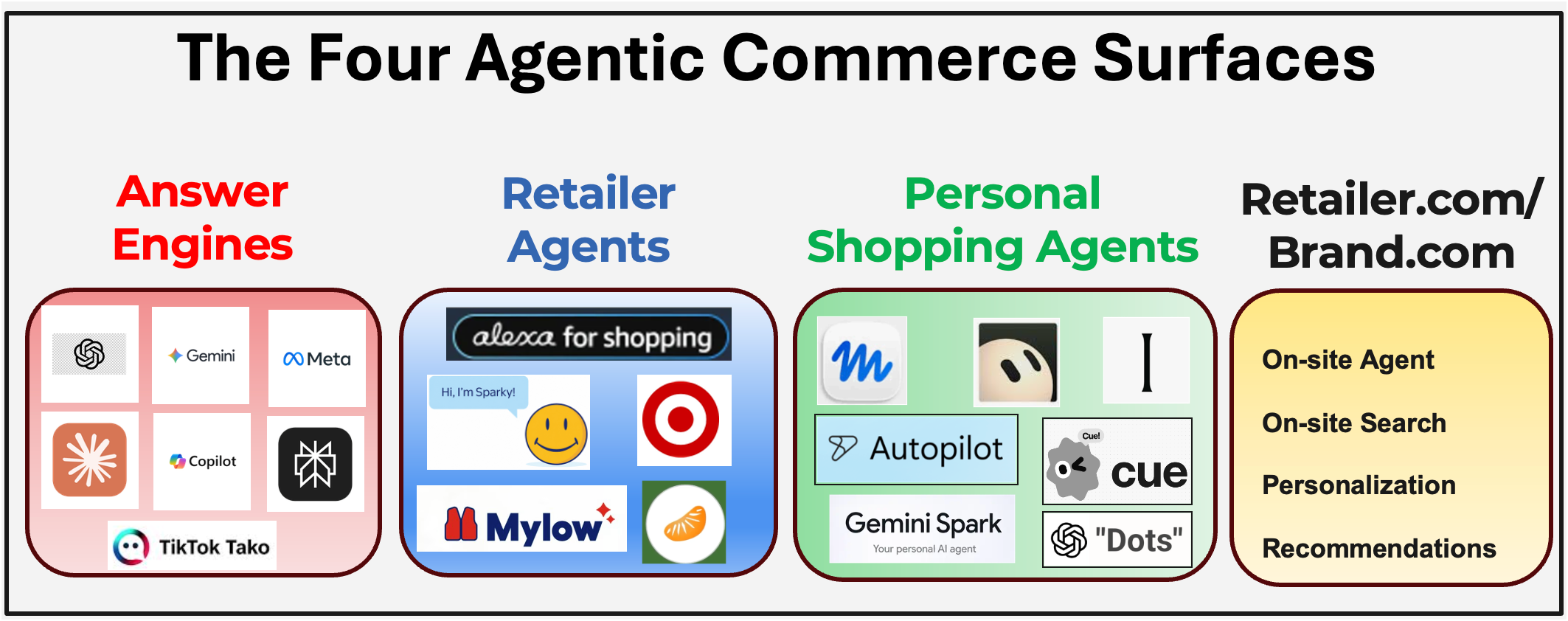
In the early days of Retailgentic (2025-Q1 26) while Rufus and Sparky were out there, they were generations behind the Answer Engines, so we focused on the Answer Engines. Then around Q2 26, the Retailer Agents took a significant step up. Now every large retailer is either re-doing their strategy to level-up (Target announced this strategy) or launching a very advanced retailer agent such as Instacart’s Clementine (which just launched a national TV campaign, here’s my favorite one).
OpenClaw came out in November of 2025 and everyone saw a glimpse of the future. Now we have our third ‘Agentic Commerce Selling Surface’ - Personal Agents.
Finally, both retailers and brands seeing the success of AFS/Rufus and Sparky and also realizing they need to elevate the customer experience to match the wave of Agentic Commerce are investing in next-generation on-site agents (Gemini, AWS, Claude, Salesforce and hundreds of other options are available), AI/LLM powered on-site search engines, next-generation personalization and recommendation systems, etc.
Today the result is we have four Agentic Commerce selling surfaces:
Answer Engines
Retailer Agents
Personal Agents
Brand.com/Retailer.com
In the next section let’s look at a snapshot of where each is using our Retailgentic Agentic Commerce 5 Levels of Autonomy framework.
Retailgentic Agentic Commerce Levels of Autonomy
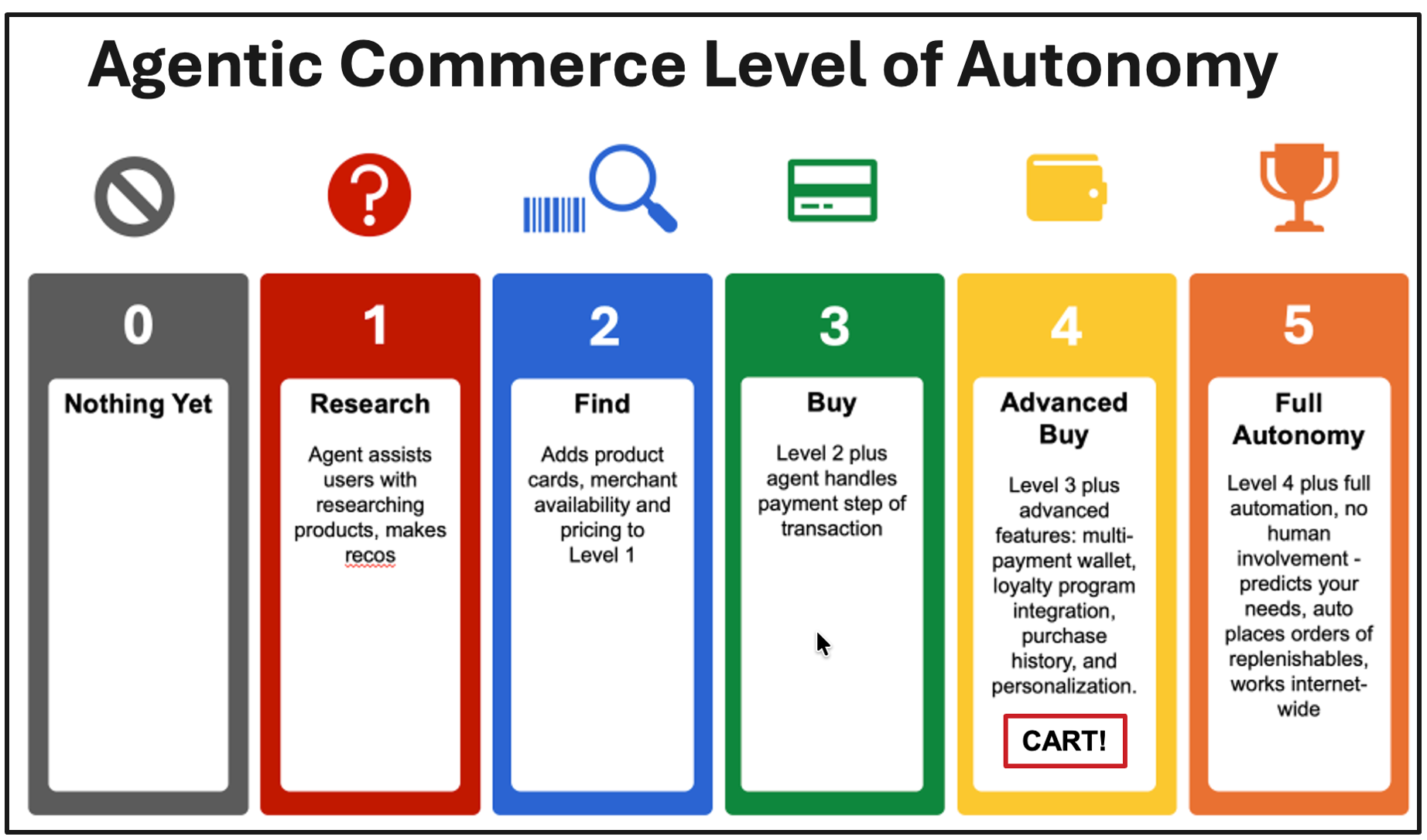
I met many long-time Retailgentic readers at RetailClub and the Agentic Commerce Levels of Autonomy framework always comes up. We created this to help ‘level-set’ the various answer engines. Today we’re expanding it to cover Retailer Agents and Personal Agents as well.
One clarification we’ve added - to get to Advanced Buy, a pre-requisite is a cart, or more technically the ability to buy more than one thing. For example, for a single unit, there are now Personal Agents that can achieve Level-5 full autonomy. But the single-item limitation keeps them below level 4. The good news is I think we’re months away from some clever cart implementations, so stay tuned.
Before we get into that in detail, let’s revisit Answer Engines.
AC Autonomy: Answer Engines
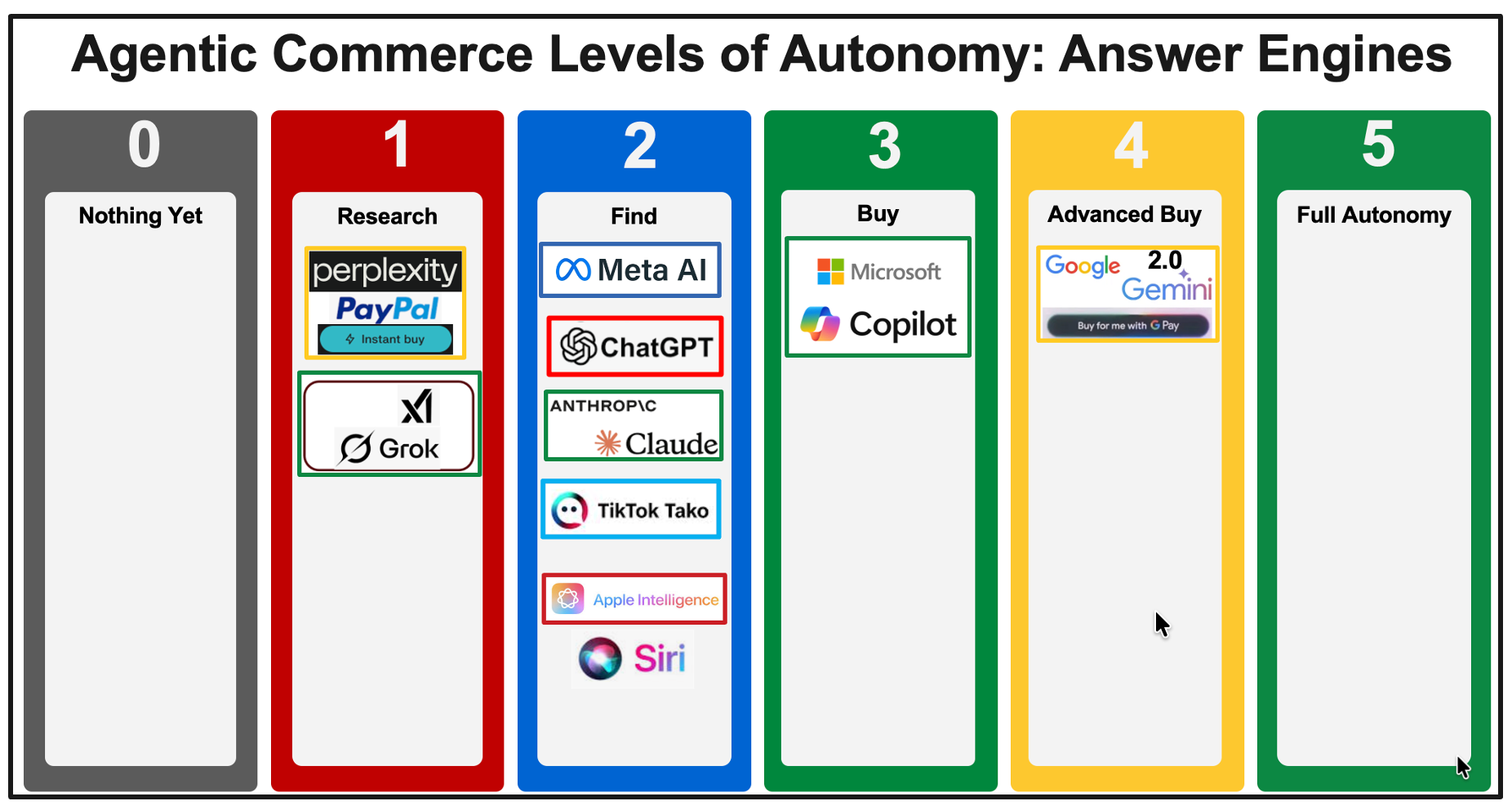
There hasn’t been much movement here, of note:
This year ChatGPT decided to focus on discovery (Research/Find) and not checkout, so they moved back to Level 2
Claude did come out with product cards
Apple’s new Siri with iOS 27 has some agentic commerce capabilities (more on that later) so we moved it to Level-2
Gemini’s UCP and Multi-cart announcement have it ahead of the pack at Level-4
Anatomy of a Product Card
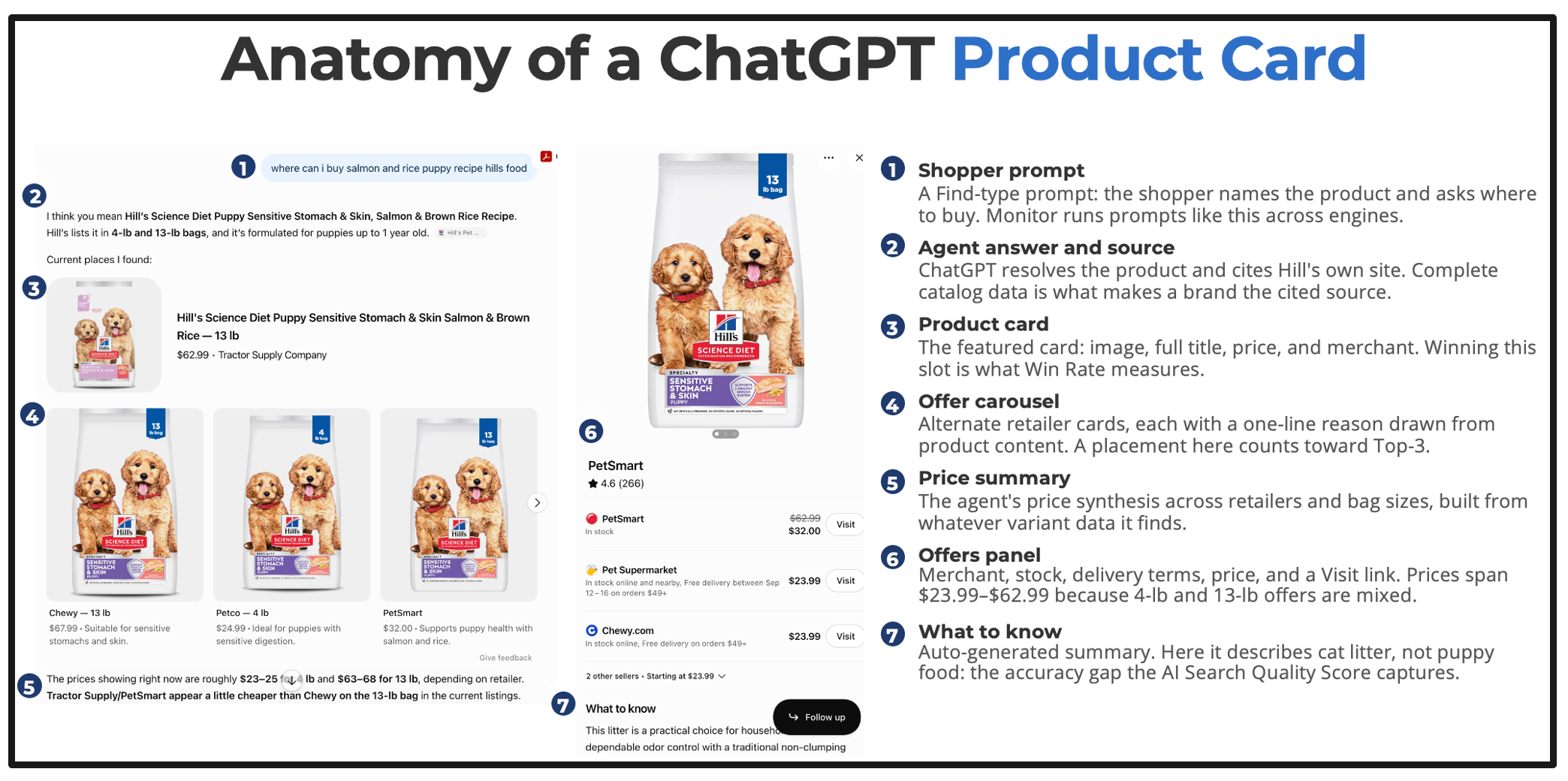
In answer engines, there is an underlying ‘global catalog’ that the answer engines have built. The consumer’s view of that catalog is through Product cards and Offer Cards.
In the above example, you can see the 7 different components of a product card. Whether you are a brand or a retailer (or both), making sure your products show up, are correctly represented and correctly linked to your site for purchase is absolutely essential.
Now let’s look at Retailer Agents:
AC Autonomy: Retail Agents
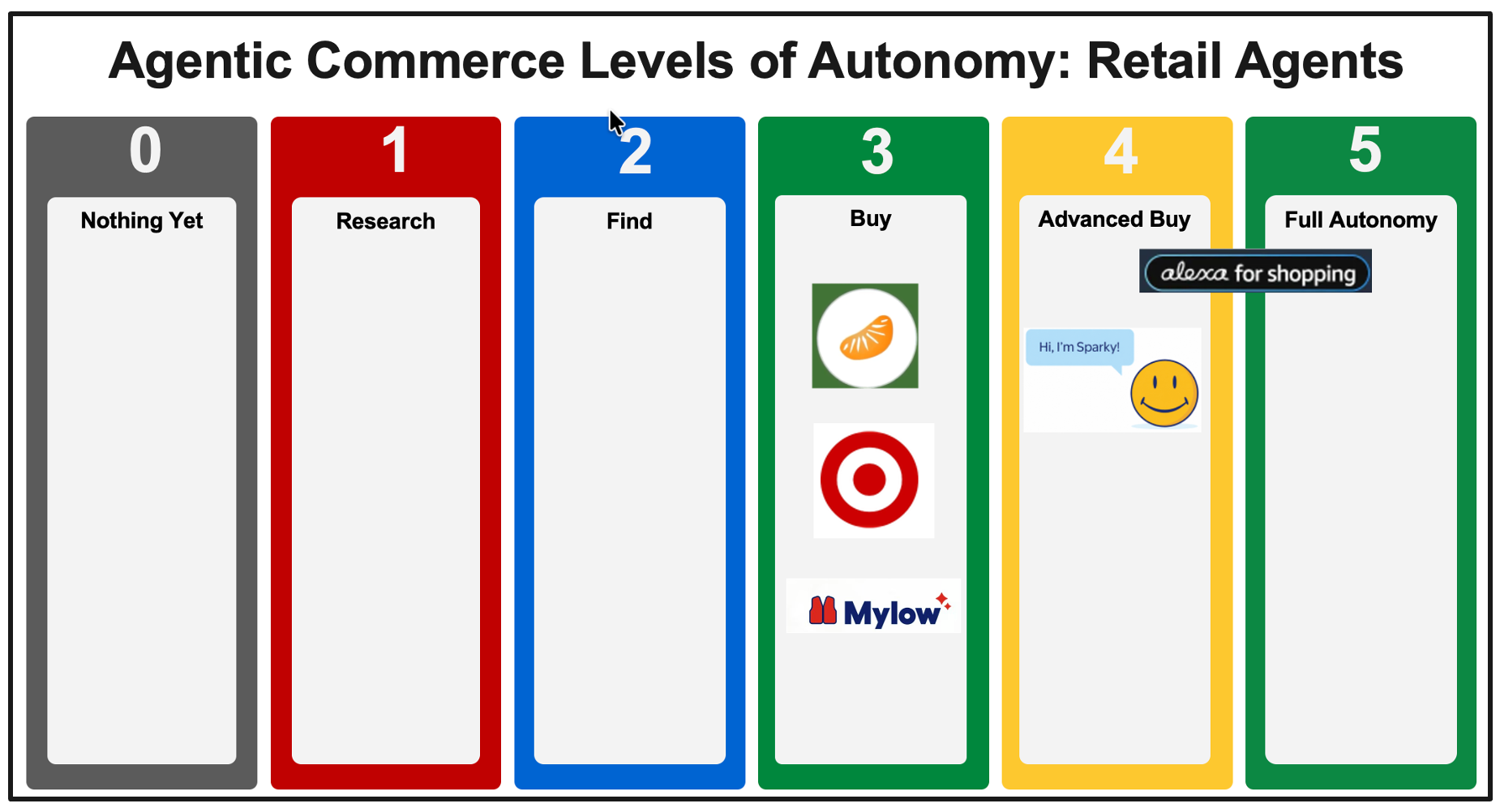
There are six Retail Agents we are tracking closely:
AFS - Amazon moved Rufus to AFS this year and recently implemented the ‘auto-buy’ feature. AFS works with the Amazon cart so it gets multi-item capabilities ‘for free’. With cart and auto-buy we have moved AFS to the highest level recorded thus far: Level 4.5. What keeps it out of Full Autonomy is no predictive element and the multi-cart and auto-pay support is still rudimentary. Amazon has reported that 350m consumers use AFS, interactions are up 5x y/y and AFS users spend 40% more per order.
Sparky - Walmart has moved Sparky along dramatically in 2026. It went from mobile only to web and now has a more dedicated panel. Along the way the experience has improved dramatically. Like AFS, Sparky gets cart ‘for free’, but does not yet have an auto-buy type feature. Walmart’s CEO Furner said in their Q2 that Sparky usage is up 70% y/y, and Sparky users spend approximately 40% more than non-Sparky (sounds familiar!).
Target - Target’s agent used to be called TSA - Target Shopping Assistant. In their quarterly earnings they announced they have something new coming out later this year. We’re keeping an eye out for that.
Instacart Clementine - If you haven’t tried Clementine, you should give it a shot. It’s got meal planning, multi-item, advanced cart capabilities and is a very solid offering that sets the bar high for CPG/Grocery type agents.
Home Depot and Lowes - Both companies have increased their investments and their agents are improving, but still several steps behind the state-of-the-art.
Now let’s look at the exciting new OpenClaw-inspired category: Personal Agents:
AC Autonomy: Personal Agents
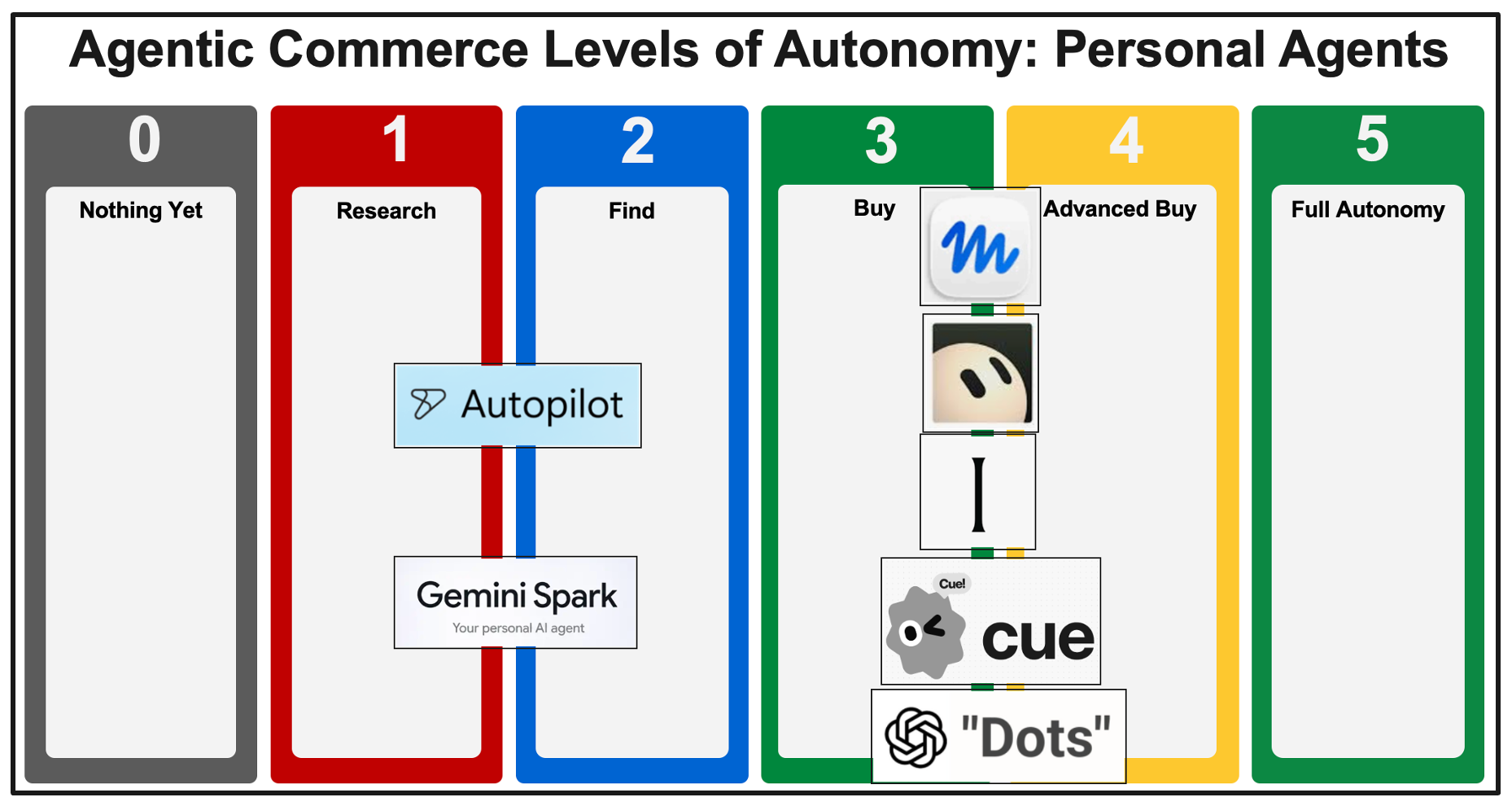
We went from zero to 7 offerings here and more are coming. You can see we’ve clustered Muse, GrokBot, Instinct, Cue (from Muse), and made a guess that ‘Dots’ will be at the 3.5 level. As mentioned, we are placing them there due to the lack of a multi-item/cart capability. Microsoft’s Autopilot and Gemini’s Spark are very far behind, but we expect Google to catch up by end of October.
Instinct’s CEO yesterday announced a massive funding round and that the company is driving over $1B of transactions. We suspect the bulk of that is Travel, but there’s a good bit of commerce in there - best guess is 70/30 split travel/ecomm. Instinct is growing 10% w/w so that will be $2B plus very quickly.
Agentic Commerce: Brand.com/Retailer.com
Because it’s so unique to every retailer, we can’t place all of these on the Levels of Autonomy framework, but you’re seeing every retailer and brand invest heavily in this space. We are evaluating adding a measure of where the top 1000 retailers are on this dimension to our popular AI1000 index.
Personal Agents and Answer Engines vs. Retail Agents
For me, one the most interesting arguments in Agentic Commerce is ‘who will win’:
Horizontal play: Personal Agents and Answer Engines vs.
Vertical play: Retail agents
Here’s a simple visualization of the argument:
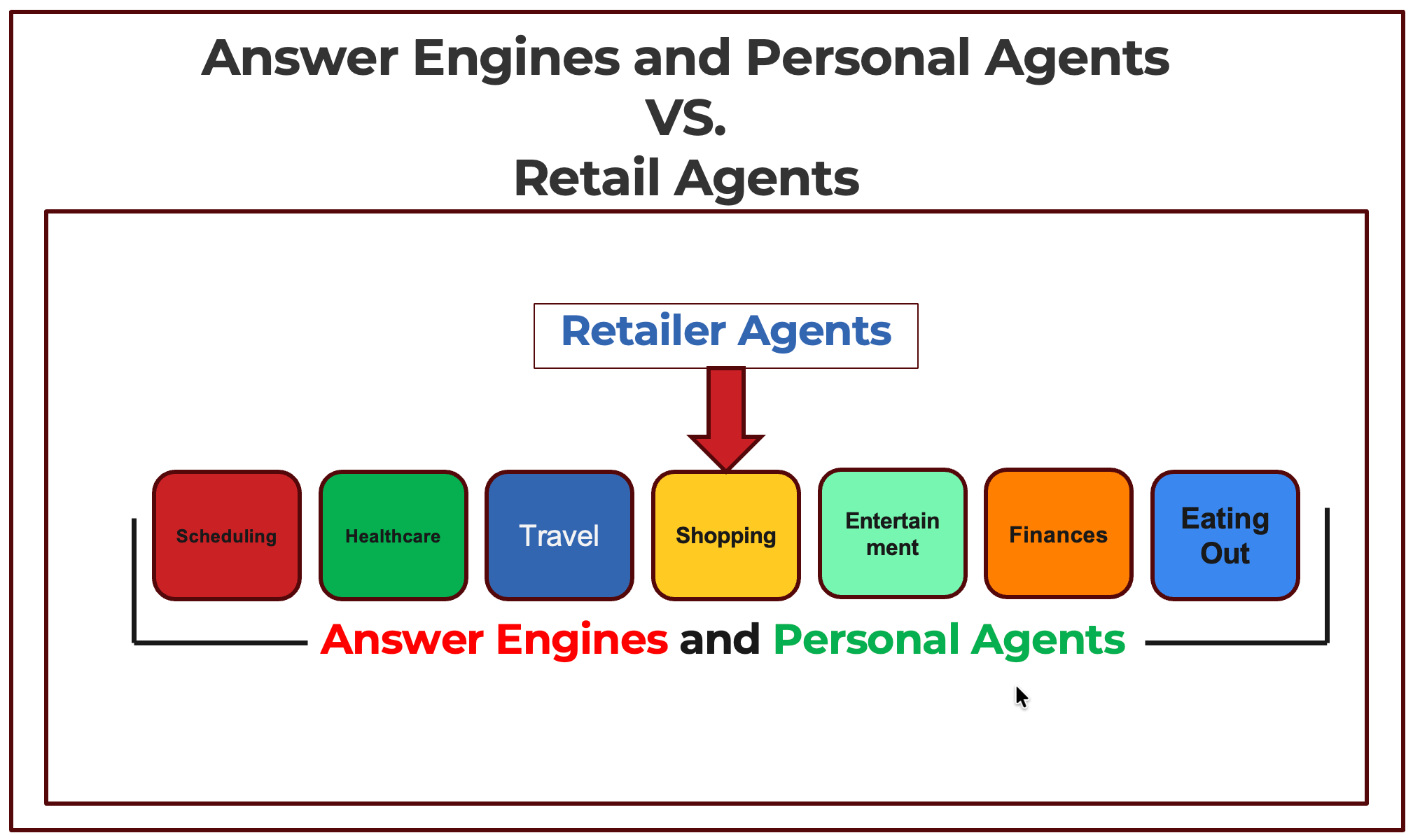
The argument FOR Answer Engines and Personal Agents goes:
If the consumer trusts the agent with multiple-aspects of their lives, the agent will have a ‘first shot’ at any shopping that happens. For example, a project like ‘I’m planning a trip to Europe next Summer’ could lead to trip planning, travel booking, and purchases of luggage and apparel for the trip (and sunscreen - Jason Goldberg’s favorite example).
The argument FOR the retailer agent goes:
The retailer agent (AFS/Sparky) is so focused on doing this well, that consumers will leave the personal agent for the fast shipping, the store experience, the returns capabilities, etc.
Who do you think will win?
Agentic Commerce Optimization: What is it and Updated Strategies
When it comes to what you can do to optimize for a strong holiday 2026, we coined the phrase Agentic Commerce Optimization:
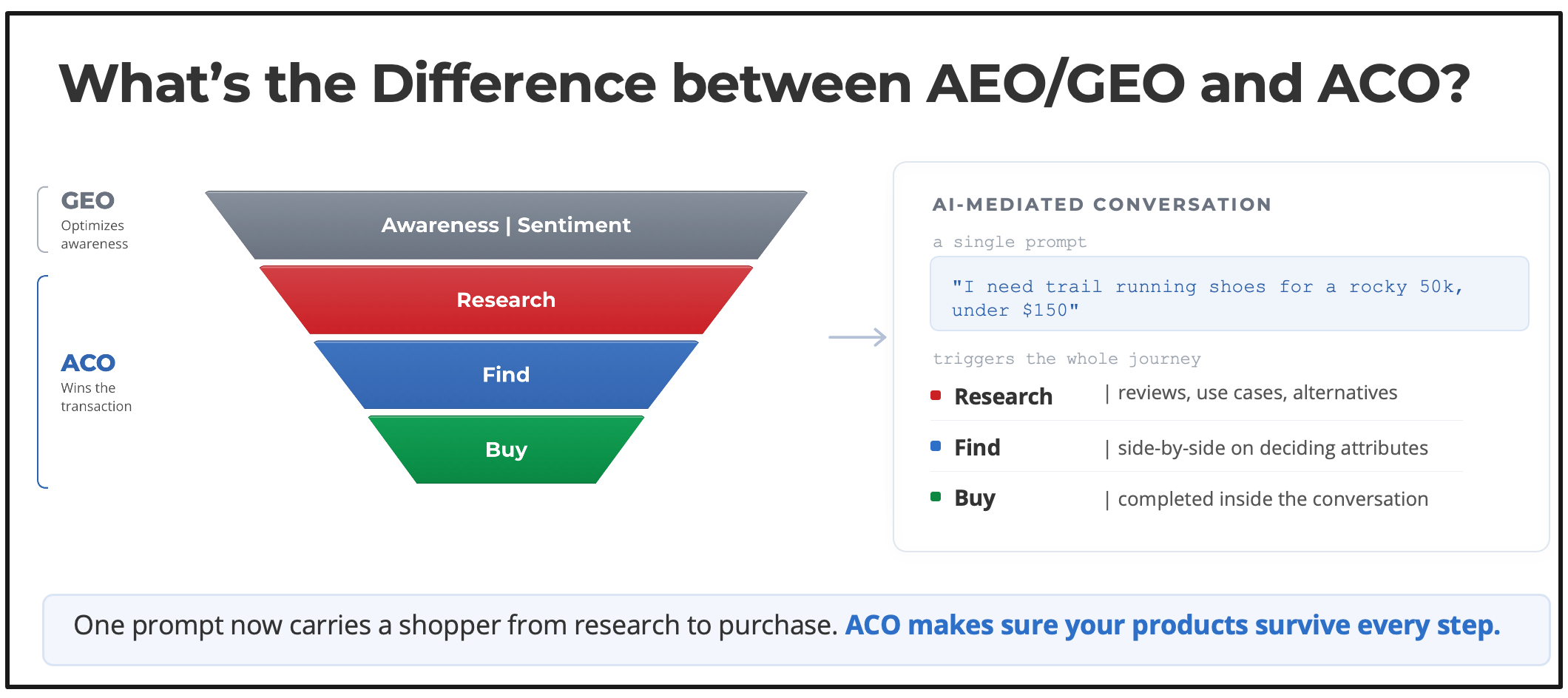
AEO/GEO focuses on AI visibility - does the Agentic Commerce surface (AEO/GEO is really only Answer Engines) know your brand, does it mention you - this is called AI Visibility. Most of these companies are focused on a very vertical set of customers: Fintech, travel, b2b, etc. and for those types of companies being strong at the sentiment/visibility layer is important.
In our world of commerce, our register doesn’t ring on AI Visibility, it rings on a purchase - the BUY part of the funnel. ACO picks up where GEO leaves off:
Making sure your products are on the product card
Are all your product’s features and offer components correctly stated?
Are you optimized for each surface?
Underneath ACO it always comes back to the product catalog - it’s the foundation for everything:
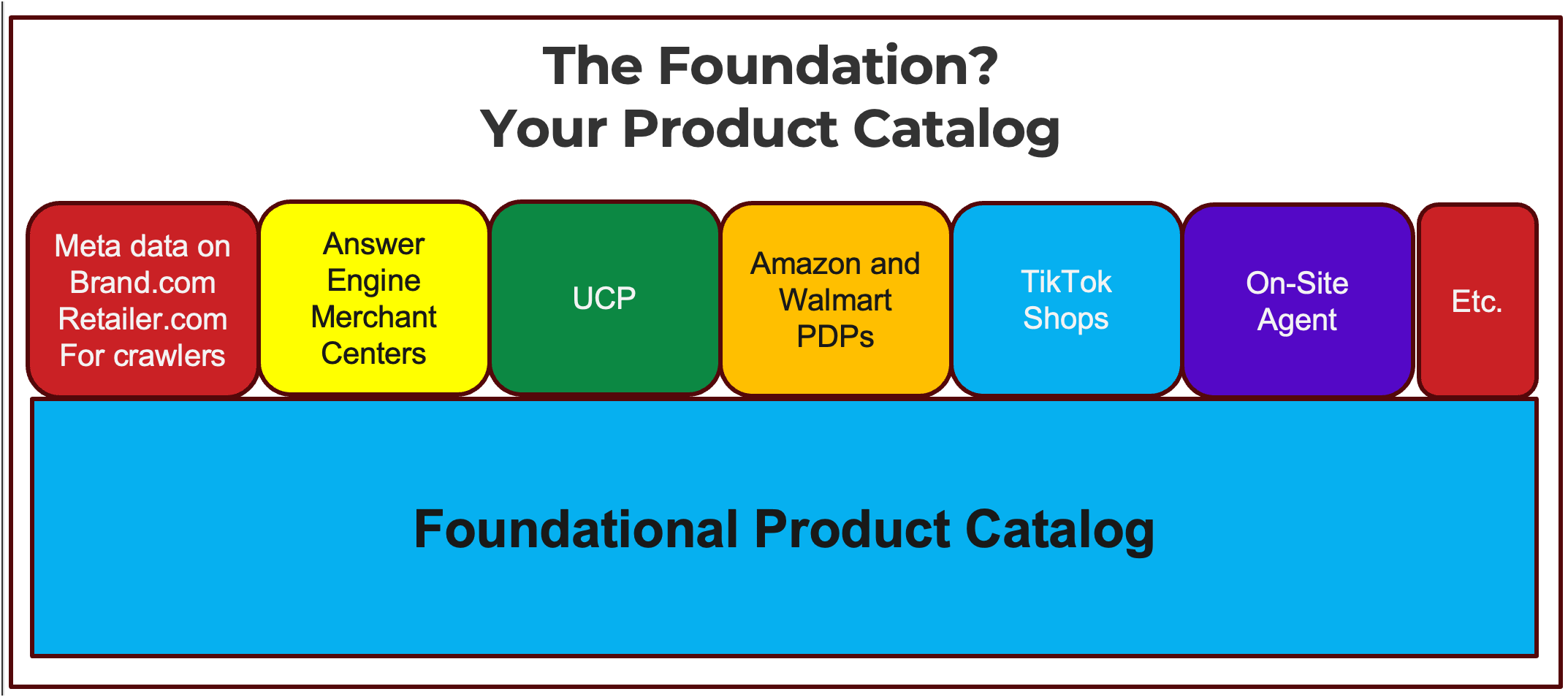
Here we’re illustrating a framework to think about:
First, your product catalog used to be largely static - today it needs to be updated regularly to keep up with the optimizations and changing ways consumers are discovering products.
Previously we used to primarily focus on the on-site PDP for your product catalog and them some data feeds to Google Shopping. Today you need to surface your catalog via meta data for crawlers, enhanced feeds for answer engines, UCP, if you are on Amazon/Walmart, you need to apply ACO principles for AFS/Sparky, TikTok Shops, your on-site agents, etc.
The good news is an investment in your product catalog pays off across all 4 Agentic Commerce surfaces and we believe it’s in the sweet spot of ‘low effort’ / ‘very high impact’.
ACO Everywhere
We call this strategy of applying ACO-oriented optimizations to your catalog on a recurring basis: ACO Everywhere:
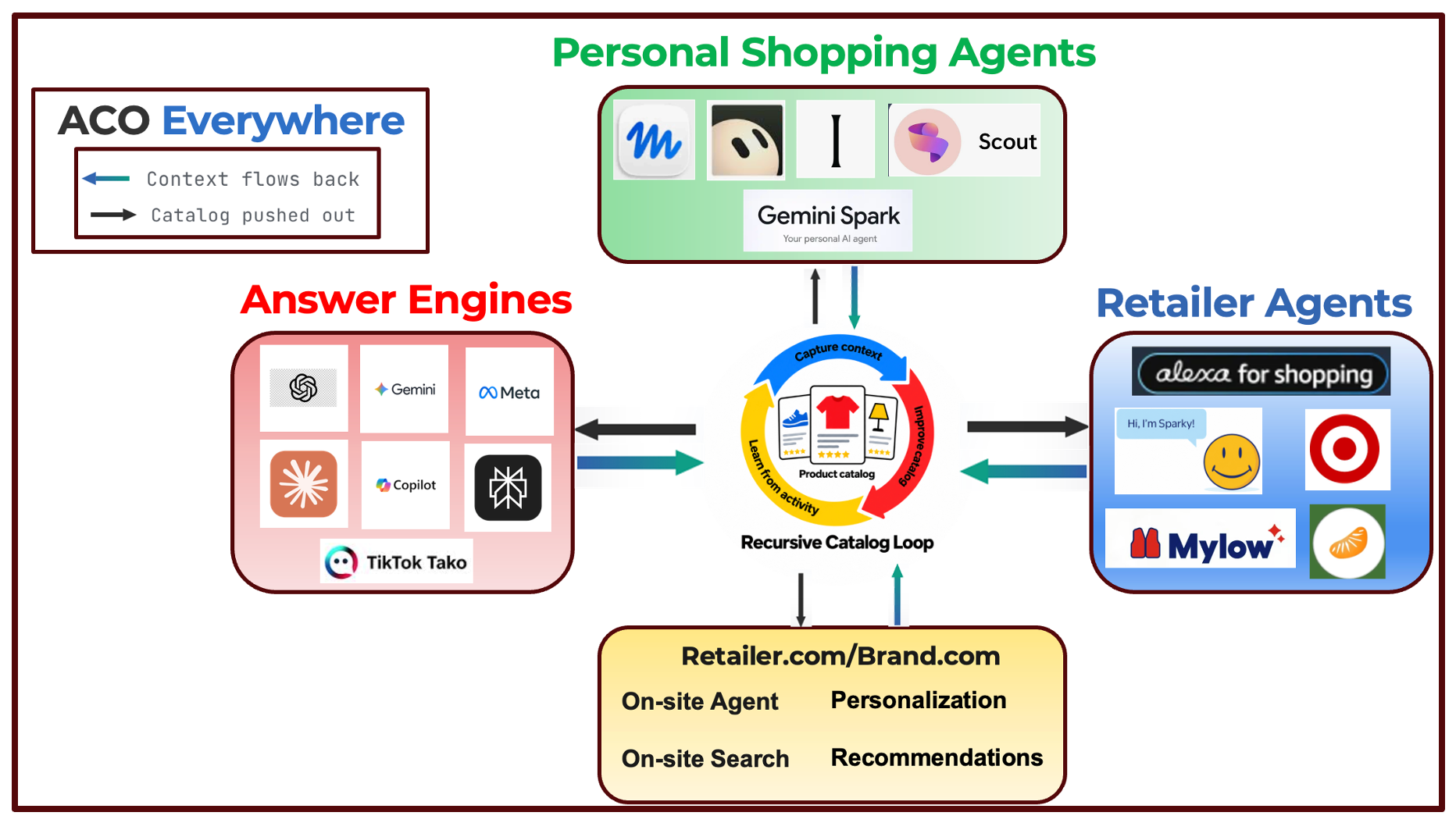
Thankfully despite all this new complexity we’re dealing with and the 30-40 new destinations for consumers, your catalog can be simultaneously optimized for Answer Engines, Personal Agents, Retailer Agents AND your on-site Agentic Commerce investments. It’s like a 4X BOGO!
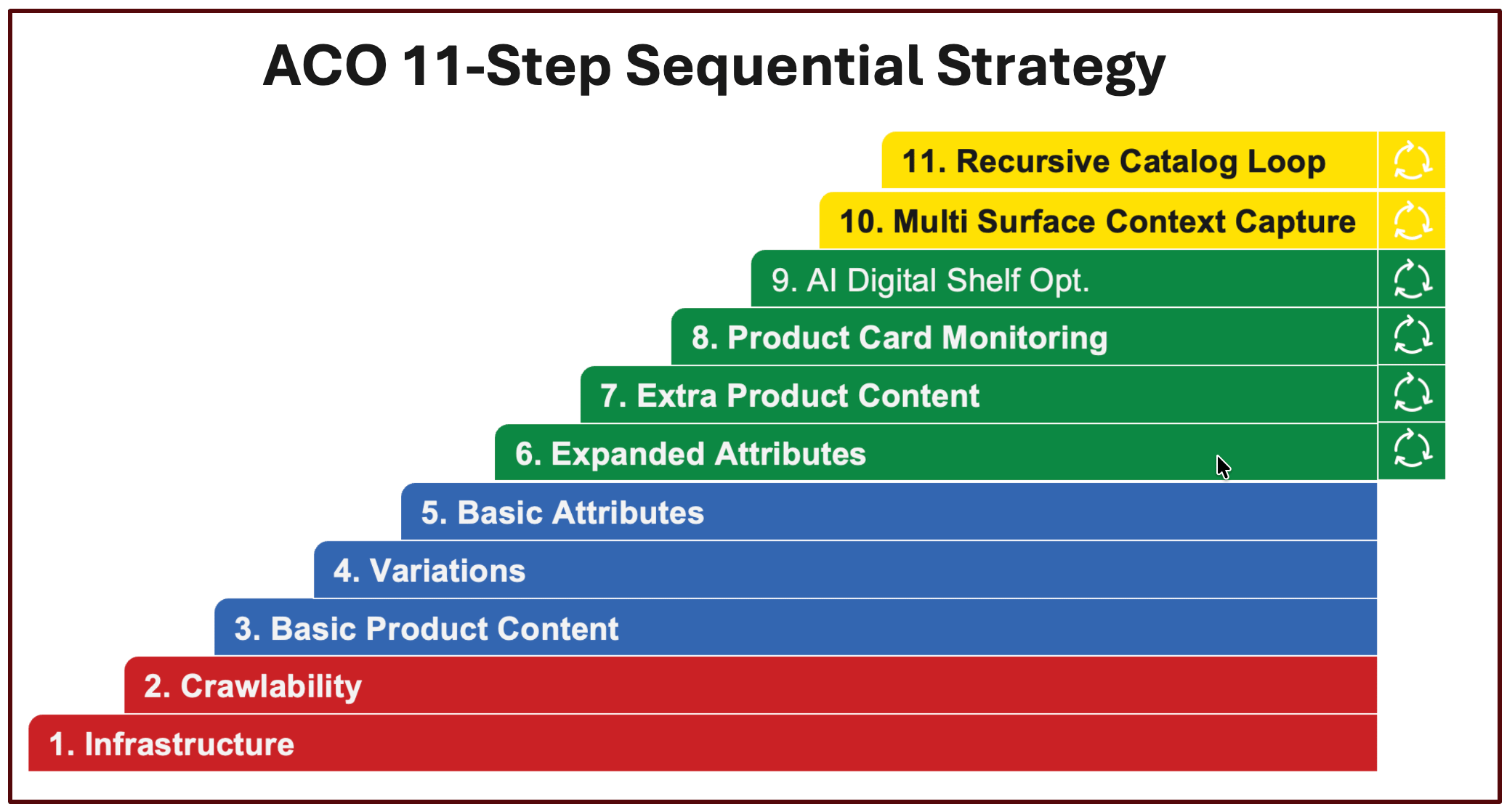
ACO 11-Step Strategy
Because of what we’ve learned from the power of loops and context capture to pull in the learnings from all these surfaces back into the catalog in a closed-learning-loop, we added steps 10 and 11 to the ACO 9 step strategy sequence:
Conclusion and Happy Agentic Commercing…
In Summary:
Consumers continue rapid adoption of Agentic Commerce
There are now four Agentic Commerce Surfaces to consider: Answer Engines, Personal Agents, Retail Agents and on-site agents.
Agentic Commerce Optimization (ACO) provides actionable and measurable steps to increase sales on these surfaces
ACO focuses on optimizing your product catalog
Advanced ACO is a closed loop system that captures product-level context, measures the impact at each Agentic Commerce surface, grabs context clues and feeds all of that back into the system for continuous improvement.
Anyone can (and should) implement ACO, small marketplace sellers, brands, grocers, CPG, auto.
An investment in your catalog today, amplifies to all four agentic commerce selling surfaces and will future-proof your company through these exponentially growing changes and explosion of consumer options.
Happy Agentic Commercing and we hope everyone has a strong Q4 - we’ll be back in Q1 with another State of Agentic Commerce Update and, of course, we’ll be reporting all the news heading up to and through Holiday 26.