


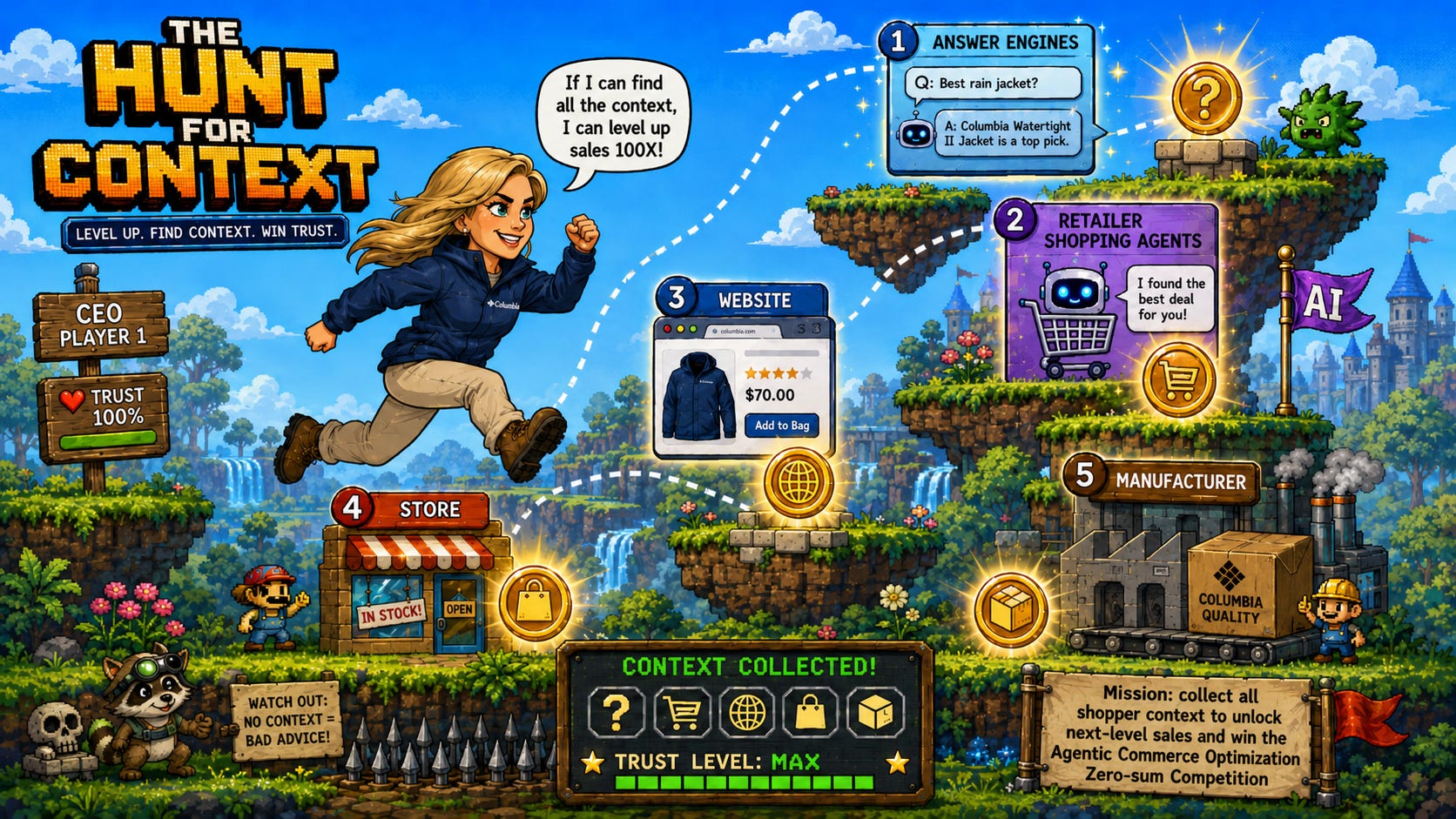
Welcome to Part IIB of a III Part series: on ‘What’s Next in Agentic Commerce Optimization (ACO)’. Here’s the quick guide for this multi-part series
Part I: The Next Phase of Agentic Commerce Optimization: Context Capture is here.
Part IIA: “Product-Level Context Capture: Where, How and When?” is here.
Part IIB: “Recursive Context Capture Loop Tactical Example” <YOU ARE HERE>
Part III: Introducing ACO Everywhere 🚀 is here
Recap of Context Capture
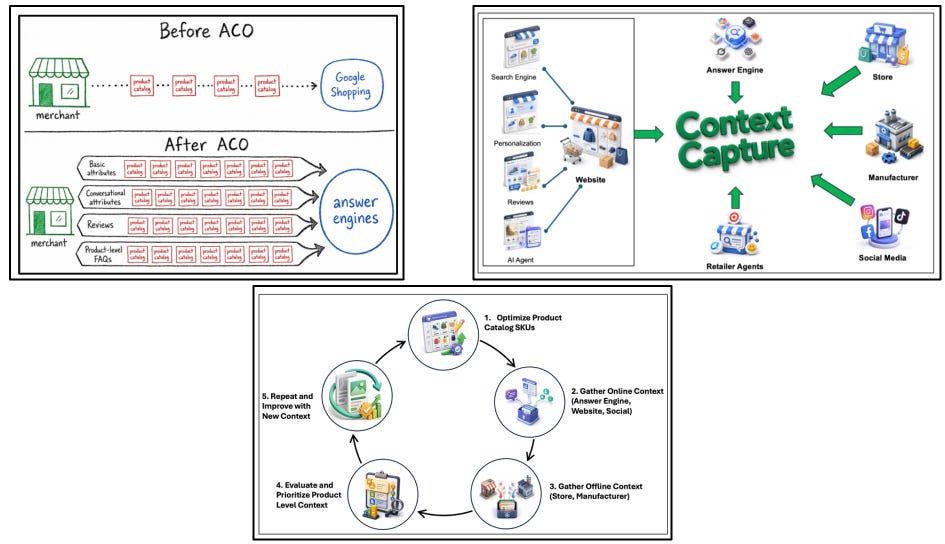
In Part I, we introduced the idea that the next big unlock in Agentic Commerce Optimization is product-level context capture. We looked at how the Answer Engines are telling us they want this context by opening up 4 massive high-speed lanes of data (inside UCP/ACP) to provide this unprecedented level of context. Then in Part IIA we looked at where you can go to capture the context. Finally we introduced the concept of a Recursive Context Capture Loop (RCCL).
Part IIB: Tactical Example of SKU-level Context Capture
So far in this series, we’ve been dealing in the theoretical, and now it’s time to get ‘real’ and deal in real-world examples. As I write this, it’s raining and my favorite raincoat is this Columbia Watertight II jacket, so i’m going to use it as an example because I’m familiar with it and long-term readers are probably burned out on dog treats ;-)
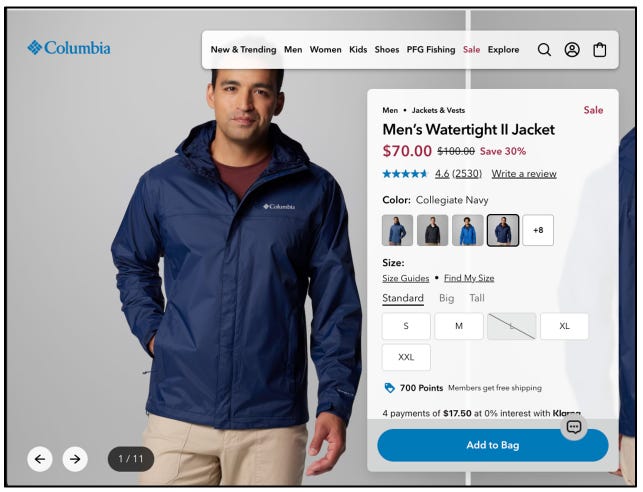
Disclaimer: I picked this product at random, as part of this experience, I’m going to purposely try to find contexts of all kind including both positive and negatives. This is part of the context capture experience for every SKU and we always recommend looking at both sides of the bell curve for contextual clues. In fact, it’s one of my favorite products.
Answer Engine Contextual Clues
Since this is Retailgentic, let’s look at the Answer engines first. To save time, we’ll look at the top 2: ChatGPT and Gemini.
ChatGPT
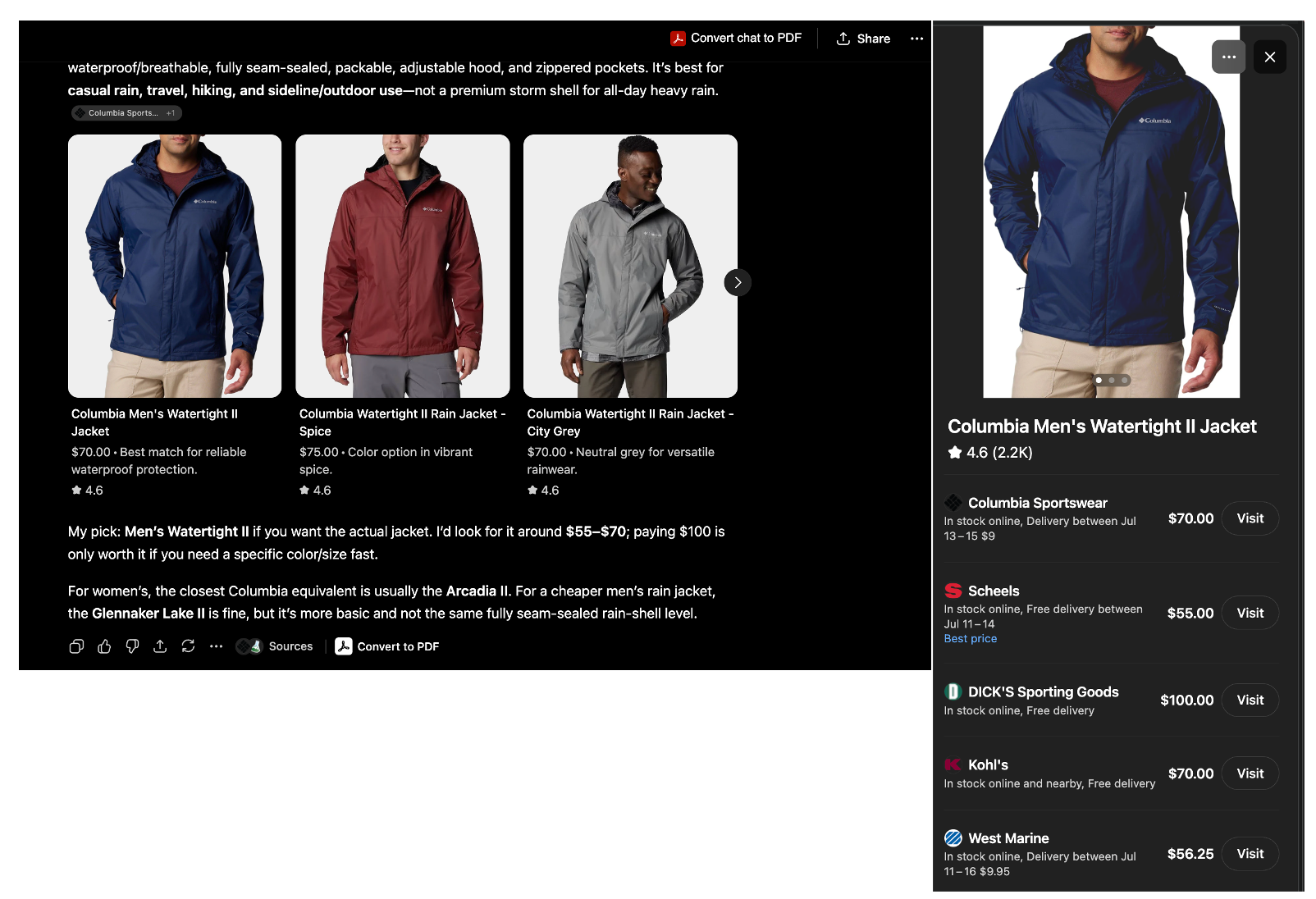
Lower on the offer card, there’s a ‘What people are saying’ section:
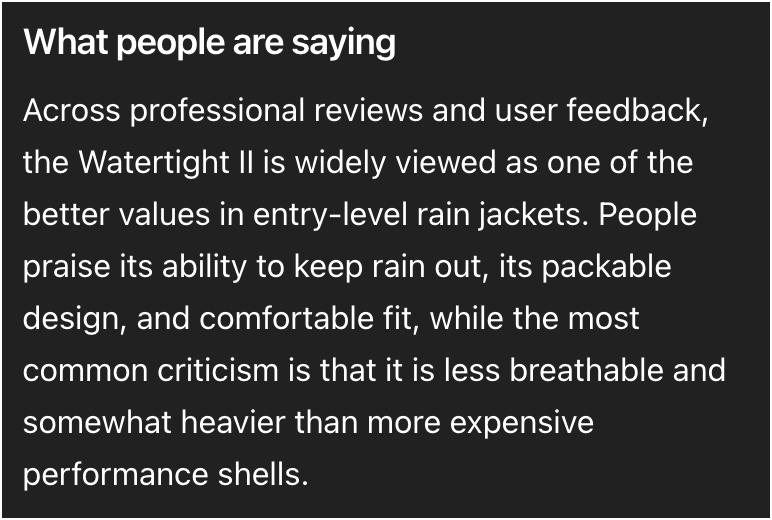
Here’s where we find our first contextual clues:
ChatGPT Context pros:
Better value in entry-level jackets
Ability to keep rain out
Packability
Comfortable fit
ChatGPT Context negatives:
Less breathable
Heavier than other options
Pro Tip: Always ask an answer engine specifically for negatives:
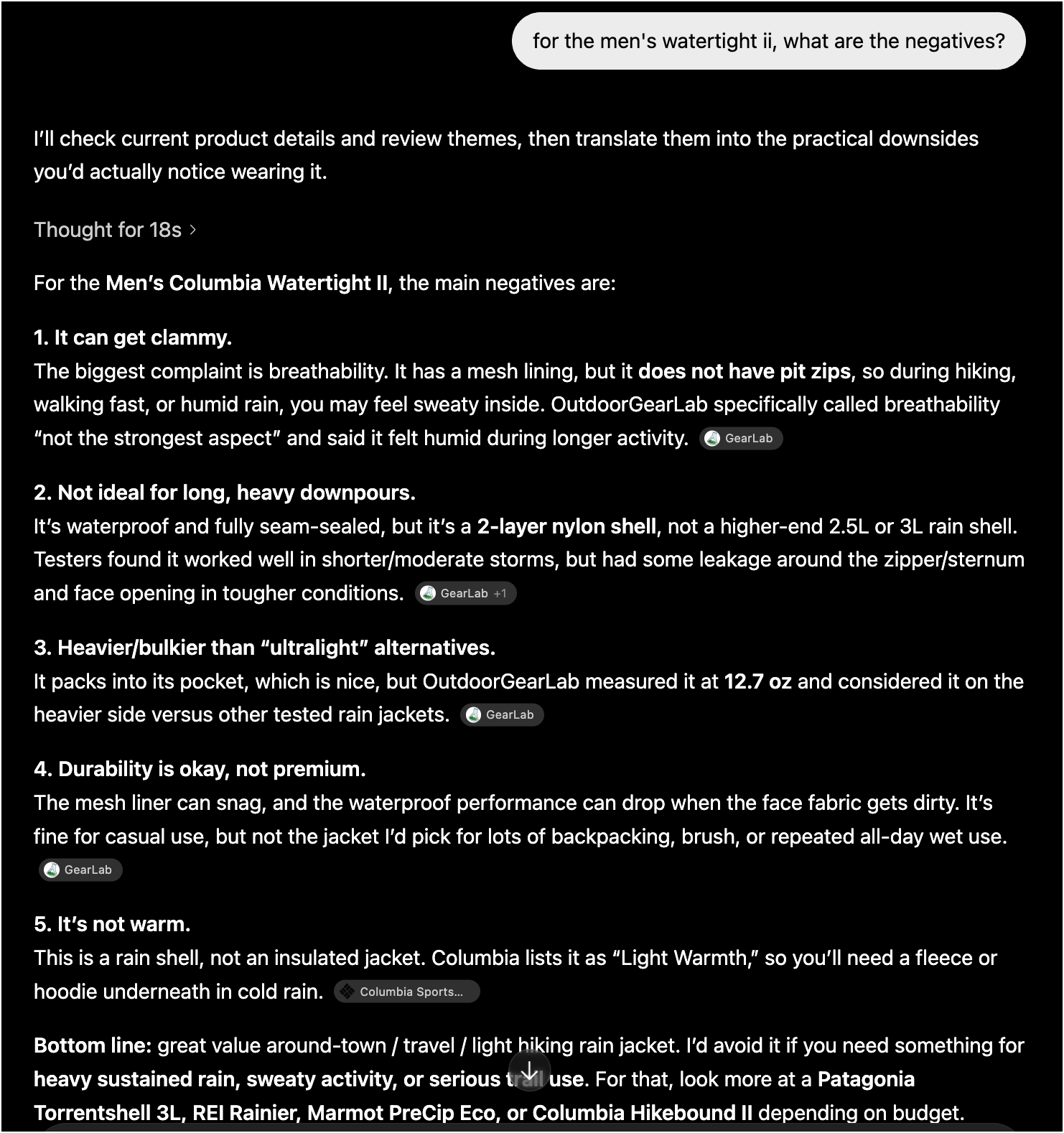
I won’t list the 5 negatives here, but I do want to point out the products that ChatGPT does recommend as alternatives, these are always good to know: Patagonia Torrentshell 3L, REI Rainier, Marmot Precip Eco, Columbia Hikebound II.
Gemini
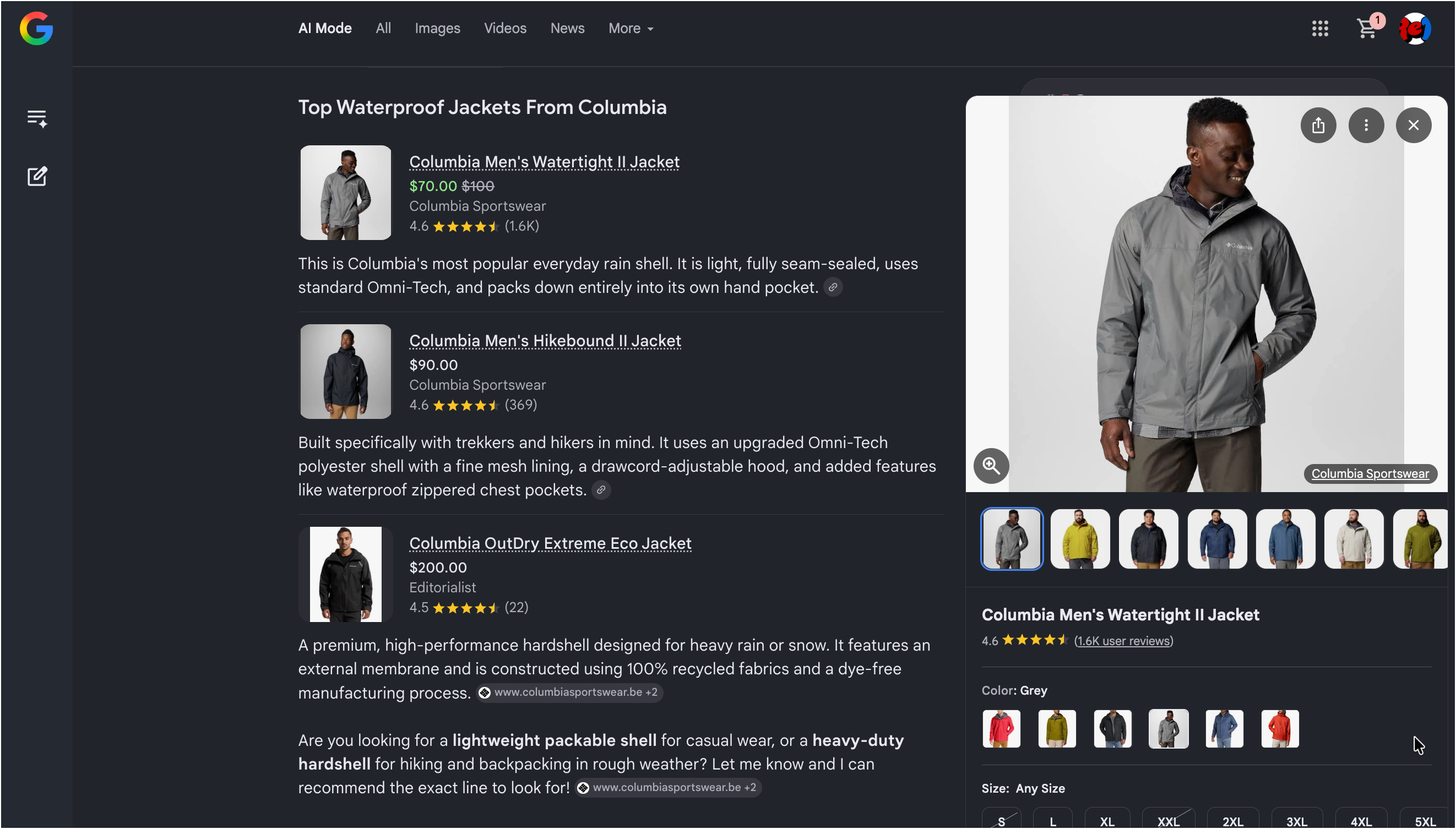
Gemini has very helpful offer cards - as you go down the offer card you get some really good context. For example, the ‘What to know’ section here:
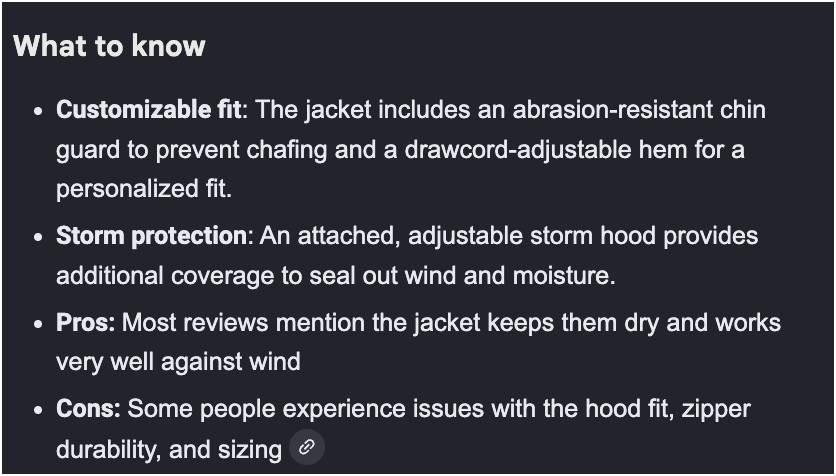
Note that we’re on step 2 and we’re still finding different pros and cons - an example of the
Then even further in the review section we get more→
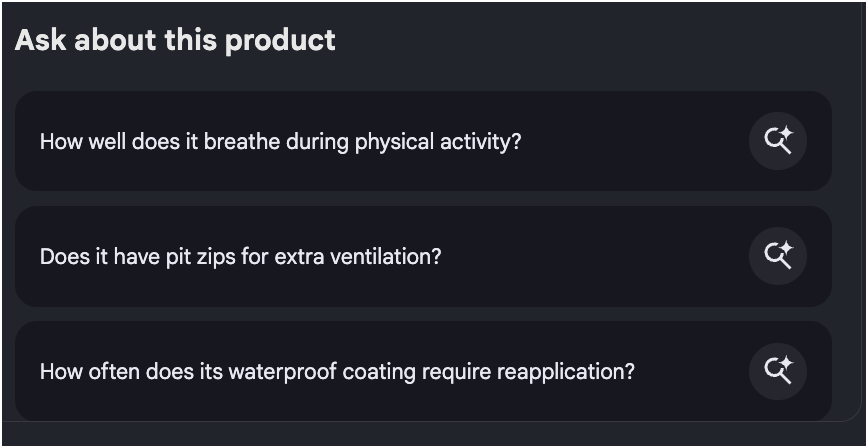
Google is surfacing right here for us the top questions it receives on this product.
Finally at the bottom of the offer card, it surfaces up reviews of interest. It surfaces these two negative Reddit reviews in that section:
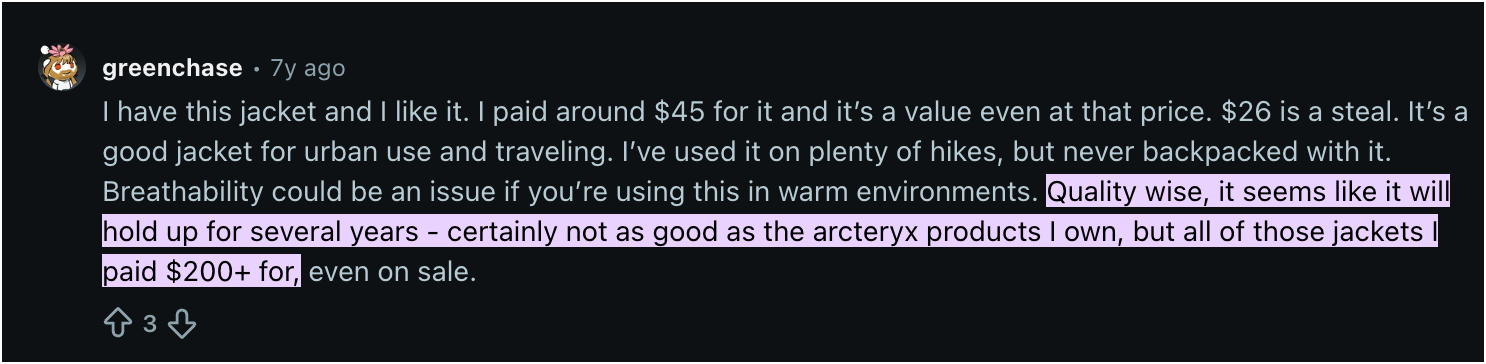

Unfortunately Gemini summarizes these as: “doesn’t hold up long” and “pockets don’t protect phone”.
Summary Context from Answer Engines:
Contextual pros:
Good value in entry-level jackets (2x)
Ability to keep rain out (2x)
Packability
Comfortable fit
Customizable
works well in wind
Contextual negatives:
Issues with hood fit
Zipper durability
Sizing
Pockets leak on phone (reddit)
Durability (reddit/gemini and ChatGPT)
Less breathable (repeated as clammy)
Heavier than other options (ChatGPT+Gemini surface)
Not for super heavy downpours (2 layer not 2.5L/3L)
Warmth - shell, not insulated
Other contextual clues:
FAQ: Does it have pit zips?
FAQ: What’s the breathability?
FAQ: How often does the waterproof coating require reapplication?
Retailer Agent Context
This item is not available on Walmart, so let’s look at Amazon. Here’s the PDP on Amazon. On Amazon we always first look at the Alexa prompt pills. These live in three places:
Top of PDP
Middle of PDP Q+A section
Alexa left-pane invocation
In this screen shot I’ve gathered all three:
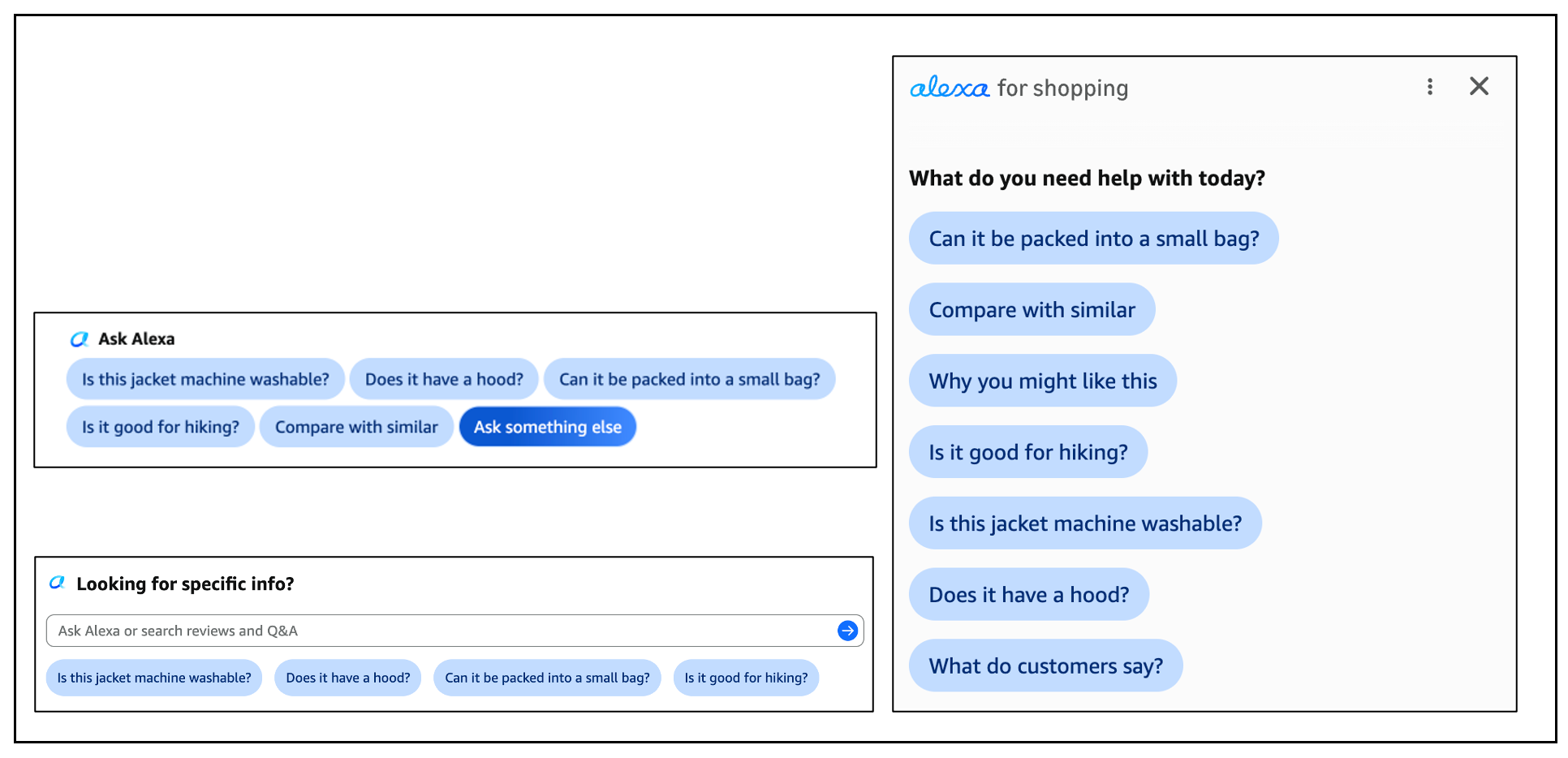
Here’s the union of these:
Is this jacket machine washable?
Does it have a hood?
Can it be packed into a small bag?
Is it good for hiking?
Compare with similar
Ask something else
Why you might like this
Let’s pause for a second here. Amazon has the largest catalog and is the largest retailer. They are also further up the learning curve on Agentic Commerce than any other retailer. They would never publicly talk about it, but you can bet they are on version 3.0 of their own RCCL and this is is one of the outputs. The Amazon context engine is telling us these 7 questions are the most frequently asked questions/concerns have about this SKU.
One of the most impactful for brands to see is the ‘compare with similar’ - here, again, Alexa is quite mature data-wise and ACO-wise, it is going to show you what Amazon’s customers are most frequently comparing to with this SKU - competitive context is very helpful. Unfortunately it does it by making the user scroll across a panaromic comparison grid. We’ve unfolded it for you here→
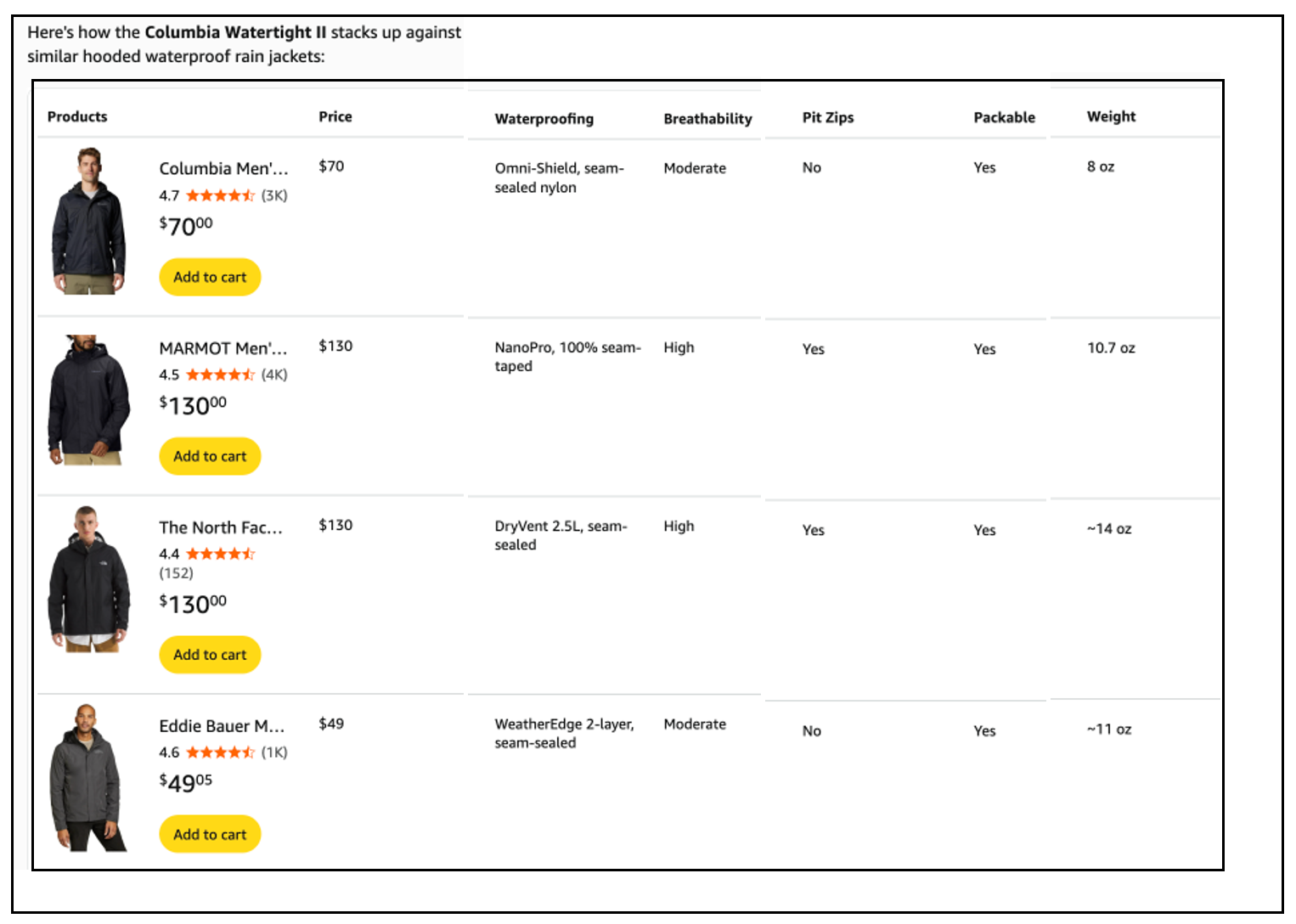
At the top Alexa is showing the anchor product, then it gives us two rain coats at a higher price point (MARMOT and North Face) and one at a lower (Eddie Bauer). Notice the comparison criteria - also very important context:
Waterproofing, breathability, Pit Zips, packable, Weight
Also there’s a ‘dog that isn’t barking’ here - why isn’t Amazon offering a higher-end Columbia product instead of competitive brand - it frequently does in other scenarios. Hmmm 🤔
Website Context
Unfortunately, we don’t have access to Columbia’s website. But if we did what we’d look at these areas for contextual clues:
On-site search engine - Columbia has a typical search engine (more on this on a second)
Personalization platform - Unknown what they are using
On-site reviews - There’s no easy summary here, but we do have access to them so we’ll run an agent to do this.
AI Agent - While they have an agent, it requires login and appears less about finding products and more about post-sales customer service queries.
Website: On-site search Context Strategy
For your on-site search engine, you want to look at the head and the long-tail of the distribution curve of search terms that result in PDP traffic and/or conversion of the SKU. At the head, you want to make sure all the high converting search terms are captured and not only integrated into your pdp, but your entire outbound catalog. On the poorly converting terms or the null search results, you need to have an AI agent analyze those for possible misses in contextual clues. Perhaps a new shopper behavior is developing you’re missing. For example, I remember my Grandfather called raincoats - ‘slickers’. In the modern world, all it takes is about 10 minutes for a celebrity to coin a new phrase or be seen in a product and it goes from ‘the Columbia Watertight II’ to “Hailey Bieber’s raincoat’
Website: Analytics Context Strategy
After the search engine, the other very valuable data on the site is analytics. We recommend looking at your analytics by looking at the PDP traffic and putting into four quadrants as illustrated:
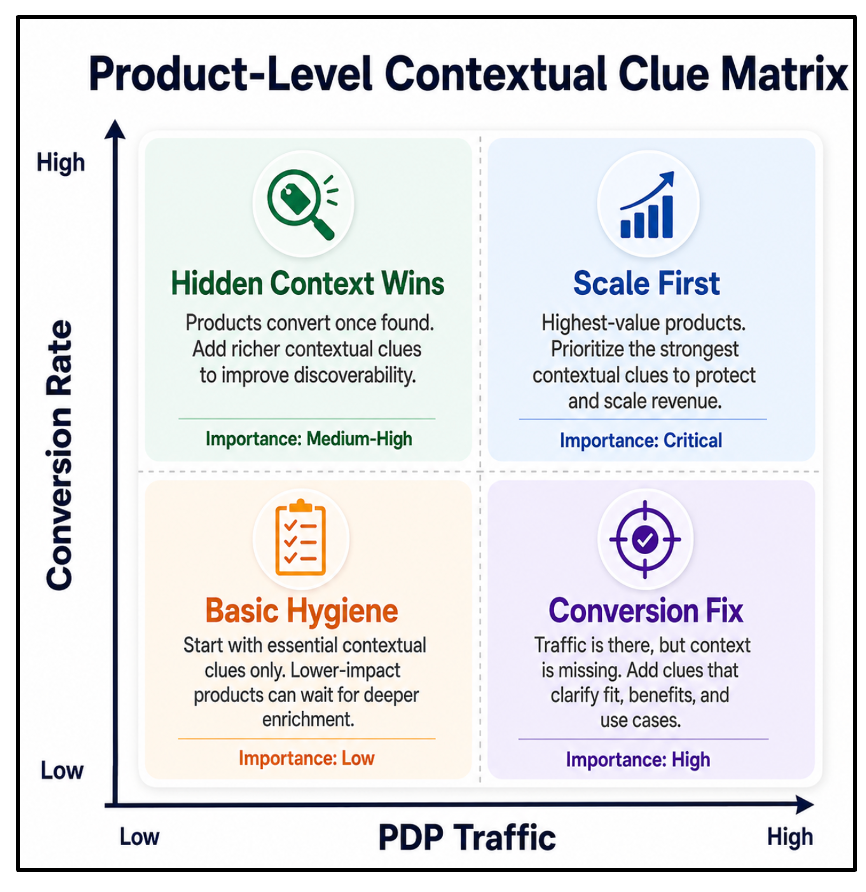
In these high traffic quadrants, we want to first look at the low conversions - this is where we’re getting a hint from consumers there is missing context here, because they didn’t convert. What was missing? This is where an on-site agent can give you more contextual clues a bit further down funnel than analytics and search terms, but since we’re looking deep (website) and deep (across answer engines, website, retailer agents), many times we’ve seen people do this exercise and those contextual clues essentially tell them what’s going on.
For example, Amazon told us top questions asked of Alexa are:
Is it machine washable? (not on PDP)
Does it have a hood? (on the PDP down the page in ‘details’, but should be clearly stated above the fold - pictures with hood are behind a semi-transparent part of site.
Can it be packed into a small bag? (again on the PDP, but far down in details)
Is it good for hiking? (an occasion type question frequently missed by PDPs). The PDP has this: “Uses: Hiking, Everyday”. That’s not enough context and is a symptom of the over optimization of PDPs for keywords/SEO. In the SEO era, SEO experts would tell you not to be too wordy because that would delete the impact of the keyword hiking so we end up with: “Uses: Hiking, Everyday”. How about - “Whether you’re in the Pacific North West, Maine, Florida or all the places in between, if you are on an a warm weather hike this jacket is perfect protection from wind and rain.” It’s Omni-tech technology is both protective and breathable. The size customization makes it great for hikers that like a tight or lose fit and the hood not only protects your head from getting soaked, but provides valuable sun protection.”
After the high traffic, low conversion, we want to look at high traffic high conversion - what is on the PDP in these examples that’s making this page click? Are we taking everything that’s working here, capturing that context and publishing it externally?
Since we don’t have access to Columbia’s site, we don’t have any new context to add from this section. But hopefully Social Media gives us a last boost.
Website: Reviews
I like to use all the AI tools possible, and for this we need an agent that has access to a consumer-level browser so I had Claude cowork w/ chrome do the negatives and Perplexity Comet Assistant/Computer do the positives.
Website: Reviews: Positives
Here’s a summary of several hundred positive reviews focused on the top 5:
1. Keeps you dry — the top positive, cited constantly. People report staying dry through real tests: daily rain across a full Ireland trip, kayaking in Alaska rain for 2 hours, hiking full rainy days on the Appalachian Trail, a Texas tropical storm, yard work in moderate rain. Common phrasing: “kept me dry the entire time,” “water beads up nicely,” “does exactly what it promises.”
2. Lightweight and packable. A huge recurring theme, especially for travel. “Packs down incredibly small in my backpack,” “light enough to push into a backpack,” “compact, lightweight, and keeps you dry.” Frequently called the go-to travel/hiking rain shell.
3. Good fit / true to size. Most say “true to size,” “fits great,” “perfect fit,” with room to layer underneath. (A couple note it runs a touch small and sized up — the mild counterpoint to the reviews’ sizing complaints.)
4. Comfortable and versatile. Praised as an all-weather, everyday jacket — dog walks, commuting, travel, golf, night walks. “Light, comfortable, stylish and weatherproof.”
5. Style, color, and value. Many like the color options (the yellow/”mustard” gets specific love) and the look (”professional look,” “great fit”). Several call out good value and fast shipping, and a number are repeat buyers or bought extras for family.
Website: Reviews: Negatives
And here’s the same treatment for the negatives:
1. Not actually waterproof — by far the biggest complaint (~18 of 40). Over and over people say they got soaked, often in light or moderate rain within minutes. Representative: “leaked everywhere,” “back seam across the shoulders leaks,” “got soaked in a light rain,” “not even CLOSE to 100% waterproof,” “drenched to the skin both times,” and a paddler describing “catastrophic failure” after 3 hours in rain. Several call it “a windbreaker, not a rain jacket.” A couple also say it isn’t breathable.
2. Cheap, thin, noisy material. The most repeated phrase is that it “feels like wearing a trash bag” / “plastic bag” / “aluminum foil.” Others: “very thin,” “flimsy,” “like a thin trash bag,” “cheap looking material.”
3. Fit / sizing problems. Runs small and cut too short; inconsistent sizing between Big and Regular; sleeves too long; “about a size and a half too small”; doesn’t fit over a layer.
4. Build-quality defects. Zipper caught and broke on first use, a hole next to the zipper out of the box, hood elastic snapped on first use, unevenly-sewn/shallow pockets, smeared heat-transfer logo (vs. embroidery), velcro instead of snaps.
Website: FAQs/Q+A
Columbia has a FAQ section which is also available to a browser agent, so here’s what that surfaced:
Weight: ~0.95 lb.
Waterproofing/DWR: described as Omni-Tech fully seam-sealed, “so you stay completely dry”; for re-treating over time they recommend Nikwax (TX works well) or GEAR AID.
Pockets: two zippered hand pockets.
Layering: regular fit with room to layer; works as an outer shell over most layers.
Warmth/temperature: no insulation or warming tech — layer for cold.
PFAs: fabric does not contain PFA “forever chemicals.”
Packability: packs into its own hand pocket.
Climate control sheet: directed to contact Customer Care.
Social Media Context
Social media is a goldmine for context. We always recommend looking for your product’s mentions or PDPs on TikTok, Reddit, Pinterest and Instagram and capture all the hash tags, categories, groups, and any influencers that are mentioning your products as the most valuable context.
For our Columbia jacket, some interesting findings:
There’s a movement called Gorpcore that started out a bit fancier and higher end where urban dwellers wear hiking gear in the city. Today it’s heading to ‘normcore’ or “quiet outdoor” or “technical fashion for the city”. It turns out our Columbia Watertight jacket is popular with this community.
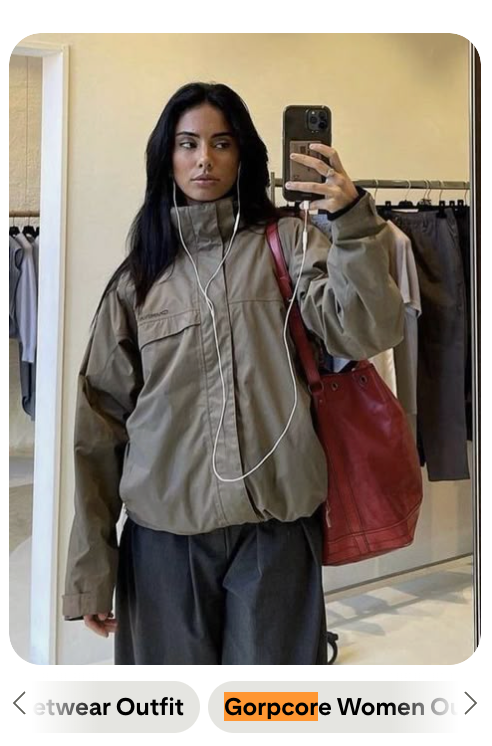
There’s a bunch of communities under the umbrella “Cool Girl/Cool Girl Hiking” term that encourage females to get out and hike. These communities love gear and our Columbia Watertight (the female edition) is a popular product in this community.
If we had access to the search terms, these types of social-media findings are unfortunately almost never captured, and then fed back to the PDP and therefore will show up as the top null search results.
Social Media Context Captured
To summarize for social media, this was a fast tour due to time constraints, if we had more time we’d spend a lot more time on YouTube and TikTok. But we did find some valuable information already:
Gorpcore trend
Normcore
Cool Girl Hiking
Other Sources of Context: Store and Manufacturer
Columbia has about 200 Columbia stores and says they have 1,850 retail partners. That’s a very rich surface area with humans selling Columbia products every day, answering questions, understanding occasions and the lifestyles where Columbia’s customers use the products. That data and information is gold, and figuring out a process for collecting, collating and feeding that into the Context Capture engine is well worth the effort.
Even though Columbia itself is the manufacturer, we’ve found that even branded manufacturers have a significant loss of valuable information as products go from idea→design→prototype→iterate→final product→scale. Frequently the digital team is given 4 bullets to work with and hires copy writers to recreate copy that was lost in the process. Agentic Commerce Optimization can hopefully become the value creation engine that tears down these silos and enables the digital team to have
Putting it all Together
For our Recursive Context Capture Loop, in this post, we got our hands dirty and illustrated steps 2 and 3 at a very granular level for one SKU: (to the extent possible with a randomly selected product using publicly available information)
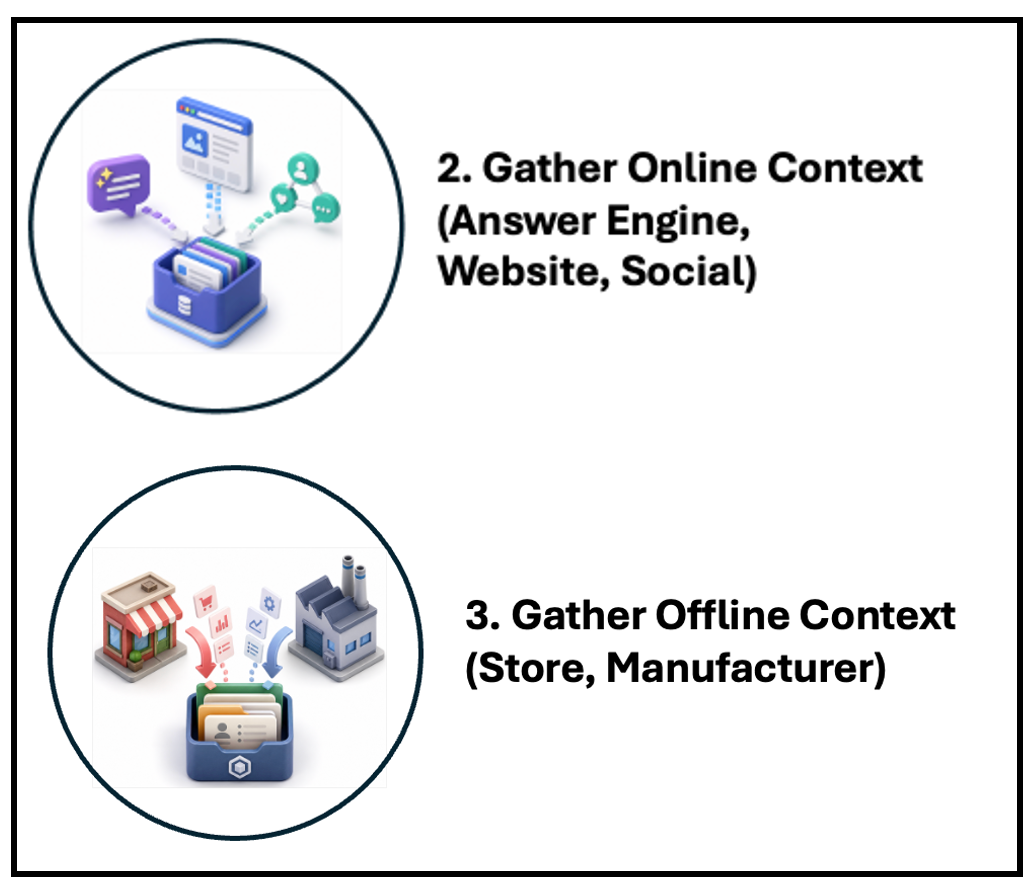
Through that process, here is a summary of valuable context we captured about this SKU put into 6 buckets:
Pros/positives
Cons/negatives
Top competitors mentioned/compared
Social/lifestyle signals
FAQS (from around the web and the PDP)
Reddit Authoritative Content
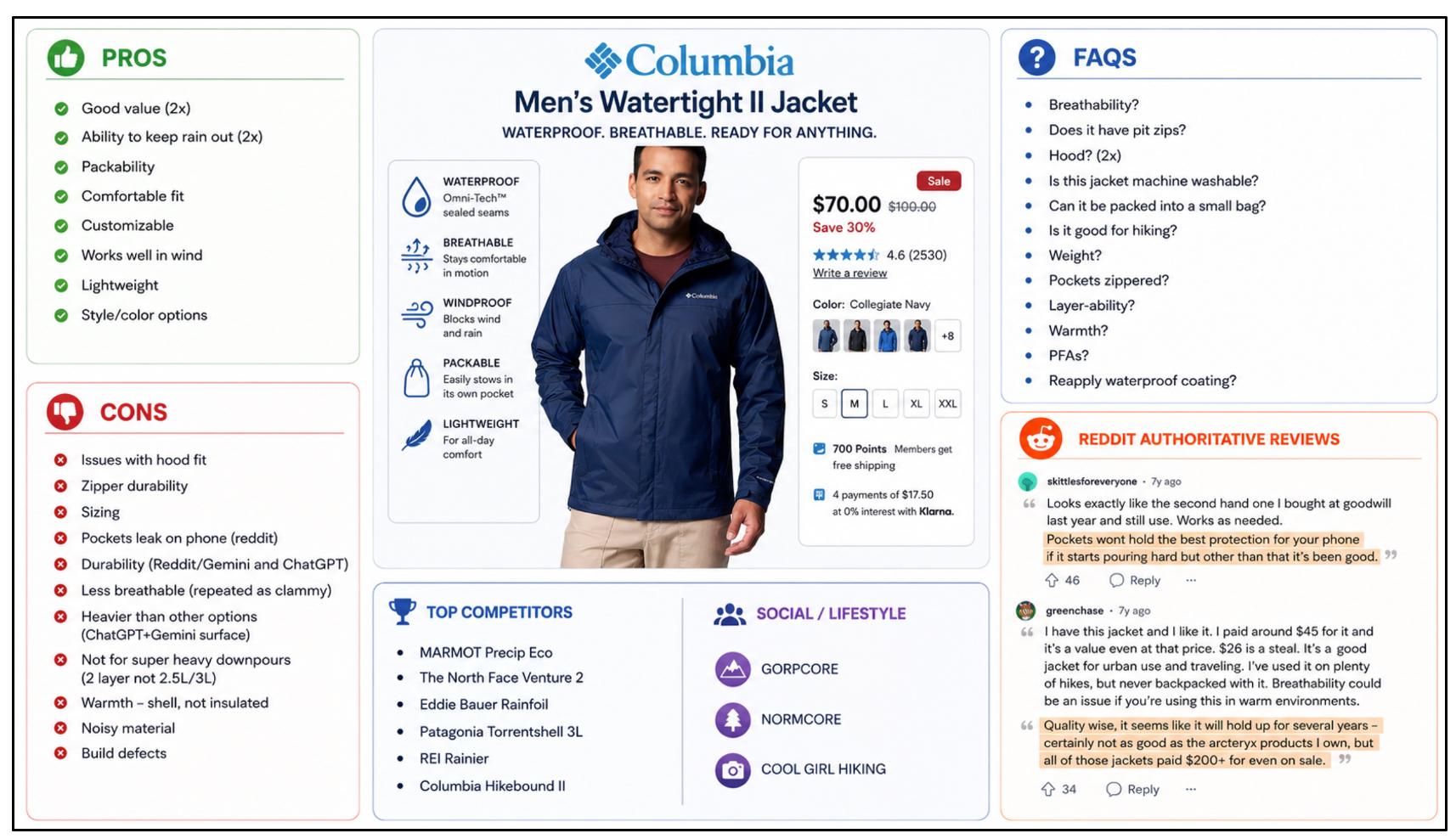
It’s important to note that Columbia itself should be able to pull together 3-5X what we can find publicly from online and offline sources (website, store, manufacturing process, etc.). Today you may say that juice is not worth the squeeze, but I think in < 9 months it will be, so if you want an edge, get started on this today.
What’s Next?
In Part III, coming Tuesday July 14th, we’ll conclude the series and put a proverbial bow on it by tying it together at the strategic level and then come back to our Columbia Watertight jacket and implement what we’ve learned here.