Welcome to Part II of a III Part series: on ‘What’s Next in Agentic Commerce Optimization (ACO)’. Here’s the quick guide for this multi-part series:
Part I: The Next Phase of Agentic Commerce Optimization: Context Capture is here.
Part IIA: “Product-Level Context Capture: Where, How and When?” <YOU ARE HERE!>
Part IIB: “Recursive Context Capture Loop Tactical Example” is here.
Part III: Introducing ACO Everywhere 🚀 is here
In Part I, we introduced the concept of context capture and how it is now necessary to beef up the product-level context to match the sharp increase in shopper context.
Product Catalogs in the Agentic Commerce Era
Before 2022, Product Catalogs were largely static. There were new products added every quarter and some products ‘deleted’. Seasonal businesses like fashion had more movement like that. But once created, each individual SKU didn’t really change except for price and inventory which have been increasingly dynamic over the decades.
In the post Agentic Commerce Era, due to the new importance of integrating context into product catalog as covered in Part I.
Where Should You Capture Context?
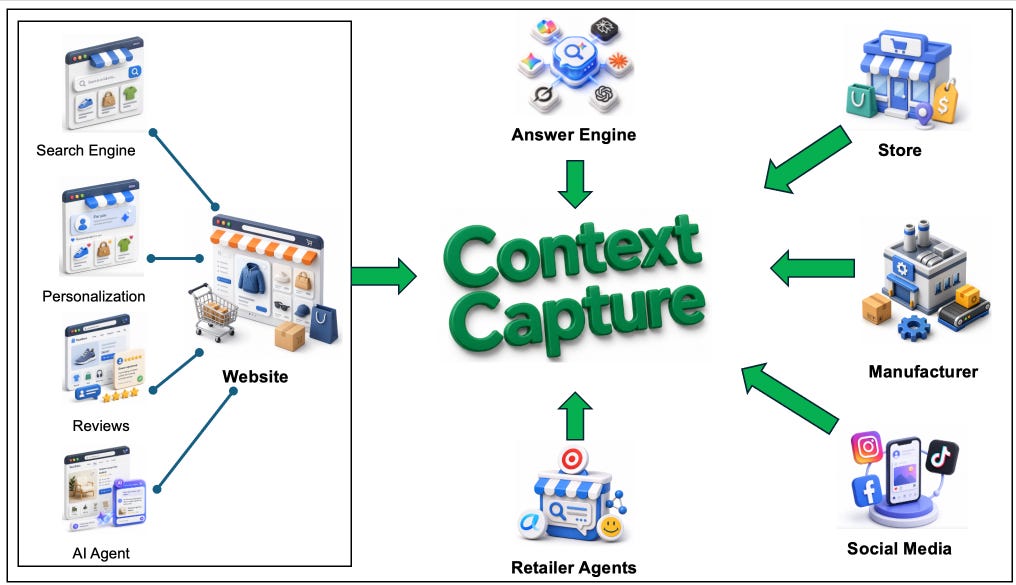
There are 6 major areas where you can capture extremely valuable consumer shopping product-level context. They are:
Answer engines - With Google releasing AI Performance insights and rumors that ChatGPT’s ad engine is going to be sharing a similar level of information. We are entering an era where Search Engines shared little to nothing, but Answer engines are going to have much more transparency. This information is valuable context capture.
Retail agents - Like Answer Engines, I suspect that Amazon/Rufus, Walmart/Sparky and other retailer shopper agents like Target’s TSA are going to be providing more infromation about what prompts shoppers are using, the topics being discussed, product features compared, comparative products, etc.
Physical stores - If you are omni-channel, your retail stores are a wealth of context that you previously haven’t thought of leveraging elsewhere, but now in the AI era, there’s very rich information you should vacuum up for your on-line efforts. Sales rep training manuals, product guides and anything that a store associate would be trained on can be leveraged by an LLM for product-level context.
Brands/Manufacturers - As a retailer, the deepest level of product information is typically available from the manufacturer, and then frequently this is either ignored and recreated or condensed down to 2% of the original content. If you are the brand, frequently the online group actually does the same thing as a retailer - takes the design briefs, hundreds of pages of product information, spec sheets, technical details and boils it down to 1% for the human readable PDP, which is normal, but now we live in a world where all of that information is gold dust and we need to go figure out how to keep it at 100% from offline→online.
Social media channels - For hundreds of years, centralized merchants were the taste makers in retails, but we are now in the Kardashian/TikTok era and the tastemakers are independent influencers, celebrities, athletes and content creators. When influencers recommend, are seen with or even have a similar product to something you offer (either paid, organic or collab’ed) , that is important context that needs to be captured.
Website - Your online website is one of the largest surface areas of lost context. Each shopper is browsing, searching, receiving personalizations, leaving and consuming reviews and increasingly prompting your on-site shopping agent. Those contextual artifacts on both the positive (high converting) and negative side (low converting) are significantly valuable contextual clues to product-level shopper behaviour that needs to be captured, gathered and actioned.
Across these six opportunities to increases context capture, every retailer will have different amounts of context and priorities for their business. In fact it can seem overwhelming when you really start thinking about how much context could be captured. We recommend this best practice to solve that problem:
Context Capture Action item: Create a company-specific rubric for what’s important to your company from a product-level context capture perspective (what is your biggest product-level content hole to be filled by contextual information) and then rank all 6 of these context captures sources. Create a prioritized list with the first 2 being your ‘top priority sources’ to start with, the next 2, your middle and your last 2 your low priority context sources.
Building a Compounding Context Capture Recursive Loop
Before AI, workflows across programming/coding and optimizing digital sales be it ecommerce or ads or what-not was a mostly linear process with a bit of a maybe quarterly, semi-annual or annual closing of the loop. Since November 25 when the agentic capabilities of the ChatGPT and Claude models took a huge leap forward, developers have realized that with AI automating a lot of the process that these ‘loops’ can be significantly tighter. Developers are particularly obsessed with these loops now.
Why are AI Developers Obsessed With Loops?
There are two types of Loops - ones with AI in the middle as the ‘judge’ or ‘tagger’ and then those without a human.
If a human is in the middle it’s called Reinforcement Learning with Human Feedback - RLHF. If AI is in the middle, it’s called Reinforcement Learning with AI Feedback. As you can imagine, relative to AI, humans are slower and less scalable and more expensive so if RLAIF is » RLHF. (Want to learn more? Start here.)
This started with some basics and then one of the most famous AI developers, Andrej Kartpathy who has a mini llm he calls nanoGPT, created a RALAIF recursive loop so this llm model codes itself and if the new version improves it’s benchmarks, it is good, otherwise, it deletes that and tries again. In this post, he ran it in this mode for 2 days on this loop→


In this chart down and to the right is better. You can see that after 2 days with zero human interaction the sytem got better.
Today, ChatGPT and Claude are built this way - they build a new version of themselves. If that version is better. v2 then builds a better version to v3 and so on. This is why model releases are bending the exponential curve. (Anthropic hired Andrej btw).
While that’s a little scary 🤯, let’s stay in our World where YOUR job is to drive more sales and profit for your org (while crushing the competition) and answer the most important question of the day:
What Do Recursive Programming Loops Have to Do With YOU?
This concept of loops can be applied to any system that has a definitive zero sum or measurable outcome. That’s not only coding, it’s digital retail and marketing.
Example from coding: Did the code compile? Did the code pass the tests? Was the desired outcome generated by the code?
Example from Digital Retail: Did the SKU map correctly? Make a change to optimize the product catalog - did that that increase conversions? Did the ad hit the ROAS target for SKUX?
These are perfect for the digital vs. analog world because in the digital world no humans are in the loop so the loop is faster and tighter. For example, if you wanted to use RLAIF for store inventory, the loops are too slow, over 3yrs it will have an impact, but not 6 months.
I believe that in the next 18 months we’re going to see significant digital retail disruption due to these loops. Some forward-leaning retailers and brands, are going to lean into these and use them for digital advertising.
Answer engines (Claude, ChatGPT, META, SpaceXAI, Gemini) are going to be using these to hyper-improve the customer-experience and conversion rates of Agentic Shopping and the performance of AI Ads.
Quick Recap to Tie it All Together (so far)
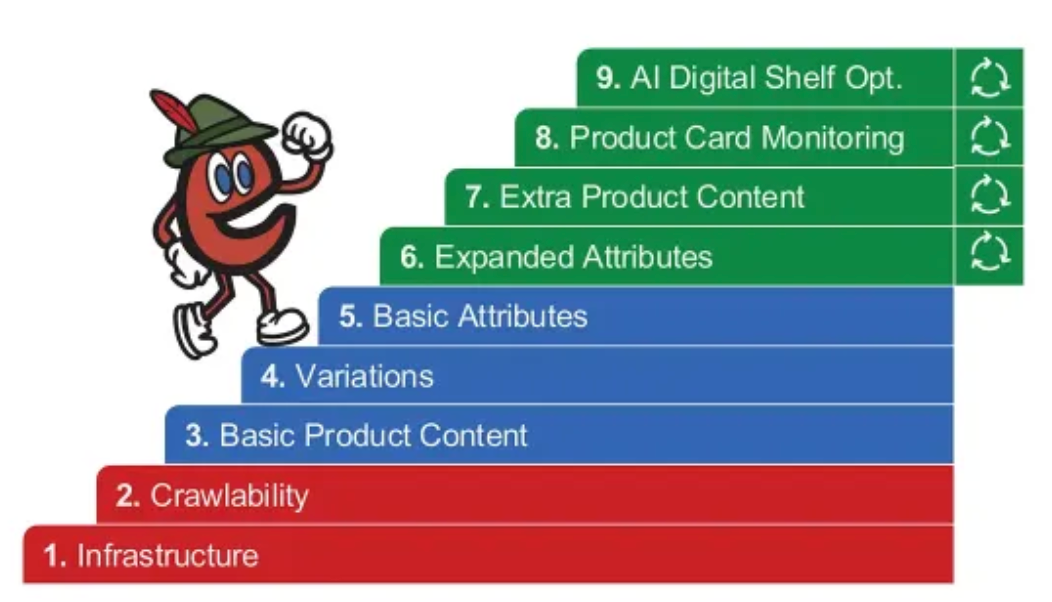
If you’re with me, here’s the logic path from Part I to where we are here at the end of Part II:
Product-level Context is the next frontier - After doing the basics (steps 1-5 of our agentic commerce optimization framework), and the advanced step 6. To do steps 7,8,9 you need a loop (that’s why we put those little circles there back in Sept of 25 ;-) )
UCP/ACP have given us plenty of ‘room’ for context - In addition to much wider basic attributes and conversational attributes, we have an essentially unlimited product-level FAQ data feed we can send the answer engines→
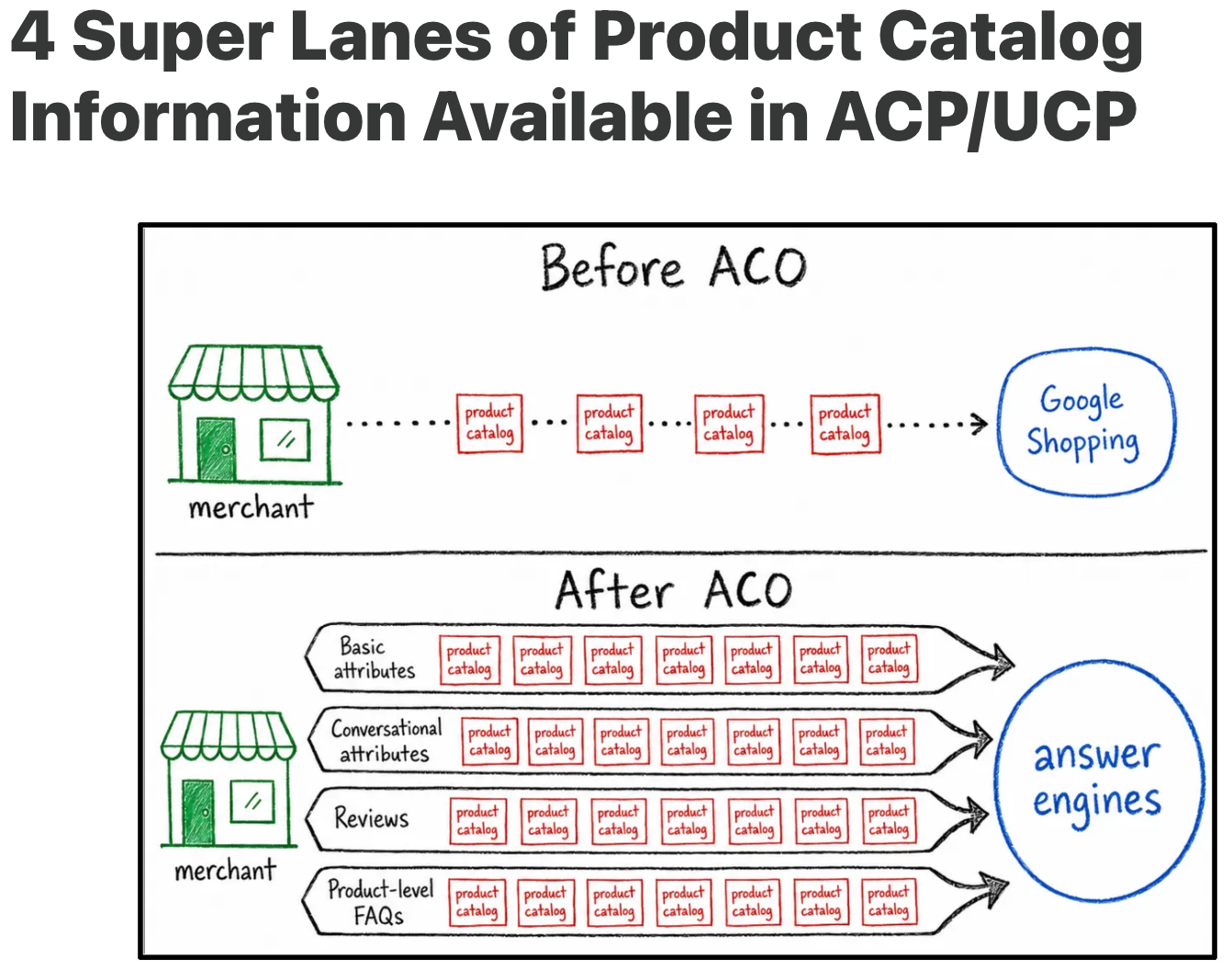
Conclusion: We need a system that recursively loops through and ‘captures’ the tons of product-level context (website/store/manufacturer/social/retailer agents/answer engines) as fast as possible and captures the increasingly unpredictable rapidly changing capricious shopper behaviors, feeds the context BACK into the catalog, publishes, RLAIFs the results, then loops again, faster and faster, smarter and smarter - the era of the rapidly self-improving product catalog is upon us!
Good news! We now have all the pieces in place to build such a system….
Leveraging the AI Loop Concept and Context Capture: Compounding Context Capture via a Recursive Loop
I believe what all retail and DTC brand CDOs need to be thinking about maybe by Holiday 26, but definitely by the end of 2027 is how to create a recursive compounding context loop or a RCCL. Here’s what it looks like:
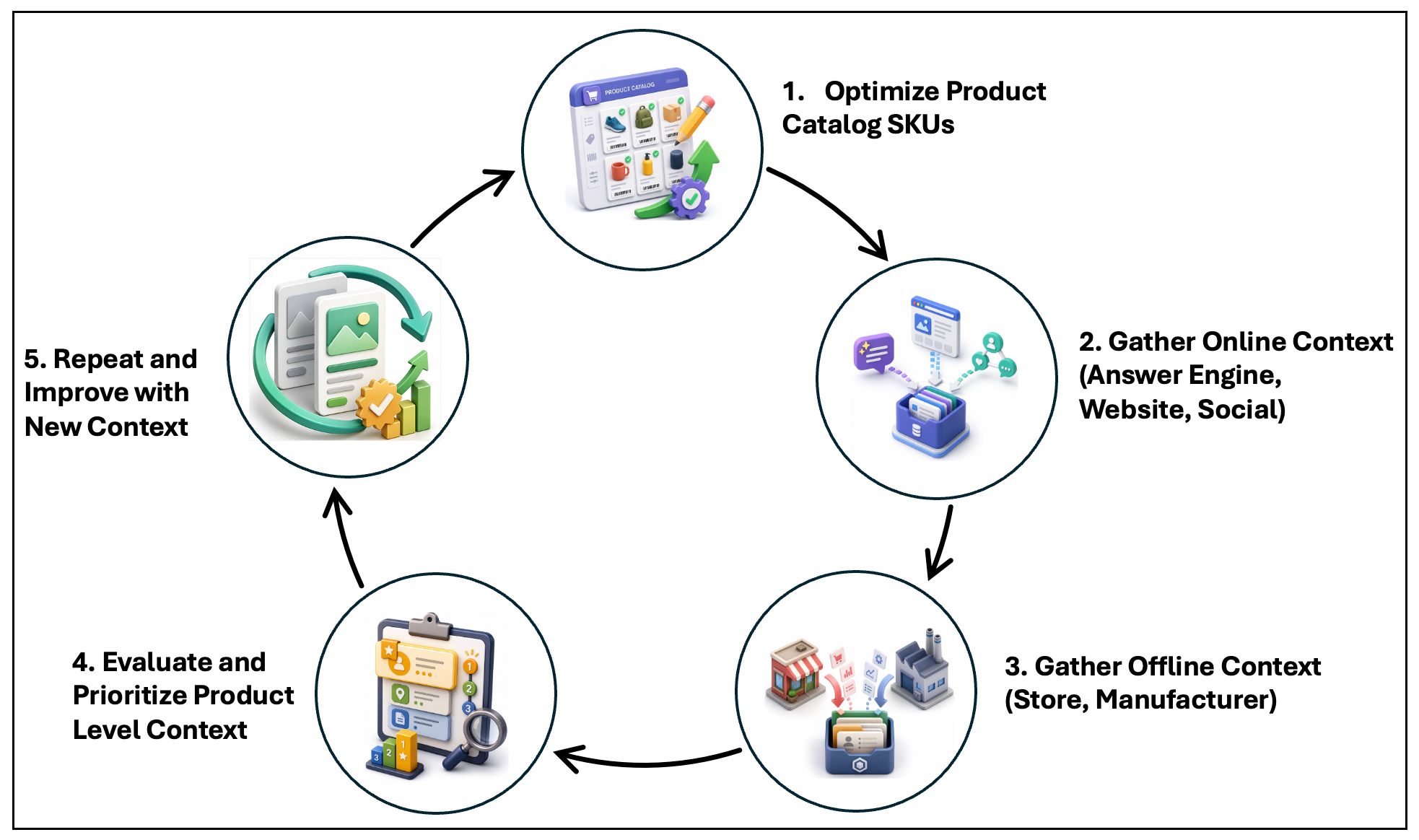
Step 1: Optimize Product Catalog SKUs
In this step we publish the latest version of the product catalog and measure the impact. While that measurement is happening we simultaneously collect context.
Step 2: Gather Online Context (Answer Engines, Website, Socials)
I grouped the online sources together because being digital they are always going to be faster than offline. You can API/MCP into your datasources or larger orgs will have a real-time-ish data lake they can pull from. Because of this maybe you pick up digital every time through the loop and offline ever 4th time or maybe once a month type thing for what fits your org.
Step 3: Gather Offline Context (Store, Manufacturer)
Offline is always slower and won’t update as much as online, so maybe for your org once is enough through here, but if you have stores, you should prioritize a more real-time way to pull store associate feedback- specifically any interesting consumer behaviors changes/nuances into the system. That can be made pretty quick, especially if you are on a retailing type in-store system.
Step 4: Evaluate Context and Prioritize
In Step 4, the evaluation from the current version is done and opportunities for improvements have been discovered and made. At the same time, new context from steps 2 and 3 is pulled in and evaluated. A new version of the catalog is ready for the next loop.
Step 5: Loop with new context in the Product Catalog
Catalog new version is ready to go and published and the loop starts again. Faster and faster.
I realize this is significantly different than the way we have operated in the past and it maybe seem like overkill, and we’ll get to more of why this is a priority in the next post.
What’s Next?
I was going to keep going right into examples here, but that’s a lot to digest and sit with, therefore I’m going to split part II into 2 parts IIA and IIB. Part B will be out July 8th and Part III will be out on July 15th. Until then we’ll continue to have awesome pods for you and also don’t forget to subscribe to our new channel! - www.retailplaybook.ai
Have a great Independence Day everyone! Here’s to 250 years of America! 🇺🇸