


Part I: The Next Phase of Agentic Commerce Optimization: Context Capture is here.
Part IIA: “Product-Level Context Capture: Where, How and When?” is here.
Part IIB: “Recursive Context Capture Loop Tactical Example” is here.
Part III: Introducing ACO Everywhere 🚀<YOU ARE HERE!>
Series Recap
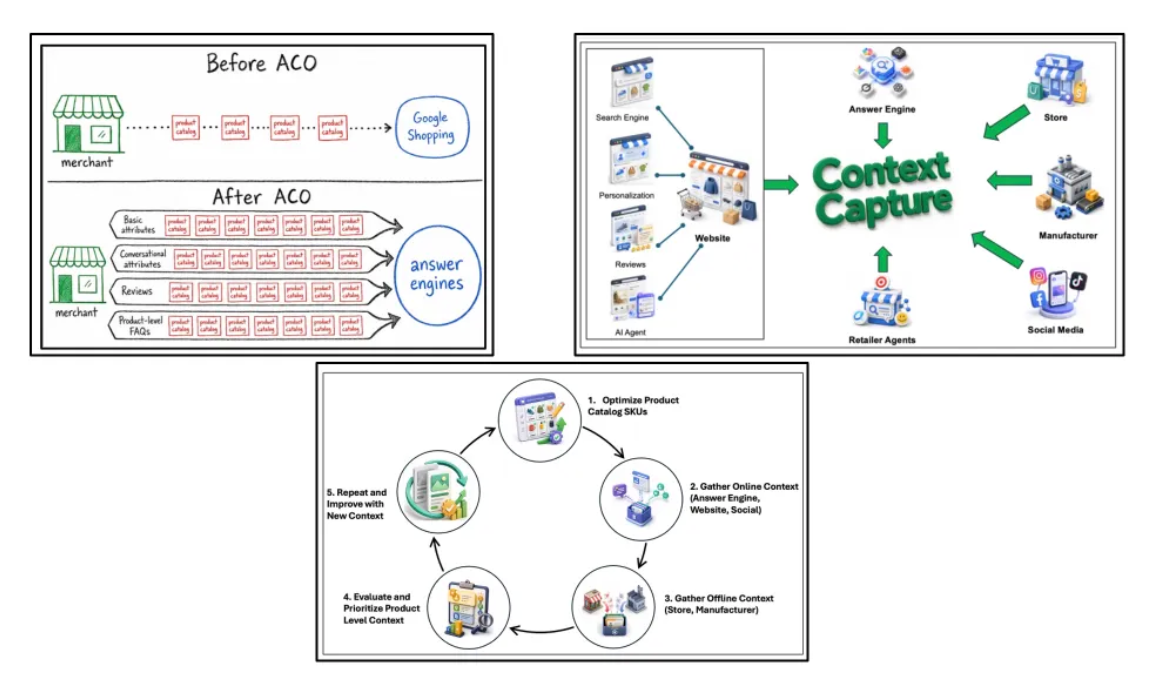
Part I introduced the importance of product-level context capture.
Part I also highlighted that Answer Engines now give merchants 4 high-capacity lanes of product-level data (via UCP/ACP standards) to input into the Answer Engines a significantly larger amount of product-data than we ever contemplated before 2026.
In Part IIA we theorized the best places to capture context.
Part IIB showed that in practice
Finally, we looked at how important recursive improvement loops are in optimizing systems with AI-fueled agents.
These are building blocks, let’s start putting them together to build the next level of Agentic Commerce Optimization.
Putting it All Together…
In Part IIB, we showed in detail, that for one SKU (the Columbia Watertight II jacket) if we looked at these eight surfaces for context:
Answer Engine - ChatGPT
Answer Engine - Gemini
Retailer Agent - Alexa
Website - On-site search
Website - Reviews
Website - FAQs/Q+A
Social Media - TikTok, Pinterest, Instagram, YouTube
Offline: Store and Manufacturer
In these 8 contextual sources, we found about fifty pieces of important SKU-level context:
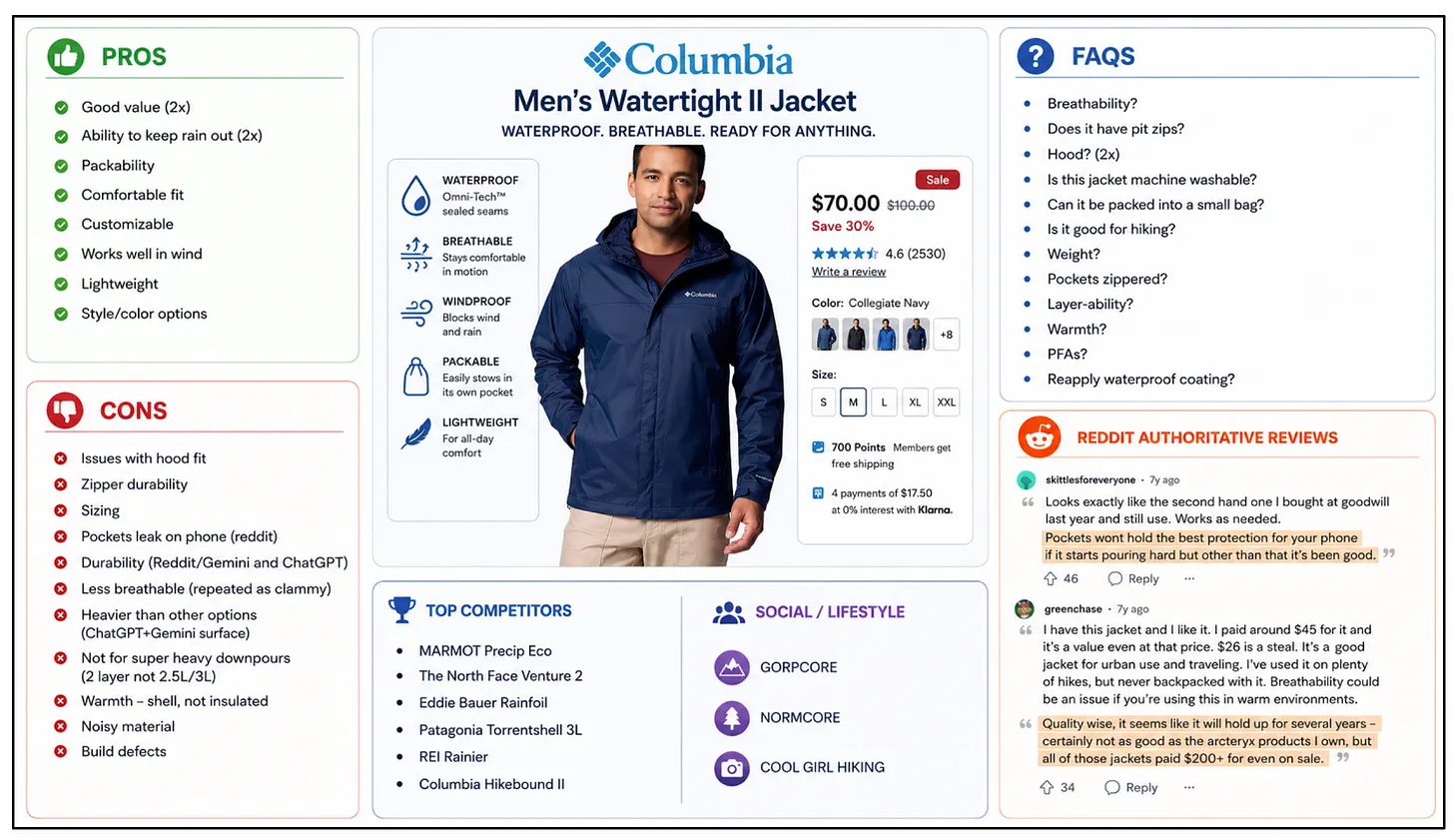
And THAT was just illustrative. If you could theoretically build a massive ‘context capturing machine’ you’d want it to cover ALL the answer engines, all the retailer agents, the closed and open data from the website, all the social media channels, and the gigabytes/terabytes of data stuck in the offline operations.
Context Capture Machine
You can imagine it would look something like this:
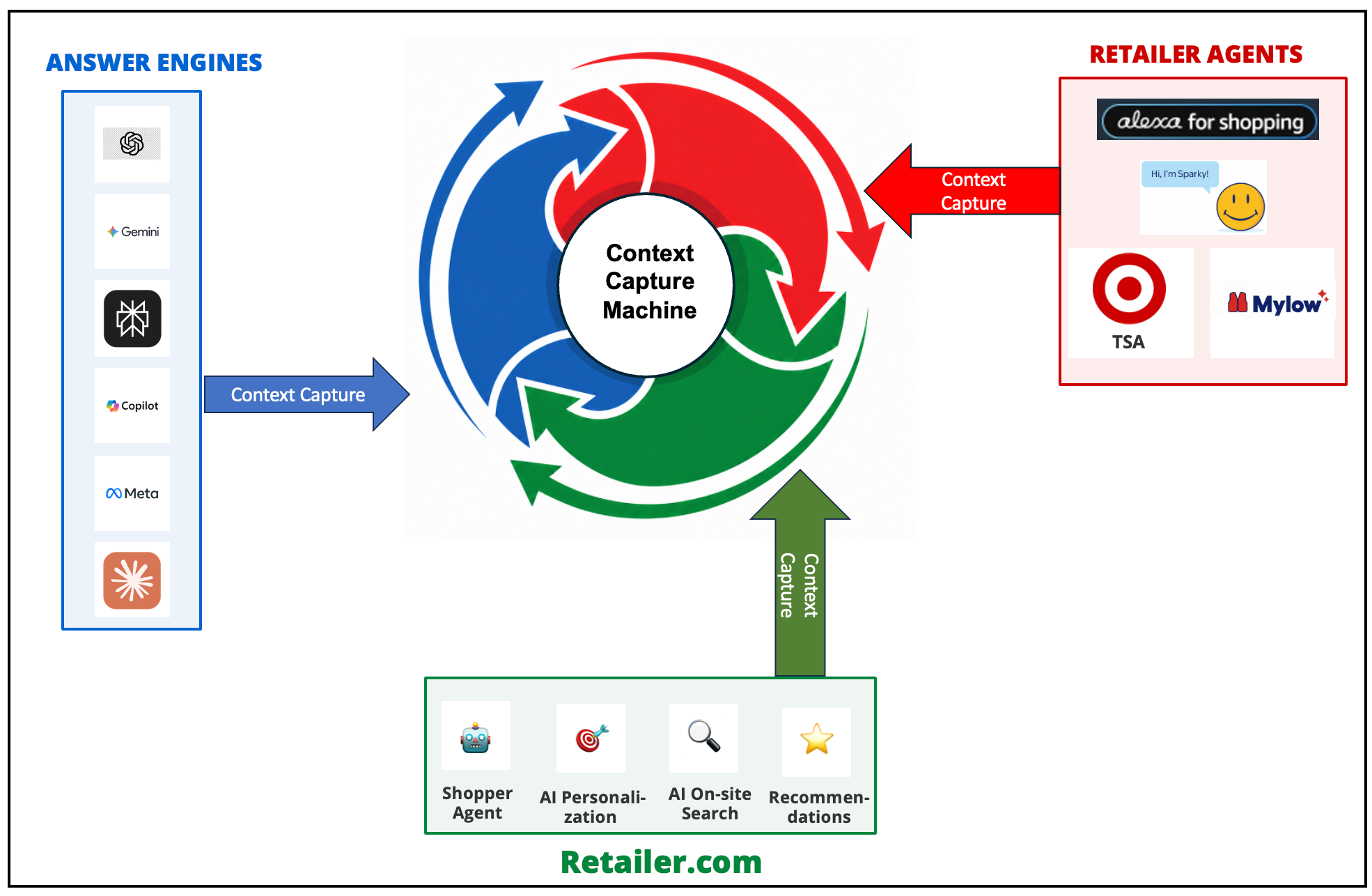
Capturing valuable product-level context from every available surface and looping through it. That’s what we illustrated in IIB.
Then What?
But there’s something missing. Let’s get tactical again.
Let’s pick one of the negatives surfaced by answer engines and retailer shopper agents for our hero SKU (Columbia Jacket) to ‘fix’ - let’s work on the combined issue of zipper reliability, pocket waterproof-ness and the phone-in-pocket safety bundled together.
For this one, because all the LLM based systems have now given us the ability to send a very large FAQ, we introduce a new FAQ: (I’m going to make educated guesses on this and some assumptions to illustrate how this works. Note this is never AI Slop and never bad intent/grey hat/black hat -the brand/retailer is just stating product facts):
*****BEGIN FAQ ADDITIONS TO UCP/ACP DATA FEED AND ON PDP METADATA
Question: Are the pockets zippered?
Answer: Yes, both pockets are zippered.
Question: How reliable are the zippers?
Answer: We use an independent garment testing lab (<link to report>) and they report the zippers on this jacket are good up to 1200 zip cycles. With daily wear this would be 2yrs with several daily zips a day. Most customers wear this seasonally or in inclement weather which would extend the life of the garment well beyond 2 years.
Question: Are the pockets water proof for my phone?
Answer: With the zippers closed and thanks to our Omni-Tech fabric technology, the pockets are are very water resistent. That being said if the jacket is held under water, zippers will leak. Its also helpful to note that many modern phones are increasingly water resistent and water proof - check your model for details.
*****END FAQ ADDITIONS TO UCP/ACP DATA FEED AND ON PDP METADATA
To be clear, this does not go on the human-readable part of the PDP - you can put it there if you want
Next, we publish this FAQ to all the selling surfaces.
Finally, after a week of publishing the new FAQ version, we re-run our context capture experiment again and look to see if the zipper context changed and what new context bubbled to the top.
Note: after about a week it will change in the answer engine data, after six months the underlying models will all be trained in the new data.
By implementing the:
Context Capture→Update Product Catalog→Publish
three steps, we now have created a feedback loop that can iterate. We call this strategy ACO Everywhere:
Introducing ACO Everywhere
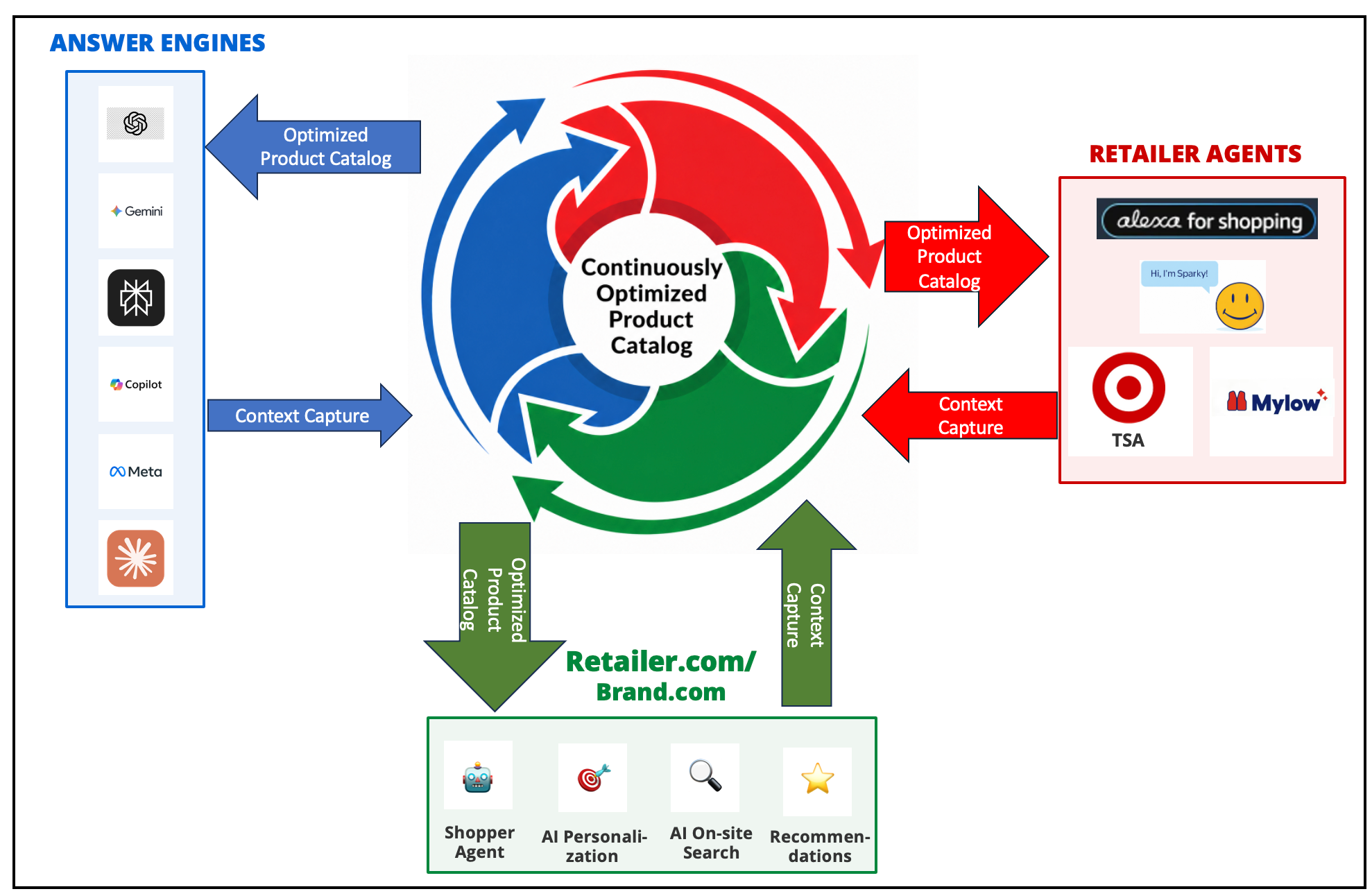
It’s been about 1 ‘AI Year’ (the equivalent to 5 pre-ChatGPT years) since we coined the phrase ACO and introduced our popular 9-step framework (here) . We’ve been deep in this at ReFiBuy systemizing ACO and have now optimized millions of SKUs. As we’ve learned more about the nuances of ACO, the answer engines have matured their Agentic Commerce capabilities and our customers have worked with us to experiment on the components of this concept.
Today we are revealing the results of the last year of ACO deep learnings and research - what we call “Agentic Commerce Optimization Everywhere” and where we think we as an industry will be focusing on going forward.
This is the future of Agentic Commerce optimization for brands and retailers:
Highlights of ACO Everywhere:
Retailers and brands can start with whatever Agentic Surfaces are most important to them.
Most retailers start with Answer Engines (ChatGPT and Gemini) and then add the retailer.com
Most brands start with the Retailer agents and then work on brand.com
Different verticals will have different agentic surfaces and contextual captures that they will want to prioritize. For example, fashion and beauty will lean in on social context more than say, auto parts.
You can easily manually research a handful of SKUs (we’ve given you a roadmap to do in part IIB and) then manually test this yourself and you will see the results over < 30 days. Unlike AEO/GEO/SEO, ACO Everywhere is: visible, understandable, actionable and the results are measurable.
Why Implement ACO Everywhere?
I was on a customer call recently and our VP of Research, Andrew Bell was walking a brand through the gaps in their PDP/ASIN and they asked if doing all this work would be worth it. His answer made a huge impression on them (and me):
“Every unanswered gap in your product catalog is a doorway to a competitor” - Andrew Bell, VP Research, ReFiBuy.
That’s the ‘why’ - if you don’t implement ACO Everywhere, your competitor will. It’s right there for the taking. The context is ‘free’ - its everywhere and historically we didn’t have anything to ‘do’ with it, and now we do. Look back at post IIB - you can see that every time the Columbia jacket doesn’t answer a question, a competitive product enters the conversation.
Because the loops are weekly you can see results quickly and there’s 18 weeks until Thanksgiving, so there’s plenty of time to get roing - that’s 18 weekly loops!
The 11 Steps of ACO Everywhere
To wrap up the post and the entire series, we are updating our “9 Steps to Agentic Commerce Optimization“ popular diagram we introduced in Q3 2025:
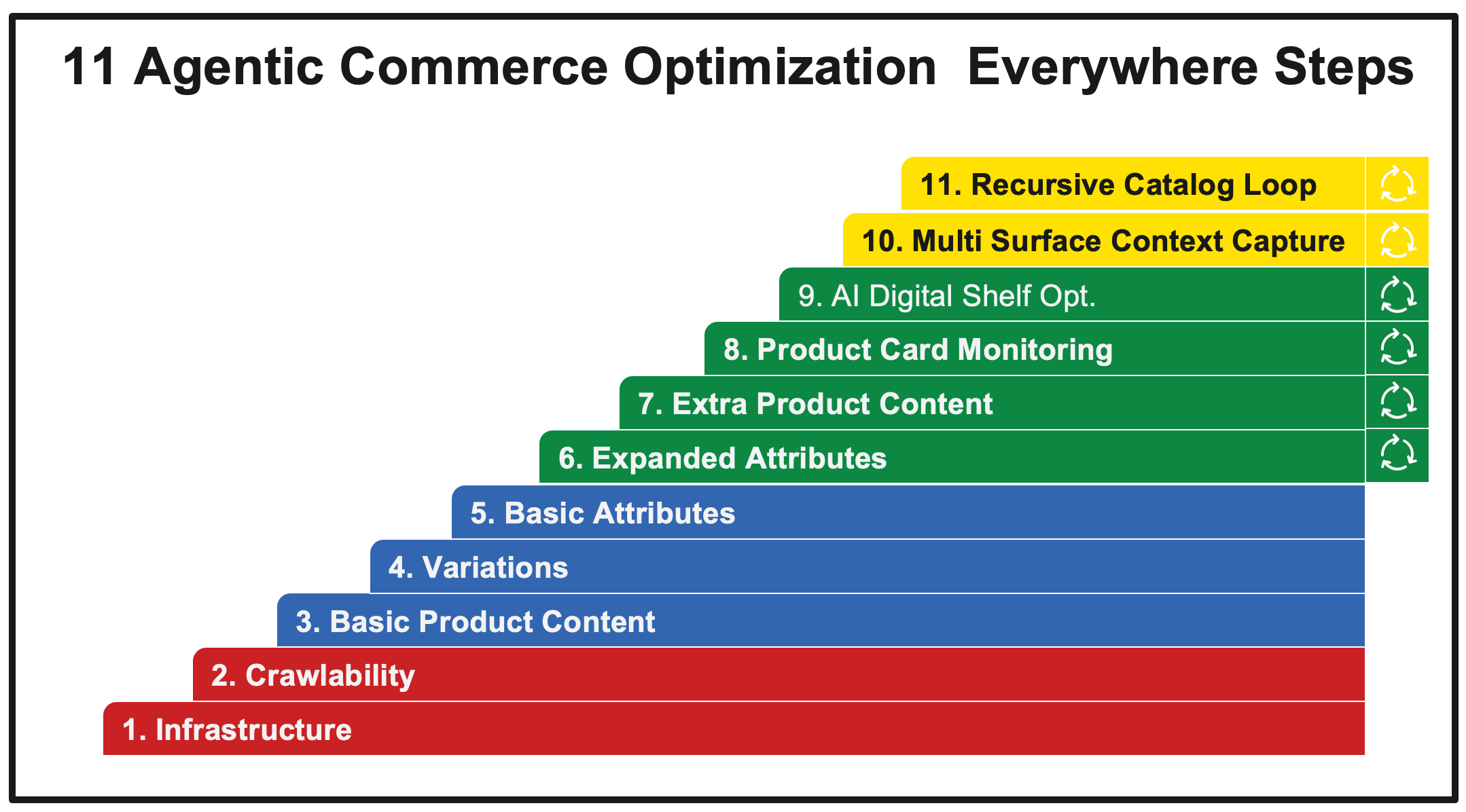
We now have the 11 steps to ACO Everywhere and introduce 2 new steps:
10. Multi Surface Content Capture
11. Recursive Catalog Loops
Time to get going with YOUR ACO Everywhere Strategy:
Context Capture→Update Product Catalog→Publish
Want to Learn More?
Today at ReFiBuy we are launching a complete initiative around ACO Everywhere and have some openings for our design partner program. Details at: