


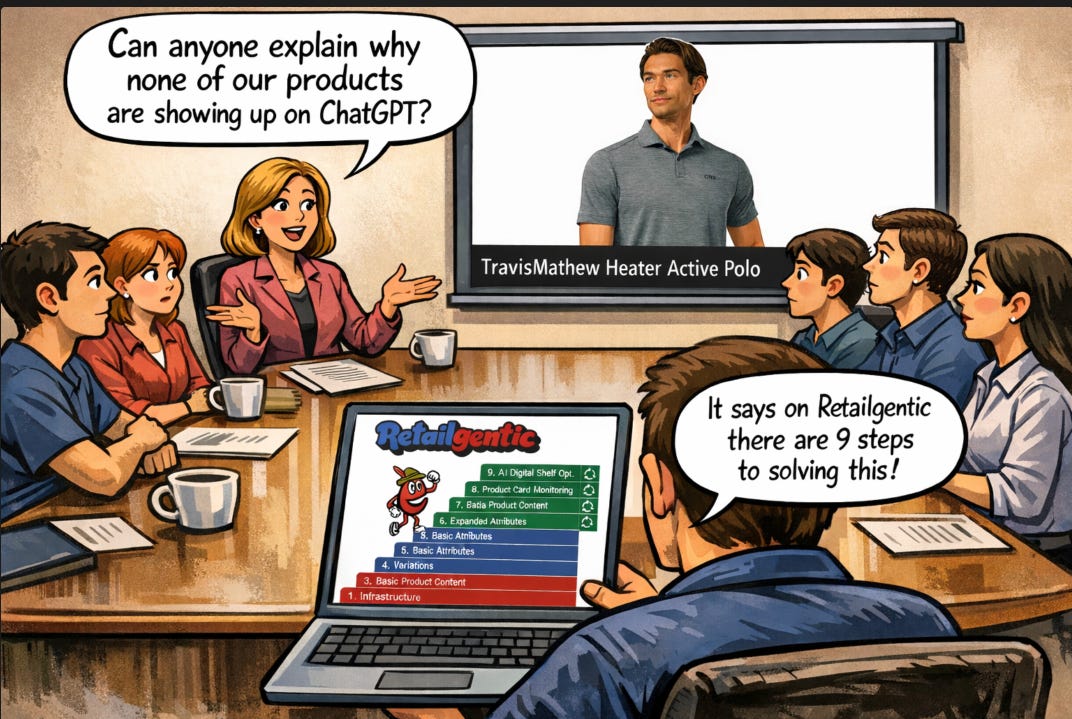
This is the fourth part of a thematic series sharing what we’re learning in Q1 as
We’ve talked about Keyword Jail and the Golden Age of Storytelling - we have a deficit of product information - content and context in the Agentic Commerce era.
Then we looked at what I call the Iceberg Problem - We have waaay (100X+) more product stories and content to provide to tell than brand/category level.
Finally in the ‘Good Bad and Ugly of AEO/GEO - AEO/GEO is good for sentiment analysis and understanding how your brand story is landing with AI, but not for Agentic Commerce.
Today, we’ll build on those three articles, plus we build on and revisit our (now vintage) September 3, 2025 4-part series where we introduced Agentic Commerce Optimization which you can find here if this is all new to you.
Since that 9/3/25 series where we coined ACO, it’s been 6 months the Agentic Commerce world has seen a ton of news and new implementations. Remember that was before ACP/UCP/ChatGPT apps, Perplexity/PayPal, etc. In pre-ChatGPT time, it feels like about 5 years have passed!
The overall ACO framework we predicted and shares has held up surprisingly well from that period→
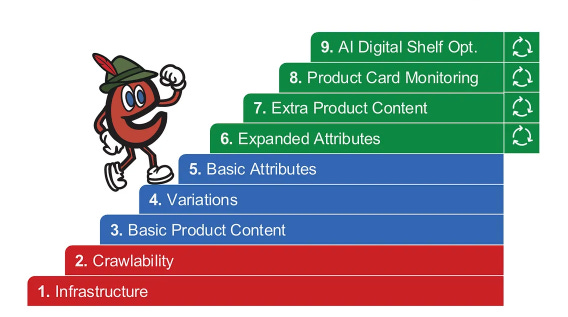
How did you predict this 6 months ago?
We’ve been helping merchants optimize third-party ecommerce marketplaces since 2001 and based on what we learned, there when the very first Product Cards emerged, we saw some patterns from the marketplace world appear.
However, because the underlying engines powering Agentic Commerce are LLMs, there are big strategic differences - so it’s simultaneously similar, yet also wildly different.
Revisiting Agentic Commerce Optimization
In today’s article, we’ll revisit the concept and reasons for Agentic Commerce Optimization, starting at the ‘problem’, understanding the three core challenges and review+update the framework for solving them from the 9/3/25 ACO posts. Then next week, we’ll reveal how real-world teams at brands and retailers are engaging in ACO, how they are reconfiguring their omni-channel and digital retail orgs to accelerate into ACO and we’ll tie together why ACO is totally white hat, measurable, predictable, etc.
Anatomy of Agentic Commerce
Whether we’re talking about any of the 4 Agentic Commerce solutions, while they have different ‘Research’ mechanisms and extremely different visualizations, at the end of the process when you boil it down, there are three elements:
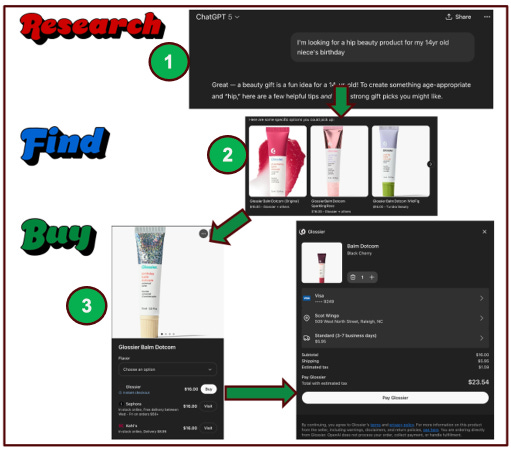
The Prompt
The Product Card(s)
The Offer Card
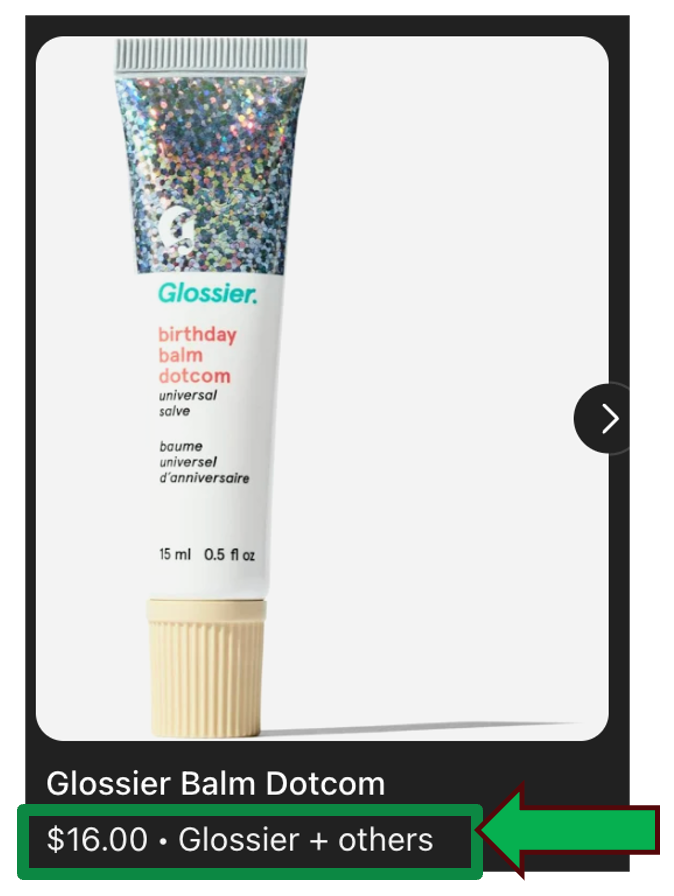
In narrative from here is how we talk about this in Agentic Commerce. The shopper prompted the AI Answer Engine (ChatGPT in this example) for a beauty product as a gift. The shopper then picked the ‘Glossier Balm Dotcom’ product card. On the Offer Card there were three merchants: Glossier, Sephora and Kohl’s.
Glossier “Owns the product” card - in other words they are the first offer. This means two things that are very important to ACO:
More sales -Historically, on third-party marketplaces the top merchant offer receives a disproportionally large % of transactions (90%+ for owning the buy-box on Amazon for example) for offers on that product.
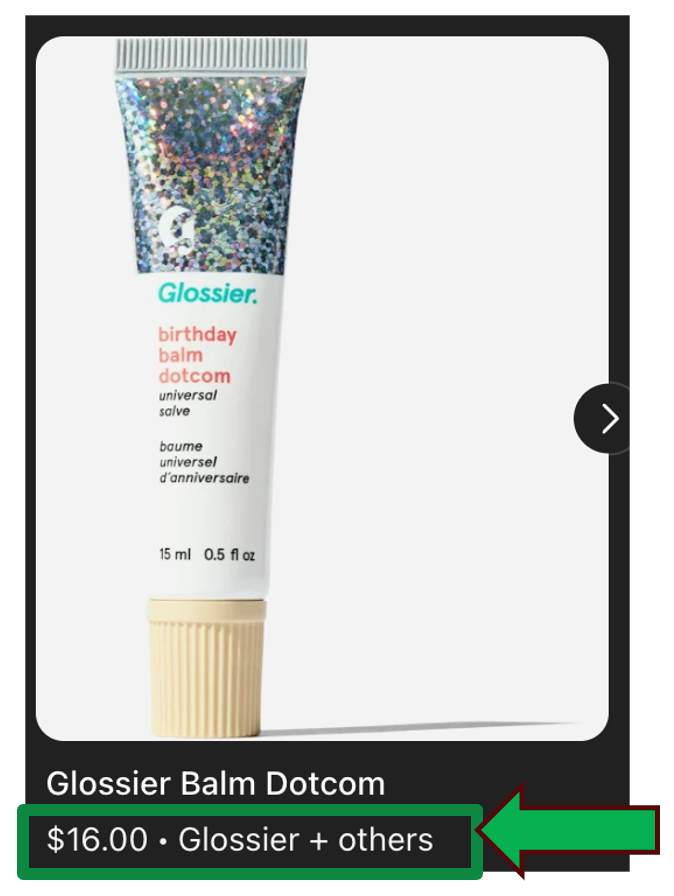
‘Priming’ for purchase - If you look back at the product card (above)- Only one gets a mention at that part of the process, and it’s the one that owns the Product Card. Do you want to be mentioned or ‘others’? This 'Priming’ of the buyer is a factor that the ‘More Sales’ in 1.
Agentic Commerce Goals and How To Measure Them
With that three step buyer flow in mind, your goal, if your organize chooses to lean-in on Agentic Commerce can be simply stated, tracked and measured across three dimensions:
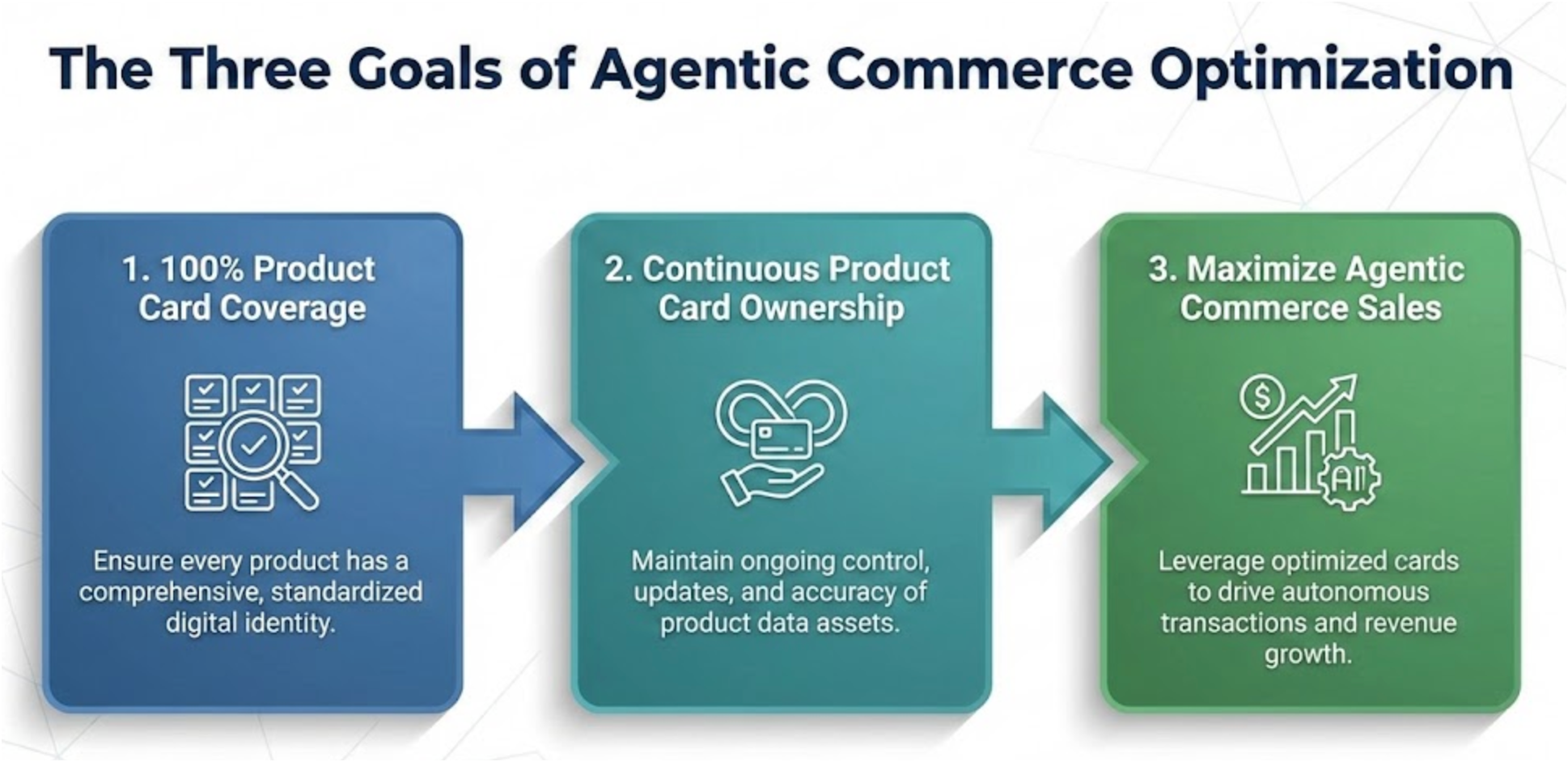
Let’s go through these in a bit of detail including how to measure them.
100% Product Card Coverage - Simply stated if you have X products in your catalog, what % are on the right product card? E.g. If you have 50,000 core SKUs and 10,000 are on the right product card you have a 20% Product Card Coverage score.
Continuous Product Card Ownership - Out of your X SKUs, what % do you own the Product Card? To continue the example from above, retailer above:
Out of the 10,000 product cards the retailer owns 3,000 so 30% coverage of Product Cards
However, the SKU Coverage is 3,000/50,000 or 6% SKU coverage - we recommend tracking this as priority, because it highlights how important Product Card Coverage is.
Maximize Agentic Commerce Sales - The ‘output’ of steps 1 and 2 is Agentic Commerce Sales. Today, they are 95% of the equation, but based on our experience, we are anticipating many more ‘dials merchants will be able to turn’ to maximize sales (e.g. Cart optimization, loyalty programs, offers, and ads).
ACO is Sequential: Don’t Skip Steps
It’s important to highlight that these goals sequentially build on each other. For example, if you have 50,000 products and only 1,000 are on product cards, then you can’t possibly own more than 1000 Product Cards. This will, also logically, substantially hamper your goal of maximizing agentic commerce sales. This will come up in the next, post, but as you think about deploying ACO, there is a natural phased approach to launch and then an ongoing-optimization that is driven by this ‘sequential build’.
Product Card Coverage is Foundational, Without it you will not be successful - Nail this first!
The Challenges Standing Between You and Three Goals
Core First Principle Challenges of Agentic Commerce Optimization:
Product Card Mapping (Canonicalization) - How do you get your products on the cards?
Offer Card Optimization - How do you show up number 1?
Measurability - Product-card and offer level Visibility - How can you measure this to track your progress and see what to do next?
Challenge 1: Product Card Mapping (Technically Coined Canonicalization)
Inside the product card mapping problem there are three main root-causes of the problems:
The asymmetrical data problem - Imagine a game where we both had a deck of a cards and we are trying to merge them together by suit and face-value. I say to you - this one is red. That narrows it down to 26 cards. Our chances of finding the right one to map to are 3.8%.
A data matching problem - Now we’re playing the same card game and I say, ok I’ll be really specific now, I have a King of moons, do you have a match? Now you have to decide - do I have some new generation of cards with a fourth suit? This is the first time in you’re life you’ve heard of ‘moons’ - the chances it is ‘real’ are low, so you reject this card.
Target Catalog drift - I can’t think of a clever card analogy, but target catalogs are constantly improving and being added to/deleted/updated by the catalog owner and the merchants all inserting/mapping their products into the catalog. In the Amazon world today, this causes problems maybe ever 18 months today. In the Agentic Commerce world, this is a near-daily never announced seismic change we all adapt to as fast as possible.
Real-world Product Card Mapping Example - Data Asymmetry
Let’s get out of theoretical card games and look at an example of data asymmetry to help you understand from both the merchant and ‘Target catalog’ example what’s going on behind the scenes.
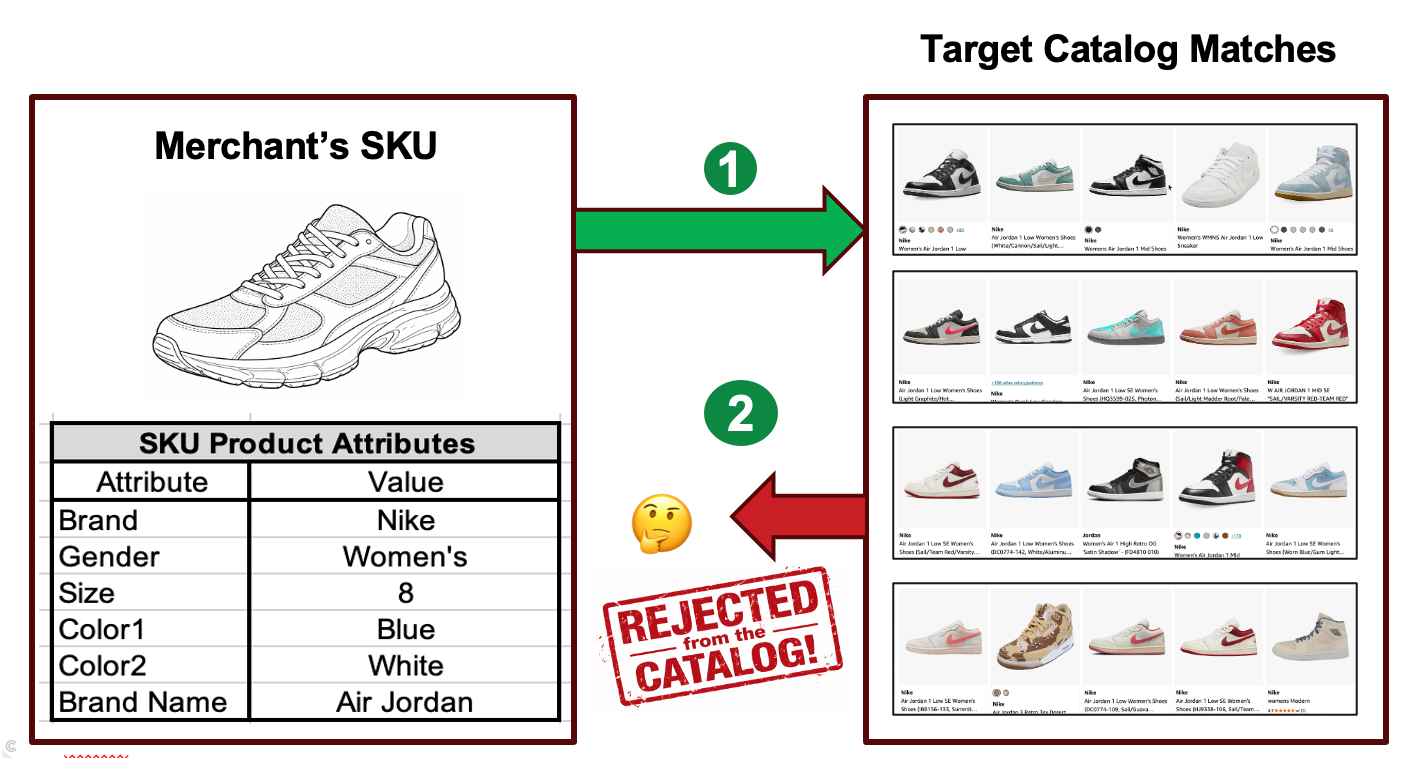
The visual above illustrates the data asymmetry problem. First a little vocabulary. Whatever system we are mapping to has their own catalog we are mapping OUR (merchant) catalog SKUs to their (target - agentic commerce in our example) catalog.
ChatGPT’s crawler has picked up these attributes from the merchant’s PDP for a shoe and picked up these attributes: Nike, Women’s, Size 8, blue/white, Air Jordan. It will also pick up the title, the price and a lot of other information, and that factors in, but for this simplification, I haven’t listed all that.
ChatGPT then tries to map that against it’s catalog and gets 16 potential matches. Now what’s it supposed to do? Pick the first one? Remember, these engines ignore your images (other than the URL), it’s far too computationally expensive (tokens💵) to do an image match - and even if it did there are probably 4-6 close matches still.
Instead it basically rejects the SKU. The end result - your product isn’t on the product card.🥺
How do you fix the mapping problem?
Agentic Commerce and Marketplaces could spend infinite time improving their catalogs, instead they use incentives (merchants want to sell stuff) to push the work to them. This isn’t going to change. Unfortunately a lot of merchants new to this setup want to go spend their valuable time trying to call a human at the target catalog company and tell them to “fix their janky messed up catalog!” - while that may feel good in the short term, it’s not going to fix the problem and help us achieve the first goal of 100% Product Card Coverage.
What you have to do is, sku-by-sku, figure out what went wrong. Some things to look for:
What does the target catalog tell you about the card you want to map to?
Is your product mapped to the wrong card? If yes, why?
Do you have information on your PDP that’s hidden from the crawler?
To fix these you’re going to take these actions:
Expand the attributes provided to help solve the data asymmetry problem
Make sure your data you send the engines as closely as possible matches their conventions (the consumer doesn’t see this, but it can be the ‘nudge’ that helps
Make sure your variations match the target catalog’s
and so on.
It can sometimes take 5-10 trial-and-error cycles to get a SKU to ‘map and stick’ to the target catalog.
FAQ: Once I map to ChatGPT does that make mapping to Google/AI Mode, Copilot and Perplexity easier?
Unfortunately, no, each target catalog has very different characteristics, here’s how I’d describe them as of today’s writing:
ChatGPT - It’s a toddler catalog, it was born about a year ago and still finding it’s sea legs. It’s maturing rapidly and making lots of improvements. Agentic Commerce/Instant Checkout will accelerate that as there’s a strong profit motive on their side to make it more robust because the catalog is the foundation of the consumer buying experience.
Google - In a way, Google starts ahead of the game. Google’s Agentic Commerce offerings are based off of the Google Shopping graph that has (from their UCP announcement: “50b product listings, that are updated 2b times hourly.” While that’s impressive, Google has never successfully used the graph to SELL STUFF. Also anyone can send products to Google Shopping and it well known to be the most polluted. There are vast canonicalization errors and mis-prices and stock issues. When you are sending traffic it doesn’t matter. When you are sending orders, it matters a LOT. Google has a lot of work on their hands to clean this up, but I’m sure they are building agents to do this so it could be solvable in this era, not before 2022.
Copilot - Same as Google.
Perplexity/PayPal - Their catalog seems to be from their Honey browser extension business the acquired. It has it’s own challenges, specifically around variations.
Where to find more information…
In the 9/3/25 ACO series we had a popular post: The 13 Agentic Commerce pitfalls that documented, at that time the 13 most common mapping issues we saw.
At ReFiBuy this is what we do, that list form Sept has expanded dramatically and is now too long and become somewhat too proprietary to share here, but it’s now 6 ‘wide’ by 20-40 deep and well over 200 and growing rapidly as Agentic Commerce is growing rapidly.
Challenge 2: Offer Card Optimization
Now that your products are on the product card, you are in the arena and now it’s time to play the boss level - offer card optimization. Based on tens-of-thousands of datapoints, here some of the factors that determine where your product shows up on the product card. Note: As you can guess the weight of these varies wildly across the 4 platforms.
Offer Card Algorithm Factors
Price
Shipping time and cost
Intent match from catalog details provided and context clues (We’ll dig into this more next time)
Local availability
Merchant reviews
Product reviews that mention the merchant (positively/negatively)
Do they advertise (Google has a new ad unit that seems to reward paying merchants if they pay - I have a note in for clarification).
Click through rate (this tends to re-inforce the top position)
That’s the short list today, this is changing very rapidly and depending on the engine, there are different factors.
Challenge 3: Measurability
Finally, for one SKU, you can see how to do this and measure it. For 100-500 you can do it manually, for 1000+ SKUs it becomes untenable.
The Results…
If you can nail all three of these goals, you will achieve Agentic Commerce Optimization Nirvana and more sales and hopefully be the hero of your company:
BONUS: For Advanced Players
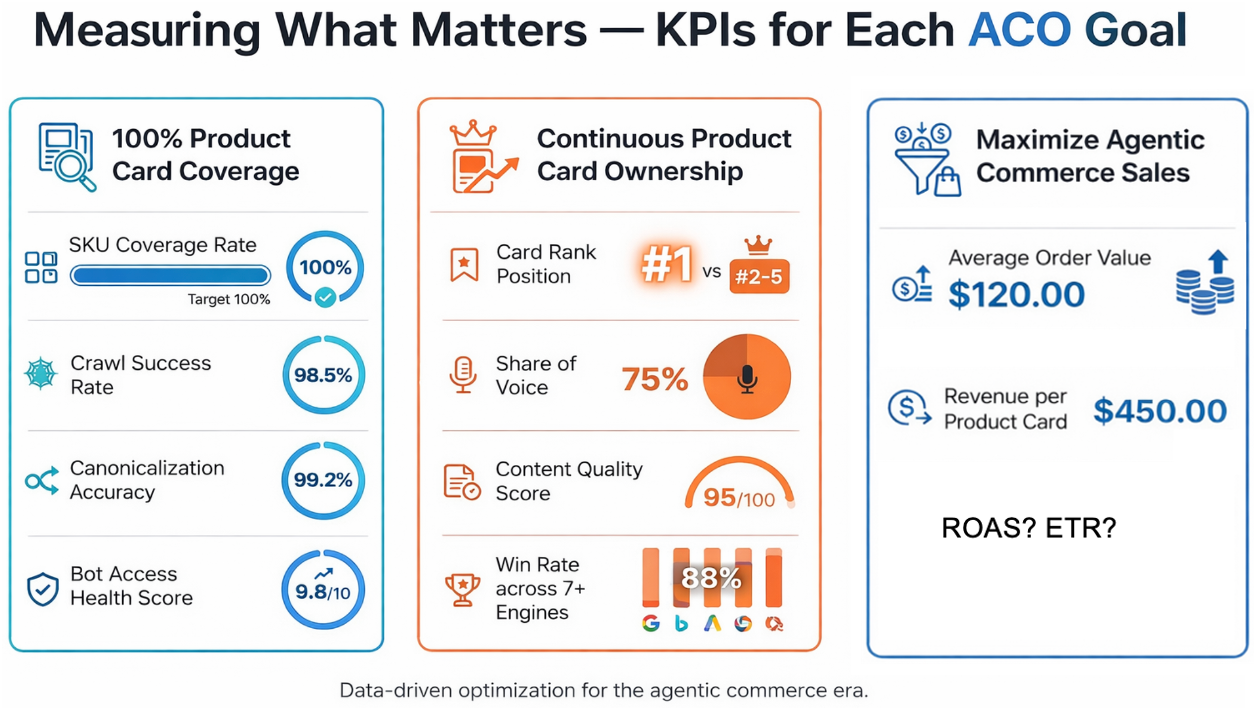
If you’ve read this far, you are on your way to be an ‘advanced player’ in this game. Pro tip - after you nail the three main basic metrics and get your catalog humming and your sales up and to the right, you can go deeper on each of the three headline metrics with underlying KPIs like this→
Up Next…
In the next post, we’ll cover:
Team Structure and skill needs
How to create and frame the business case
What separates the Agentic Commerce leaders from the laggards
Example timeline and phases to start and scale an Agentic Commerce Optimization strategic initiative.
Product Content Strategy (This ties into the intent signal mentioned above
Core differences of the engines
Multi-layer PDP strategy
Your ACO FAQS - answered!
Happy Agentic Commercing…