


Welcome to the fifth and final part of a thematic article series sharing what we’ve learning through 2026 Q1 as retailers+brands implement and scale their Agentic Commerce strategies. First a quick recap:
We started the series covering Keyword Jail and the Golden Age of Storytelling - we have a deficit of product information - content and context in the Agentic Commerce era.
Then we looked at what I call the Iceberg Problem - We have waaay (100X+) more product stories and content to provide to tell than brand/category level.
Next in the ‘Good Bad and Ugly of AEO/GEO - AEO/GEO is good for sentiment analysis and understanding how your brand story is landing with AI, but not for Agentic Commerce.
Finally, in the last post we covered Agentic Commerce Optimization Update - Strategies and Tactics to Optimize ChatGPT/ACP, Google Gemini/UCP, Copilot and Perplexity
In this last article, between the presentations I’ve given at kickoffs, industry events, for brands and retailers and our overall team at ReFiBuy has talked to hundreds of brands and retailers over the last six months on this topic. As a team, we boiled down the top strategic (big picture) and more tactical (faster hits, take a week) questions and then refined them, then refined them further. The result? We have identified the top 6 Strategic and 7 Tactical questions we receive, for a lucky 13 in total.
In this post we’re going to go through them all and answer them for you. This should help you think through your 2026 Agentic Commerce plan and pick your battles for Holiday 2026 which we believe is going to be a huge step-up in Agentic Commerce driven transactions (10%!?).
Enjoying Our Content, Dig Deeper with the ReFiBuy ACO Guide…
Looking for even more detail? Check out our ACO Guide here today!
6 Strategic Agentic Commerce Optimization FAQs:
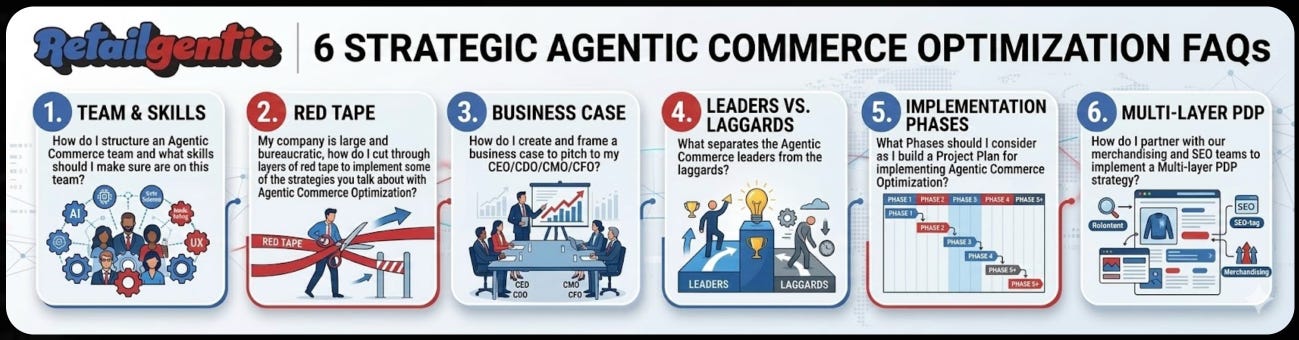
Strategic Questions: Questions that are bigger picture in nature
How do I structure an Agentic Commerce team and what skills should I make sure are on this team?
My company is large and bureaucratic, how do I cut through layers of red tape to implement some of the strategies you talk about with Agentic Commerce Optimization?
How do I create and frame a business case to pitch to my CEO/CDO/CMO/CFO?
What separates the Agentic Commerce leaders from the laggards?
What Phases should I consider as I build a Project Plan for implementing Agentic Commerce Optimization?
How do I partner with our merchandising and SEO teams to implement a Multi-layer PDP strategy?
7 Tactical Agentic Commerce Optimization FAQS
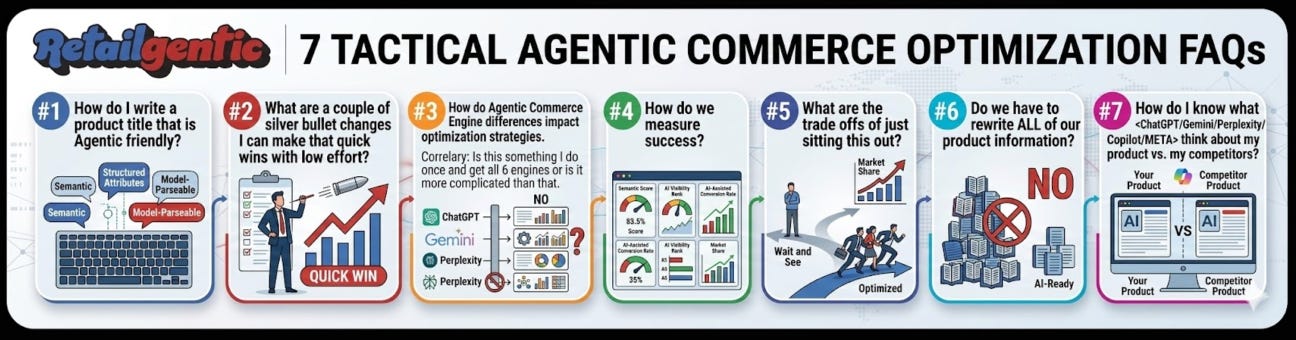
Tactical ACO FAQS - Shorter questions with quick answers implementable in under one week
How do I write a product title that is Agentic friendly?
What are a couple of silver bullet changes I can make that quick wins with low effort?
How do Agentic Commerce Engine differences impact optimization strategies. Corollary: Is this something I do once and get all 6 engines or is it more complicated than that.
How do we measure success?
What are the trade offs of just sitting this out?
Do we have to rewrite ALL of our product information?
How do I know what <ChatGPT/Gemini/Perplexity/Copilot/META> think about my product vs. my competitors?
How to Leverage This Article…
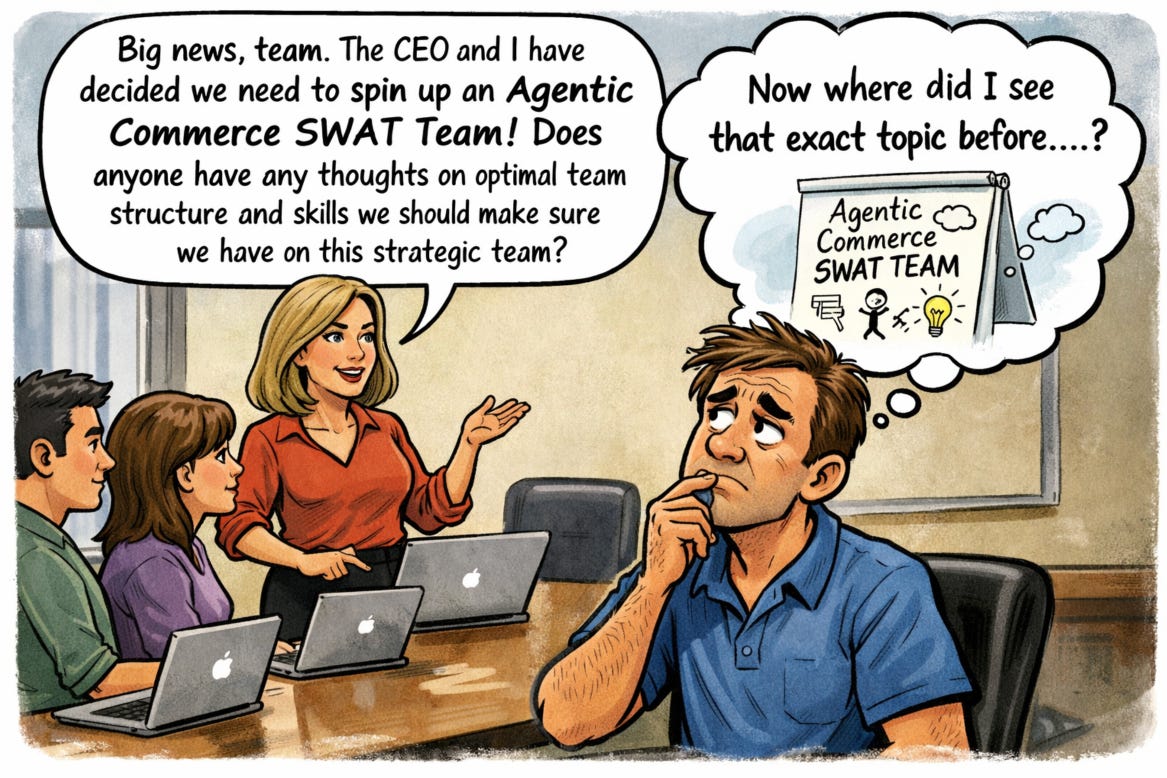
Unlike our usual mid-length content, this one is a going to be a long one. You’re certainly welcome to read it top to bottom, but it’s also designed to be a bookmarked reference for you. We recommend scanning it to become familiar with the questions covered, then as you execute on your plan in 2026, you’ll have this as a resource to refer back to. After we publish, the links above will turn into links into the article (anchor links) and you’ll be able to jump straight to your topic.
S-Q1: How do I Structure an Agentic Commerce team and What Skills Should I Make Sure are on the Team?
One of the most common questions we get from retailers exploring agentic commerce is: “What kind of team do I need?” We recently walked a major retailer through this, and the answer surprised them — it’s not a technical focus, it’s a marketing focus. The people who thrive in ACO roles are folks who already understand catalog optimization, ‘digital channel management and optimization’, and digital ai shelf positioning.
The most critical capability? Agility. You need someone who can spin up a catalog data feed, test new product attributes, and iterate in days — not someone stuck in a 6-month approval workflow just to change a product description. Think of it as a parallel catalog strategy specifically for answer engines, separate from your main commerce feed.
Medium-term as these platforms mature, you’ll want to specialize. Today covering ChatGPT, Gemini, CoPilot and Perplexity is relatively the same task. But each engine has its own catalog structure, its own matching quirks, and its own optimization “nudges.” By holiday 2026, the retailers winning in this space will have platform-specific specialists, someone managing the emerging paid/ad opportunities, and a partner relationship lead keeping tabs on the rapidly expanding vertical and horizontal agentic commerce ecosystem. Google traffic is already down 40-50% for some fashion and beauty brands as search shifts to answer engines → the team you build now is how you claw that back in the short-term for Holiday 26, for Holiday 27, you’ll need to specialize by engine.
S-Q2: My company is large and bureaucratic, how do I cut through layers of red tape to implement some of the strategies you talk about with Agentic Commerce Optimization?
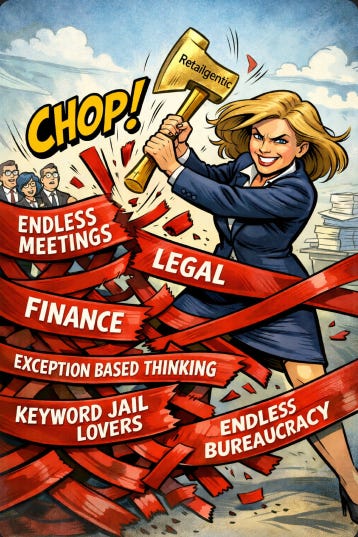
Another frequently asked strategic question we receive is how retailers can cut through the red tape in their org to implement agentic commerce optimization. Here’s what we’ve seen work → treat your AI catalog as a separate experiment or sandbox. At most companies, touching the core product catalog and thus the PDPs requires a workflow that runs through six different orgs and can take six months to get a single change approved. That complex change management process is a death sentence in Agentic Commerce. Your competition will literally run circles around you. Plus, the targets are moving way too fast — engines are updating their catalog structures, new commerce features are launching, and your priority products are shifting week to week. If you’re locked into a traditional change management flow, you’re going to get over-run on four sides.
Our advice is to carve out a separate process specifically for AI answer engines, make it clear to leadership that this doesn’t touch the site or the consumer-facing catalog, OR SEO and give your team the authority to enrich, optimize, and iterate without waiting in line. Once you prove things out in the experimental agentic sandbox, you can pull the best stuff back into your PDPs - either human-readable or machine-readable (SEO) and broader catalog — but you need the ability to optimize for AI in isolation to get there.
S-Q3: How do I create and frame a business case to pitch to my CEO/CDO/CMO/CFO?
There are three ideas we have for helping you frame the business case for creating a team and investing Agentic Commerce Optimization.
Revenue Recovery Framing
One way to think about the business logic (this concept is borrrowed from Avinash Kaushik, ex-Google Analytics guru turned newsletter writer who we covered in detail here.) is what we call the “recovery model.” Here’s the reality → traditional Google traffic is declining 20-50% for a lot of retail categories as search shifts to answer engines. But consumers didn’t stop shopping. Those intent signals didn’t disappear, they moved up to the agentic layer.
Retail has a new front door. Are your products behind that door?
The question your finance team can help figure out is:
How much Traditional Google traffic have we lost so far, what happens if that trend continues (or accelerates) into 2026, and what percentage can we recover through agentic commerce?
We’ve seen brands build models where they believe they can claw back up to 100% of that lost traffic. That’s a compelling number to put in front of a CFO. And it reframes the conversation from “here’s a speculative new channel” to “here’s how we recover revenue we’re already losing.” Layer on top of that the fact that ads are coming to these engines by holiday — and you need talent on your team who understands ROAS from the old CPC world is going to need to translate that into the agentic world and make the case for more budget as the signal strengthens.
The New Opportunity Framing
Deloitte actually put out a solid one-pager that works as a CFO cheat sheet for sizing this opportunity — worth grabbing if you need to arm your finance team with a framework they’ll trust from a super reputable source. Here’s the P&L bridge→
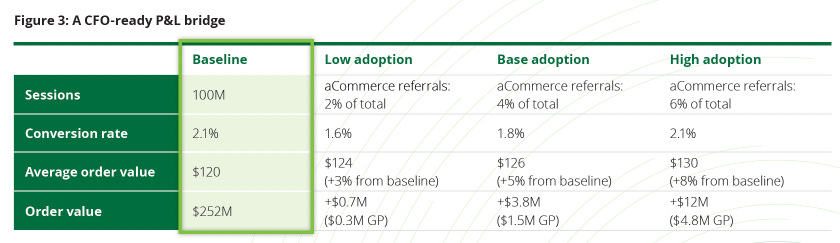
The entire papers is here→

And your favorite podcast, Retailgentic, had the authors Saurabh Vijayvergia and Brian McCarthy on the 2/12/26 episode.
Video here→
The Audio version is here→ (all of your favorite podcast players are supported).
Influenced vs. Direct Framing
Today, most of the value from Agentic Commerce is in driving traffic back to your site — direct checkout through answer engines is still ramping up. That can make it harder to justify headcount internally when finance wants to see a direct revenue number. Our advice is to run both tracks in parallel: optimize for visibility and click-through now, which is your influenced revenue play, and position yourself early for checkout when it becomes material. The retailers who wait for direct revenue to materialize before investing are going to be way behind by holiday 2026, which is when we think this really starts to ring the register.
None of these three approaches is mutually exclusive and most recently we had a customer blend all three to create a ‘triangulation’ on the opportunity which made it extremely bullet-proof and defensible.
S-Q4: What Separates the Agentic Commerce Leaders from the Laggards?
Let’s start by looking at A couple of Agentic Commerce Leaders that are very public in their support and worth watching.
Category-level Agentic Shopping Adoption.
Due to demographics and Google’s category-by-category decline in clicks plus the Agentic Commerce engines categorical focus, we see the following categories that were highlighted in the Morgan Stanley November 25 AlphaWise survey reveal the leaders and laggards in Agentic Commerce:
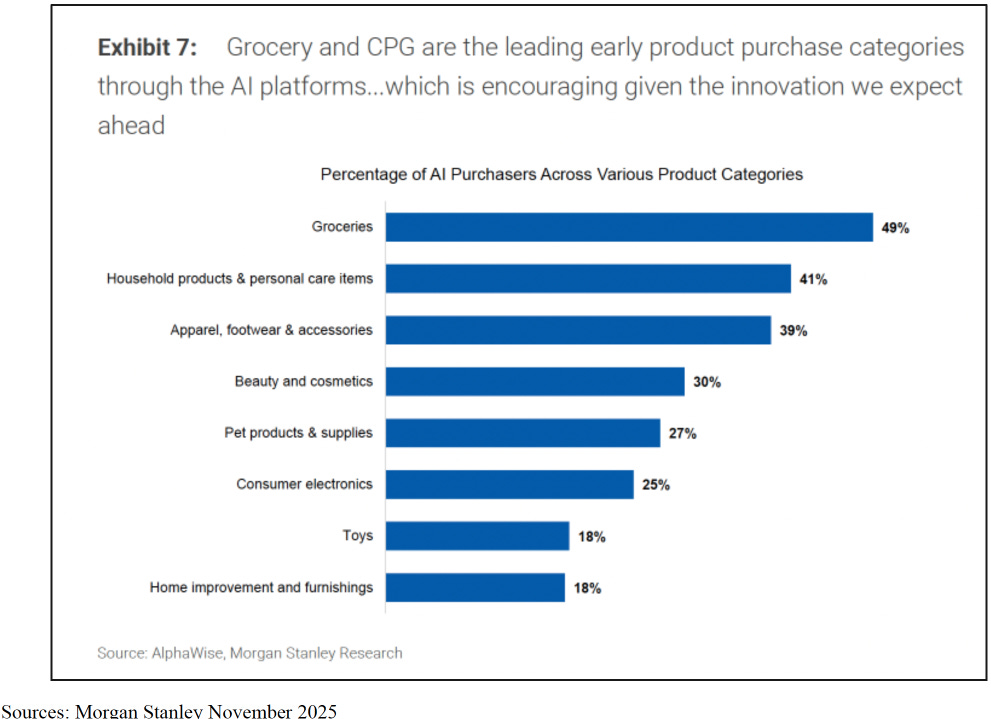
Grocery is the exception because it was dead-last on this list from Q1-Q3 2025 and then popped to the top - more on that in a future post. Next you have personal care, fashion and beauty followed closely by Pet.
Speaking of the beauty category, our first leader is deep in the category:
Ekta Chopra - CDO at e.l.f Beauty
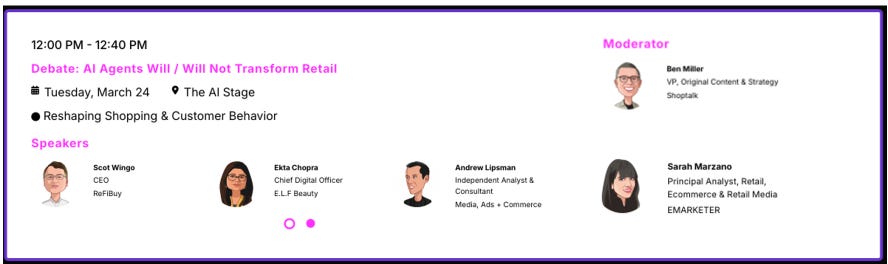
In fact at ShopTalk Spring on Tuesday March 24th, Ekta and I are on the “Pro Agentic Commerce” side of a debate vs. Andrew Lipsman and Sarah Marzano representing the “AI Will Not Transform Retail” side (aka the Naysayers) - come watch us duel it out!
Also, Ekta publishes a regular substack I highly recommend called AI Chef. In there she helps answer a lot of these strategic questions.
How to talk to the board about Agentic Commerce and more. You can subscribe here→
Steve Madden - Josh Krepon and Colleen Waters
Steve Madden has been one of the earliest and most aggressive adopters of Agentic Commerce Optimization. Josh and Colleen frequently speak at industry events and Colleen will be speaking at Shoptalk as well.
Diageo - Roger Dunn - Global Retail Media Lead
Roger frequently posts his throughs on Retail Media and also Agentic Commerce on his LinkedIn feed and he’s definitely a thought leader at a top ‘house of brands’ in Agentic Commerce.
Ulta Beauty

Finally, we’re back to….beauty. Ulta made ripples in Agentic Commerce in Holiday 25 when their GEO mentions rocketed ahead of Sephora and Amazon (self inflicted damage there).

And just last week, Ulta announced they are launching a TikTok Shop. This shows a readiness to really lean in on new opportunities and take calculated risks that can result in outsized results.
Agentic Commerce Leadership Commonality
What separates the Leaders in the Agentic Commerce from the Laggards are a couple of factors. Leaders have top-down commitment. They are supported by the board, the CEO and the leadership team. We’re seeing dedicated cross-functional teams of 10-15 people, active Slack channels, weekly/daily stand-ups, and top-initiative prioritization across the org.
Leaders are also getting their products visible today, leaning into how build a much rich, contextual product-level story will ultimately have a leg up from a visibility and revenue perspective.
In the early days of marketplaces, mobile, TikTok Shops, retail media networks and other big disruptive new digital retail technologies leaders, leaned in, and got ahead of the game while laggards took a ‘wait and see’ approach.
S-Q5: What Phases should I consider as I build a Project Plan for implementing Agentic Commerce Optimization?
We get asked all the time: “Okay, we’re bought in on ACO — but how do we actually roll this out?” We’ve landed on a three-phase approach that balances speed with organizational readiness. Let’s dig in.
Phase 1: Learn (Weeks 1-6) — Get Smart Before You Get Big
This is where most retailers underestimate the work. Before you start pushing optimized feeds to answer engines, you need to build internal muscle. Start with a subset of your catalog — your top 20-50 hero products — and use them to train your team on how agentic commerce actually works. Set up monitoring so you can see where you’re showing up (and where you’re not) across ChatGPT, Gemini, Perplexity, and Copilot. In parallel, get your brand guidelines and content policies documented — these engines are going to surface your products in ways your brand team has never seen before, and you need guardrails before you start pushing upgraded product catalog data out. Don’t skip this phase 1. We’ve seen retailers try to jump straight to optimization and end up burning cycles fixing things and pulling the org along.
Phase 2: Integrate (Weeks 4-12, overlapping with Phase 1) — Connect the Pipes
This is the plumbing phase. You’re determining what integrations need to be established — product data flowing in from your PIM, eCommerce platform, or spreadsheets, and agentically optimized data flowing back out to answer engines. The workflow is straightforward: import your catalog daily, run it through agentic optimization(content generation, attribute expansion, product evaluation and scoring), then distribute it to the target answer engines and then back into your internal systems. You need your IT stakeholders aligned on the integration path, but the enrichment work itself should live in a separate environment where your ACO team can move fast without getting stuck in a six-month approval queue. The biggest risks in this phase are approval process delays and internal alignment across teams — so get your technical contact and business champions identified early.
Phase 3: Optimize (Ongoing from ~Week 10) — Now You’re Running the Business
This is where it gets fun. Your full catalog is now being optimized — both by your team reviewing and approving agentic commerce product-level context and content additions, and increasingly by taking what you have learned from performance data. You’re doing context engineering at the product level: expanding attributes, building out Q&A content, and sending platform-specific “nudges” to improve canonicalization and visibility on each engine. You’re also standing up the ongoing operational cadence — someone looking at rankings daily, reviewing what’s working, and iterating. Over time, this is where you start pulling the best SKU-level attribute additions and contextual clues back into your PDPs and broader catalog. And this is where the team structure conversation kicks in: you’ll want your marketer running day-to-day optimization, a product/project management liaison interfacing with the broader technical org, and eventually platform-specific specialists as the channel scales. By holiday, if you’ve executed well through these phases, you should be seeing significant revenue signal from agentic commerce.
Don’t try to boil the ocean on day one. Learn, integrate, optimize — in that order. The retailers who are winning in agentic commerce right now all followed some version of this playbook. The ones who are still stuck in committee trying to figure out whether to start are going to get walloped by the competition in Holiday 2026.
S-Q6: How do I Partner with our Merchandising and SEO Teams to Implement a Multi-layer PDP strategy?
Two parts to this one:
1. What is a Multi-layer PDP strategy?
Here’s a framework we’ve been developing with large retail partners → the future PDP isn’t one page. It’s three layers:
→ Layer 1: Human-Readable — The beautiful, shoppable experience your customers see today
→ Layer 2: Legacy SEO — The metadata, schema, and structured data that traditional search engines still need
→ Layer 3: LLM-Optimized — Rich context, expanded metadata, Q&A content, and deep attribute depth designed specifically for AI agent consumption
Most retailers are only running Layer 1 and maybe a thin Layer 2. Layer 3 is where the competitive advantage lives right now.
2. How do we Partner to Implement Multi-Layer PDP?
Bring in those teams early. Conduct a leadership learning session to gain buy-in from those folks who may be wary of AI and how the platform will give recommendations. Collaborate and create alignment with those teams on how they want to structure the approval process. Be sure to ensure their continued involvement and support by adding guardrails, giving examples for teams to review, and ensuring the right folks are involved earlier on rather than later makes the difference.
This ties into S-Q5 - bring them into the learning phase, make them a part of the process, not collateral damage.
T-Q1: How do I craft a product title that is Agentic friendly?
When creating titles ensure they have enough context in the title to be understood by an LLM. Avoid vague titles like “Riverbank” - it could be a piece of furniture or shoes. If you have a multi-layer PDP strategy and you have room, include some hints/clues, such as a model number to help the destination LLM map your catalog item to the destination’s catalog.
T-Q2: What are a couple of silver bullet changes I can make that deliver quick wins with low effort?
Three of the most common silver bullet-esque actions you can take to deliver quick wins:
Make sure you are not blocking Answer engine bots and their corresponding agent-bots from crawling your site.
Provide your product reviews in a datafeed, or make sure you aren’t using javascript for crawlers so they can ingest all your reviews
Create a basic Q+A based on the human knowledge you have in your org about your top selling products.
T-Q3: How do Agentic Commerce Engine differences impact optimization strategies. Corollary: Is this something I do once and get all 6 engines or is it more complicated than that?
One of the biggest “aha” moments we’re having with retailers/brands is this → unlike the ‘legacy feed era’, with agentic commerce you can’t optimize once and distribute everywhere. Each AI shopping engine has a fundamentally different catalog structure, different inputs in their “offer card” sort order and, soon, will have very different ad platforms all requiring their own bespoke optimization focus.
→ ChatGPT is building a new commerce catalog from scratch, which means matching issues require different nudges to get your products surfaced correctly
→ Google’s AI shopping/UCP is working with a catalog (Google Shopping) polluted by years of legacy shopping feed data that was very ‘dirty’ - lots of bad data and noise in there — cleaning that up is its own massive project. On top of that, UCP requires supplemental feeds with expanded attributes beyond what you’re sending today
→ Perplexity/PayPal - As best we can tell, the underlying catalog here is from the Honey browser extension. In certain categories it’s decent and in others it needs some work. Since the big changes at PayPal, it’s retailers are finding it hard to get information about the program from PayPal/Perplexity.
→ Microsoft CoPilot - CoPilot’s catalog is based on Bing Shopping, so it’s very similar to Google’s catalog - derived from an old-school comparison shopping engine that wasn’t transactional, so there’s a lot of clean up to do there.
→ META - This one is so new, we’re still digging into understanding more about the character and ‘shape’ of the catalog that we can see from the consumer-view.
The big picture - Merchants need bespoke optimization per platform. Same product, different nudges, different catalog strategies. This is fundamentally different from the “generate a basic catalog for Google Shopping feedspec and you’re done” era.
T-Q4: How do we Measure Success?
The Agentic Shopping Engines are a moving target and we’re learning more every day. For example, we’re finding that in analytics and panel data referral data for LLMs is wildly under-reported. Retailgentic friend, Kiri Masters at Retail Media Breakfast Club, calls this Dark Search and has a great piece on it here.
That’s a long way of saying, if you are measuring traffic/citations, you are chasing a ghost 👻.
In the previous post in this series, "Agentic Commerce Optimization Update” we shared these are the top three goals for ACO:
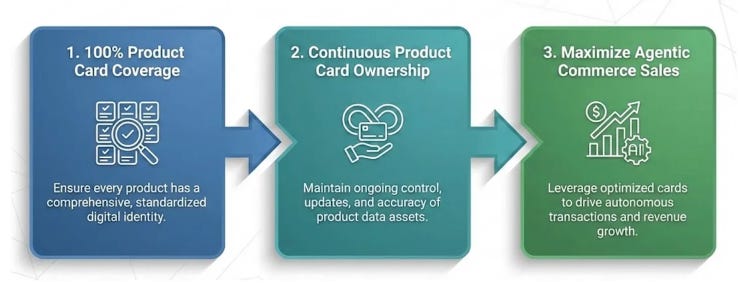
For readers that read all the way to the end we threw in a preview for exactly THIS QUESTION here→
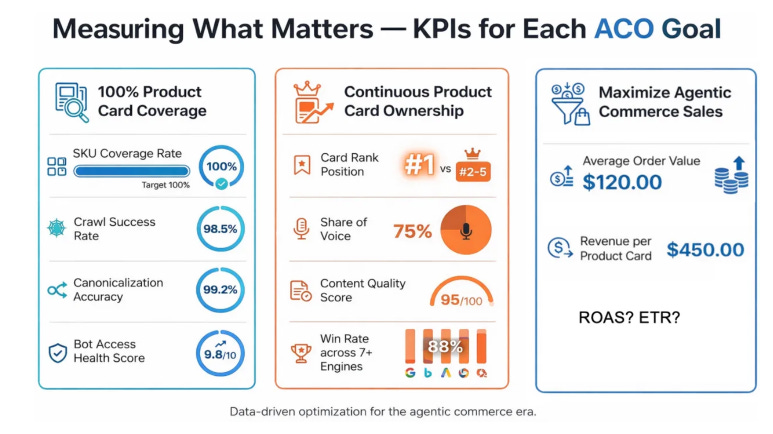
For our World of Agentic Commerce, we believe:
Product Card Mapping - Product cards are a hallmark of discovery across the engines, if you aren’t mapped correctly and showing up in the best light in the Agentic Commerce combined catalog, you aren’t in the arena at all. Focus here first.
Own the Product Card - Once you are mapped correctly, you next need to understand where you’re offer is on the ‘Offer card’ - the list of offers associated with every product card. Think of this multiplied by all of your SKUs as your comprehensive AI digital shelf. Based on how marketplaces have developed, we fundamentally believe the goal here is to be number one on this offer table. You’ll notice that across the five live answer engine Agentic Shopping Discovery mechanisms, the highest offer has many benefits around exposure. As more and more people buy from here, we believe the trend will be that the top spot receives a disproportionate % of traffic and sales. For example, if there are 5 offers, instead of there being a 20% equal distribution, it will go something like:
Top offer: 50%
Second offer: 30%
Third offer: 15%
Fourth offer: 4%
Fifth offer: 1%
Focusing on these metrics at the Research/Find phase will logically drive transactions either on-agentic or off-agentic at the ‘Buy’ phase.
T-Q5: What are the Trade Offs of Just Sitting this out?
"It's tough to make predictions, especially about the future."
-Unknown (commonly mis-attributed to Yogi Berra or Neils Bohr)
To answer this question, we have to look into our crystal balls. On these digital pages, I’ve covered 7 companies from Wall St. firms to ARK Invest to McKinsey, Accenture, Bain and Deloitte - the consensus of those predictions is that by 2030, 20-30% of ecommerce will be Agentic Commerce with some coming in as low as 15% and others coming in as high as 40%.
I’ve been making predictions publicly and transparently for ~15yrs and gotten decent at it - somewhere in the 60-70% zone and 10% of my misses are timing related. But at the end of the day - your guess is as good as mine. There are naysayers that believe this is all a mirage or hallucination and people will never shop this way. Another reminder: we’ll be debating two of the most staunch and vocal naysayers at ShopTalk- details above.
For most retailers, what is moving them off the dime as the saying goes is the decrease in traffic from Google. That’s a ‘hard push’ causing retailers to wake up that we will face a zero click world soon. If you’re seeing your SEO/SEM traffic decrease, I encourage you to look at question S-Q3 and build a replacement model and project that model forward at the same ‘slope’ - that’s the trade off cost of ‘doing nothing’.
T-Q6: Do we Have to Rewrite ALL of our Product Information?
Your product data typically does not need to be fully re-written:
Start with phases and look at your top sellers
Start with expanding basic attributes and adding reviews
Work in that sandbox until you have reached the % of top sellers in your phased approach
Then work on bringing the data back into the ‘metadata’ layer and cherry pick attributes you want on your PDPs and work that sub-set through your change management process for on-site, human-visible changes.
T-Q7: How do I know what <ChatGPT/Gemini/Perplexity/Copilot/META> Think about my Product vs. my Competitors?
The good news is it’s right there on the offer page→
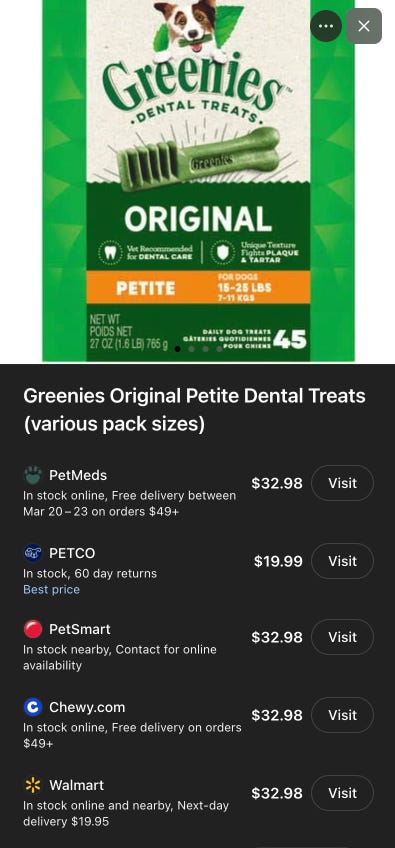
In this example, Walmart hs found itself a the bottom of the offer list and PetMeds has found itself at the top.
You can immediately see that PETCO is not mapped correctly (It’s the 20 count when you click through not the 45 count) - this means PETCO’s 20-count SKU is not mapped correctly either.
Anyway, taking that one out, there’s reasons for the sort order if you think about it this way - if you were building the algorithm, what inputs do you have? How would you prioritize them? What have we seen marketplaces do in the last era of ecommerce with a similar decision matrix? One hint - look at what ChatGPT thinks the Walmart shipping fee is 🤔.
What are YOUR FAQs?
That concludes our top 13 FAQs with answers (6 Strategic + 7 Tactical) -we hope this helps you navigate our rapidly changing world and think through the big picture strategic decisions and then get moving with actionable answers to your tactical questions.
Stay tuned! We’ll keep sharing what we’re learning from the front lines as more retailers move from strategy→planning→execution for ACO.
I like the "experimental agentic sandbox" approach, especially for larger Retailers. From what I have seen from my past as a Solution Architect in the Retail space, making any changes in the system and process chain between the PIM, the ecommerce storefronts and marketplace aggregators will be too much of a headache to get approved.
Separating this out into an agentic sandbox would allow them to make their first moves on a more reasonable time scale.